This was broadly the Budget that many people were expecting. A relatively small cost of living package and a handful of tax rises. Borrowing higher across the rest of the decade. Nods that there are bigger things to come, including in the 10 year plan.
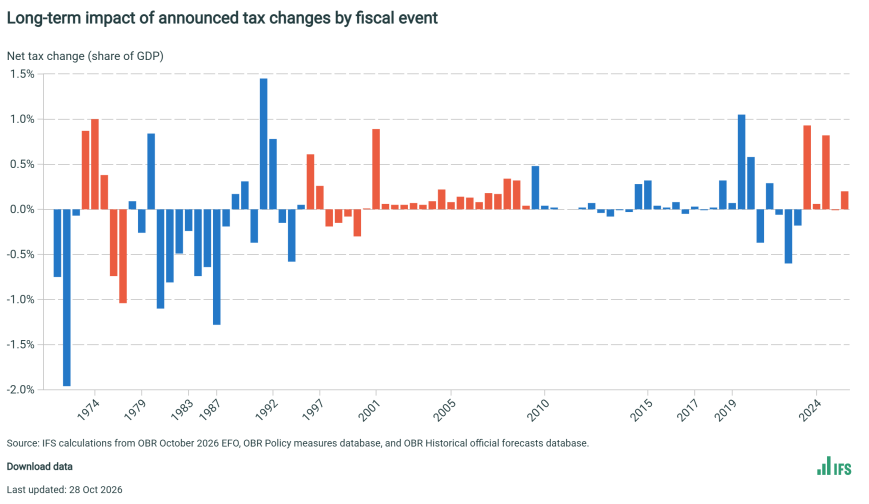
One surprise was the length of the scorecard. There were a whopping 98 measures. Some of this seemed to be in the spirit of the Prime Minister’s ‘everyday fixes’ – small measures that make things better. Sadly, there was also a lot of small, unhelpful fiddling with the tax system.
Sticking with the big picture for now, I am left thinking what I thought before the Budget. Public service spending plans look extremely tight. They don’t look to me like plans that this government would want to deliver. Whether or not they are delivered matters because the spending plans underpin the plan to bring down borrowing.
I think that is the key story, and it’s worth unpacking.
Tight spending plans
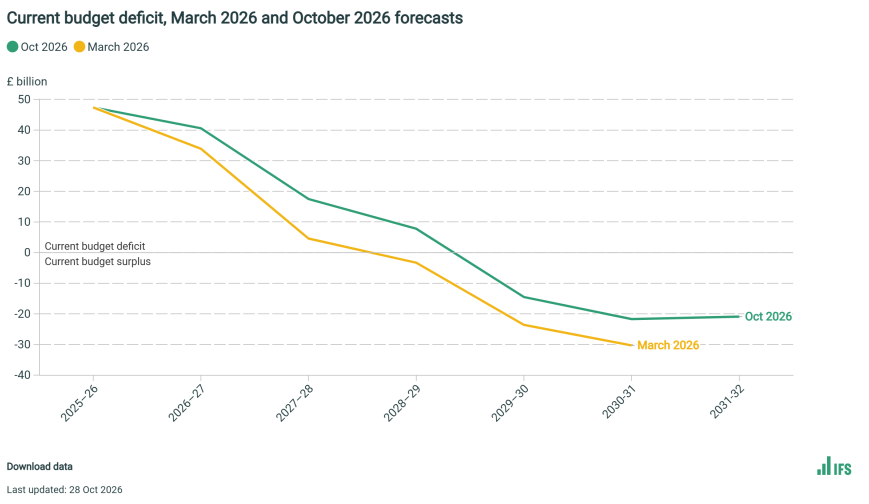
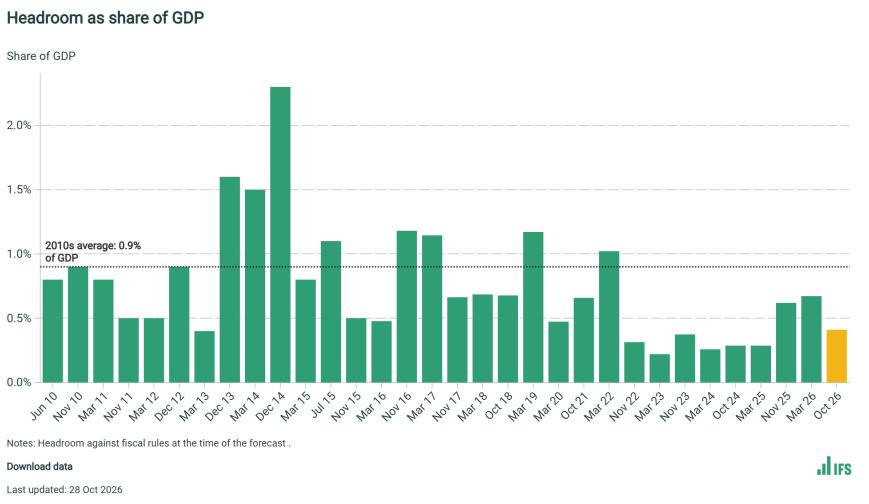
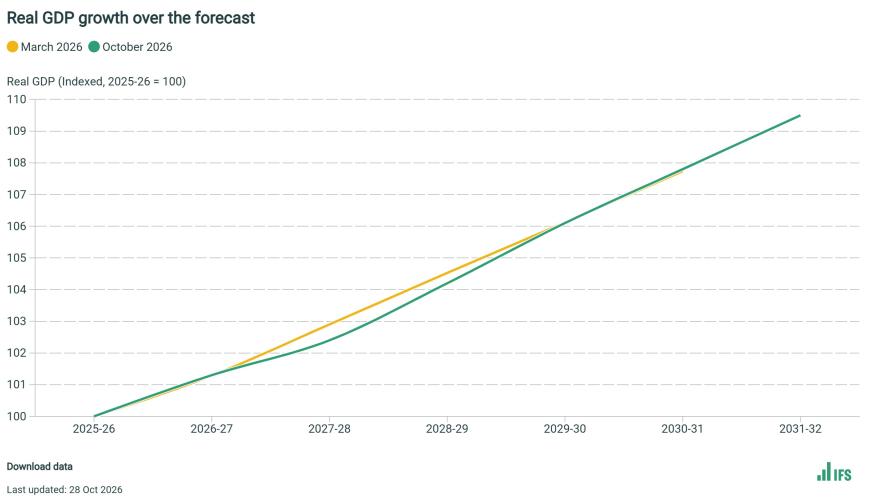
The Chancellor was keen – and right – to point out that the UK’s planned consolidation is more ambitious than those seen in other G7 countries. He was also right to highlight that the economic outlook is worse than it was in March. The OBR forecasts that higher borrowing costs have almost halved the headroom against the fiscal rule that requires the government to balance the current budget in 2029–30.
Faced with these forecasts, it was a reasonable choice to allow headroom to fall to absorb this bad news. But higher borrowing will need to be paid for. A lower buffer leaves the Chancellor more exposed to future bad news. There are risks to this approach.
There are also risks to the spending plans that underpin the forecast cut in borrowing.
The Chancellor left plans for overall departmental spending across the rest of the parliament broadly unchanged in cash terms. In the face of higher inflation, this means that the real-terms value of budgets has been cut. Taken at face value, and alongside the inherited plans to slow down spending growth sharply in coming years, that is a big choice. It effectively implies that some public services will see real-terms cuts in next year’s Spending Review. Avoiding the cuts implied by both higher inflation and tight envelopes could plausibly require a top-up of £17 billion in 2030-21. That’s true even before thinking about the £11 billion needed to fund defence plans.
Defence
On defence, John Healey confirmed 2030 as a target date to get spending to 3% of GDP but I’m still no wiser as to how he plans to get there, let alone to 3.5% by 2035.
I’m grumpy about how the Chancellor decided to fund the relatively small hole in the Defence Investment Plan – that’s the plan that gets defence spending to 2.7% of GDP next year and keeps it there until 2029–30. Much of it came from further cuts to the capital budgets of other government departments. Fine. Priorities change. But the rest came from raiding reserves in future years. This is worth drawing out: John Healey has now spent 25% of the capital reserve set aside for the next three years. He’s also spent 40% of the day-to-day reserve. This is categorically not what the reserves are for. Drawing down reserves is another way that the government has reduced its buffer against future shocks.
My colleagues will say more about how the Chancellor might reach 3%. But I’ll highlight now that I find it hard to believe that this government will want to increase defence spending to 3% of GDP entirely within existing spending envelopes.
I want to be clear that my concern is not that it would be impossible to deliver the implied cuts to other services – that could be done. But I’m sceptical that this government would be willing to do it. I’m also sceptical because I didn’t hear John Healey starting the kind of pitch-rolling that you would expect if he intended to deliver these spending plans. And I’m sceptical because history advises scepticism. When Chancellors pencil in tight spending plans in the future, they tend not to deliver.
I think some will respond by saying this is simply not the time to make plans. That the economic backdrop is just too uncertain. But that view completely misses the point of planning. Of course plans may have to change as the world changes. A plan is not a prediction of the future. It is a statement of priorities and intentions, based on the best information currently available. It should demonstrate what the government wants to achieve, the choices it is prepared to make, and how it intends to navigate the challenges ahead, even when there are stormy seas.
Scorecard measures
Based on what I’ve said so far, you would have expected the Budget document to be a slim affair. It’s not – in large part due to the raft of policy measures. A few words on those.
As expected, there was a cost of living package. The highest-profile measure was the one-off £100 payment, delivered through a reduction in council tax, for those in council tax bands A-D in England. I can’t help but comment that it is sad to be basing anything on property values that are 35 years out of date. It is also sad that, in the time since the last energy price surge, the government hasn’t bothered to invest in the data that would have allowed a package more targeted at those most badly hit by rising energy prices. But here we are.
The key choice was to give a relatively small payment to around 80% of households, rather than a larger payment targeted on a smaller group. Alongside other temporary measures, it will help households over winter. But winter is coming and it still looks tough for many families across the country.
The cost of living measures are part of a much larger collection of small policy measures. They amount to a net giveaway in the next couple of years and a net takeaway by 2030.
Small isn’t necessarily bad. Chipping away at fixing small things can really help people. And there were some good things here, including the plan to remove the cliff-edge in carer’s allowance.
But there were plenty of bad things too. I’m disappointed to see yet another tax increase on landlords, still with no attempt to fix a large set of problems with how that group are taxed. We got more tinkering with business rates – that is getting tiresome. And we got a new relief in capital gains tax that deserves a special mention. After years of arguing that Business Asset Disposal Relief was a bad idea – and just when I thought the relief was on its last legs – a new, similar relief has popped up. The new Founders’ Relief looks bonkers. It gives a lower rate of capital gains tax to a small subset of people with large gains. That will include some entrepreneurs that make investments with broader societal benefits – although most of that activity would have happened without the relief. But it will also include people that just got lucky. There are very complex rules around who gets it – rules that will incentivise people to change their behaviour in weird ways simply to be able to get the relief. I could go on. But the punchline is that this looks to me like yet another tax break for a chosen group with little economic reasoning behind it.
In isolation, this measure is very small. But it’s part of a bigger, important pattern. We have a tax system that is a mess. It is far more complex than it should be. And that is because, Budget after Budget, chancellors make seemingly small tweaks that lack principle and don’t systematically move us to a better place. This approach gives us more complexity and more instability. Both have real economic costs.
While we’re on the topic of changes that lack principle – let’s come to the energy market. The Chancellor has announced that he will scrap standing charges for gas and replace them with higher unit prices. This will be popular among many – standing charges are widely disliked. And, as it happens, this reform actually moves the market in a positive direction: gas is under-taxed relative to electricity, and higher unit prices will encourage households and businesses to reduce their usage. But it was a fairly cack-handed way to achieve this outcome. And it’s not a policy that should be replicated with electricity bills. In that case, moving even more costs onto unit prices would make current problems worse.
The important background is that the system of energy taxation is a hodgepodge that creates wildly different tax rates across different energy sources. As John Healey moves forward with plans to reform the energy market he should make sure to start with that big picture. As we discussed in our Green Budget – there are good options available.
Twin challenges
Zooming back out, the government continues to face two big problems: a growth problem and a debt problem. The Chancellor’s pitch is that he is taking important action on both.
On growth, the government deserves credit for its announcements on the devolution of tax revenues within England. We don’t yet have all the details. But we do now have a framework, and overall it’s a reasonable one. England’s regional mayors will keep some of the proceeds from faster-than-average growth in income tax revenues, or take a hit if they grow more slowly. Together with plans for local areas to retain 100% of business rates revenues, that introduces stronger financial incentives for mayors and local authorities to grow their economies. But there are guardrails around this, with revenues for the fastest-growing areas capped in order to pay for a safety net for other places. And while there may be some rough edges in the current plans, it is good to see the government setting out a clear framework and then taking time to work through the details collaboratively.
The Budget also contained a smattering of others measures to chip away at the low growth problem, including some regulatory reform in some sectors, a more supportive environment for data centres, and looser rules for highly-skilled migrants. Taken together, these moves are likely to push up on growth but they are unlikely to seriously move the dial.
We can expect more – this feels like a government that is just getting started with its plans to create a more active public sector.
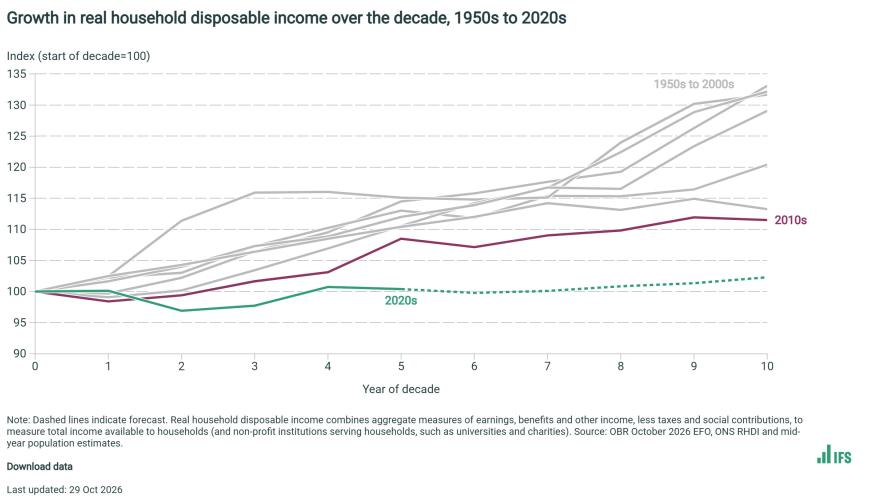
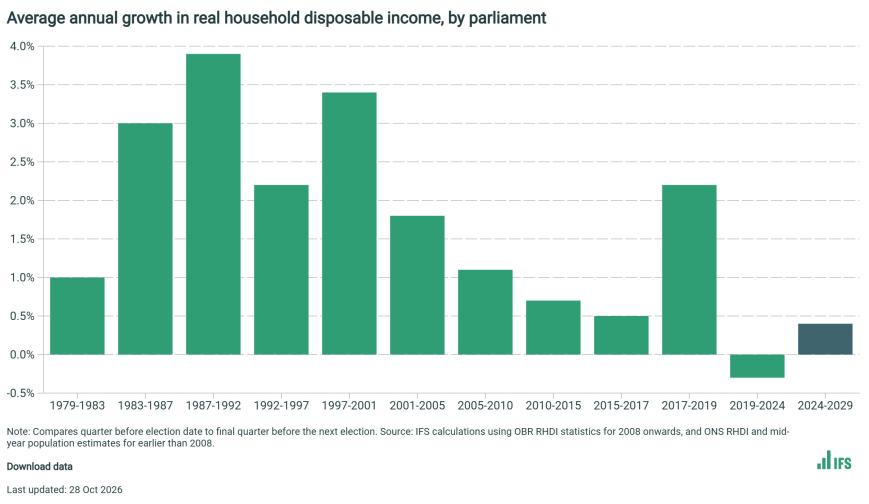
And we will need more. This decade looks set to be the worst decade for growth in household incomes on record. Just wait until you see the chart. It’s depressing. No amount of temporary cost of living packages will fix that. We need a stronger economy.
On debt, and coming back to where I started – it’s worth remembering the ambition underlying the fiscal rules. It’s to get debt on a more sustainable path. Lower debt would allow us to stop devoting such an eye-watering share of our income to servicing the debt. It would give us more fiscal space to respond to the really big shocks of the future, whatever they may be.
The Chancellor is right that there is a real prize to be had if we can cut borrowing and stop the debt growing. But we won’t realise that prize if John Healey turns out to be another Chancellor who is more enthusiastic about pencilling in reductions in borrowing than actually delivering them.
I am left with the impression that the Chancellor is hoping the economic forecasts improve enough that he can make good on his plan to cut borrowing without having to also make large cuts to public spending or raise taxes. I hope that happens. And it might – a re-opening of the Strait of Hormuz or AI-driven productivity growth really could create sunnier skies. But, equally, things could get worse. If they do, the Chancellor now has less insurance.
A clear short-term risk with the Chancellor’s choices is that next year – with low headroom and a spending review that looks pretty brutal for some departments – we see another season of damaging speculation about tax rises. A risk in coming years – and when the target year for the fiscal rules rolls forward – is that the government chooses to borrow more to top up spending. I genuinely hope we don’t see either. More importantly, we should all hope that John Healey has more than hope up his sleeve when the time comes to settle the next Spending Review.