In June this year, John Healey resigned as Defence Secretary over the government’s refusal to increase defence spending further, arguing that 'a headmark date for 3% of GDP on defence in 2030 is what Britain must set'. Now, as Chancellor, he must decide whether to commit to reaching 3% by 2030 – meaning increasing defence spending faster than current plans – and, if so, where any additional money is to come from.
Defence spending has increased substantially in recent years. Existing plans imply that NATO-qualifying spending (a broad measure including most Ministry of Defence spending, along with military pensions and some spending on intelligence agencies) will reach 2.7% of GDP by 2027–28, up from 2.1% in 2023–24. But there is clear pressure for the UK to go further and faster. The government has committed to spend 3% of GDP on defence at some point in the next parliament, and 3.5% by 2035 alongside NATO Allies. (NATO Allies also committed to spend an extra 1.5% of GDP on wider 'resilience and security' by 2035, but the government has suggested this would be met within pre-existing spending plans, so here we focus on 'core' defence spending.)
While the UK has increased spending considerably, some other NATO countries have moved further and faster. Poland spent a similar share of GDP on defence to the UK four years ago, but by 2025 had increased defence spending to 4.3% of GDP. Germany is also planning to increase defence spending faster than the UK, and overtook the UK as having the second -largest defence budget in NATO in 2024.
Further increases could be expensive. Even before any new commitments, the government still needs to find an average of £1.2 billion per year to fully fund top-ups announced alongside the Defence Investment Plan in June. Reaching 3% of GDP on defence by 2030–31 would require around £11 billion of additional spending in that year, relative to keeping defence spending at 2.7% of GDP. Going further to 3.5% would require an even larger, and more sustained, increase.
The central question – at both this Budget and next year's Spending Review – is how the government will reconcile its defence ambitions with an already-challenging fiscal outlook, a commitment to reduce the size of the deficit and substantial pressures to increase spending on other public services. The government could fund higher defence spending through cutting spending elsewhere, increasing taxes or raising borrowing. But all three look challenging.
Figure 1: Defence Spending Out-Turn, Plans and Scenarios
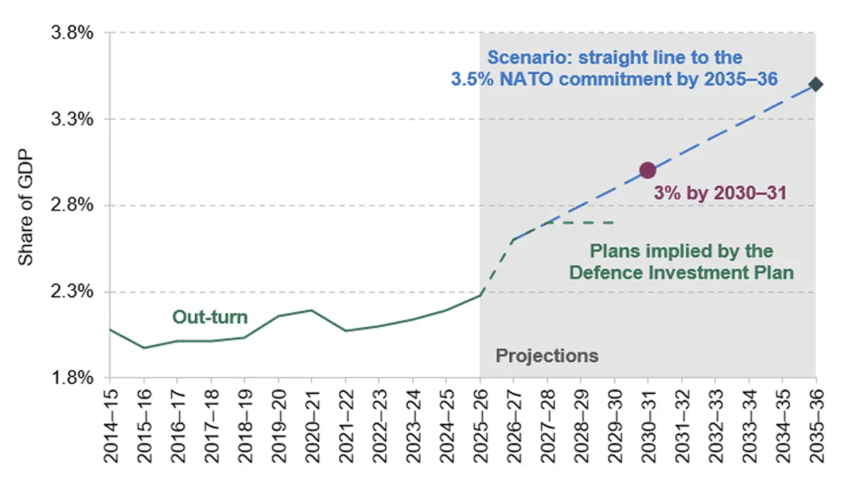
Note: Defence spending here refers to NATO-qualifying defence spending. Scenario shows a linear path of defence spending to 3% of GDP by 2030–31 and to 3.5% of GDP by 2035–36.
Source: Figure 6.9 from Boileau, Harvey-Rich and Snape 2026 (https://ifs.org.uk/publications/public-service-spending-plans-and-pressures)
Funding higher defence spending
One option is to squeeze spending on other public services – such as schools, prisons or transport. This is how the government already plans to fund much of the increase in spending it announced as part of the Defence Investment Plan. But this could be challenging: growth in public service spending is set to slow in coming years, and services face a range of other pressures, including from higher inflation.
Consider next year's Spending Review: even with defence spending flat at 2.7% of GDP, if the government decided to grow health spending in line with plans at the last Spending Review, this would imply small real-terms cuts to the combined budgets of all other departments between 2027–28 and 2030–31. Increasing defence spending to 3% of GDP by 2030–31 without topping up overall spending would deepen these cuts.
Alternatively, the government could cut spending on areas outside departmental budgets – for example, spending on working-age benefits or the state pension – to top up defence budgets. This would also involve difficult choices, and have consequences for households receiving those benefits.
Another option is to pay for higher defence spending with tax rises. For a sense of scale, funding an increase to 3% of GDP by 2030–31 would require additional revenue equivalent to around a 1p increase to all rates of income tax, or a 1p increase to the standard rate of VAT. Here, though, the government is politically constrained by the tax commitments in its manifesto, and taxes are already set to reach historically high levels.
The final option is borrowing. Borrowing for a permanent increase in defence spending is unlikely to be sustainable, and would be hard to justify on the grounds that defence spending will boost long-term economic growth. There could be a case for using increased borrowing in the short term as a means of delivering immediate increases in spending while more gradually increasing taxes or cutting spending elsewhere. But this would need to be weighed against the costs of additional borrowing – UK debt and borrowing costs are already very high, and debt interest now accounts for £1 in every £13 the government spends. Some other countries, including Poland and Germany, are relying partly on higher borrowing to increase defence spending, but both start from a stronger fiscal position than the UK.
Achieving higher defence capabilities
Much of the recent debate has focused on defence spending targets, in part because of the importance of international agreements. But the primary goal is an increase in defence capabilities, and the link between increased spending and the resulting capabilities is not automatic.
One important consideration is the timing of spending increases. Even if defence spending reaches 3.5% of GDP by 2035, different paths to that commitment could have different consequences. 'Backloaded' increases – with slower growth now and faster growth in the early 2030s – would mean that the government spends less cumulatively to reach the target. But given the importance of investment in equipment, which takes time to procure and builds up over many years, this would leave defence capabilities lower in 2035 than if spending had been increased in a smoother way. Backloaded growth could also mean capabilities will be lower in the years before 2035, and could open questions in early years over how credible the commitment to 3.5% is.
Decisions on where money is spent also matter. In recent years, a growing share of spending has gone on investment in major equipment, rather than spending on personnel and other day-to-day costs. How this balance changes will also determine the sorts of capabilities increased by higher spending.
The government is also banking on substantial efficiencies to deliver existing plans. The Defence Investment Plan set out efficiencies of around £1.8 billion per year over the next four years, around 70% of which it classes as 'low maturity', suggesting substantial uncertainty around their delivery. In principle, making defence spending more productive – so that more can be delivered within the same budgets – is very attractive. But if these efficiencies are not achieved, the government will need to choose between topping up spending further or allowing capabilities to grow more slowly than planned.
The bigger picture for defence
The Chancellor does not need to resolve all these challenges at the Budget. Indeed, John Healey has said that it will be at next year's Spending Review that he will set out ‘a clear path’ to the NATO commitment in 2035 and a target date for 3%. But at the Budget, he needs to set out plans for total spending on public services over the next five years.
These totals do not need to be allocated to departments until next year, but they should be ones he would be willing to live within. The government's plans to reduce borrowing and meet its fiscal rules will be predicated on the spending totals he sets out; if these totals are ones he has no intention of delivering and intends to top up at a later date, his fiscal plans will not be credible. Of course, he could fund higher defence spending within existing budgets, or choose to scale back ambitions for defence, but should make these choices – and their consequences – clear.
Much recent discussion has focused on the short-term challenges of increasing defence spending – how the Defence Investment Plan is funded, what this means for the Budget, when the UK will get defence spending to 3% of GDP. But we should not lose sight of the bigger picture. Beyond this Budget, higher defence spending will continue to reshape the British state.
For decades, falling defence spending as a share of GDP allowed governments to spend more on health and benefits without a correspondingly large increase in the size of the state – the so-called peace dividend. The government can no longer rely on this. Meeting the NATO commitment to spend 3.5% of GDP on defence by 2035 will mean increasing defence spending while also facing pressure to increase spending elsewhere, including on health and social care.
The challenges of funding higher defence spending are therefore not isolated to this Budget, or next year's Spending Review, but will shape the UK’s public finances for years to come.
This article was first published by RUSI and is reproduced here with kind permission.
Authors

Bee Boileau
Bee joined the IFS in 2021 as a Research Economist and works in the Retirement, Saving and Ageing sector.

Max Warner
Max joined the IFS in 2020. His work covers health and social care, public spending and public sector productivity.
More from IFS
Understand this issue


Policy analysis


Academic research