Related documents
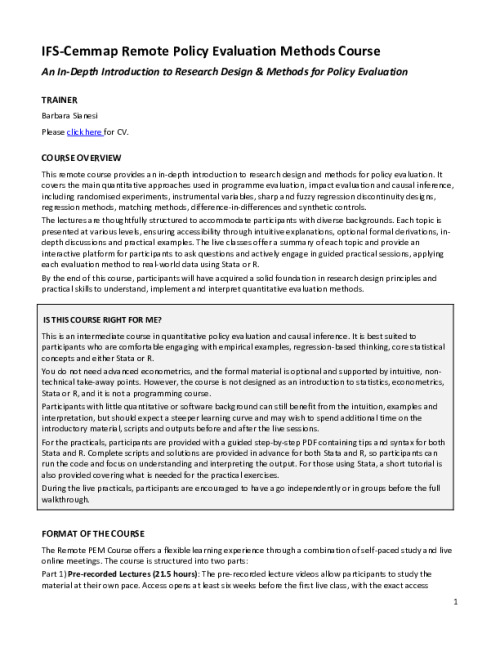
Download the full course details
PDF | 374.89 KB
An In-Depth Introduction to Research Design & Methods for Policy Evaluation
Course Dates
November
- Earliest access: from 9th October 2026 for early registrants.
- Rolling access thereafter: later registrants receive access within 1-2 working days of signup.
- Weekly live classes: 20th Nov, 27th Nov and 4th Dec 2026.
- Post-course access: online materials available until 8th January 2027.
February - Three day intensive course
- Earliest access: from 11th January 2027 for early registrants.
- Rolling access thereafter: later registrants receive access within 1-2 working days of signup.
- Classic intensive live classes: 22nd - 24th Feb 2027.
- Post-course access: online materials available until 24th March 2027.
March
- Earliest access: from 20th January 2027 for early registrants.
- Rolling access thereafter: later registrants receive access within 1-2 working days of signup.
- Weekly live classes: 3rd Mar, 10th Mar and 17th Mar 2027.
- Post-course access: online materials available until 21st April 2027.
June
- Earliest access: from 23rd April 2027 for early registrants.
- Rolling access thereafter: later registrants receive access within 1-2 working days of signup.
- Weekly live classes: 11th Jun, 18th Jun and 25th June 2027.
- Post-course access: online materials available until 16th July 2027.
Course Overview
This remote course provides an in-depth introduction to research design and methods for policy evaluation. It covers the main quantitative approaches used in programme evaluation, impact evaluation and causal inference, including randomised experiments, instrumental variables, sharp and fuzzy regression discontinuity designs, regression methods, matching methods, difference-in-differences and synthetic controls.
The lectures are thoughtfully structured to accommodate participants with diverse backgrounds. Each topic is presented at various levels, ensuring accessibility through intuitive explanations, optional formal derivations, in-depth discussions and practical examples. The live classes offer a summary of each topic and provide an interactive platform for participants to ask questions and actively engage in guided practical sessions, applying each evaluation method to real-world data using Stata or R.
By the end of this course, participants will have acquired a solid foundation in research design principles and practical skills to understand, implement and interpret quantitative evaluation methods.
Is This Course Right For Me?
This is an intermediate course in quantitative policy evaluation and causal inference. It is best suited to participants who are comfortable engaging with empirical examples, regression-based thinking, core statistical concepts and either Stata or R. You do not need advanced econometrics, and the formal material is optional and supported by intuitive, non-technical take-away points. However, the course is not designed as an introduction to statistics, econometrics, Stata or R, and it is not a programming course. Participants with little quantitative or software background can still benefit from the intuition, examples and interpretation, but should expect a steeper learning curve and may wish to spend additional time on the introductory material, scripts and outputs before and after the live sessions. For the practicals, participants are provided with a guided step-by-step PDF containing tips and syntax for both Stata and R. Complete scripts and solutions are provided in advance for both Stata and R, so participants can run the code and focus on understanding and interpreting the output. For those using Stata, a short tutorial is also provided covering what is needed for the practical exercises. During the live practicals, participants are encouraged to have a go independently or in groups before the full walkthrough.
Please click here for the full course details.
Course Pricing
All prices include VAT.
| Higher Education | £540.00 |
| Charity or Government | £972.00 |
| Other Delegates | £1994.40 |
For more information please contact [email protected]
Speakers

More from IFS
Understand this issue

Policy analysis


Academic research


