
Nick Ridpath, Research Economist at IFS, said:
“Today’s ONS borrowing figures show that in the first quarter of the financial year, the government borrowed £57.6 billion, £2.7 billion more than forecast by the OBR back in March. Debt interest has exceeded the OBR’s forecast by £1.6 billion, largely driven by higher payments on index-linked debt following upwards pressure on inflation from the war in Iran. The lesson of the last months and years – that debt interest can rise sharply, sometimes due to events outside the government's direct control – is not going out of fashion any time soon. A new Prime Minister and Chancellor can make different choices, but they will be facing the same fiscal constraints as their predecessors.”
This morning, the Office for National Statistics released new data on the public finances, providing estimates of how much the government spent, raised in taxes and borrowed in the first three months of the financial year (April to June). It showed that the government borrowed £57.6 billion, £2.7 billion more than the Office for Budget Responsibility expected in its Spring forecast in March, but £3.7 billion less than the same period last year.
- Today’s figures show that debt interest spending in the first quarter of the financial year was £33.3 billion, £1.6 billion above the OBR’s forecast and the fourth-highest figure in the first quarter of the last thirty financial years (Figure 1). June’s public finance out-turn was always expected to show higher debt interest spending than other months, as debt interest tends to spike at this time of year. In addition, higher inflation due to the closure of the Strait of Hormuz, which had not begun when the OBR finalised its March forecast, pushed up debt interest spending over the whole quarter.
- Higher-than-expected inflation pushed up earnings and led to partially countervailing effects on other parts of the public finances: spending on benefits including the state pension was £1.8 billion higher than forecast across the quarter, but tax revenues exceeded the forecast by £2.4 billion, mostly driven by strong PAYE income tax revenues.
- Stepping back, monthly public finance numbers are always subject to revision and we are only three months into the financial year, so we should avoid reading too much into this – or any – monthly snapshot of borrowing. The bigger picture is that the debt interest bill facing the government remains worryingly high, and the OBR expects that to continue over the next several years. We could well see it surpass its forecast this year, if inflation and interest rates stay elevated.
Figure 1. Debt interest spending as a share of GDP by year, April to June
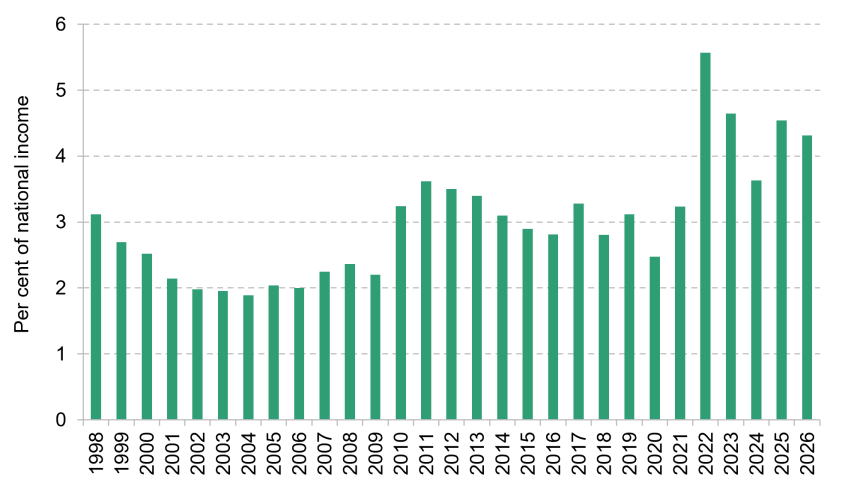
Note: GDP in 2026 is the OBR’s Spring 2026 forecast.
Source: Office for National Statistics, Public sector finances time series: central government net interest payable (series NMFX); Office for Budget Responsibility, Economic and Fiscal Outlook, March 2026 (detailed forecast tables: economy).
Authors

Nick Ridpath
Nick joined the IFS in 2023 and works in the Education and Skills sector, focusing on the long-run impacts of education policy.

Isabel Stockton
Isabel works in the Healthcare sector, and on the public finances. Their research focuses on retaining and developing the NHS workforce.
More from IFS
Understand this issue


Policy analysis


Academic research


