
The Prime Minister recently told journalists that he was ‘looking at’ the possibility of changes to the income tax personal allowance. In this explainer, we provide a brief overview of the allowance, its recent history and the implications of increasing it.
What is the personal allowance and how long has it been frozen?
The personal allowance is the amount of income that an individual can receive free of income tax. By default, the personal allowance is uprated annually in line with inflation. However, in March 2021, the then Chancellor Rishi Sunak announced that inflation uprating of income tax thresholds would be suspended and the allowance frozen at its April 2021 level of £12,570 until April 2026. That freeze was later extended, first by two years under the chancellorship of Jeremy Hunt and, most recently, by a further three under that of Rachel Reeves. The result is that, under current plans, the personal allowance will remain at its current level of £12,570 until April 2031 – a full decade after it first reached that level.
What has been the impact of the freeze?
Had it been uprated in line with inflation since April 2021, the personal allowance would today stand at £16,070 – £3,500 higher than its actual level. By 2030–31, the gap between the personal allowance and where it would have been had it not been frozen will (under current inflation forecasts) reach £4,870. This represents a 22% real-terms reduction in the value of the personal allowance between 2021–22 and 2026–27, with a further 8% reduction expected by 2030–31. The eventual scale of the real-terms cuts to the allowance over the next four years is, however, subject to considerable uncertainty. Indeed, when the freeze to the personal allowance was introduced at the March 2021 Budget, inflation was forecast to be just 1.9% in 2022–23, a year in which it ultimately reached 10.0%.
Although substantial, these real-terms cuts to the value of the personal allowance follow even larger real-terms increases to the allowance, particularly in the first half of the 2010s. The result – as shown in Figure 1 – is that by 2030–31 the personal allowance will still (under current forecasts) be higher in real terms than it was in 2011–12. An important exception to this is pensioners. Prior to April 2016, those aged 65 and over benefited from more generous allowances. Those allowances were not subject to the large increases made to the main allowance in the early 2010s, with the result that the pensioner and non-pensioner allowances eventually converged. As a consequence, the personal allowance of those aged 65 or over is now at its lowest real-terms level since 2004–05.
Figure 1. Real value of the personal allowance
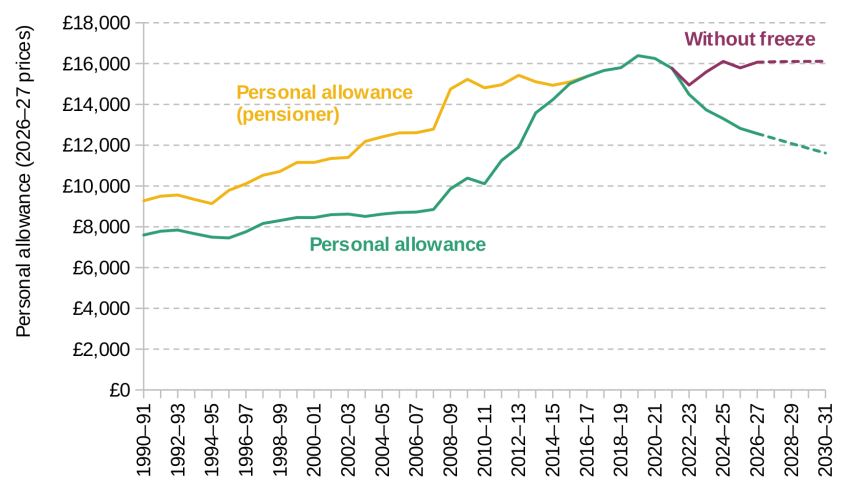
Note: ‘Personal allowance (pensioner)’ refers to the personal allowance for those aged between 65 and 74: until 2016–17, there was a slightly higher personal allowance for those aged 75 or over.
Source: Personal allowances from IFS Fiscal Facts, adjusted for fiscal-year-average inflation using the Consumer Prices Index from the Office for National Statistics (series MM23) and forecasts from the Office for Budget Responsibility’s March 2026 economic and fiscal outlook.
The large real-terms cuts to the personal allowance that have occurred since the turn of the decade have resulted in a large increase in the number of individuals subject to income tax. As shown in Figure 2, the share of individuals whose income is sufficiently high to incur income tax is forecast to rise to 76% in 2030–31, up from just 60% in 2021–22. While some of that increase would have been expected even without the freeze, most would not. In 2026–27, the number of individuals paying income tax is estimated to be 4.9 million higher than if the personal allowance had not been frozen in the years since 2021, with that figure projected to rise to 6.1 million by 2030–31.
It may initially appear surprising that the share of adults paying income tax is projected, by 2030–31, to be substantially higher than in the early 2010s given that (as shown in Figure 1) the real value of the personal allowance is projected to remain comfortably above its 2010–11 level. There are two main reasons for this.
- First, real income growth. Since incomes tend to grow faster than prices, the number of people with incomes above the personal allowance will tend to rise even if the allowance is increased in line with prices (this can be seen in the fact that the share of adults paying income tax would have been forecast to increase even in the absence of the freeze – the yellow line in Figure 2).
- Second, as discussed above, those aged 65 and over saw little real-terms increase in their personal allowance during the 2010s (dampening the degree to which personal allowance increases reduced the number of taxpayers in this period), but have been subject to the large real-terms cuts to the allowance over recent years.
Figure 2. Share of adults paying income tax
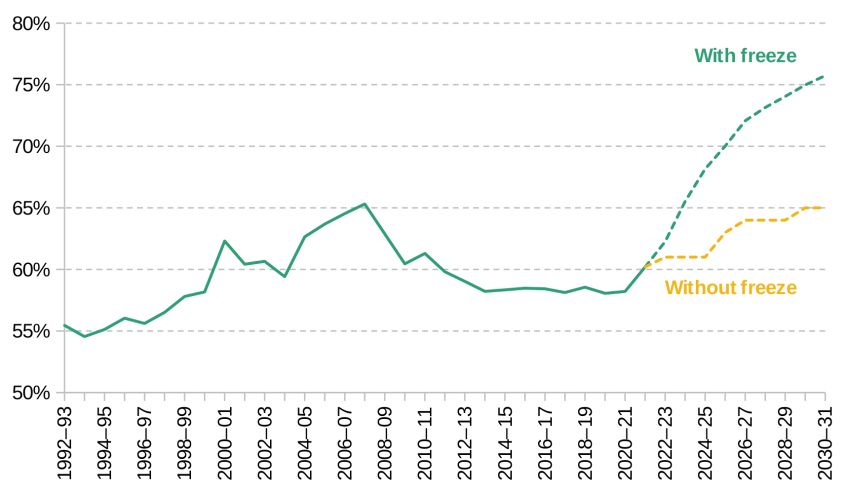
Source: Number of taxpayers prior to 2022–23 from HMRC income tax statistics, table 2.1, https://www.gov.uk/government/statistics/number-of-individual-income-taxpayers-by-marginal-rate-gender-and-age. For later years, forecast number of taxpayers taken from the Office for Budget Responsibility’s March 2026 economic and fiscal outlook – detailed forecast tables: receipts, table 3.18. Population estimates prior to 2025 taken from Office for National Statistics (ONS) population estimates – local authority based by five-year age band, https://www.nomisweb.co.uk/datasets/pestnew. Population projections for 2025 onwards are taken from ONS national population projections (2024-based), https://www.nomisweb.co.uk/datasets/ppsyoav2024.
How much would it cost to unfreeze the personal allowance?
Were the Prime Minister minded to increase the personal allowance, one option for doing so would be to end the freeze early – for example, by returning to inflation uprating from April 2027. While this would not reverse the real-terms cuts to the personal allowance made since April 2021, it would prevent those currently planned over the next four years. By 2030–31, this would entail annual tax savings (in today’s prices) of £198 for most basic-rate taxpayers – that is, those with incomes between £12,570 and £50,270 a year at current thresholds – and £395 for higher-rate taxpayers whose incomes do not exceed £125,140.1 As discussed below, the overall gains to some taxpayers would be smaller than this because increases to individuals’ post-tax incomes would result in reductions to means-tested benefits. Most taxpayers with incomes in excess of £125,140 would not benefit at all as the personal allowance is gradually withdrawn for people with incomes between £100,000 and £125,140.
That would be an expensive change, entailing (in today’s terms, i.e. relative to national income) a long-term cost of £8.4 billion a year to the exchequer, under current inflation forecasts. If inflation turns out to be higher than expected this cost could be even higher, while if it turns out to be lower than expected it would be less costly. To put that number in perspective, it is more than the cost of reducing the basic rate of income tax from 20% to 19% (£7.4 billion) and only slightly less than the cost of reducing the higher rate of income tax from 40% to 35% (£9.5 billion).
A cheaper option would be to uprate the allowance in line with inflation in April 2027 and then freeze it again at its new level until April 2031. On current inflation forecasts, this would see the personal allowance rise from £12,570 to £12,840 in April 2027 and would, by 2030–31, entail annual tax savings (in today’s prices) of £50 for most basic-rate taxpayers and £100 for higher-rate taxpayers whose income does not exceed £125,140. That would mean a long-term cost to the Treasury of around £2.1 billion a year in today’s terms.
Alternatively, the government could choose to implement a one-off increase to the personal allowance of some other amount. For every £100 that the personal allowance is increased, the long-term cost to the Treasury would be around £800 million in today’s terms, entailing (by 2030–31) savings of £18 a year for most basic-rate taxpayers and £37 a year for higher-rate taxpayers whose income does not exceed £125,140.
All of these options would strengthen work incentives overall, with larger increases in the personal allowance having a greater effect.
Would the higher-rate threshold also increase?
By default, for each £1 that the personal allowance increases the higher-rate threshold – the level of income at which the 40% rate of income tax begins to apply – is also increased by £1. This is because it is the width of the basic-rate band (known as the basic-rate limit), not the higher-rate threshold, that is assumed to be held fixed when the personal allowance is changed. One way to reduce the cost of unfreezing the personal allowance would be to do so while maintaining the higher-rate threshold at its current level of £50,270. This would reduce the long-run cost of resuming inflation uprating of the personal allowance from April 2027 from £8.4 billion to £6.7 billion in today’s terms. This approach would also reduce the tax saving for individuals higher up the income distribution. By 2030–31, this would mean a tax cut of £198 a year for almost all those with incomes between £12,570 and £125,140 (in today’s prices).
Would NICs thresholds also be increased?
Earnings (although not other income) are subject to both income tax and National Insurance contributions (NICs). Currently, the thresholds at which employee and self-employed NICs begin to be paid (known respectively as the primary threshold and the lower profits limit) are aligned with the personal allowance, while the thresholds at which the additional (2%) rate of NICs begins to apply (known as the upper earnings limit for employees and the upper profits limit for the self-employed) are aligned to the income tax higher-rate threshold. Were the personal allowance to be unfrozen, the government would need to choose whether to maintain alignment and adjust NICs thresholds as well. Allowing income tax and NICs thresholds to become unaligned would not be a novelty – the primary threshold and lower profits limit have only been set at the same level as the personal allowance since 2022 – but it would represent a step backwards in terms of tax simplicity. If the government wished to maintain alignment between income tax and NICs thresholds, this would increase the long-term cost of resuming inflation uprating of the personal allowance to around £10.4 billion in today’s terms, or £9.1 billion if the higher-rate threshold were held fixed.
A summary of the long-run fiscal costs and illustrative taxpayer savings of the potential measures set out in this and the previous two sections can be found in Table 1 at the end of this explainer.
What would be the impact on Scottish taxpayers?
While the Scottish Government has the power to set most income tax thresholds in Scotland, the personal allowance is determined at a UK level. Because income tax rates and thresholds (other than the personal allowance) are different in Scotland from those in the rest of the UK, the impact of personal allowance increases would also differ. Were inflation uprating of the personal allowance to resume from April 2027, the tax saving for Scottish taxpayers by 2030–31 would, in today’s prices, be £188 a year for a starter-rate taxpayer, £198 a year for a basic-rate taxpayer, £208 a year for an intermediate-rate taxpayer, £415 a year for a higher-rate taxpayer and £445 a year for an advanced-rate taxpayer. For a one-off increase, every £100 that the personal allowance was raised would, by 2030–31, entail a tax saving of £18 a year for starter- and basic-rate taxpayers and tax savings of £19, £39 and £42 for intermediate-, higher- and advanced-rate taxpayers respectively (all expressed in today’s prices).
As with the higher-rate threshold in the rest of the UK, another consequence of increasing the personal allowance in Scotland would be that, by default, the thresholds for the starter, basic, intermediate, higher and advanced rates would increase by the same amount. It would be up to the Scottish Government whether it wished to offset this increase in other thresholds.
Who would benefit from increasing the personal allowance?
It is often assumed that increasing the personal allowance would be a progressive measure – in other words, that it would provide the greatest benefit (as a share of income) to poorer households. That is not the case. Instead, the distributional impact of increasing the personal allowance is broadly ‘n-shaped’, providing the greatest benefit (relative to household income) to upper-middle-income households while providing the smallest benefits to the poorest and richest households.
The precise distributional details of any increase to the personal allowance would depend on the exact choices the government made – many of which are outlined above. Figure 3 provides two illustrative examples. It shows the distributional impact across households (ignoring behavioural responses) of a one-off £100 increase to the personal allowance both if the higher-rate threshold were allowed to rise by £100, as is the default (green bars), and if the HRT were held fixed (yellow bars).
Figure 3. Distributional impact of a £100 one-off increase to the personal allowance
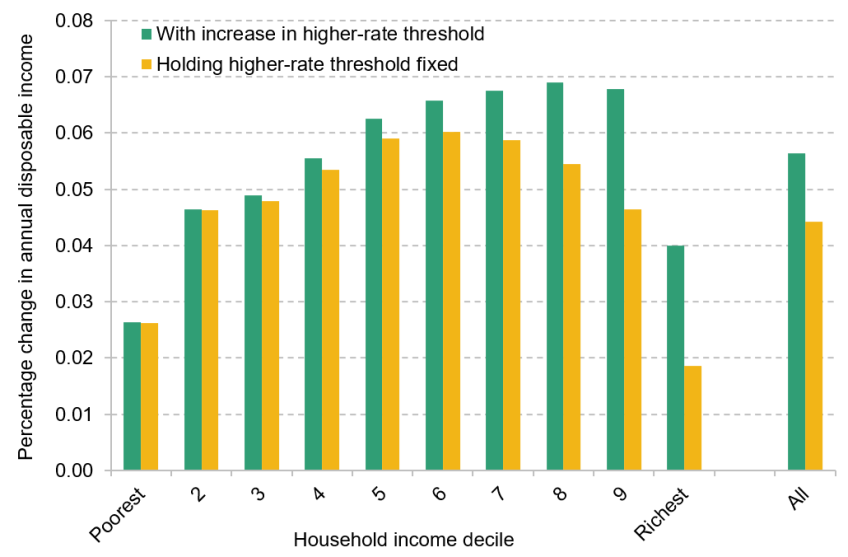
Note: Figure shows the average effect on household disposable income of a one-off £100 increase in the personal allowance in April 2027. In the ‘holding higher-rate threshold fixed’ scenario, the basic-rate limit and the Scottish intermediate-rate limit are both assumed to fall by £100, holding the relevant higher-rate thresholds fixed. The additional-rate threshold and Scottish top-rate threshold are assumed to remain aligned with the end of the personal allowance taper.
Source: Author’s calculations using TAXBEN, the IFS microsimulation model of the tax and benefit system, and the Family Resources Survey, uprated from 2022–23, 2023–24 and 2024–25.
If the higher-rate threshold rises alongside the personal allowance (green bars), higher-rate taxpayers with incomes below £125,140 receive twice as large a saving as basic-rate taxpayers. When the higher-rate threshold is held fixed (yellow bars), basic- and higher-rate taxpayers receive broadly the same cash saving, with the consequence that Figure 3 shows smaller benefits for richer households. However, the chart makes clear that even if the HRT is held fixed, savings relative to disposable household income peak at the sixth decile of the distribution and are clearly ‘n-shaped’ overall. There are three main reasons for this:
- First, increasing the personal allowance would provide no benefit at all to the roughly a quarter of adults whose incomes are too low to incur income tax.
- Second, means-tested benefits such as universal credit are assessed on claimants’ post-tax incomes. As a result, some of the savings from an increase in the personal allowance would be offset by a reduction in benefits. Given that claimants of means-tested benefits typically have lower incomes, this dampens overall savings for poorer households.
- Third, two-earner couples – who tend to have higher family incomes – can benefit twice over from an increase in the personal allowance, meaning that more of the benefit accrues to better-off households.
While increasing the personal allowance would not be a progressive measure, it is nonetheless true that most other ways of cutting income tax (for example, by reducing rates) would be even more weighted towards better-off households. The flip side of this is that increasing the personal allowance would also do less to strengthen work incentives than other ways of reducing income tax.
Table 1. Summary of measures
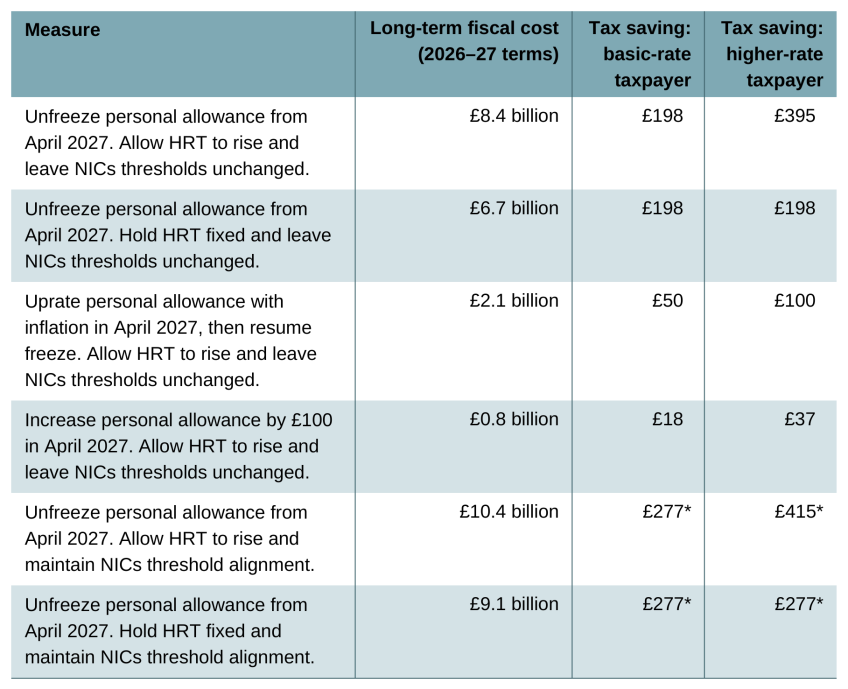
*Figures assume that the taxpayer’s income takes the form of employment earnings subject to employee NICs.
Note: HRT = higher-rate threshold. Tax savings are annual tax savings in 2030–31 in today’s terms and apply to taxpayers outside Scotland. Higher-rate taxpayer savings apply only to taxpayers with incomes below £125,140. Taxpayers whose incomes lie between the current and revised levels of either the personal allowance, the higher-rate threshold or the end of the personal allowance taper will all receive different savings from those shown.
Acknowledgements
The author thanks Stuart Adam for helpful comments and suggestions and Jed Michael for additional analysis.
Endnotes
Authors

Isaac Delestre
Isaac is a Senior Research Economist in the Taxation sector, focusing on the taxation of high-income individuals and closely-held corporate entities.
More from IFS
Understand this issue


Policy analysis


Academic research

