
This month, the state pension age (SPA) is going to be gradually increased once again, from 66 today up to 67 by early 2028. This affects people born on or after 6 April 1960. At the same time, an independent review of the state pension age is currently underway, considering the framework for increases in the SPA beyond 67.
The state pension age is the earliest age at which people can claim a state pension, and therefore plays an important role in determining the financial resources for people to rely on in older age. In this comment, we consider the rationale behind the upcoming increase in the SPA, what past evidence tells us about the effects this increase might have on individuals, and how increases in the SPA interact with other policies in the private pension and benefit systems.
Why is the state pension age being increased?
Between 1948 and 2010, the state pension age remained unchanged at 65 for men and 60 for women. At the same time, life expectancy at older ages significantly increased. Figure 1 shows remaining life expectancy upon reaching the SPA for men born in different years. A 65-year-old man born in 1920 could expect to spend a little under 15 years above the SPA (as they had a life expectancy of around 80), while a man born in 1950 could expect to spend 19 years above the SPA.
Figure 1. Years of remaining life expectancy at state pension age, for men, by year of birth
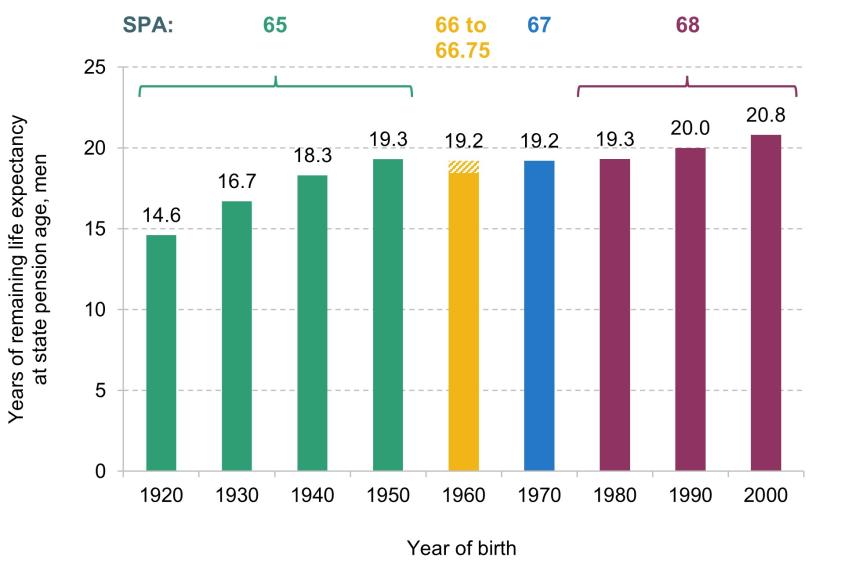
Note: Cohort life expectancy for men at SPA, from 2022-based life tables for UK. SPA for men born in 1960 depends on the month of birth – it is 66 for those born before 6 April 1960 and rises gradually for those born later in the year, reaching 66 years and 9 months for men born on or after 6 December 1960. The solid bar for the 1960 cohort shows the life expectancy above SPA for a man born on or after 6 December 1960 (calculated as life expectancy at 66 less 9 months). The solid bar together with the shaded area (as well as the data labels) reflect life expectancy above SPA (66) for a man born before 6 April 1960.
Source: https://www.ons.gov.uk/peoplepopulationandcommunity/birthsdeathsandmarriages/lifeexpectancies/bulletins/pastandprojecteddatafromtheperiodandcohortlifetables/2022baseduk1981to2072.
Between 2010 and 2018, the female SPA was increased to 65. This has since been followed by ‘universal’ increases in the SPA, following the 2002–06 ‘Pensions Commission’ which recommended increases in the SPA as life expectancy rose, designed in part to help finance a more generous flat-rate state pension. This led to increases in the SPA to 66, 67 and 68 being legislated.
The coalition government brought forward the increases to 66 (to 2018–20) and 67 (to 2026–28), motivated both by further improvements in life expectancy projections and by the desire to limit the cost of the state pension system in the face of an ageing population and strained public finances. As Figure 1 shows, life expectancy at SPA is still approximately constant (at around 19 years) for men born in 1950, 1960, 1970 and 1980, despite a three-year increase in the SPA for men.
The benefit to the public finances of increasing the SPA is significant. Indeed, the Officefor Budget Responsibility estimates that the net saving from the increase in the SPA from 66 to 67 will be £10 billion per year by the end of the parliament. Most of the saving comes from the direct impact of paying the state pension to fewer people, with additional benefits to the exchequer from increased tax revenue from more people remaining in employment. This is very partially offset by higher working-age benefits spending as the SPA is increased.
What do we know about the effects of increasing the state pension age?
Predicting the effects of a future policy change is difficult, but we can use evidence from previous increases to the state pension age as a guide.
Previous increases in the SPA have been shown to cause some people to delay retirement and stay in paid work for longer. Employment rates of affected age groups have increased by about 10 percentage points in response to previous increases in the SPA. This effect is fully driven by people staying in their existing jobs for longer, rather than moving to a new job or re-entering paid employment after leaving the labour market.
However, as only a minority of those affected respond to the reform by working longer, these increases only partially offset the direct loss of income as the SPA is increased. Previous research shows that average incomes are markedly lower among affected individuals, as they have to wait longer to receive their state pension. Lower household incomes also lead to an increase in income poverty – as the SPA was increased from 65 to 66, the income poverty rate of the affected age group (65-year-olds) rose from 10% to 24%, with the effects concentrated amongst those who were out of paid work.
There are also broader effects of these reforms. Previous research at IFS has found that increases in the SPA lead to a reduction in life satisfaction among affected age groups, while there is mixed evidence on the impact on individuals’ health. This is likely because increasing the SPA affects people in different ways depending on their health and work circumstances before the reform. Staying in employment in your 60s when the SPA goes up seems to be beneficial for at least some forms of health; on average, it has been shown to improve cognition and reduce physical disability, although other studies find negative effects of increases in the SPA on mental health. The effects also vary by job type. For example, continuing to work in a sedentary job is bad for people’s mobility, while continuing to work in less sedentary jobs is markedly better for mobility.
There are reasons why the magnitude of the effects of increasing the SPA to 67 might be different from the effects of previous increases. Employment rates fall as people get older, and disability becomes more common. We might expect these factors to limit the extent to which people remain in employment as the SPA is increased further. So while employment responses so far have been similar in magnitude as the SPA (for women) has risen from 60 to 66, employment may not rise as much as it has previously when the SPA is increased further. Though whether this will actually materialise this time around is difficult to predict.
Future state pension age increases and interactions with other policies
What will happen once the SPA has reached 67? The ongoing independent review of the state pension age is considering what kind of framework the government should use when deciding on future increases. The increase to 68 is currently legislated for 2044–46, although the 2017 Cridland Review recommended bringing this forward to 2037–39. While the government accepted that recommendation in principle at the time, it did not legislate to bring it forward. No increases in the SPA beyond age 68 are currently legislated.
In coming years, there is a good case for legislating for further increases in the SPA beyond 68, as part of the response to rising life expectancy and the resulting public finance pressures. These pressures are significant. Even assuming the SPA rising to 69 in the early 2070s, the Office for Budget Responsibility forecasts that state pension spending would rise to close to 8% of GDP by that point, up from around 5% of GDP today.
However, the SPA (and the extent to which it is increased) should not be considered in isolation, as it interacts with both the wider pension system and the working-age benefits system. Considering the system as a whole will be important both for the independent review of the state pension age and for the government as it develops a strategy for future increases.
Alongside the state pension, private pensions play an important role in providing many people with financial resources in retirement. A large majority of people reach SPA with some private pension wealth, which can currently be accessed from age 55 onwards (rising to 57 in 2028). Early access to private pensions enables many people to leave paid work before SPA. And as the SPA is increased, more people may choose to use their private pensions as a ‘bridge’ to provide income before being able to claim the state pension.
This flexibility is important for people managing their employment and financial lives at older ages, but it also creates some risks, including risk of living on a low income later on in life particularly for those with low financial literacy or understanding of pensions. Drawing on a pension early means there will be less available for financing retirement later on, especially as earlier retirement also means fewer years being spent contributing into a private pension. The government will have to choose whether this minimum age for accessing a private pension continues to rise as the SPA is increased further. Indeed, the IFS Pensions Review last year suggested it should be raised gradually to 60 in coming decades, so as not to leave too wide a gap between the point of access to private pensions and the SPA.
The SPA also interacts with the wider benefit system. This is important because, while for some people the decision of when to stop paid work will be a voluntary choice, others may find it very hard to remain in paid work until the SPA due to health reasons, caring responsibilities or simply being unable to find a job. These people often receive benefits through the working-age means-tested benefit system, which is considerably less generous than the system for pensioners. In particular, basic means-tested support in 2026 is 143% higher for a single person just above SPA than for a similar individual below SPA.
As discussed in the IFS Pensions Review, there is a good case that as the SPA rises, this cliff edge in means-tested support should be made less stark by providing additional means-tested support for people just under the SPA. In effect, this would mean channelling a small fraction of the public finance savings from a higher SPA, to target support to groups who are least able to respond by extending their working life. We argued in the IFS Pensions Review that additional support of this kind could be particularly important in maintaining support for the principle that increased life expectancy should result in a higher SPA. Focus groups commissioned as part of the IFS Pensions Review found public support for additional help for some of those most affected by SPA increases. Increased support was particularly favoured for those with disabilities, as this group was seen to require more support and be more reliant on state benefits. International evidence from the International Monetary Fund also indicates that pension age rises are more publicly acceptable – and politically easier to implement – when accompanied by such mitigation measures.
A final consideration for the government should be how much notice to give people about changes in the SPA. Previous independent reviews have suggested that people should have at least 10 years’ notice of any changes to their SPA. This would mean that any changes happen before most people have left paid work to retire, and would give people time to adjust their saving and retirement plans. If the government does want to bring forward the increase in the SPA to 68 to the late 2030s (suggested by the 2017 independent review), it would need to do so promptly to maintain the suggested principle of 10 years’ notice of any change.
Authors

Jonathan Cribb
Jonathan joined IFS in 2011. His research areas includes: pensions, ageing and demographic change, public sector pay, housing, and inequalities.

Heidi Karjalainen
Heidi is a Senior Research Economist in the Retirement, Saving & Ageing sector. Her current research is on pensions and saving for retirement.

Laurence O'Brien
Laurence is in the Retirement, Savings and Ageing sector. His work focuses on people’s savings decisions and on economic activity in later life.
More from IFS
Understand this issue


Policy analysis


Academic research


