
Prime Minister Andy Burnham has announced that the triple lock – the way in which the flat-rate parts of the state pension are increased over time – is to be reformed starting in 2030–31. This Comment analyses how the new triple lock will work, and what its effects might be.
How will the triple lock work from 2030–31 onwards?
The triple lock was introduced in 2011. To date, the flat-rate parts of the state pension (the basic state pension and – since 2016 – the new state pension) have increased each year in line with the highest of: average earnings growth; consumer price index (CPI) inflation; and 2.5%. As has been frequently discussed, this leads to a ‘ratchet’ effect which pushes up the value of the state pension compared with either growth in prices or growth in average earnings. This leads to a higher level of, and expenditure on, the state pension over time, albeit one that is extremely unpredictable because it depends on exactly how earnings growth and inflation move compared with each other and with 2.5% over time.
The new, reformed version of the triple lock still contains three parts. Inflation, earnings growth and 2.5% are all important. But the new mechanism means that each year the state pension will instead increase by the maximum of:
- CPI inflation;
- 2.5%;
- the amount needed to ensure the state pension keeps up with average earnings growth since the introduction of the new policy.
To see how this changes the triple lock, consider Figure 1, which shows an illustrative 10-year period. In this stylised example, inflation is always 2%. At the beginning of the period, average earnings, shown by the green line, are growing at 4% per year. In years 4, 5 and 6, earnings growth falls to only 1% (i.e. below inflation).
Under the old triple lock, as shown by the dashed yellow line, the state pension would increase in line with earnings growth in the first few years. When earnings growth falls below 2.5% and inflation, in this example the state pension would then rise by 2.5% each year from years 4 to 6. It would then return to growing in line with average earnings growth in year 7 when it returns above 2.5% and inflation. The fact that it returns to growing in line with average earnings growth in year 7 generates the permanent ‘ratchet’: the state pension is now permanently higher relative to average earnings.
In contrast, the new triple lock is shown in the dashed blue line. When earnings growth falls below 2.5% and inflation, the state pension still rises by 2.5% each year. But importantly, as earnings growth recovers in year 7, under the new triple lock the state pension does not grow in line with earnings. This is because at this point, the state pension has grown faster than is needed to keep up with average earnings since the start of the policy. Therefore, it instead continues to rise by 2.5% (or inflation, if higher than 2.5%) each year until the growth in the state pension is matched by growth in average earnings. By year 9, the growth in the state pension has matched the growth in average earnings since year 1, and so the state pension returns to rising in line with average earnings growth.
This is the key difference between the old and the new triple lock. While the new triple lock generates a temporary period in which state pensions are higher relative to average earnings (years 4 to 8 in this example), it does not permanently ratchet up the level of the state pension like the old triple lock does.
The removal of this permanent ratchet is to be welcomed and marks a substantial step towards a more sustainable and predictable state pension system.
Figure 1. Illustration of how the new triple lock would operate compared to the old triple lock
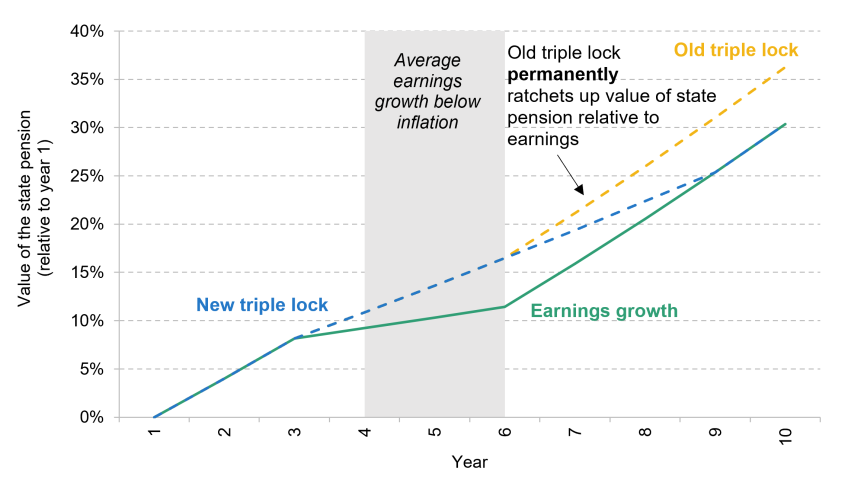
Note: Assumes inflation of 2% and average (nominal) earnings growth of 4% in all years, apart from years 4–6 when it is 1%.
What would the effects of the new triple lock be?
A simple summary of the new triple lock is that it removes the most expensive part of the old triple lock, which is that the old triple lock permanently ratchets up state pension spending.
However, the new triple lock still leads to a higher state pension expenditure in many years than under either a state pension that rose only in line with average earnings, or a ‘smoothed earnings link’. A smoothed earnings link (proposed by various institutions, including the IFS Pensions Review) is similar to the new triple lock, but it does not include the condition that the state pension must always rise by at least 2.5% each year. It therefore leads to a state pension which rises in line with average earnings but also prevents the state pension falling in real terms in any year.
The features of the new triple lock are shown in Figure 2. This figure shows how the flat-rate parts of the state pension would have increased since 2010–11 if they had been increased under the rules of the new triple lock, compared with the old triple lock; earnings indexation; and the smoothed earnings link.
The early 2010s were a period of weak earnings growth, and the earnings growth rate was consistently lower than inflation, and in many years also below 2.5%. Over this period, the new triple lock – like the old triple lock – would have led to state pensions rising compared with average earnings. In the early 2020s, however, while the new triple lock would have protected state pensions when inflation was higher than earnings growth, once earnings growth rose above inflation again, the new triple lock would have increased state pensions at a slower rate than the old triple lock.
The chart therefore shows that the new triple lock would not have pushed up the state pension by as much since 2010 as the old triple lock. We have estimated that the old triple lock has increased annual state pension expenditure by £16 billion by 2026–27 compared with indexation in line with average earnings growth. If the new triple lock had been in place instead, expenditure in 2026–27 would be £9 billion lower than it currently is.
It is worth underlining, however, that if the new triple lock had been in place between 2010 and 2026, the state pension would still have risen in real terms (i.e. faster than inflation) by 6%. This illustrates a broader point: the new triple lock still leads to increases in the real value of the state pension over time, just not quite as fast as it would have under the old triple lock.
The comparison between the new triple lock and the smoothed earnings link shows the consequences of the fact that the new triple lock maintains the minimum 2.5% increase in the state pension each year. This 2.5% minimum is an arbitrary minimum increase that does nothing to protect state pensions against inflation or help them keep up with average earnings. But it does mean that, following a period when inflation is above average earnings growth, it takes longer for the new triple lock to return the state pension to the level at which it would have kept up with overall earnings growth. This is most notable in Figure 2 in the years after 2014, when low inflation would have helped hold down growth in the level of the state pension.
The difference, over a long period, between the new triple lock (blue dashed line) and smoothed earnings link (purple dashed line) shows that the ‘2.5%’ part of the new triple lock does not generate a permanently higher state pension, but it does lead to considerably higher spending over a long period of time.
Figure 2. Cash-terms growth in the state pension under different uprating methods since 2010
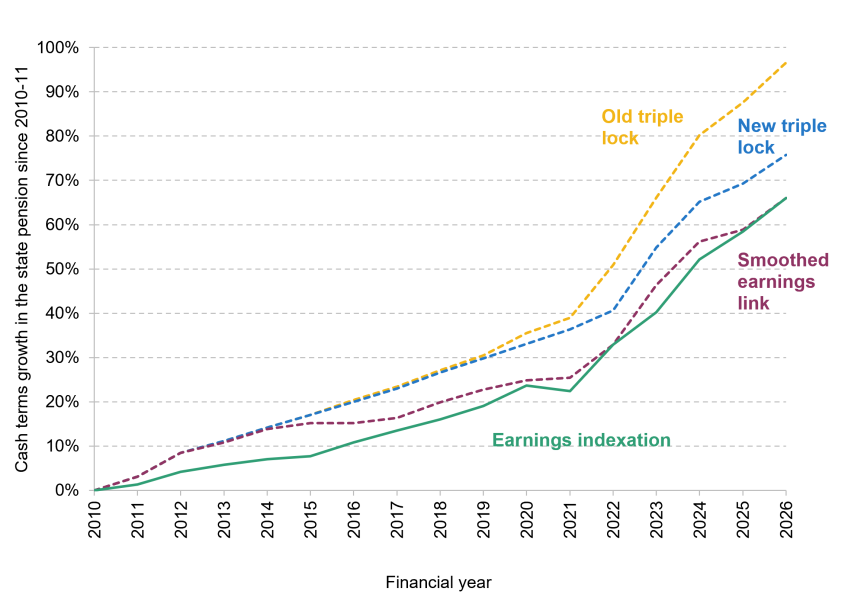
Note: Average earnings growth and inflation series from the Office for National Statistics (ONS). ‘Old triple lock’ excludes the effect of the temporary suspension of the triple lock in 2022, and excludes the use of indexation in line with Retail Prices Index (RPI) inflation (rather than CPI inflation) in 2011.
Summary
The reform to the triple lock announced by the Prime Minister is a welcome change. It removes the most expensive and unattractive element of the old triple lock which is the permanent ratchet effect. From 2030–31 onwards, we can expect the state pension to grow in line with average earnings in the long run, and to be protected from inflation in each and every year. The fact that it will also rise by a minimum of 2.5% each year does not change that, but it can lead to significant periods of higher state pension expenditure compared with what expenditure would have been if that element had not been included.
The savings to the Exchequer from this reform are likely to be relatively small in the first few years. However, over time the new triple lock will prevent the state pension being locked into an ever-increasing level of generosity compared with workers’ earnings, thereby generating significant savings in the long run.
Authors

Jonathan Cribb
Jonathan joined IFS in 2011. His research areas includes: pensions, ageing and demographic change, public sector pay, housing, and inequalities.

Heidi Karjalainen
Heidi is a Senior Research Economist in the Retirement, Saving & Ageing sector. Her current research is on pensions and saving for retirement.

Helen Miller
Helen joined the IFS in 2007. She has almost two decades of experience analysing UK fiscal policy and providing trusted advice to policymakers.
More from IFS
Understand this issue


Policy analysis


Academic research


