In recent decades, spending on the NHS in England has almost always grown faster than was originally planned. Budget top-ups have become the norm, occurring with a regularity seen in almost no other department. But last financial year, 2025–26, seems to have been different, with far smaller top-ups than in 2023–24 or 2024–25.
This comes following a ‘fundamental reset’ of the NHS financial regime announced just before the start of the 2025–26 financial year. Wes Streeting, Health Secretary at the time, declared that the ‘culture of routine overspending without consequences’ was over. This year, NHS England reported that this approach had ‘delivered results’ and that ‘for the first time in ten years the financial position [had] been delivered without drawing on a Reserve claim from HM Treasury’. This represents a marked change from the practices of the previous decade.
Sometimes, top-ups have reflected genuinely unexpected costs, such as those incurred in the immediate response to the COVID-19 pandemic. But the recurrent practice of the government making top-ups to NHS budgets every year strongly suggests that something has been going wrong with the process by which the government and the NHS agree both a budget and expectations of what will be delivered with that budget. Either the government has been repeatedly setting budgets insufficient to deliver its desired performance from the NHS; or the NHS has been unable to keep spending within agreed limits; or some combination of the two. In any case, recurrent overspends and frequent changes to budgets may mean money is being spent less well than if a realistic budget was agreed up front and stuck to.
In this comment, we assess whether the NHS really did stick to its original budget in 2025–26, and discuss the implications for what we should expect in future. Throughout, we focus on the Department of Health and Social Care’s day-to-day budget. The vast majority of this reflects spending on the English NHS, although it also includes some smaller health spending programmes, such as public health grants.
Did the NHS stick within its budget in 2025–26?
Figure 1 shows how the plans for the Department of Health and Social Care’s day-to-day budget changed in 2025–26 and the two previous years. Departmental budgets are usually first agreed a number of years in advance at a Spending Review (shown by the yellow bars). DHSC’s initial budget for 2025–26 was set at £200.5 billion at the 2024 Spending Review.
Figure 1. Changes to the Department of Health and Social Care's day-to-day budget between 2023–24 and 2025–26
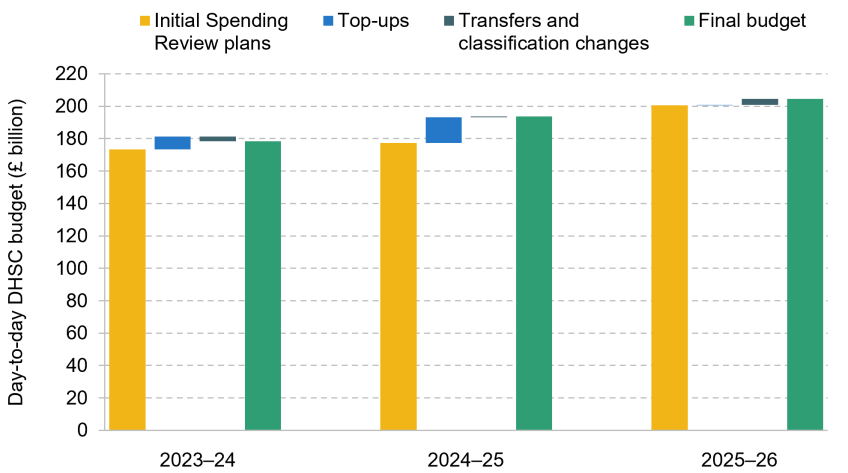
Note: Initial Spending Review plans are Spending Review 2021 for 2023–24 and 2024–25, and Spending Review 2024 for 2025–26. Figures are in nominal terms, to avoid conflating the planned budgets at Spending Reviews with the (unexpected) level of inflation in the out-turn. Transfers and classification changes include changes related to National Insurance and pension contribution changes, accounting and classification changes, and routine transfers between government departments (e.g. for the Immigration Health Surcharge). In all three years, actual spending was slightly below the final budget by an amount similar to the transfers and classification changes.
Source: Authors’ calculations using HM Treasury’s Public Expenditure Statistical Analyses (2022, 2023, 2024, 2025, 2026) and Department of Health and Social Care’s Supplementary Estimates (2023–24, 2024–25, 2025–26).
Budgets can then be topped up to represent increases in spending power (shown by the blue bars) or because of changes in classification, accounting practices or transfers between government departments (shown by the grey bars). In 2025–26, DHSC had a top-up of £0.4 billion (discussed in more detail below) and transfers and classification changes of £3.6 billion. These transfers included, for example, funding to compensate NHS organisations for the increase in employer National Insurance contributions. This left the final budget at £204.5 billion (shown by the green bars).
The DHSC budget was therefore topped up in 2025–26, but mostly due to transfers and classification changes rather than additional funding for operational budgets. That is very different from 2023–24 and 2024–25. In both cases, as Figure 1 shows, there were substantial top-ups: £7.9 billion in 2023–24 and £15.8 billion in 2024–25.
Figure 2 categorises these top-ups into four groups. Top-ups can occur at fiscal events when the Chancellor changes the DHSC budget, funding this through changes to tax, borrowing or other spending policy (the green bars). They can also come from the Reserve, which is a contingency fund held by the Treasury (the yellow bars). Finally, DHSC and the Treasury can agree to restructure existing DHSC budgets, either by moving money from capital budgets to day-to-day spending budgets (the grey bars) or by moving forward money from future budgets (the purple bars).
Figure 2. Breakdown of top-ups to the Department of Health and Social Care’s day-to-day-budget, 2023–24 to 2025–26, excluding classification changes and transfers
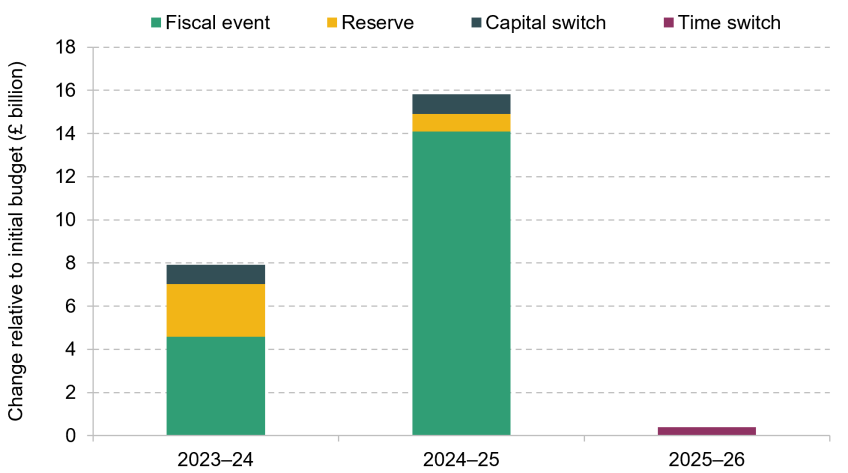
Note: Figures are in cash terms, as in Figure 1.
Source: Authors’ calculations using HM Treasury’s Public Expenditure Statistical Analyses (2022, 2023, 2024, 2025, 2026) and Department of Health and Social Care’s Supplementary Estimates (2023–24, 2024–25, 2025–26).
Each of these ways of funding a top-up has different associated challenges. Repeated use of the capital investment budget to fund day-to-day pressures, for example, was highlighted by the Darzi Review as a key budgeting failure that has damaged the NHS’s ability to build and maintain its capital stock. The Treasury Reserve, meanwhile, is designed for ‘genuinely unforeseen, unaffordable and unavoidable pressures’, rather than repeated annual top-ups to the NHS budget. Frequent use of the Reserve for the NHS likely leaves less money for genuinely unforeseen pressures in other departments. We have previously criticised recurrent Reserve claims to fund asylum costs, on very similar grounds. And whilst top-ups at fiscal events sometimes reflect a policy decision to expand the scope of NHS services – a very reasonable reason to top up budgets – as with Reserve claims they often instead reflect that existing plans have not been deliverable within the initially agreed budgets. Indeed, in a 2024 survey of local NHS finance managers, many reported that their performance targets were not ‘realistic and achievable’ within agreed budgets.
Figure 2 shows that 2023–24 and 2024–25 had relatively large top-ups to budgets at fiscal events (£4.6 billion for 2023–24 and £14.1 billion for 2024–25). One reason is that the initial plans for these years were set at Spending Review 2021. After those initial budgets were set, there was much-higher-than-expected inflation, reducing the real-terms generosity of budgets relative to initial plans, which likely increased the pressure for top-ups. Yet these budgets had already looked unrealistic relative to the government’s ambitions for the NHS when they were set, as we argued in 2021. There were also further Reserve claims and transfers from capital budgets to fund pay awards, ‘winter pressures’ and ‘NHS pressures that ultimately could not be absorbed within the budget’.1
Whilst not without top-up, 2025–26 did not see this sort of magnitude of budgetary changes, with only a £400 million top-up. The initial budget for 2025–26 set at the 2024 Spending Review was notably higher than the equivalent starting point for 2024–25, partly to take into account the significant inflation of the prior three years. There was also a small ‘reprofiling’ of spending at Autumn Budget 2025, bringing forwards £400 million of spending for later years into 2025–26 to ‘[facilitate] DHSC, NHS England and wider NHS restructuring and reform’. But there was no Reserve claim or capital–resource budget transfer, which are both ways of funding top-ups that are particularly concerning, as discussed above.2 The NHS therefore seems to have had meaningfully better budget performance in 2025–26 than in recent years.
2025–26 was also a break from a longer-term trend. Figure 3 shows all top-ups to day-to-day DHSC budgets that were funded from the Reserve or from capital budgets since 2011–12, focusing here on two types of top-up that are particularly indicative of poor financial planning. We exclude 2020–21 and 2021–22, as although large Reserve claims were made, emergency funding for the NHS operated very differently during the COVID-19 pandemic. The figure shows that the NHS made a Reserve claim or capital transfer for operational pressures in every financial year between 2014–15 and 2024–25, but not in 2025–26.
Figure 3. Claims made by the Department of Health and Social Care on the Treasury Reserve and in-year switches between capital and day-to-day budgets, 2011–12 to 2025–26
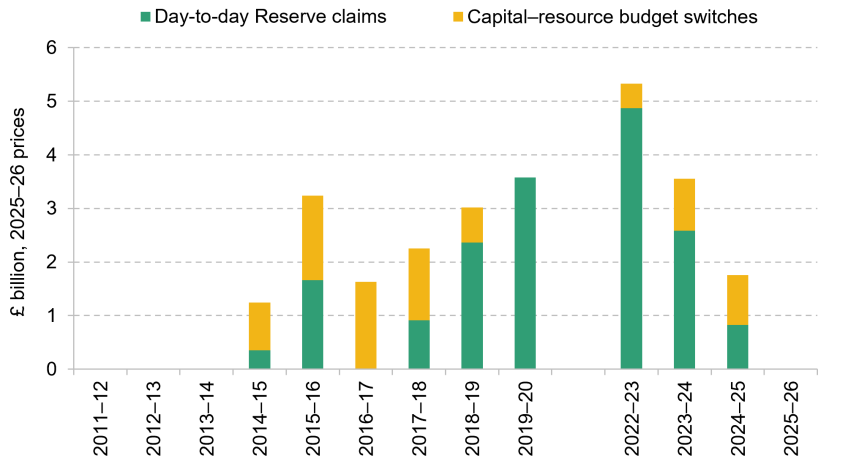
Note: Reserve claims shown only for the RDEL (resource departmental expenditure limit) Reserve. We exclude Reserve claims and budget switches related to transfers between government departments and classification changes. We exclude 2020–21 and 2021–22, which both featured large Reserve claims. Figures here are adjusted for inflation, and so are not directly comparable to the nominal totals in Figures 1 and 2.
Source: Authors’ calculations using HM Treasury’s Public Expenditure Statistical Analyses (2010 to 2026) and Department of Health and Social Care’s Main and Supplementary Estimates (2010 to 2026).
How was this delivered?
Top-ups to NHS budgets would not be needed every year if both the government and NHS agreed budgets and performance plans that were consistent with each other, taking into account the inevitability of as-yet-unexpected pressures, and the NHS was then able to maintain financial control to keep spending within budget. This means that better financial performance in 2025–26 could be explained by initial budgets being more generous; by performance plans being less ambitious (or at least the government tolerating worse performance without topping up spending); by productivity improvements enabling better performance within the same budgets; or by improvements in NHS financial controls. In the rest of this section, we examine each of these, and argue they each seem to have played a role.
Take first the initial budget. The budget agreed for 2025–26 at the 2024 Spending Review was markedly higher than the initial plans for previous years (set at the 2021 Spending Review), with real-terms spending growth of 3.0%, compared with an average planned growth of 0.7% per year for 2023–24 and 2024–25. This is also relatively fast compared with spending growth in the 2010s. But higher planned spending growth does not guarantee that actual spending stays within budget, especially when the government also has wide-ranging ambitions for what it would like the NHS to deliver. For example, in the early 2000s, initial budgets implied much faster spending growth than seen since, but spending still ended up growing even faster than planned.
Turning next to NHS performance ambitions, the NHS continued to deliver more services and somewhat better performance against headline targets than in previous years. But the rate of growth in services did slow down substantially. Figure 4 compares the annual growth rates of measures of hospital activity, the single largest area of NHS spending, for 2024–25 and 2025–26. Almost every measure shows markedly slower growth in 2025–26 than in 2024–25. The NHS also slowed down staffing growth considerably in 2025–26. One large group of staff – clinical support roles – even shrank by 2% during this year (the first year there was a fall in staff in this group since 2011–12). Slowing down activity and staffing growth is consistent with the government accepting a slower growth in NHS performance to stick within budgets, and also consistent with the NHS having stronger financial ‘grip’ on hospital trusts.
Figure 4. Annual growth rates in selected measures of hospital activity, 2023–24 to 2025–26
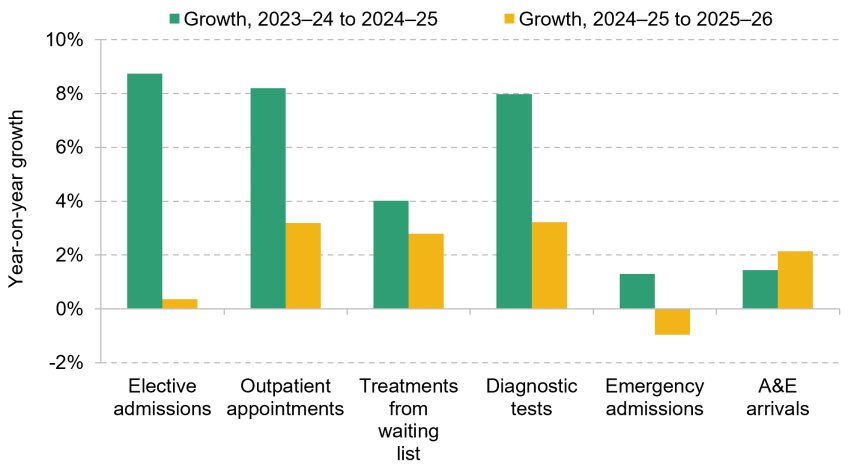
Note: A&E arrivals are for type 1 major A&E departments. Outpatient appointments are attended appointments.
Source: Authors’ calculations using NHS Digital’s Hospital Episode Statistics for admitted patient care, outpatient, and accident and emergency data (2026), NHS England’s referral to treatment (RTT) waiting times (2026) and NHS England’s diagnostic waiting times and activity statistics (2026).
Even these figures represent higher activity growth than what would be implied by sticking strictly to budgets in 2025–26. Front-line NHS organisations, on aggregate, still overspent their budgets slightly last year (by £560 million, or 0.3% of their budget). As is often the case, this was compensated for by underspends in central spending by NHS England.
Finally, improved productivity could have played a key role in delivering the financial position. Productivity has likely risen in the English NHS this year, at least according to NHS England’s own measures of trust-level productivity, which is welcome news for both the NHS’s finances and patients. However, these same measures suggest that productivity growth was very similar in 2024–25, in which there was a large top-up. Improvements to productivity therefore made it easier to deliver services within budget this year, but only when accompanied by the slowdowns in activity growth and higher initial budgets, as discussed above.
What does this mean for future years?
It is possible that 2025–26 will be a genuine break point for the government’s budget-setting process with the NHS. Persistent Reserve claims for operational overspends on this scale have never been tolerated for other public sector bodies, such as schools and police forces, and it may be that the norms have now changed to impose the same constraints on the NHS. If the NHS and government have really learnt to agree budgets that can be stuck to, this will mean fewer last-minute top-ups, transfers and fiscal changes. It may well mean more spending increases that can be given to other departments, or money that can be spent on other priorities such as tax cuts.
However, one reason that past governments have persistently allowed the NHS to overspend its budget is that they have frequently found the on-the-ground consequences of sticking to the planned budgets they set unpalatable. Governments in the 2010s repeatedly set out plans for NHS spending to grow slowly, but then preferred to allow Reserve claims and capital budget raids to fund responses to winter pressures.
Looking ahead, NHS spending is set to grow more slowly in the coming years than in 2025–26. The key question is therefore whether planned budgets will be sufficient for the government to deliver its ambitious performance targets. Otherwise, the government will have to choose between accepting slower performance improvements or returning to the old habit of topping up budgets once again.
The 2026 edition of the IFS Green Budget is funded by the Nuffield Foundation, Barclays and the Economic and Social Research Council (ESRC) through the Centre for Microeconomic Analysis of Public Policy (CPP). IFS is an independent Research Institute. As with all pieces of work, IFS has full editorial control over its analysis and conclusions. In addition to providing funding, Barclays authors will write chapters for the 2026 Green Budget, covering topics (the macroeconomic outlook and bond market) where their expertise complements that of IFS.
Endnotes
Authors

Olly Harvey-Rich
Olly joined the IFS in 2024 and works in the Healthcare sector.

Max Warner
Max joined the IFS in 2020. His work covers health and social care, public spending and public sector productivity.
More from IFS
Understand this issue


Policy analysis


Academic research