
Downloads
Download the report as a PDF
PDF | 1.25 MB
Executive summary
The late 2010s saw the Scottish Government gain powers over several existing taxes (most notably income tax) and benefits (mainly related to disability), as well as powers to create new benefits. Devolved taxes now account for around 33% of all tax revenue raised in Scotland. On the benefits side, devolved benefit spending accounts for 22% of all social security benefit spending in Scotland. Building on changes made in the 2016–21 Scottish parliamentary term, the last five years have seen the Scottish Government make further changes.
Are there any common themes in how the current Scottish Government has used its powers? Who are the winners and losers from the reforms it has undertaken? What opportunities has it taken and what difficult decisions has it ducked? And what are some of the key issues for the coming years?
Key findings
- The Scottish Government has used its devolved powers, including over the current parliament, to adopt a more progressive income tax and benefit policy than in the rest of the UK (rUK), through increased taxes on higher-income taxpayers and the expansion of means-tested benefits for families with children. This comes at the cost of weakening work incentives. Beyond increasing progressivity, it has failed to develop an overarching strategy for tax reform – including the role of different taxes in achieving its economic and social objectives – and to address both equity and efficiency issues with current tax design. Closer collaboration between the Scottish and UK governments would also allow improvements to the fairness and efficiency of Scotland’s devolved benefit system.
- Scotland has adopted a more progressive income tax schedule than in rUK, with changes over the parliament continuing this trend. In 2026–27, the lowest-income 55% of Scottish income tax payers are forecast to pay less income tax than they would in rUK – but the difference is at most £40 a year. The highest-income 45% will pay more, and sometimes much more. For example, taxpayers with an income of £50,000 will pay around £1,500 a year more, and those earning £125,000 will pay around £5,200 a year more.
- The overall effect of Scotland’s income tax reforms is to raise revenue. If taxable income were held fixed, the latest forecasts imply that revenue would be £1.8 billion higher in 2026–27 than if rUK tax rates applied in Scotland. But the actual net contribution of Scotland’s devolved income tax revenues to the Scottish budget is forecast to be just under £1 billion. The gap between these numbers reflects the combination of behavioural responses to Scotland’s higher income tax rates, and somewhat slower underlying growth in earnings since income tax was devolved in 2016–17 – both of which reduce the Scottish income tax base somewhat.
- A range of evidence suggests that behavioural responses to changes in income tax rates are likely to be particularly large for the highest-income taxpayers. Indeed, estimates from Scotland’s initial income tax reforms in 2018–19 suggest that increases in the top rate of income tax may reduce rather than increase revenue. However, these estimates come with wide margins of error, so significant uncertainty about the scale of behavioural responses remains, and more research is needed.
- Council tax rates have been reduced by about 5% in real terms, on average, since 2021, though that reduction will be partly reversed in 2026. The tax cut is bigger in cash terms for people in higher-band properties; but it is bigger as a percentage of property value or income (on average) for those in lower-band properties (except for those receiving a means-tested council tax reduction, who are unaffected by it).
- Despite a manifesto commitment to reform council tax, the current Scottish Government has failed to make major changes. A 2023 consultation investigating the possibility of making council tax less regressive was shelved. A new consultation on revaluation and reform was launched in 2025, but ministers have said substantive reforms will not come into effect before the end of the decade. This means that the problems with the current system – including basing tax bands on relative property values from 1991, well over a third of a century ago – remain. In the interim, the current Scottish Government has announced it will follow England in introducing a ‘mansion tax’ from April 2028 on fewer than 1% of properties in Scotland with an estimated value over £1 million, but that is no substitute for genuine reform.
- Policy on business rates has continued the Scottish (and wider UK) trend towards greater differentiation in tax rates, with tax cuts for businesses occupying low-value properties, as well as the retail, hospitality and leisure sector, coming at the expense of businesses in high-value properties and other sectors. The economic case for such variation is far from clear.
- Land and buildings transaction tax (LBTT) has been made even bigger and more damaging by freezing its thresholds and increasing the tax rates on purchases of second and rental properties. A landlord buying a £200,000 property, for example, must now pay £17,100, or 8.6%, in LBTT on top of the purchase price, compared with £1,100, or 0.6%, if bought as an owner-occupier’s main home. This encourages owner-occupation, which is already extremely tax-favoured, but makes it even more difficult and expensive for those who remain in the rental sector – tenants (who are likely to face higher rents as a result of the policy) as well as landlords. And preventing a landlord who wants to sell their property to another landlord from doing so is bad for both landlords and tenants.
- The Scottish Government has substantially increased the generosity of its benefit system for lower-income households with children. Over the current parliament, it has increased the value of the Scottish child payment from £12.80 to £28.20 per week per child (in April 2026 prices), and extended eligibility to families on universal credit with children aged between 6 and 15 inclusive. (Families already received the payment for children aged 5 or under.) This, as well as support to mitigate the effects of the UK government’s benefit cap and slight increases in the value of Best Start grants, has acted to increase the incomes of lower-income families with children, continuing the trend from the previous parliament. Low-income families without children have, on average, seen small cuts to benefit entitlements over this parliament due to the introduction of means-testing for the pension age winter heating payment. However, they continue to receive higher payments than they would in the rest of the UK through reforms such as the Scottish carer supplement and mitigation of the under-occupancy charge (or ‘bedroom tax’).
- The current parliament has seen the roll-out of a new system of Scottish disability benefits, replacing UK government benefits. The rates of Scottish disability benefits are currently the same as their UK equivalents, but the application processes have been reformed to make them easier to navigate and less stressful for claimants. After an initial spike in the rate of new applications and awards for adult disability payment (which replaces personal independence payment and disability living allowance for working-age adults), awards are back on a similar trend to that in England and Wales. This is because while application rates remain higher than in England and Wales, success rates in Scotland have fallen (from over 50% in 2023 to below 35% by mid 2025) below those in England and Wales (around 45%). The reasons for this decline are unclear, with quarterly Social Security Scotland statistical publications silent on the matter. Expenditure on disability benefits in Scotland is set to remain higher than if it had grown in line with England and Wales, but this gap is now forecast to stabilise, rather than grow, given the trend in success rates.
- On average, the combined effect of reforms to Scottish income taxes and benefits during the current parliament is to reduce households’ net incomes. Reforms over the last five years have increased households’ average income tax liability by £700 but increased their benefit entitlement by only £190. However, there is a clear redistributive pattern to these reforms. The lower-income half of households are on average unaffected by the tax rises, but those with children have gained from the increases in benefits and so have gained on average. On the other hand, the higher-income half of households are relatively unaffected by changes in the generosity of devolved benefits but have seen increases in income tax bills, and so have lost on average.
- Compared with the system in place in England and Wales, the Scottish income tax and benefit system raises more revenue and is more redistributive. Households’ income tax bills are on average £710 a year higher under the Scottish system, while benefit entitlements are on average £310 a year higher. It is at the top of the income distribution where income tax is higher, averaging just over £4,000 a year more per year than under the English and Welsh system for the highest-income tenth (decile) of households. On the other hand, Scotland’s more generous benefit system means the second-lowest income decile gain on average £790 a year under Scotland’s tax and benefit system. This rises to £2,760 a year (or 9% of net income) for households with children in this decile.
- All else equal, more generous means-tested benefits and higher income taxes, while increasing the progressivity of the system, will inevitably reduce work incentives. However, there are clear opportunities to improve the design of the system to mitigate some of these adverse consequences. Many Scottish benefits are contingent on receiving universal credit. The way this is implemented creates ‘cliff edges’ in benefit entitlements. Households with small universal credit awards can suddenly lose their entire entitlement to Scottish benefits when their pre-benefits income rises by a small amount, if this rise means they no longer receive universal credit. These cliff edges become starker as benefits such as the Scottish child payment increase in value. The Scottish Government should therefore consider options for tapering benefits away gradually as incomes rise, and work with the UK government to make this happen. Aside from improving work incentives, this would also make the system fairer, as presently families with very similar incomes before benefits (just either side of the cliff edge) can receive very different levels of support.
1. What tax and benefit powers are devolved to Scotland?
The Scottish Government has set council tax and business rates policy since the advent of devolution in 1999. It also had the power to vary the basic rate of income tax by up to 3 percentage points between 1999 and 2015, although it never made use of this.
Following the Calman and Smith Commissions, since the latter half of the 2010s the Scottish Government and Parliament have gained and made use of a wider range of powers over tax, as well as parts of the benefit system. Table 1 summarises forecast revenue from devolved taxes and forecast spending on devolved benefits for the year just ending, 2025–26.
Table 1. Scottish devolved taxes and benefit spending
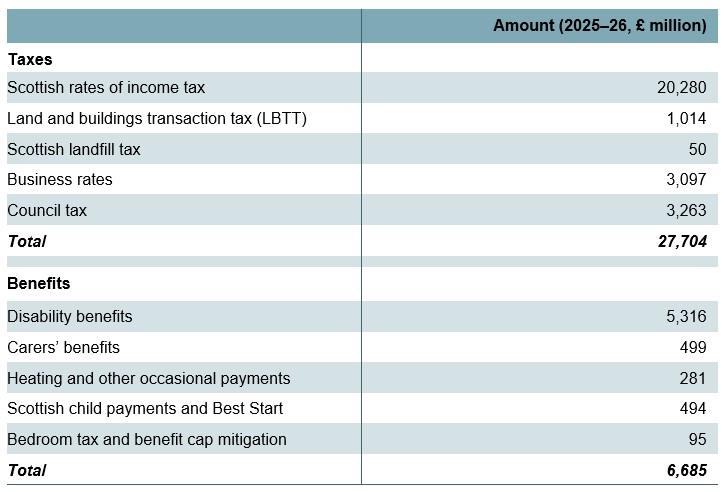
Note: Disability benefits are adult disability payment, child disability payment, pension age disability payment, employment injury assistance, Scottish adult disability living allowance and severe disablement allowance. Heating and other occasional payments are child winter heating payment, funeral support payments, pension age winter heating payment, Scottish Welfare Fund grants and winter heating payment.
Source: Scottish Fiscal Commission, 2026a; Scottish Government, 2025a.
On the tax side, the Scottish Parliament and Government have powers over:
- Income tax rates and bands (though not allowances) for income other than savings and dividend income. These are forecast to raise £20.3 billion in 2025–26, and the power to set these rates and bands was first devolved in 2017–18.
- The taxation of land and property transactions. In Scotland, this is enacted via land and buildings transaction tax (LBTT), which is forecast to raise £1.0 billion in 2025–26. This power was devolved in 2015–16.
- Taxation of landfill disposal, via the Scottish landfill tax. This is forecast to raise £50 million in 2025–26 and was also first devolved in 2015–16.
- Business rates, which are forecast to raise £3.1 billion in 2025–26. Business rates have been devolved since the start of devolution in 1999–2000.
- Council tax, which Scottish councils set the headline (‘band D’) rate of and retain the revenues from, and which is forecast to raise £3.3 billion in 2025–26. The design of council tax has been devolved since the start of devolution in 1999–2000, and Scottish councils have set the headline council tax rate since the introduction of the tax in 1993.
Taken together, these taxes represented approximately 33% of all tax revenue raised in Scotland in 2024–25.1 The first four, which contribute to the Scottish Government’s budget, accounted for 48% of its funding for day-to-day (resource) spending in 2025–26.
Powers over taxing the extraction and import of aggregate (stone, gravel and sand) are due to be devolved from April this year (with forecast revenue of £42 million in 2026–27). Agreement has also been reached in principle to devolve powers over air passenger duty (forecast to have raised £305 million in Scotland in 2025–26) and to allocate half of VAT revenues raised in Scotland (£8.1 billion) directly to the Scottish Government. The Scottish replacement for air passenger duty, air departure tax, is due to commence from April 2027. Technical issues have so far prevented assignment of VAT revenues.
On the benefits side, most benefits remain the responsibility of the UK government, but powers have now been devolved to the Scottish Government over:
- Disability benefits (disability living allowance, personal independence payments, attendance allowance, severe disablement allowance and industrial injuries benefit – though not employment and support allowance, an earnings-replacement benefit for those unable to work because of ill health or disability, or the disability components of universal credit or tax credits).
- Carer’s allowance, for those caring for people with a disability.
- Various occasional payments: winter fuel payments, cold weather payments, funeral expenses payments and maternity grants.
The Scottish Government can also provide top-ups to UK benefits and introduce new benefits (such as the Scottish child payment) and has control over discretionary housing payments and other discretionary schemes (such as the Scottish Welfare Fund) which are administered on the ground by councils.
While responsibility for spending on most of these benefits transferred to the Scottish Government in the last Scottish parliamentary term (in 2020–21), the transfer to new Scottish benefits administered by Social Security Scotland was mainly in the current parliamentary term.
In total, the Scottish Government has responsibility for funding approximately £6.7 billion of benefit expenditure in 2025–26, of which:
- £5.3 billion relates to disability benefit spending – where increases in spending have been driven by increased caseloads (see Section 8);
- £0.5 billion relates to benefits for those caring for people with disabilities;
- £0.5 billion relates to benefits for low-income families with children (Scottish child payments and the Best Start programmes) – where increases in spending largely reflect increases in benefit generosity (see Section 7);
- £0.3 billion relates to winter heating and other occasional payments;
- £0.1 billion relates to discretionary housing payments, which the Scottish Government uses to mitigate the so-called ‘bedroom tax’ and ‘benefit cap’ – where increases in spending largely reflect the cash-terms freeze in the level of the UK benefit cap (meaning more people are subject to it as inflation indexation pushes up benefit rates).
In addition to these formal social security benefits, there are a range of other transfers that are sometimes included in the definition of the Scottish benefit system. Further information can be found in our online explainer on the powers and responsibilities devolved to the Scottish Parliament and Scottish Government.2 Most significant in terms of expenditure are means-tested council tax reductions for households with low incomes and financial assets. This council tax reduction scheme (CTRS) is more generous than the schemes operated by most English councils and is likely to cost somewhat over £0.4 billion in 2025–26.3
2. Income tax has been increased and made more progressive
Under the Scotland Act 2016, the Scottish Parliament sets the tax rates and tax bands (albeit not the tax-free personal allowance) for income tax on non-savings non-dividends income. Savings and dividends remain subject to UK-wide tax rates and bands.
The 2016–21 parliament saw these powers used to both increase overall revenues and increase the progressivity of the income tax. This included reducing the higher-rate threshold and increasing the higher and top rates (to 41% and 46%, respectively), and splitting the basic-rate band into three bands: starter (19%), basic (20%) and intermediate (21%).
Reforms over the 2021–26 parliament have continued in this direction – raising further revenue, increasing progressivity, and further increasing complexity by adding another band (the ‘advanced’ band).
Changes to income tax in the 2021–26 parliament
Over the current parliament, up to April 2026, the Scottish Parliament has:
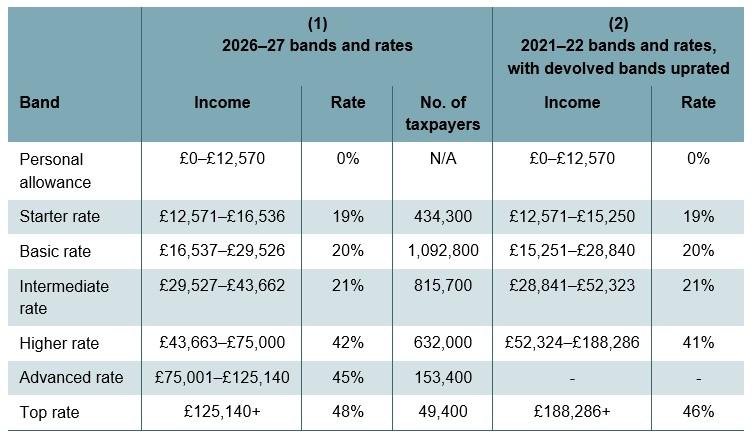
- uprated the starter-rate band by more than inflation, meaning that the threshold at which taxpayers start paying the basic rate of 20% is now £16,537 rather than £15,251 in real terms;4
- uprated the basic-rate band by more than inflation, meaning the threshold at which taxpayers start paying the intermediate rate of 21% is now £29,527, rather than £28,841;
- increased the higher rate of tax from 41% to 42%;
- frozen in cash terms the higher-rate threshold, at which taxpayers start paying 42%, from £52,324 to £43,663, meaning a real-terms fall in its value;
- introduced a new advanced rate of tax of 45%, on income between £75,001 and £125,140;
- increased the top rate of tax from 46% to 48%;
- decreased the value of the top-rate threshold, at which taxpayers start paying 48%, from £188,286 to £125,140, through the combination of a cut followed by a nominal freeze (and therefore further real-terms fall) over the course of the parliament.
The personal allowance and the higher- and additional-rate thresholds set by the UK government have all also been frozen since 2021–22. The first two of these are set to remain frozen until April 2031, and the additional-rate threshold is set to remain frozen indefinitely. The personal allowance freeze also increases tax liabilities for Scottish taxpayers (as do the other UK threshold freezes, for savings and dividend income). The Scottish Government has announced that the higher-, advanced- and top-rate thresholds in Scotland will be frozen until April 2029. However, changes planned to come into effect after April 2026 are not reflected in the rest of the analysis in this section.
Table 2 shows the bands and rates that will apply to Scotland from April (column 1), and what the system would have looked like if the widths of all Scottish tax bands had been uprated in line with inflation over the current parliament (column 2). These bands sit on top of the tax-free personal allowance, which has been frozen in cash terms by the UK government. Because the personal allowance is outside of the Scottish Government’s control, we keep this at its actual value (£12,570) in our counterfactual ‘inflation-uprated’ Scottish bands and rates in column 2. But in addition to changes to tax rates and bands by the Scottish Government, the UK government’s freeze in the personal allowance has increased income tax bills of Scottish taxpayers with incomes between £12,570 and £125,140 (after which point the personal allowance is fully withdrawn).
Table 2. Income tax rates and thresholds in Scotland in 2026–27 versus 2021–22
Source: Authors’ calculations.
Figure 1 shows how the specifically Scottish Government changes over the current parliament have affected the tax bills of people with different levels of non-savings non-dividends income. It shows that these changes have had very little effect on the tax bills of low- and middle-income taxpayers: the relatively modest real-terms changes to bands/thresholds, combined with the small (1 percentage point) changes in tax rates at tax thresholds, mean that the reforms have saved them £20 a year at most, compared with inflation-based uprating of thresholds. Taxpayers with incomes above around £43,760 (around a quarter of Scottish income tax payers (Scottish Fiscal Commission, 2026b)) have seen increases in their tax bills as a result of changes in tax rates and real-terms changes in bands by the Scottish Government, with those increases rising with income. For example, this parliament, someone with an income of £50,000 has seen their income tax bill rise by around £1,300 due to the freeze in the higher-rate threshold and the increase in the higher rate of tax, while someone with an income of £100,000 has seen an increase of around £3,000 due to the freeze in the higher-rate threshold, the increase in the higher rate of tax and the introduction of the new ‘advanced’ rate.
Figure 1. Increase in income tax liability due to Scottish reforms over the current parliament, by earnings

Source: Authors’ calculations using Scottish Fiscal Commission (2026a).
Changes in income tax rates and bands over the current parliament have therefore both increased the progressivity of the Scottish income tax system and raised revenues (with the higher bills of higher-income taxpayers far outweighing the small cuts for lower-income taxpayers). This very much continues the trend seen in the previous parliament.
Another trend that has continued is the increase in complexity of the system. The addition of the advanced-rate band this parliament follows on from the addition of the starter- and intermediate-rate bands in the previous parliament, and means Scotland now has twice as many bands and rates as the rest of the UK (six versus three). This is unnecessary and regrettable. While the introduction of new bands does allow somewhat more precise targeting of tax changes at particular groups of taxpayers, similar overall distributional impacts can generally be achieved with fewer new bands and rates. For example, as discussed in our 2021 Scottish election analysis (Adam and Phillips, 2021), setting a small 0% band above the personal allowance and increasing the basic rate to 21% above this would have been both simpler and slightly more progressive than splitting the basic-rate band into three bands.
Comparisons with income tax in the rest of the UK
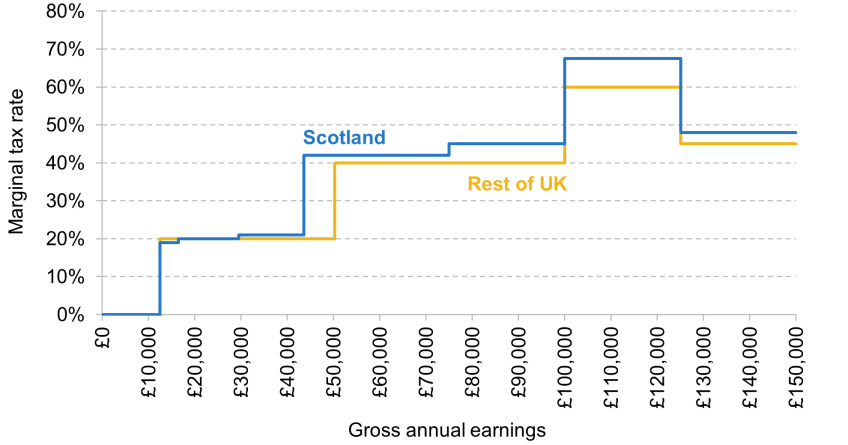
We now look at how income tax bills under the Scottish income tax system compare with bills under the system in place in the rest of the UK (rUK). Figure 2 shows the marginal income tax rates paid at different levels of income in Scotland and rUK, as of April 2026.
Figure 2. Marginal income tax rate schedule in Scotland and in the rest of the UK
Source: Authors’ calculations.
As well as creating higher marginal rates for workers earning more than £29,526, the figure clearly shows the more complicated structure of Scotland’s income tax system. The figure does not show the impact of National Insurance contributions, which are set by UK government policy. For employees with smooth earnings over the year, they add 8p to the marginal tax rates for annual earnings between £12,570 and £50,270, and 2p to the marginal tax rates for annual earnings above this. Accounting for these, the Scottish marginal tax rate schedule looks even more complicated, rising from 29% to 50% at £43,663, then falling to 44% for earnings above £50,270.
Figure 3 shows the difference in income tax bills between Scotland and rUK for different incomes, as of April 2026. It shows that income tax bills are the same or slightly lower (up to £40 a year lower) in Scotland for those with incomes up to £33,500. Based on current forecasts, this meets the current Scottish Government’s objective of having ‘more than half of [income] taxpayers in Scotland continu[ing] to pay less than in the rest of the UK’ (Scottish Government, 2026a), with the Scottish Fiscal Commission (2026a) forecasting that this will be true of 55% of income tax payers.
Figure 3. Difference between income tax liability in Scotland and in the rest of the UK, by earnings from employment

Source: Authors’ calculations using Scottish Fiscal Commission (2026a).
Tax bills are higher for those with higher incomes, with this difference remaining small for those with incomes up to the Scottish higher-rate threshold (£43,663) because the intermediate tax rate (21%) is only slightly higher than the UK’s basic rate (20%). Above this point, the combination of a lower higher-rate threshold and higher tax rates means much more substantial differences in income tax bills. Income tax bills in Scotland are around £1,500 a year higher at an income of £50,000 a year, and around £5,200 a year higher at an income of £125,000 a year.
Since the start of tax devolution in 2016–17, the proportion of taxpayers paying at least the higher rate of tax has grown faster in Scotland than in the UK as a whole – reflecting Scotland’s lower higher-rate threshold. The Scottish Fiscal Commission (2026b) estimates that in 2026–27, 26.3% of Scottish income tax payers are expected to pay at least the higher rate, higher than the UK-wide proportion of 21.9%. In 2016–17, only 12.1% of taxpayers in Scotland paid at least the higher rate, lower than the UK-wide proportion of 15.3%.
Revenue and behavioural effects
Scotland raises more revenue from income tax than it would if it applied the rates and bands that apply in the rest of the UK. However, Scottish policy is not the only factor affecting the contribution of income tax to the Scottish Government’s budget. First, Scottish income tax revenues are also affected by the size of the Scottish income tax base – that is, the amount of taxable non-savings non-dividends incomes in Scotland. In turn, two key factors affecting this are the employment rate and both the average level and distribution of earnings. Second, the net contribution of income tax to the Scottish budget is the difference between Scottish income tax revenues and the block grant adjustment (BGA) that is subtracted off the block grant funding the Scottish Government receives from the UK government to account for income tax devolution.
The income tax BGA was initially set equal to the amount of income tax revenue that was devolved to Scotland when income tax was first devolved in 2016–17. It has subsequently been indexed based on changes in income tax revenues in England and Northern Ireland,5 whether due to changes in policy or changes in the underlying income tax base. This approach helps insure the Scottish Government against several types of fiscal risk, and helps ensure tax changes only applying outside Scotland neither benefit nor cost residents of Scotland.6 The ‘income tax net revenue position’ – that is, the difference between income tax revenues and the offsetting BGA – therefore depends not only on differences in income tax policy between the Scottish and UK governments, but also on differences in the growth of underlying income tax bases in Scotland and in England and Northern Ireland and, in turn, differences in employment and earnings trends.
The Scottish Fiscal Commission (2026a) forecasts that the income tax net revenue position will be just under £1 billion in 2026–27. This is lower than the just under £1.8 billion revenues that Scotland’s higher income tax rates would raise if the tax base was held fixed. The £0.8 billion gap between these two figures, which the Scottish Fiscal Commission refers to as the ‘tax base performance gap’, reflects a variety of factors. These include slower private sector earnings growth in Scotland in the late 2010s and early 2020s, in part due to a fall in the number of jobs in the traditionally high-paid oil, gas and ancillary industries (Adam and Phillips, 2025).
But some of the gap will also highly likely reflect behavioural responses to the Scottish Government’s increases in tax on higher incomes. Such responses can take several forms: reductions in hours of work or effort; (legal) tax avoidance and (illegal) tax evasion; and migration out of Scotland (or discouraged migration into Scotland). Because Scottish rates of income tax do not apply to savings and dividends, one way to avoid them (and pay UK government rates of tax instead) is to set up an incorporated business and take income in the form of dividends rather than salary or self-employment profits. This option is therefore likely to increase the size of behavioural responses to changes in Scottish income tax rates by employees or self-employed taxpayers who have the option to incorporate, compared with the situation where Scottish rates applied to all forms of income.
However, the exclusion of dividends and savings income from the Scottish income tax base also means Scottish tax revenues are not currently affected by the group that seems most responsive to income tax rates – existing owner-managers of incorporated businesses (Adam et al., 2021; Miller, Pope and Smith, 2024). These have access to ways to avoid tax not open to employees and the self-employed – such as retaining income within their businesses and withdrawing it at a time or in a way that will reduce the tax due (such as selling their business in whole or part and paying typically lower capital gains tax instead of income tax). The fact that Scottish revenues are not currently exposed to this behaviour – because company owner-managers’ dividends income is excluded from the Scottish tax base in any case – is a factor that likely reduces the size of behavioural responses to changes in Scottish income tax rates overall, compared with a situation where the rates applied to all forms of income. This countervailing factor therefore means it is not fully clear-cut that the exclusion of dividends and savings income from the Scottish tax base will affect the overall size of behavioural responses to Scottish income tax rates (measured by so-called ‘taxable income elasticities’) – more research is needed.
Research does suggest though that behavioural responses to income tax changes are larger for income tax payers with higher levels of income, and especially those with incomes above the top tax threshold – reflecting the fact that they find it easier and/or more worthwhile to make changes to their behaviour that reduce their tax liability.7 Drawing on such research, the Scottish Fiscal Commission (2026a) assumes that whereas only 8% of the mechanical revenue increase from freezing the higher-rate threshold in 2027–28 and 2028–29 will be offset by behavioural responses, around two-thirds of the mechanical revenue increase from freezing the top-rate threshold will be. Scottish Fiscal Commission (2023) assumes that around 85% of the mechanical revenue increase from increasing the top rate of tax from 47% to 48% in April 2024 will have been offset by behavioural responses.
Direct evidence on just how responsive Scottish taxpayers have been to the increases in tax on higher-income taxpayers is still very limited – and non-existent for the changes seen during the current parliament. HMRC analysis of the initial increases to Scotland’s income tax rates in 2018–19 suggested responses were relatively modest (in line with Scottish Fiscal Commission assumptions) for those in the intermediate- and higher-rate bands. But, driven by those with the very highest incomes (over £500,000 a year), the central estimates of responses to changes in the top rate of income tax were larger than assumed by the Scottish Fiscal Commission (see Phillips (2024) for a review). Indeed, the central estimates for the top rate would imply that increases in the top rate of income tax may actually reduce rather than increase revenue due to the scale of behavioural responses. However, HMRC and the Scottish Fiscal Commission also highlight the margins of error and uncertainty around these central estimates – with a need for further analysis and research, including on the changes to Scottish income tax rates since 2018–19. It is therefore too early to draw conclusions about whether Scotland’s higher top rate of income tax is increasing or reducing revenue. But the relatively small share of Scotland’s income tax base in the top-rate tax band and broader evidence that taxpayers with the highest incomes are particularly responsive to changes in income tax do imply that if the next Scottish Government wanted to continue to use income tax to raise more revenues, broader-based rises would be needed to raise significant sums (see Macfarlane et al. (2026) for one such proposal). Conversely, if the next Scottish Government wanted to reduce the top rate of income tax in Scotland, while the exact revenue impact of this is uncertain, it would highly unlikely result in large revenue losses.
3. Will council tax be reformed after years of dithering?
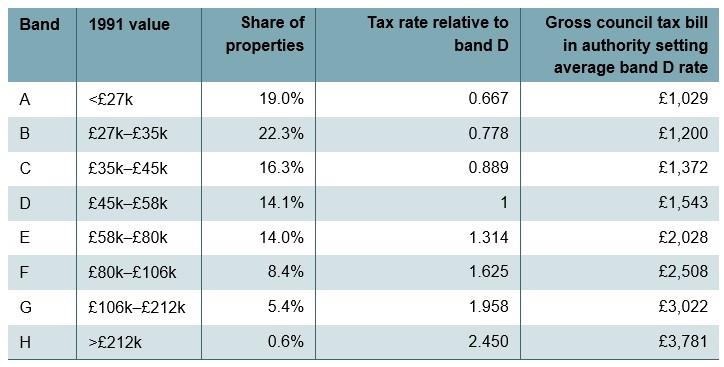
Households pay council tax on the property they occupy. The Scottish Government determines the structure of the tax – including the relative tax rates for different properties – while individual local councils set the overall level of the tax in each area. The current system is summarised in Table 3.
Table 3. Summary of the Scottish council tax system in 2025–26
Source: Average band D rate and share of dwellings in each band calculated using data from Scottish Government (2025k).
Comparison across nations of the UK
Comparing council tax in Scotland with council tax in England and Wales is difficult: comparing the average rate for a band D property, for example, is not very meaningful because properties are not allocated to bands on the same basis (the thresholds are different in England, while in Wales they are based on values in 2003 rather than 1991).8 The overall average council tax bill in 2025–26 is almost 30% lower in Scotland (a little under £1,300) than in England or Wales (both around £1,800).9 But property prices are considerably lower in Scotland than in England, so the average bill is a similar or slightly higher percentage of average property value in Scotland than in England (a little over 0.5%), though considerably lower than in Wales (around 0.75%).10 If the average bill in Scotland were the same as in England and Wales, council tax revenue in Scotland would be about £1.3 billion higher. But that would imply the tax’s being a much higher percentage of property value in Scotland than in England. Lower property values in Scotland than England suggest that Scottish households are financially less well off (in terms of their housing wealth, at least) and arguably should pay less council tax than the English; and if they have to spend less of their income on housing, that implies they will be spending more of it on other things and paying correspondingly more VAT etc., compensating for their lower council tax payments.
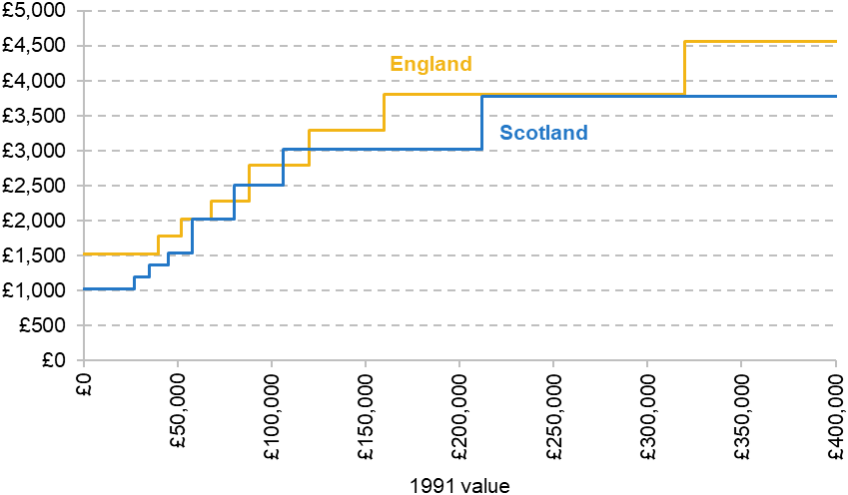
Figure 4 shows how council tax bills vary by 1991 property value in Scotland and England,11 assuming the average band D rate across local authorities in the respective nations and taking into account the different band cut-offs in each nation as well as the higher tax ratios for bands E to H now in place in Scotland.
Figure 4. Council tax due in a local authority setting the average band D rate in Scotland and England, 2025–26
Note: Average band D rate in England includes precepts from police and fire authorities. Scottish police and fire services are funded by Scottish Government grants rather than through council tax.
For a council setting the Scottish average band D rate, properties in bands A to E in Scotland (86% of the total) attract less council tax than they would if the English system applied (with the English average band D rate). For higher-value properties, the pattern varies, though for the very highest-value properties council tax is again unambiguously lower in Scotland: the lower average band D rate in Scotland more than offsets the effect of increasing the multiple of the band D rate charged in band H.
Property prices have not grown at the same rates in England and Scotland since 1991, so this does not necessarily paint an accurate picture of how Scottish and English council tax liabilities compare for a property with the same current value. However, it will still be true that council tax is lower in Scotland than in England for both the lowest-value and the highest-value properties.
Real-terms reductions in bills but a lack of real reform
Although the current parliament has seen significant increases in council tax rates in cash terms, there has been rapid inflation over this period, so in real terms the average band D rate has declined by almost 5% (Scottish Government, 2025k), reducing Scottish councils’ revenue by about £170 million. This is a bigger real-terms reduction than England’s 3% (UK government, 2025a), while Wales’s average band D rate has increased by 1% in real terms (Welsh Government, 2021 and 2025d). The reduction in council tax is bigger in cash terms for those in higher-band properties; but it is bigger as a percentage of property value or income (on average) for those in lower-band properties (except for those receiving a means-tested council tax reduction, who are unaffected by it). However, many councils in Scotland are increasing council tax by substantially more than inflation in 2026–27 (e.g. BBC, 2026), which will go part of the way to reversing this decline.
Perhaps more significant than what has happened in this parliament is what has not happened.
The SNP’s 2021 election manifesto pledged to remove council tax for under-22s (that is, to increase the minimum age for paying council tax from 18 to 22). This promise has not been kept.
More importantly, the manifesto said ‘We are committed to reforming the Council Tax to make it fairer’, building on cross-party talks on a replacement for council tax that had been paused because of the COVID-19 pandemic (Scottish National Party, 2021). Five years on, there has been no fundamental reform.
Reform is certainly needed:12
- Most obviously, council tax in Scotland (as in England, though not Wales) is, ludicrously, still based on relative property values in 1991. In the 35 years since then, the values of different properties have increased by vastly different amounts. Properties now worth similar amounts can face bills that differ by hundreds of pounds because they used to be worth different amounts in 1991; conversely, properties now differing in value by hundreds of thousands of pounds can face the same tax bill. This is unfair and we estimate that about half of properties are now effectively in the ‘wrong band’, in the sense that if the same number of properties were in each band but based on current rather than 1991 values, half would be in a different band.
- The use of a small number of wide bands means that properties just either side of a threshold, with very similar (1991) values, attract very different tax liabilities; while properties at opposite ends of a band can have very different (1991) values yet attract the same tax.
- Council tax is regressive with respect to property value: it is a higher percentage of property value for low-value properties than for high-value properties (at least before means-tested discounts). As Table 3 shows, band H properties have a (1991) value at least 7.9 times as high as band A properties but attract only 3.7 times as much council tax, despite a reform in 2017 which somewhat increased relative tax rates for high-band properties. Not every tax needs to be progressive: what matters is the effect of the tax system as a whole. But if we want to levy higher tax rates on those with more resources in general then it seems odd to levy lower tax rates on those with more of one particular resource (housing) as the current regressive structure does. Moreover, the fact that it is harder to hide or move housing than it is to hide or move income means that combining a regressive council tax with a progressive income tax is likely to increase the economic distortions and costs of redistribution. Even if one did not want to increase the progressivity of the overall tax system, there is a case for making council tax less regressive (and other parts of the tax system, such as income tax, less progressive) to redistribute in a less economically costly way.
- The way the 25% discount for single-adult households is designed – worth more if living in a high-band property than a low-band property – makes it cheaper for single-adult households, and more expensive for multi-adult households, to live in higher-band properties, contributing to both under-occupation and overcrowding.
In 2023, the Scottish Government did consult on further increasing the relative tax rates on band E–H properties, building on a similar reform in 2017. This would have reduced the regressivity of council tax, though it ducked the vital issue of revaluing properties to bring the tax up to date. An analysis of consultation responses published by the Scottish Government (2024a) found that only 4% of respondents approved of the plans, which may reflect the fact that around 90% of respondents listing a council tax band were in bands E–H, compared with 28% of all households in Scotland. In the end, the potential reforms were shelved.
In 2025, the Scottish Government launched a new ‘Future of council tax in Scotland’ consultation (Scottish Government, 2025d) which considers a much wider range of reforms, including revaluation and new bands (drawing on analysis of indicative reform options commissioned from IFS researchers (Adam, Phillips and Ray-Chaudhuri, 2025b)). The process of public and stakeholder engagement around this is still ongoing.
Yet when publishing the consultation document, Finance Secretary Shona Robison said ‘The Scottish Government is not advocating for a specific reform, rather the aim of this work is to examine whether consensus around a unified position on council tax could be achieved. Any reform proposals that come forward in the next parliament would clearly be contingent on securing that unified position, would require a long delivery period and would likely not be complete in this decade’ (Scottish Government, 2025j).
That was a remarkable, and depressing, statement: virtually ruling out meaningful reform until the 2030s – and until there is consensus (not just a majority) on a specific reform package, which may never be achievable. Moreover, despite the Scottish Government’s Tax Strategy (Scottish Government, 2024b) committing to publishing a summary of responses to its consultation and holding a debate in the Scottish Parliament prior to the May 2026 elections, it has not yet done so and at the time of publication there are only six working days before the current parliament is dissolved (and several bills still to pass).
The Welsh Senedd has legislated for a revaluation in 2028 (and every five years thereafter), showing that it can be done. In light of the Finance Secretary’s statement and given the decades of consultations, reports and discussions that have already been undertaken in Scotland, it is hard not to see yet more of them as merely kicking the issue into the long grass once again.
Mansion tax – a stepping stone to real reform or a poor substitute?
Despite that, when the UK government announced the introduction of a high-value council tax surcharge (‘mansion tax’) in England in its November 2025 Budget, the Scottish Government quickly followed suit in its January 2026 Budget.
The planned Scottish reform, to take effect in April 2028, is somewhat different from England’s. It will apply to properties worth £1 million or more, not £2 million as in England. And whereas the proposal in England is for a new tax to be paid alongside council tax, in Scotland it will take the form of two new council tax bands (bands I and J), with properties worth £1–2 million and more than £2 million put into bands I and J respectively instead of their current bands, and subject to higher rates of council tax accordingly.13
According to documentation newly released in response to a Freedom of Information request (Scottish Government, 2026d), the Scottish Government has been working with illustrative tax rates which would add around £720 a year to council tax bills for band I properties (which would still leave them paying marginally less than a band H property in England, in a council setting the respective nations’ average band D rates) and £3,600 a year for band J properties. These tax rates have not yet been finalised, but the Scottish Government estimates that applying them would raise £12–16 million a year.
It is reasonable to increase council tax for the highest-value properties (though little over 0.5% of households will be affected); as noted above, council tax is currently a lower percentage of value for high-value properties than for low-value properties, and this change will do less economic damage than other ways of increasing taxes on the well-off, since properties cannot be moved or hidden. And it is surely right to use up-to-date values rather than 1991 values.
Yet moving to base council tax on up-to-date values for the highest-value properties highlights the absurdity of continuing to use 1991 values for the rest. Many more properties will be valued than will ultimately be subject to the new tax rates, since the first step is to estimate which properties are worth more than £1 million: for those valued at less than £1 million, the new estimates will simply be ignored in favour of estimates decades out of date. The valuation process will reveal properties currently worth more than others but taxed less – but will not rectify the anomaly unless they are worth more than £1 million. And since nowadays the valuation process is based in large part on computer-based statistical modelling, and the highest-value properties are among the most difficult to value and require most manual intervention, the cost of a comprehensive revaluation would probably not be that much higher than that of valuing only £1-million-plus properties.
The way that this reform was announced also calls into question the Scottish Government’s explanation for slow progress on wider council tax reform. The Scottish Government contends that revaluation and reform of council tax cannot be done without years of consultation and complete consensus. Yet here it has announced a reform, involving revaluing some properties and creating losers, without any such consultation. While in the middle of consulting on the merits of council tax revaluation, the Scottish Government announced that it will go ahead with a revaluation – but only for some properties. It is hard to see any principled reason for revaluing some properties but not others, or why other reforms should require years of consultation and consensus when this one can be announced without warning as a fait accompli.
A council tax based on 1991 values for some properties and up-to-date values for others is completely incoherent. If the introduction of these new, higher council tax rates proves to be a stepping stone to more comprehensive reform – establishing the principle and modern apparatus of revaluation which can then be applied more widely – it will look like a step in the right direction. But if this is the final destination – a way to implement a tax increase on households in the very highest 0.5% of properties without having to grasp the nettle of wider-ranging change – it will look like a poor substitute for much-needed fundamental reform.
4. Further differentiation in business rates
Business rates (officially non-domestic rates) are a tax paid by firms on the estimated annual rental value (‘rateable value’) of the property they occupy. Those occupying more valuable properties pay a higher percentage of that value in tax. As with other taxes, the business rate schedule in Scotland is more progressive than the one in the rest of Great Britain, as shown in Figure 5. For high-value properties, Scotland’s business rates are the highest in Britain; but business rates in Scotland are lower than in Wales for properties with a rateable value below £51,000, and slightly lower than in England for properties with a rateable value between £12,000 and about £18,000.14
Figure 5. Business rates schedules, 2026–27

Note: Assumes a business occupying a single property, not engaged in retail, leisure or hospitality, and ignores transitional arrangements associated with the 2026 revaluation. Schedule for England is that applying outside London. Rateable value is estimated market rental value as of April 2025 in Scotland and April 2024 in England and Wales.
While the pattern of greater progressivity in Scotland has been true for some time, the level of the tax in Scotland relative to England and Wales is different in Figure 5 from in the past. At the time of the last Scottish election in 2021, business rates in Scotland were lower than in Wales for all properties, not just those below £51,000; the tax was barely above England’s for the highest-value properties and more significantly below England’s for a wider range of lower-value properties. The change is partly because commercial rents have increased less quickly in Scotland than elsewhere, so the tax must be a higher percentage of property value to maintain revenue, even if average bills do not rise in real terms. It may also reflect differences in how expected valuation appeals are accounted for when adjusting the tax rate alongside property revaluations in 2026.
Variation by property value
Changes to business rates in recent years have increased the progressivity of the business rates schedule in Scotland (as in England and Wales). While the tax on high-value business properties has generally increased in line with inflation, the tax rate for properties with a rateable value below £51,000 was frozen in both 2024–25 and 2025–26: a real-terms reduction in tax bills.15
This reduction in business rates for less valuable properties has increased the jump in liability at £51,000: in 2026–27, Scottish properties with a rateable value £1 above that threshold will attract £2,754 more tax than properties £1 below the threshold. Charging £2,754 extra tax for a property that costs £1 more to rent is simply unfair, and it would be better for the Scottish Government to remove this ‘cliff edge’. Indeed, the Scottish Government removed precisely such cliff edges in 2023–24 when it changed the structure of the Small Business Bonus Scheme, which reduces business rate bills – mostly to zero – for the very lowest-value properties. This scheme previously created even larger jumps in liability (about £4,000) at rateable values of £15,000 and £18,000 as relief was withdrawn; the Scottish Government sensibly reformed it to replace those cliff edges with the more gradual (albeit still steep) slopes shown in Figure 5.16 To have removed those cliff edges only to exacerbate the one at £51,000 seems a shame.
The underlying rationale for varying the tax rate by property value is unclear. It is tempting to think of levying higher tax rates on high-value properties as akin to levying higher tax rates on high-income individuals, but the analogy is flawed. The people who ultimately bear the burden of a tax on business property – a combination of the taxpaying firms’ owners, employees, customers, suppliers and landlords – are not necessarily any better off for high-value properties than for low-value properties. Taxing high-value business properties does not necessarily affect better-off people more than taxing low-value business properties. Making the business rate schedule more progressive – making the tax more progressive with respect to rateable value – does not necessarily make the tax more progressive with respect to household income.
In fact, economic theory and the (limited) empirical evidence available suggest that business rates largely get reflected in rental prices in the long run.17 Higher business rates reduce what potential occupiers are willing to pay for a property, and since the total supply of property is quite unresponsive to tax, the reduced demand forces landlords to accept lower rents if they wish to find a tenant (though existing long-term rental contracts mean it can take time for market rents to adjust in this way). Reduced business rates for low-value properties are therefore likely to benefit landlords primarily, rather than the businesses occupying the premises.18
The retail, hospitality and leisure sector
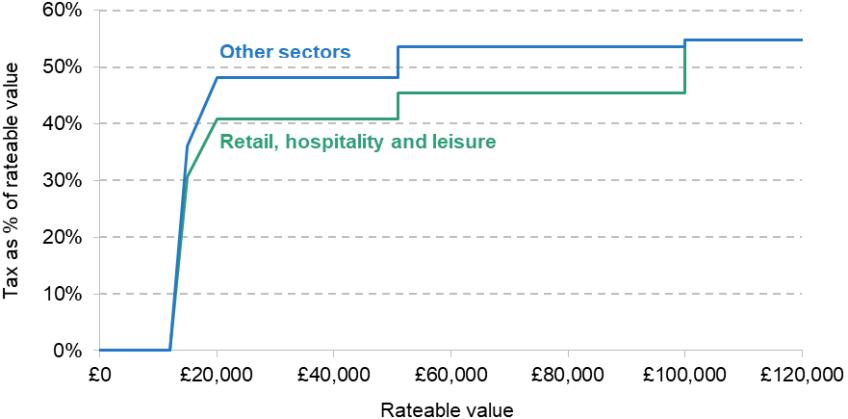
Figure 6 highlights another notable feature of recent policy on business rates: reduced rates for the retail, hospitality and leisure (RHL) sector.
Figure 6. Business rates schedules in Scotland, 2026–27
Note: Assumes a business occupying a single property, not affected by transitional arrangements associated with the 2026 revaluation. Rateable value is estimated market rental value as of April 2025.
Across Great Britain, reliefs for the RHL sector were introduced during the COVID-19 pandemic, providing much-needed support. Unlike England and Wales, Scotland allowed those reliefs to expire when the pandemic receded. From a policymaking point of view, this simple, decisive approach of removing a relief when the rationale for it no longer applied made sense, and was preferable to the year-by-year extensions and uncertainty seen in England and Wales at the time.
But the Scottish Government then introduced a one-year hospitality relief for 2025–26, and the latest Scottish Budget in January 2026 announced a new relief for the RHL sector – not, at this stage, on a permanent basis (unlike that for England announced in Rachel Reeves’s November 2025 Budget) but for three years from April 2026 to March 2029. The relief will reduce bills by 15% for RHL properties with a rateable value up to £100,000 – creating another large cliff edge at £100,000 – with total relief capped at £110,000 per business for those occupying more than one property. This scheme is a little more generous than its English equivalent for businesses in low-value properties, but less generous for businesses occupying larger properties or multiple properties due to the £100,000 and £110,000 limits. A further change was announced on 12 February, introducing an additional 25% relief specifically for licensed hospitality premises and music venues with a rateable value of £100,000 or less, on top of the 15% relief for the whole RHL sector. This does not look like simple, stable tax policy.
Again, part of the benefit of the relief for the RHL sector will flow to landlords in the form of higher rents as demand from RHL businesses increases. The policy could nonetheless help to grow or sustain the RHL sector, and if more property is used for RHL purposes (than would otherwise have been the case) as a result of the lower business rates, then the increased availability of premises could slightly lessen the rent increases in the RHL sector, meaning overall (in combination with the tax relief) reduced property costs for RHL businesses looking to occupy them – but only to the extent that the reduced availability of non-RHL premises symmetrically increased rents for businesses ineligible for the relief but which compete with the RHL sector for properties.
The case for promoting greater use of property for RHL purposes at the expense of other uses is not clear. Perhaps RHL activity has benefits to wider society beyond what the market will recognise (though no doubt other sectors could make such a claim too), and perhaps reducing the tax on its property use is the best way to promote the sector (though there are other, more natural candidates); or perhaps, if online shopping and other changes in technology and tastes mean that people are less inclined to spend their money at RHL premises than in the past, the sector should be allowed to shrink.
Fundamental reform
The fundamental problem with business rates is not that they increase the cost of premises for the firms occupying them: as we have explained, the tax burden is mostly passed on to landlords via lower rents, even if tenants do not realise that their rent would be higher if they did not have to pay business rates. Rather, the problem is that, by reducing property values, business rates reduce the incentive to develop and use property for business at all. The disincentive for development is mitigated by business growth accelerator relief, a 12-month business rates exemption for newly built premises or improvements to existing premises, introduced in Scotland in 2018 (and subsequently echoed in England’s improvement relief). It is quite well targeted at encouraging property development; the Scottish Government could go further by extending the 12-month period for which the exemption applies. However, the effect of business rates on discouraging the development and use of business property could be removed almost completely without the revenue cost that these tax cuts entail, by replacing business rates with a land value tax, levied on the value of land excluding any buildings on it.19 Successive official reviews have recommended more work to explore this possibility, but as yet there is no sign of the Scottish Government (or indeed the UK government) doing this.
5. Land and buildings transaction tax made more economically damaging
Land and buildings transaction tax (LBTT) is a tax on property transactions in Scotland. The rates and thresholds for residential property are shown in Table 4.20
Table 4. Rates and thresholds of land and buildings transaction tax for residential property, 2025–26

a £175,000 for first-time buyers.
Note: Rates apply to the part of the value in each band. Additional 8% of the full purchase price payable on transactions of at least £40,000 if the buyer owns another residential property.
Source: Shares of transactions calculated by the authors from Revenue Scotland (2025).
Changes to land and buildings transaction tax during the 2021–26 parliament
When LBTT was first introduced in 2015, it differed significantly from the UK-wide stamp duty land tax (SDLT) it replaced: higher for high-value properties and lower for low-value properties, and without the ‘slab structure’ which had meant sharp jumps in liabilities at thresholds. The UK and Welsh governments subsequently followed Scotland’s lead in those respects.
Since then, however, the main rates and thresholds have not changed (apart from a temporary COVID-related relief).
Freezing thresholds for a decade is a big real-terms reduction, making the tax bigger over time: the resultant fiscal drag means that 66% of housing purchases were above the £145,000 threshold for paying the tax in 2024–25, up from 47% in 2015–16, and the number subject to the 12% top rate more than trebled in that time – still to only 1.3% of transactions, but accounting for 22% of revenue from residential LBTT (Revenue Scotland, 2025).21
Taxing property transactions is an exceptionally damaging way to raise revenue. It discourages mutually beneficial transactions, so properties are not owned by the people who value them most. In concrete terms: LBTT discourages people from downsizing, upsizing, or moving to a different location to take a job or enjoy their retirement. That misallocation of property makes everyone worse off. Freezing thresholds for a decade has exacerbated the problem.
There is also a second way in which LBTT has become bigger and more damaging. While the main rates and thresholds of LBTT have not been changed during the current parliament, the additional dwelling supplement (ADS) payable on top of the main rates of residential LBTT on purchases of second or rental properties in Scotland – around a fifth of housing transactions – has been doubled from 4% to 8% (having not existed at all until 2016).
Figure 7 shows what the ADS implies for tax bills. A landlord buying a £200,000 property, for example, must now pay £17,100, or 8.6%, in LBTT on top of the purchase price (compared with £1,100, or 0.6%, if bought as an owner-occupier’s main home). At higher values, it gets more extreme: a £500,000 purchase attracts an eye-watering LBTT bill of £63,350, or 12.7%, for a landlord (compared with £23,350, or 4.7%, if bought as an owner-occupier’s main home). Many will be put off by that. (On that scale, the small LBTT discount for first-time buyers – worth £600 for any purchase above £175,000 – is barely discernible on the graph.)
Figure 7. Land and buildings transaction tax on residential property transactions, 2025–26
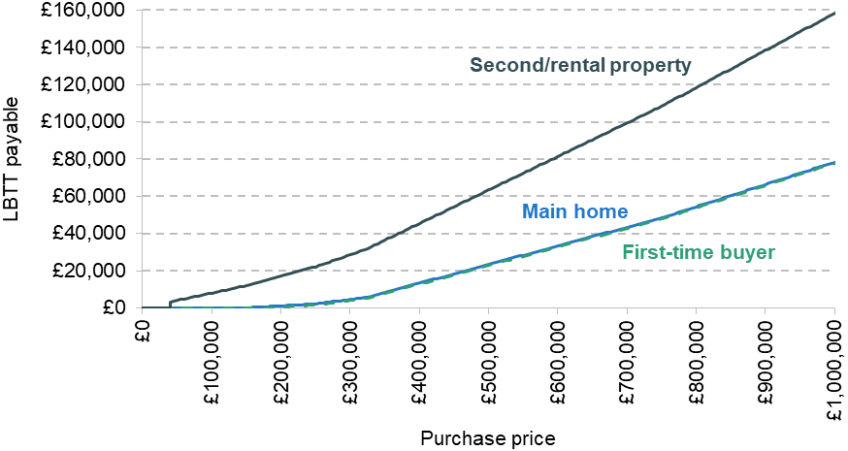
Increasing the ADS was justified as a way to promote owner-occupation, as well as a way to raise revenue. Penalising the rental sector does indeed make it cheaper and easier for people to move into owner-occupation. But it also makes it even more difficult and expensive for those who remain in the rental sector – tenants (who are likely to face higher rents as a result of the policy) as well as landlords.
Landlords must already pay income tax on their rental income and capital gains tax on any increase in the property’s value, neither of which applies to owner-occupiers. The case for tilting the playing field even further towards owner-occupation and away from rental is doubtful. But in any case, an LBTT supplement is a bad way to do it. The ADS does not just penalise the rental sector; it penalises transactions within the rental sector. Preventing a landlord who wants to sell their property to another landlord from doing so is bad for both landlords and tenants.
This is even more pointed as the Scottish Government has now introduced a new power for councils to ask ministers to designate areas for rent controls. The combination of rent controls and high LBTT could lead to significant shrinkage of the rental market in some areas as landlords exit the market, and while some tenants would benefit from existing rents being held down and from owner-occupation being made more affordable, others would lose as a result of fewer properties being available and only at higher rents.
Apart from the ADS, LBTT has been essentially unchanged in this parliament. Such stability is generally something to welcome in tax policy. But this is a tax that needs to change. As recommended by, among others, the Mirrlees Review of the tax system (Mirrlees et al., 2011) and more recently Future Economy Scotland (Macfarlane et al., 2026), the Scottish Government and its counterparts elsewhere in the UK should reduce – or preferably abolish – the tax on property transactions, and make up the revenue by raising more from a reformed council tax and business rates. This would be fairer and more efficient. Making up the revenue through other property taxes would prevent the tax cut bidding up overall property prices and therefore being a giveaway to existing property owners. Another consequence would be to decentralise more of Scotland’s revenue-raising to local councils.
Comparison with the rest of the UK
As with other taxes, Scotland’s tax on housing transactions is more progressive than that in England and Northern Ireland.22 Purchases above £333,000 – about 18% of purchases in Scotland – are taxed much more heavily in Scotland than in England or Northern Ireland (see Figure 8), while purchases below that level are taxed slightly less – unless they are first-time purchases (since Scotland’s discount for first-time buyers is less generous than that in England and Northern Ireland) or second/rental properties (since Scotland’s supplementary tax on such purchases is higher).
Figure 8. Tax on residential property transactions, 2025–26
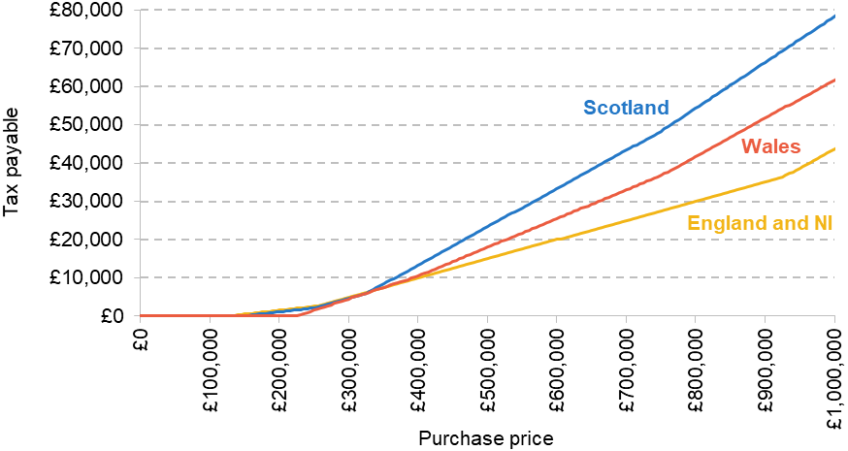
Note: Rates shown apply where the buyer is not a first-time buyer and does not have another residential property.
In 2024–25 (the latest data available), the average tax bill across all housing transactions in Scotland (purchases of main and additional properties by first-time and other buyers at all prices) was £6,467.23 This is considerably lower than the £9,889 for England and Northern Ireland, where average property prices are much higher; but it is somewhat higher than the £5,049 seen in Wales.24 This is despite Wales having slightly higher average property prices, and is because of the higher taxes applied to most transactions in Scotland (and especially the highest-value transactions and second/rental properties). The average tax bill was a higher percentage of average sale price in Scotland (2.8%) than in either England and Northern Ireland (2.7%) or Wales (2.2%).25
6. New taxes and further tax devolution
The current parliament has seen no further tax devolution to the Scottish Government, with the exception of powers over taxes on the extraction and import of ‘aggregate’ (stone, gravel and sand): Scottish aggregates tax will replace the UK aggregates levy from 1 April 2026. It will have the same design and rates as the UK tax it replaces. The Scottish Parliament is also, at the time of writing, in the final stages of legislating for a building safety levy – a national tax on the construction or conversion of residential property, aimed at raising revenue to fund cladding remediation work. The tax is planned to commence from April 2028.
In addition, the Scottish Parliament has passed legislation to allow councils to set and retain ‘visitor levies’ on stays in overnight visitor accommodation, discussed in Box 1. The Scottish Government has also consulted on giving councils the power to set and retain a ‘cruise ship levy’ based on either ship size or passenger numbers (Scottish Government, 2025e). More generally, the Scottish Government has wide discretion over the range and design of local taxes to be collected by councils – which could, in principle, be used to create more substantial new taxes (such as local wealth taxes or local sales taxes). It can prescribe the rates that can be charged by councils – as the Welsh Government has done for its visitor levy – although if it was compulsory for the council to charge the tax, the UK government may decide that such a tax encroaches on reserved tax powers.26
Box 1. Scotland’s visitor levy
In 2024, the Scottish Parliament gave powers to local councils to introduce a visitor levy (sometimes called a ‘tourism tax’, though it applies to business trips etc. as well) on overnight stays in hotels, B&Bs, self-catering accommodation, campsites and so on. If, following consultation, a council decides to impose a visitor levy, it sets the tax rate as a percentage of the price of the accommodation (excluding any separate charges for additional services such as meals). Edinburgh is the first council to introduce a visitor levy: from 24 July 2026, it will charge 5% tax on the price of the first five nights of any stay. Four councils (Glasgow, Aberdeen, Stirling and West Dunbartonshire) have confirmed that they will introduce levies in 2027, at rates ranging from 3% to 7%, while three others (Highland, Argyll & Bute and Dumfries & Galloway) have completed consultations and several more are conducting early engagement on the possibility (see VisitScotland (2026) for details).
The visitor levy gives councils an additional revenue-raising option. But that on its own is not a good reason to levy a tax specifically on overnight visitors rather than on anything else.
One argument for a visitor levy is that the tax reflects costs (‘negative externalities’) that visitors impose on an area – whether that is the cost to councils of providing additional services or costs imposed directly on local residents such as via litter and congestion. A subtly different argument is that visitors should make a contribution towards the local service provision they enjoy (a ‘benefit tax’), regardless of whether the cost of service provision is higher as a result of their presence. A visitor levy can also give councils a more direct financial stake in attracting visitors to the area.
Of course, there are counterarguments too. Visitors can bring benefits to an area, not just costs. Taxing overnight stays discourages spending on tourism and business travel relative to spending on other things which may be no more valuable – and discouraging economic activity comes at a cost in revenue from other taxes (such as VAT and income tax) which would be felt by the UK and Scottish governments, not the council making the decision. The administrative and compliance costs of the tax may be significant relative to the modest revenue it could raise. And the policy allows councils to tax people who do not have a vote in the area – potentially politically attractive precisely because it is a form of taxation without representation. The tax burden would not necessarily fall entirely on visitors, however: those who run and work in the visitor economy – many of whom will be local residents – would also be affected, and might lobby and vote accordingly.
There is some logic to this being a local tax, as voters/policymakers in different places may take different views as to the costs and benefits of visitors to the area and whether they want to encourage or discourage visitors – though local variation adds to the complexity of the tax. But there is also a case for capping the tax rate that councils can set, to limit the extent to which they can raise revenue at the expense of non-residents and the UK and Scottish governments.
Legislation is currently passing through the Scottish Parliament which, if passed, will make the levy more flexible, allowing councils to charge a flat cash amount per person per night (rather than a percentage of the bill) and to vary it by (among other things) time of year, location and type of accommodation.
This is welcome. The core reasons given above for taxing visitors – the costs they impose and the public services they benefit from – are not obviously bigger for more expensive accommodation, so charging a flat charge per person per night makes more sense than charging a percentage of the accommodation cost. The most common argument for a proportional tax – that it is more progressive – is weak. It is the progressivity of the tax and benefit system as a whole that matters: not every tax needs to be progressive, and there are much-better-targeted tools available (such as income-related taxes and benefits) if the Scottish Government wants to make policy more progressive, rather than taxing well-off travellers more than well-off non-travellers. A flat charge also avoids some complications such as the need to separate out the cost of the accommodation from the cost of any other services that might be bundled in with it.
More broadly, if the rationale for making the tax local is to allow local policymakers to judge the pros and cons of a tax in their area, it makes sense to give them as much flexibility as possible to fine-tune the tax to local circumstances and preferences – though again that comes at a cost of greater complexity.
Other taxes to be devolved under Scotland Act 2016
In addition to those taxes currently devolved (income tax, land and buildings transaction tax, Scottish landfill tax) or about to be devolved (Scottish aggregates tax), the Scotland Act (2016) makes provision for the devolution of air passenger duty (APD) and the assignment of half of the revenues from VAT in Scotland.
Devolution of APD, initially planned for 2018, has been subject to long delays due to state aid issues related to exemptions for flights to/from the Scottish Highlands and Islands (even though such exemptions already exist under APD). The current Scottish Government now plans to commence the operation of its replacement devolved tax, air departure tax (ADT), from April 2027 and, as of the time of writing, is consulting on the design of the tax (Scottish Government, 2026b). In its first year of operation, the Scottish Government proposes to match UK APD rates (except for some changes to the scope of the Highlands and Islands exemption). The consultation does open the door to bigger changes in subsequent years, including increases in rates on private jets (the revenue and environmental effects of which are likely to be modest relative to the overall aviation sector).
Assignment of VAT revenues would not allow the Scottish Government to change VAT policy but would mean it would gain (or lose) when VAT revenues grow faster (or slower) than in the rest of the UK. Thus, it would strengthen financial incentives for the Scottish Government to boost the economy but also bring additional revenue risks. The key blockage to progressing VAT assignment is data: because large businesses have operations that span across the UK and are not required to separately report sales (or costs) for Scotland and the rest of the UK, there are no data on actual VAT revenues collected in Scotland. Moreover, survey data on household expenditures, which could help estimate VAT revenues, are subject to small sample sizes and declining quality. While, officially, work to overcome these issues continues (Scottish Government, 2025f), data challenges and the associated revenue risks and volatility they bring mean that it is unlikely that assignment is currently feasible. Improvements in data would be possible but would entail additional data collection costs – for government and potentially businesses.
Potential further taxation
It is possible that the next Scottish Government and UK government will agree plans to devolve more taxes to Scotland. The current Scottish Government has stated that its view is that, as far as possible, all taxes should be devolved to Scotland.27
In assessing the options for further tax devolution, it is first worth noting the general pros and cons of tax devolution. The possible advantages include:
- tailoring tax policy to preferences and circumstances in Scotland, which may differ from those elsewhere in the UK;
- the ability to integrate the newly devolved taxes better with tax and other policies that are already devolved;
- stronger financial incentives for the Scottish Government to boost the economy as a result of the additional revenue retained.
The potential drawbacks include:
- higher administration and compliance costs when tax rates and rules differ in different parts of the UK;
- the potential for taxpayers to respond to differences in tax policy by shifting the actual or reported location of their taxable activities, in turn incentivising tax competition between different parts of the UK;
- greater risk to Scottish Government finances as a result of greater exposure to relative rises and falls in economic performance when more of the Scottish Government’s funding depends on devolved tax revenues.
The balance between these pros and cons depends both on the specific taxes in question and on the powers already devolved to the Scottish Government. A full assessment of the options is beyond the scope of this report. But we provide brief assessments of the following options: remaining powers over income tax; National Insurance contributions (NICs); VAT and excise duties; and corporation tax.
- The case to devolve the powers to set income tax rates and bands for savings and dividends income is perhaps strongest. Doing so would allow a future Scottish Government to apply its tax bands and rates to all taxable income. This would avoid a key unfairness inherent in the current system, with those whose income is in the form of dividends paying lower (UK) tax rates than other residents of Scotland. In turn, this would help close off one way individuals can respond to the Scottish Government’s higher income tax rates – setting up a company and receiving their income in the form of dividends rather than earnings. On the other hand, the ability of company owners to retain income within their companies – potentially for years – rather than pay it out immediately as dividends would expose the Scottish Government to another potential avenue for tax avoidance that it does not currently face (the employees and self-employed individuals currently subject to Scottish income taxes cannot shift income over time in this way).
- Devolving power over National Insurance contributions would allow future Scottish Governments to, for example, align the NICs upper earnings limit with the Scottish income tax higher-rate threshold. This would simplify the overall tax rate schedule and reduce the combined income tax and employee NICs rate of 50% that currently applies on earnings between £43,663 and £50,270 (for someone whose taxable income comes entirely from stable employment income) to 44%, the rate that currently applies above £50,270. But reducing the NICs upper earnings limit in this way would mean forgoing the equivalent of between a quarter and a third of the revenue that the Scottish Government currently receives from its lower higher-rate income tax threshold. And a similar outcome – although one that might require careful explanation to taxpayers – could already be achieved using the Scottish Government’s existing income tax powers, by setting a 36% income tax rate between the Scottish and UK higher-rate thresholds. This would leave a combined income tax and employee NICs rate of 44% in this range – the same as above the NICs upper earnings limit.
- Depending on the scope of powers devolved on the rates and base of income tax, NICs and capital gains tax, future Scottish Governments might be able to make more fundamental changes to how different forms of income are taxed. For example, it might be possible to equalise overall tax rates across different forms of income (employment income, self-employment income, dividends, capital gains) while also reducing disincentives to save and invest. This would result in both a more efficient tax system – with less distortion to taxpayer behaviour – and a fairer tax system – by removing many of the arbitrary (and large) differences in tax rates faced by people receiving their income in different forms. However, such reforms would create many losers as well as winners, and this may discourage future Scottish Governments from pursuing reform (as it has perhaps discouraged the UK government). The current Scottish Government has so far chosen not to pursue radical reform in the name of efficiency and fairness in the sphere of property taxation, where it already has the powers to improve the system significantly.
- Devolving VAT to the Scottish Government would require major changes to the operation of the tax, raising administration and compliance costs. VAT is therefore less suitable for devolution than the aforementioned taxes, although if Scottish preferences over VAT rates and policies differ significantly from preferences in the rest of the UK, devolution could still be considered. Part of the challenge in devolving VAT would be due to the difficulty of apportioning value added between different activities conducted by a single business (such as its warehouses, shops, headquarters, websites and support operations) that has operations in both Scotland and the rest of the UK. But the challenge would also reflect the way VAT works: it is charged on sales, but businesses can deduct the VAT they have paid on their inputs. Devolved VAT could therefore mean businesses’ not only having to charge different VAT rates in Scotland and the rest of the UK, but also having to record where their input purchases came from, as different amounts of input VAT would be deductible based on this. Alternatively, borders between Scotland and the rest of the UK could be treated like international borders for the purpose of VAT: businesses ‘exporting’ to/from Scotland would charge a 0% rate on their ‘exports’ to other businesses. This would avoid the need for businesses elsewhere in the UK to keep track of Scottish rates of VAT (anything ‘imported’ from Scotland would be zero-rated), and vice versa. But businesses would have to keep track of whether their customers were VAT-registered businesses and, if so, where they were based, in order to work out whether VAT should be charged or zero-rating applied in the first place, which would also entail costs and potentially be more open to fraud.
- Devolving excise taxes (such as for alcohol, tobacco or fuel) would, in principle, be more straightforward than devolving VAT (as these taxes are not subject to the same output taxation and input tax deduction mechanism). Devolved taxes on alcohol and tobacco could be aligned with the Scottish Government’s approach to public health – with, for instance, higher alcohol duty for off-licence (as opposed to pub and other hospitality venue) sales being used in place of the minimum unit price. But devolution would still increase administration and compliance costs given excise duties are currently collected at production and import stage, rather than at the retail stage. Substantial difference in excise duty rates could also lead to distortions to the location of sales – via cross-border shopping – although minimum unit pricing means that is already likely happening to some extent in the case of alcohol.
- Devolving corporation tax to Scotland would, as with VAT, entail significant additional compliance and administration costs, with businesses having to allocate profits between Scotland and the rest of the UK, and tax authorities having to assess the validity of these allocations (especially if tax rates varied between Scotland and the rest of the UK).28 Profits could be allocated between Scotland and the rest of the UK either on the basis of detailed accounts of revenues and costs in each jurisdiction, or on the basis of a simplified formula based on, for example, the location of fixed assets, employment and/or sales. The former (separate accounting) approach would be most prone to profit-shifting, whereas the latter (formula apportionment) approach would be most prone to distorting the location of real economic activity, if rates differed between Scotland and the rest of the UK.
More detailed assessments of these options can be found in the Fiscal Commission NI’s (2022) final report – which, while written from the perspective of Northern Ireland, includes a discussion of the pros and cons of devolving each tax from a first-principles basis.29
7. Benefits policy boosts (some) poorer households’ incomes
The UK government remains responsible for most benefit expenditure and policy, including the state pension, universal credit, pension credit, housing benefit, child benefit and a few other smaller benefits.30 However, as discussed in Section 1, the Scottish Parliament and Government have responsibility for a range of benefits, including disability benefits, carers’ benefits, and occasional payments, including winter heating payments. They also have the power to top up reserved benefits and create new benefits – which, among other things, has been used to create the Scottish child payment and to mitigate the so-called ‘bedroom tax’ and the ‘benefit cap’.
Devolved benefits account for 22% of all social security benefit expenditure in Scotland, with disability benefits making up the large majority of this (Scottish Government, 2025b). The Scottish Government receives funding via block grant adjustments (BGAs) for each benefit that has been devolved by the UK government to Scotland. The size of these BGAs rises or falls in line with the percentage change in spending on the equivalent benefits in England and Wales (adjusted for Scotland’s slower population growth rate). If devolved benefit spending is higher than these BGAs (whether due to underlying changes in caseloads or increases in the generosity of devolved benefits), the Scottish Government must cover the cost from its other funding – either raising taxes or cutting other spending. This is the case in practice (Brogaard and Phillips, 2026). Conversely, if devolved benefit spending were lower than the BGAs, the Scottish Government is able to use the remaining funding from the BGAs to cut taxes or increase spending elsewhere.
As discussed in Section 1, disability benefits make up the bulk of devolved benefit spending; these are discussed in more detail in the next section of the report. In this section, we focus on Scotland’s other devolved benefits, most of which are means-tested and targeted particularly at low-income households. We consider both the changes made over the current parliament and the differences with respect to the benefit system in the rest of Great Britain – including impacts on household incomes and work incentives. We do not generally cover in-kind benefits, such as free prescriptions, or the provision of public services, such as education. We also do not cover locally administered or discretionary benefits,31 including council tax reductions, school uniform grants and grants from the Scottish Welfare Fund, either due to modelling limitations or because these are allocated on the basis of local discretion.
Changes to means-tested benefits during the 2021–26 parliament
The most significant change to Scotland’s means-tested benefits during the 2021–26 Scottish parliament has been an expansion of the Scottish child payment, increasing both its value and the number of families eligible for it.
Scottish child payment
The Scottish child payment is a top-up benefit received by all families on universal credit with children. In 2021, this was worth £10 per week (£12.80 in current prices) and could only be claimed for children aged 5 and under. In November 2022, it was extended to children aged 15 and under, and the rate increased by 150% to £25. Subsequent inflation-indexation means it will be £28.20 per week from this April. A family on universal credit with two children aged 6–15 will, for example, receive £2,940 more per year in Scottish child payment than they would have at the start of this parliament as a result of the expansion in eligibility and increase in rates seen over the parliament. A family with two children under 5 will receive £1,610 more as a result of the above-inflation increase in Scottish child payment rates (they would already have been eligible under the rules in place at the start of the parliament).
The Scottish child payment is the main plank of the Scottish Government’s strategy to bring down child poverty. It is now estimated to be reducing the relative child poverty rate (based on income after deducting housing costs) by 4 percentage points, meaning 40,000 fewer children in poverty (Scottish Government, 2025g). Research has found that the Scottish child payment has reduced rates of child material deprivation (the proportion of children in households unable to afford a number of essential items) and food insecurity by 8–9 percentage points (Andersen et al., 2025). This suggests a considerable effect on these outcomes, though survey volatility and representativeness issues since the pandemic mean there is considerable uncertainty around the precise magnitude. The Scottish Parliament has set a target to reduce child poverty to 10% or less by 2030–31, compared with 23% as of the latest estimates. We shall look in more detail at poverty (and incomes more generally) in Scotland in our fourth Scottish election briefing, to be published shortly.
The current Scottish Government plans to increase the payment to £40 per week for babies aged under 1 from 2027–28 – this is not reflected in the distributional analysis later in this section, which only looks at reforms up to April 2026. Previously, the Scottish Government had also planned to implement a mitigation to the two-child limit in universal credit from this March, with additional payments for families with three or more children which were affected by the universal credit limit. Following the announcement that the two-child limit will be abolished across the UK from April 2026, the Scottish Government will no longer introduce this mitigation payment (as there is no policy to mitigate). It pledged to redirect the money saved to other measures reducing child poverty – although, as the Fraser of Allander Institute (2026) has highlighted, the Scottish Government has been far from transparent about which spending it is counting towards this pledge. If, for example, it is counting increased funding for further education colleges, while this may improve services and outcomes for Scottish young people, it will not directly reduce child income poverty to anywhere near the same extent as cash payments would.
Other means-tested benefits
Other changes to means-tested benefits during the current Scottish parliamentary term include small real-terms increases to the Scottish carer supplement (an additional payment for carers) and Best Start grants (grants for low-income households with young children), as well as the mitigation of the UK government’s benefit cap. Further information on these policies can be found in Box 2 later. The only straightforward reduction in benefit generosity is the means-testing of Scotland’s pension age winter heating payment (PAWHP), which mirrors the approach taken by the UK government in means-testing the winter fuel payment (WFP) that PAWHP has replaced. Unlike the WFP, the PAWHP amount is being uprated in line with inflation.
Distributional analysis
Figure 9 shows the effects of the aforementioned changes to Scotland’s devolved benefits during the current parliamentary term on average benefit entitlements for each decile group (tenth) of the household income distribution in Scotland. Impacts are expressed in both cash terms (the green bars) and as a share of household net income (the purple lines). The top panel of the figure shows effects across all Scottish households, and the subsequent panels show effects for households with and without children.
Figure 9. Effect of Scottish benefit reforms in the 2021–26 parliament on household disposable income, by household income decile
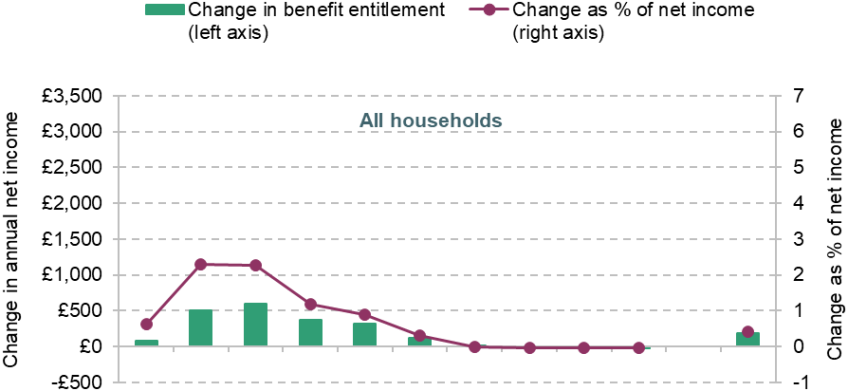


Note: Households are allocated to deciles of the 2026 Scottish income distribution based on household income adjusted for household size and composition using the modified OECD equivalence scale.
Source: Authors’ calculations using the IFS tax and benefit microsimulation model, TAXBEN, run on uprated data from the 2022–23 and 2023–24 editions of the Family Resources Survey.
These figures have been estimated based on data from the Family Resources Survey (FRS). We calculate, for each household in the survey, the change in its tax liabilities and benefit entitlements due to policy. It is important to note that survey-based estimates are always associated with uncertainty due to variation in who is sampled, and the risk that the survey is not perfectly representative. Falls in response rates mean there is heightened concern over the reliability of survey-based estimates since the pandemic, including for the FRS (e.g. Ray-Chaudhuri and Wernham, 2025).
Figure 9 shows that, due to reforms over this parliament:
- Average benefit entitlements have increased by £190 per year in real terms, equivalent to 0.4% of net household income.
- Poorer households generally gain more, with households in the second decile of the income distribution seeing entitlements to benefits rise by £500 per year as a result of benefit changes, equivalent to 2.3% of their net income.
- Gains are concentrated among households with children, reflecting the fact that it is changes to the Scottish child payment that are the largest real-terms changes in means-tested benefit spending in the current parliament. For example, households with children in the second income decile group are estimated to benefit to the tune of £2,050 a year, equivalent to 6.7% of their net income. The average gain among all households with children is £850 a year.
- Gains are smaller for the lowest income decile group than among other low- and middle- income groups. This partly reflects the fact there are relatively few families with children, and in particular with multiple children, among the lowest-income tenth of households, even after adjusting for household size. In turn, this is because the combination of UK and Scottish benefit policy – such as higher universal credit rates, child benefit and the Scottish child payment – boost their incomes if they take up the benefits to which they are entitled.32 It also reflects the fact that some households with the very lowest incomes in any one period are only temporarily poor, and have savings which make them ineligible for universal credit (and hence the Scottish child payment). Other measurement issues may be playing a minor role.
- Households without children on average see small reductions in their benefit entitlements due to the introduction of means-testing for the pension age winter heating payment.
- Cold weather payments (CWP), which in the rest of the UK provide lower-income households with payments in periods of continuous cold weather, have been replaced by the working-age winter heating payment (WAWHP). For technical reasons, this change is not incorporated in Figure 9. The WAWHP provides £62 to low-income working-age households each winter regardless of the weather. WAWHP is set to be more generous on average than CWP, costing an estimated £24 million more than CWP would have in 2026–27 (Scottish Fiscal Commission, 2026a), but no longer insures households against long spells of very cold weather.
Comparisons with England and Wales
Changes during the current Scottish parliamentary term build on changes in the last parliament. Changes in the 2016–21 parliamentary term included the initial introduction of the Scottish child payment, the mitigation of the ‘bedroom tax’ (or ‘under-occupancy charge’) for social renters, and top-ups to carers’ benefits.
Box 2 summarises the main differences between the Scottish and English-and-Welsh benefits system, resulting from changes made by the Scottish Government in both the current and 2016–21 parliaments.
Box 2. Differences between the Scottish benefit system and the benefit system in the rest of Great Britain (all cash values as of April 2026)
In total, the higher generosity of Scotland’s benefits is set to cost £1.1 billion in 2026–27 (Scottish Fiscal Commission, 2026a). This is the total spending on devolved benefits, less the block grant adjustments which reflect spending on comparable benefits in the rest of Great Britain, where applicable.
Scottish benefits to replace benefits available in the rest of Great Britain
- Best Start grants. These replace Sure Start maternity grants available in England and Wales and are more generous and available to more families. They are a set of three grants paid to parents of children, during pregnancy or before age 3, between ages 2 and 3½, and when the child is old enough to start school.
- Best Start foods. This replaces Healthy Start in the UK and helps households on certain means-tested benefits buy healthy foods such as milk or fruit during pregnancy and when their child is under 3.
- Carer support payment. This replaces the UK carer’s allowance, and has the same cash value, but is available to slightly more people (some carers in full-time education).
- Adult disability payment, child disability payment and pension age disability payment. These replace the UK’s personal independence payment (PIP) and disability living allowance (DLA) benefits, and attendance allowance, with the same respective cash values but different assessment processes. These are discussed in more detail in Section 8.
- Pension age winter heating payments. Replacing winter fuel payments, rates are set by the Scottish Government and, from this winter, have started to diverge from those in England and Wales due to inflation uprating.
- Winter heating payments. These replace cold weather payments, which are available in England and Wales for low-income households in periods of continuous cold weather. These replacement payments are paid each winter, irrespective of local weather, reducing their ability to insure households against particularly long spells of cold weather, though they are more generous on average.
Scottish benefit policies to top up claimants’ incomes on top of the existing benefit system
- Scottish child payment. This is a payment made to households with children receiving universal credit or pension credit, worth £28.20 per week per child aged 15 or under.
- Scottish carer supplement. This is a weekly payment of £11.29 to carers in receipt of the carer support payment.
- Young carer grants. These provide an annual payment of £405.10 for carers aged between 16 and 19 inclusive if they care for someone for at least 16 hours a week.
- Mitigation of the under-occupancy charge (known as the ‘bedroom tax’). Operating through discretionary housing payments, this offsets, for those in receipt of universal credit, the policy in the rest of Great Britain to cap the housing support available through the benefit system for social tenants deemed to have spare bedrooms.
- Mitigation of the benefit cap. Also operating through discretionary housing payments, this offsets the impact of the benefit cap, the policy in the rest of Great Britain capping the total benefits households out of work can receive (unless they are subject to many exemptions, mostly related to disability). The benefit cap affects a small but particularly poor subset of households, but this number will grow from April 2026 after the two-child limit on universal credit is lifted.
The combined impact of the most important Scottish benefit reforms, including the Scottish child payment, Best Start grants, mitigation of the under-occupancy charge and benefit cap, and the Scottish carer supplement, is shown in Figure 10. The same caveats and notes of caution apply here that are discussed before the distributional analysis earlier in this section.
Figure 10. Effect of devolved benefit reforms on household disposable income, by household income decile, compared with the system in the rest of Great Britain
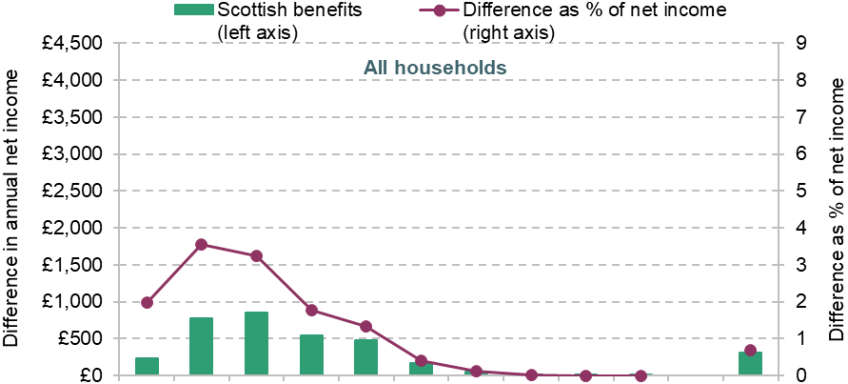


Note: Households are allocated to deciles of the 2026 Scottish income distribution based on household income adjusted for household size and composition using the modified OECD equivalence scale.
Source: Authors’ calculations using the IFS tax and benefit microsimulation model, TAXBEN, run on uprated data from the 2022–23 and 2023–24 editions of the Family Resources Survey.
On average, compared with the English-and-Welsh system, the Scottish system increases household benefit entitlements, but these increases are highly targeted towards lower-income households and households with children.
- On average, household benefit entitlements are £310 per year higher under the Scottish benefit system than under the UK government system in place in England and Wales. This is equivalent to 0.7% of net income, on average.
- As with reforms during the current parliament (shown in Figure 9), gains relative to the UK government system are largest for households in the lower decile groups: £770 per year in the second decile (3.6% of net income) and £850 per year in the third decile (3.2% of net income). In contrast, households in the top four income decile groups are largely unaffected by Scotland’s means-tested benefits.
- Gains are largest for households with children, and especially low-income families with children. Average benefit entitlement for households with children in the second income decile group are £2,750 a year (8.9% of net income) higher under the Scottish benefit system than under the UK government system in place in England and Wales. The gain across all households with children is £1,100 per year on average. Gains are lower in the first decile for the same reasons outlined above for Figure 9.
- Scottish Government modelling suggests the combined impact of Scottish Government policy is to reduce the number of children in relative poverty by 70,000 in 2025–26 (Scottish Government, 2025g).
- Households without children benefit less from Scotland’s more generous means-tested social security benefit system – although several changes, such as the carer supplement and mitigation of the ‘bedroom tax’, are targeted at (some) low-income households without children, as well as (some) with children.
Cliff edges in Scottish benefits
Benefits that increase the income of low-income families, while reducing poverty, also affect the work incentives of families. This is due to both a so-called income effect (the higher benefit income received for any given amount of earned income reduces work incentives) and the so-called substitution effect (the withdrawal of benefits as earnings rise also reduces work incentives). Empirical evidence from historical UK-wide benefit expansions shows workers do respond to these changes in incentives (e.g. Brewer et al. (2006) and Blundell et al. (2016), who studied expansions to tax credits). This trade-off between redistribution and work incentives is a key consideration for any tax and benefit system – with the appropriate policy design reflecting both governmental (or societal) preferences and how responsive individuals and families are to work incentives.
A particular feature of the way several of the key means-tested benefits are withdrawn – including the Scottish child payment, Best Start grants, and child and working age winter heating payments – is that entitlement is all-or-nothing, based on whether people are getting existing UK benefits. This was already a common feature of many benefit add-ons, including in the rest of the UK, such as free school meals. Compared with introducing a separate means test, it makes them simpler for claimants to understand and claim, and simpler for the Scottish Government to administer. But a consequence is that such ‘passported’ benefits are not withdrawn gradually as income rises, like standard means-tested benefits such as universal credit. Instead, they are withdrawn suddenly – a ‘cliff edge’ – at the income level at which entitlement to UK benefits runs out (which varies according to family circumstances). For example, a family with income just below the point at which they lose eligibility for universal credit would be eligible for the full Scottish child payment. A family with income just above the taper for universal credit would be eligible for nothing. A small increase in income (perhaps just £1 a month) could see a family lose the Scottish child payment in its entirety.
This clearly significantly weakens the financial incentives for some families to increase their earnings or hours by a small amount. Figure 11 illustrates how these cliff edges arising from the withdrawal of the Scottish child payment affect the net income of lone-parent families with different numbers of children. It shows, for example, that the withdrawal of the Scottish child payment for a lone parent with two children would kick in when monthly earnings equal £3,217, meaning they would be worse off until they earned at least £346 more. For instance, if they earned £18.50 an hour, they would be worse off by working anything up to an extra four hours per week. The increase in gross earnings needed to offset the loss of Scottish child payment would be smaller for a lone parent with one child (£173) and larger for a lone parent with three children (£662).
Figure 11. Total monthly income (including net earnings, universal credit, child benefit and Scottish child payment), by gross monthly earnings, for lone parents in Scotland

Note: Assumes lone parent is an owner-occupier. Does not account for council tax, or other benefits.
Nesom, Stewart and Tominey (2025) show that the proportion of families with incomes near the cliff edge, and therefore actually facing the prospect of becoming worse off when their incomes rise (or vice versa) is likely to be small at any one time. However, they show that second earners are more likely to face this scenario. Evidence on whether this ‘cliff edge’ policy design actually has caused families to reduce their working hours remains limited. Nesom et al. cannot find statistically significant evidence of such an effect, but given their reliance on survey data and consequent large uncertainty associated with their estimates, this does not mean we can rule it out. The Scottish Government has also assessed whether there is any evidence of claimants reducing (or failing to increase) their earnings in order to be eligible for Scottish child payment, by comparing the prevalence of small universal credit awards in Scotland with the prevalence in England and Wales (Scottish Government, 2024c). It rules out any very large effect. But the measures it examines are volatile, and only a relatively small proportion of households are likely to have earnings near the cliff edge at any one time. So responses to disincentives among these households would not be obvious when looking at aggregate statistics. We therefore also cannot rule out such responses based on this study. Importantly, there is no evidence to ‘rule in’ such responses either.
If it turns out that families have not responded to the cliff edges by altering their hours or earnings, possible reasons include: a lack of knowledge (due to the complex calculations needed to work out the end of the universal credit taper); an inability to respond to the incentives (perhaps due to rigidities in wages and hours of work); and/or non-take-up of both universal credit and the Scottish child payment by those most likely to be affected by the cliff edge.
Beyond efficiency concerns, cliff edges are also clearly not equitable, with families with very similar needs and levels of earnings either side of the end of the universal credit taper receiving very different levels of financial support through the Scottish benefit system and, in turn, having very different net incomes. As the generosity of passported Scottish benefits – most significantly, the Scottish child payment – has increased, so too have the potential incentive effects and the definite horizontal inequities.
A better method of means-testing the Scottish child payment, in particular, would be to taper it away gradually as income increases, potentially combining it with universal credit. Operating a separate tapered means test would entail additional costs and complexity for both the Scottish Government and benefit claimants – but would be particularly worth considering if the Scottish child payment is further increased. Integrating the tapering of the Scottish child payment with the tapering of universal credit, which is administered by the UK Department for Work and Pensions, would be less costly and complex. But it would require cooperation between the Scottish and UK governments, to prioritise equity and efficiency.
8. Disability benefit reform has increased successful claims – and spending
As discussed at the start of this report and briefly in the preceding section, Scotland now operates its own system of disability benefits. In particular, it has made the following replacements:
- Child disability living allowance (DLA) was replaced by child disability payment (CDP) from 2021.
- Personal independence payment (PIP) was replaced by adult disability payment (ADP) from 2022.
- Attendance allowance (AA) was replaced by pension age disability payment (PADP) from 2025.
Whilst the rates for these benefits are the same as the equivalent benefits in the rest of the UK, there are some important differences. In particular, the application, assessment and reassessment processes differ. The aim is to make it easier and less stressful to claim and receive the benefits, whilst extending eligibility to some new groups. Changes such as the removal of routine face-to-face assessments were brought in to attempt to improve the reported ‘overwhelmingly negative’ experiences faced by claimants to PIP (Scottish Government, 2026c).
In what follows, we focus on ADP. Compared with the system for PIP:
- ADP applicants can apply through a variety of formats, including online and by post;
- ADP assessments rely less on private contractor reports;
- there are no routine face-to-face assessments for ADP applicants;
- those with terminal illnesses are eligible for ADP under the special terminal illness rules, even if it is likely that they have more than 12 months to live (Social Security Scotland, 2025a; UK government, 2025d). They also automatically receive the enhanced rate for the mobility as well as the daily living component.
Disability benefit expenditure has come into sharp focus across the UK in recent years, due to a sharp rise in the number of claimants, and consequent rapid real increase in spending. This has created concern that the introduction in Scotland of a system with a seemingly lighter application process would result in even greater increases in both cases and spending. To examine this, we now compare trends for working-age adult disability benefits in Scotland and in England and Wales with two figures. Figure 12 compares rates of applications for PIP in England and Wales, and PIP (until Summer 2022) and ADP (from Summer 2022) in Scotland. Figure 13 shows the rates of new awards (which follow successful prior applications) for England and Wales, as well as Scotland. Both application and new award rates are normalised to 100 for the average across the period from 2016 to 2019, prior to the large increase in applications and awards.
Figure 12. Applications to ADP versus PIP, 2016–19 period indexed to 100
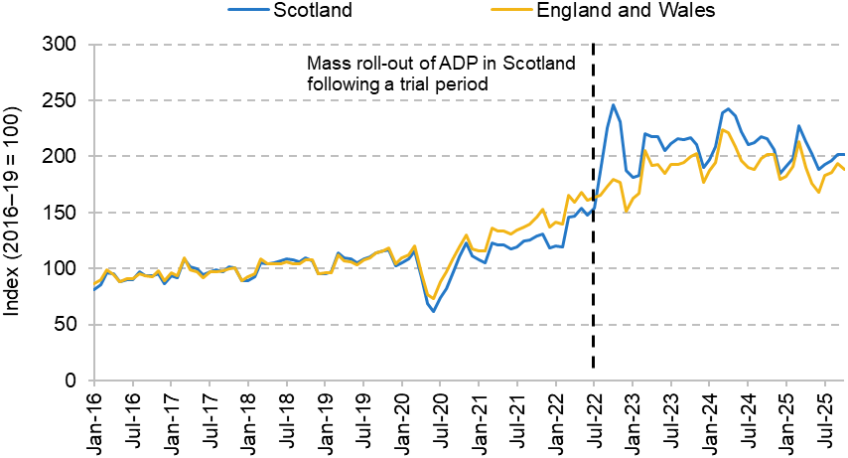
Note: Data up to October 2025. DLA reassessments not included.
Source: Authors’ calculations using DWP’s Stat-Xplore and Social Security Scotland (2025b).
Figure 13. Awards of ADP versus PIP (not including appeals), 2016–19 period indexed to 100

Note: Data up to October 2025. Only includes initial awards, so underestimates the true number of awards. DLA reassessments not included.
Source: Authors’ calculations using DWP’s Stat-Xplore and Social Security Scotland (2025b).
The figures show that, prior to the introduction of ADP, both applications to and awards of disability benefits had grown a little more in England and Wales than in Scotland since 2019. The introduction of ADP in 2022 was followed by an initial spike in total monthly applications to disability benefits. This was in turn followed by a spike in the rate of new awards, reflecting both many of these new applications being successful and an initial increase in the acceptance rate relative to PIP (Scottish Fiscal Commission, 2026a).
Since the initial spike, the rate of new monthly applications has subsided, but remains slightly higher than before ADP’s introduction. Despite this, the rate of new awards has fallen and is now similar to, or if anything lower than, before ADP was introduced. This can be explained by a recent fall in ADP application success rates – from April 2023 to July 2025, rates fell from 55% to 34%. For comparison, the PIP success rates in England and Wales have been stable at around 45% (Scottish Fiscal Commission, 2026a). The reasons why this is the case are unclear – the official Social Security Scotland (2025b) statistical releases do not explore this issue, and indeed in their narrative analysis focus on success rates during the entire period of operation of ADP. Given the scale of decline, the range of possible reasons for it and the impacts on benefit applicants, this evidence gap should be addressed.
So far, the reforms to Scottish disability benefits have therefore not resulted in a sustained increase in inflows onto the system. However, most disability benefit recipients receive such benefits for an extended period, which means that the initial increase in caseload could still mean a lasting increase in expenditure, even if the flow of awards has returned to trend. Potentially compounding this, the Scottish Fiscal Commission (2026a) suggests that, as of July 2025, the proportion of ADP awards decreasing or ending at review is around 5%, and it expects it to stabilise around that level. This is lower than the rate for PIP in England and Wales (13%), though an increase on December 2024, when the first estimates are available. The Scottish Fiscal Commission is forecasting that expenditure on working-age adult and child disability benefits in Scotland is set to grow faster than in England and Wales through to 2029–30. This means the gap between spending and the block grant adjustment is forecast to grow from £156 million in 2026–27 to £187 million in 2029–30, though it is expected to fall back to £158 million in 2030–31, close to the same level as in 2026–27 (Scottish Fiscal Commission, 2026a).
These forecasts are of course subject to change, depending on population health, individuals’ decisions on whether to claim, and further changes in policy. A recent independent review (Scottish Government, 2025h) made various substantial recommendations that might increase costs further if accepted. These include automatic entitlement for certain conditions, a relaxation of eligibility criteria for the mobility component of awards, and various recommendations to improve staff training and increase take-up. The Scottish Government’s response has signalled a willingness to improve publicity and training, with particular emphasis on inclusive communication and reducing stigma. It is uncertain whether this will have a substantial impact on future caseloads. Other more costly recommendations are under review, but no commitments have been made to enact them as of now (Scottish Government, 2026c).
Turning to future policy uncertainties, the Scottish Government could also see funding reduced as a result of potential UK government reforms to disability benefits. Whilst the UK government abandoned short-lived plans to tighten PIP eligibility criteria last summer, options remain under review, and ministers have signalled they think action is still needed to stem the increase in claimant numbers and expenditure. If the UK government reduces spending on disability benefits, this would reduce the block grant adjustments provided to the Scottish Government for disability benefit. In this case, Scotland would then need to decide whether to maintain a more generous system of disability benefits with wider coverage and, if so, whether to fund this with higher taxes or cuts to spending elsewhere.
Another uncertainty is the planned scrapping of the work capability assessment for the universal credit health element (which is separate from PIP and ADP). The UK government plans to instead base eligibility for the health element on the PIP assessment. But given the Scottish Government has abolished PIP and replaced it with ADP, which has a different assessment process, this raises the question of whether claimants to both UC health and ADP will still have to undergo two assessments in Scotland, or whether the UK government will allow eligibility for the universal credit health element to be based on the results of ADP assessments.
9. What is the overall distributional effect of Scottish tax and benefit policy?
In this section, we examine the combined distributional impact of the Scottish Government’s income tax and benefit policies. We consider the overall distributional effect of both Scottish policy reforms during the current parliament, and how Scottish policy compares with UK government policy. The reforms considered here include changes to income tax rates and thresholds (except changes due to the personal allowance, which is reserved to Westminster), as well as the Scottish child payment, Best Start grants, mitigation of the under-occupancy charge and benefit cap, pension age winter heating payment, and the Scottish carer supplement.
The analysis here does not include other taxes discussed in this report, such as council tax (which is formally set by councils), or changes to business rates or land and buildings transaction tax (which we cannot easily attribute to households). Disability benefit changes are also not accounted for, though the increase in disability benefit receipt seen so far will have increased household incomes. We also do not include locally administered or discretionary benefits,33 such as council tax reductions, school uniform grants and grants from the Scottish Welfare Fund, either due to modelling limitations or because these are determined by local policy. Nor does the analysis account for broader changes in government expenditure, principally on public services.
In all cases, the caveats and notes of caution outlined for Figure 9 in Section 7 apply, including uncertainties around the reliability of survey data. That section also contains further details on the drivers of the distributional pattern of benefit changes, including why effects of benefit changes are larger in the second and third deciles than in the poorest decile.
Effect of reforms during the 2021–26 parliament
Figure 14 shows the impact of real-terms changes to Scottish tax and benefit policy over the current Scottish parliament term – that is, increases in income tax rates and real-terms changes in income tax bands, the expansion of the Scottish child payment, and the other benefit policy changes outlined in Section 7. The actual system in place in April 2026 is compared with a benchmark system in which devolved tax and benefit parameters had been uprated with inflation but otherwise unchanged since April 2021. The green bars show the impact of benefit reforms and the grey bars show the impact of tax reforms. The blue diamonds show the combined cash effect of tax and benefit reforms, while the purple circles express this as a percentage of income and are plotted against the right axis. The top panel of the figure shows effects across all Scottish households, and the subsequent panels show effects for households with and without children.
Figure 14. Distributional impact of personal tax and benefit reforms since the 2021 Scottish election


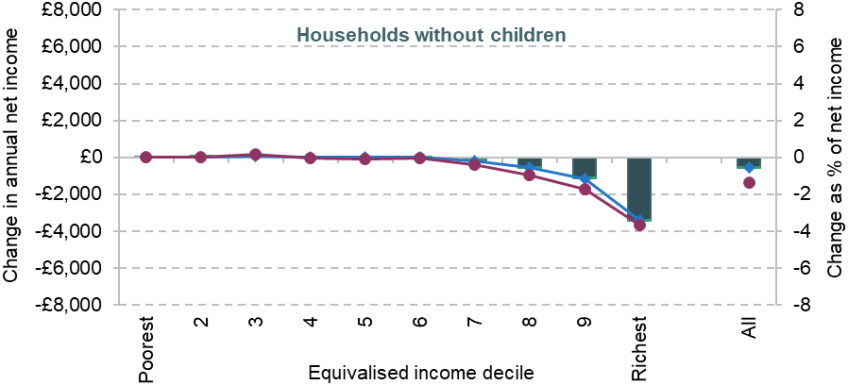
Note: Households are allocated to deciles of the 2026 Scottish income distribution based on household income adjusted for household size and composition using the modified OECD equivalence scale.
Source: Authors’ calculations using the IFS tax and benefit microsimulation model, TAXBEN, run on uprated data from the 2022–23 and 2023–24 editions of the Family Resources Survey.
Figure 14 shows that:
- On average, income tax and benefit policy changes increase tax bills by £700 per year, while they increase benefit entitlements by £190 per year. The combined effect is a reduction of £510, or 1.1% of net income.
- For families with children, tax bills rise by £1,240 per year on average, while benefit entitlements increase by £850. The combined effect is a reduction in income of £390, or 0.6% of net income. For households without children, tax liabilities rise by £540 a year on average, and benefit incomes fall by £8 (due to the means-testing of pension age winter heating payments).
- Benefit changes have increased the average entitlements of the lower-income half of households, who see little effect of tax rises. Entitlements in the second decile have increased £500 a year, or 2.3% of income, on average. These rises are larger among households with children. The lowest-income tenth see little change, as they are relatively unlikely to have children and are more likely to be temporarily poor and so have savings which make them ineligible for means-tested support (see the discussion around Figure 9).
- The highest-income 40% of households see little effect of benefit changes but an increase in tax liabilities. Scottish policy reforms reduced net incomes by over £4,000, or 3.9% of income, for the highest-income tenth of households. This is almost entirely down to increased income tax liabilities.
Overall effect of devolved policy
Figure 15 shows the impact of devolved Scottish income tax and benefit policies relative to the situation in which Scotland still had the same income tax and benefit system as implemented by the UK government in England and Wales. It shows a similar pattern, with Scottish Government policy aimed at raising net revenue (with higher income tax bills outweighing higher benefits, on average), but with a clear redistributive effect evident again.
Figure 15. Distributional impact of Scottish tax and benefit policy relative to the system in England and Wales
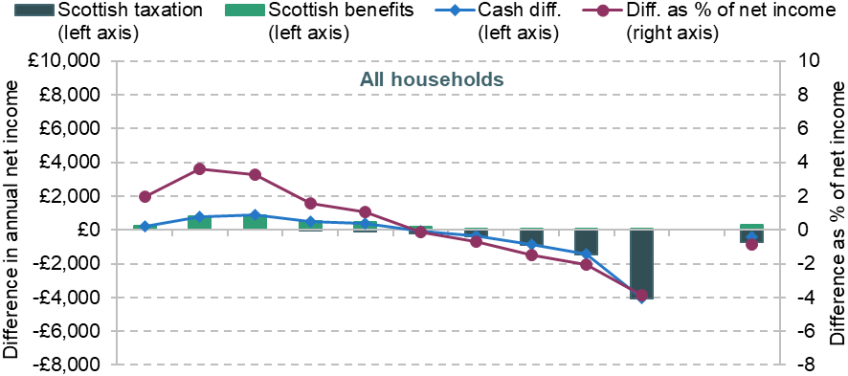


Note: Households are allocated to deciles of the 2026 Scottish income distribution based on household income adjusted for household size and composition using the modified OECD equivalence scale.
Source: Authors’ calculations using the IFS tax and benefit microsimulation model, TAXBEN, run on uprated data from the 2022–23 and 2023–24 editions of the Family Resources Survey.
- Scottish benefits increase household incomes by £310 per year on average relative to the system in the rest of Great Britain, while the Scottish income tax system increases income tax bills by £710 per year on average, relative to policy in the rest of the UK. The combined effect is a reduction in income of £400, or 0.9% of net income.
- The Scottish benefit system increases the entitlements of the lower-income half of households, who see little effect of tax rises. Compared with the system in England and Wales, Scottish tax and benefit policy increases incomes for the second decile by an average of £790 a year, or 3.6% of net income.
- The higher-income half of households see little effect of Scottish benefit policy, but an increase in average income tax liabilities under the Scottish income tax system. Income tax bills are more than £4,000 (3.8% of net income) higher on average for the richest tenth of households than they would be under the UK government’s income tax system.
Among households with children:
- On average, benefit entitlements are £1,100 higher than they would be under the English and Welsh system, while tax liabilities are £1,270 higher. Thus, the combined effect of differences in devolved benefits and income tax compared with the UK government system in place in England and Wales is to reduce the average income of households with children by a very small amount (0.3% of net income).
- However, there are clear differences across the income distribution, with lower-income households with children gaining significantly, and higher-income households losing. Net income for households with children in the second income decile group is around £2,760 per year higher (9.0% of net income), on average, as a result of differences between the Scottish income tax and benefit system and the UK government’s system in place in England and Wales. At the other end of the income scale, households with children in the highest income decile group see their net income reduced by an average of around £7,000 per year (4.6%) as a result of the higher income taxes levied in Scotland.
Among households without children:
- On average, benefit entitlements are £70 higher than they would be under the English and Welsh system, while tax liabilities are £540 higher. The combined effect is a reduction of £460 per year, or 1.2% of net income.
- Households in the poorest decile see their net incomes increase by £150 (1.4% of net income) as a result of differences between the Scottish income tax and benefit system and the UK government’s system in place in England and Wales, whilst households in the top decile see their net income decrease by over £3,400 (3.6% of net income).
10. Concluding remarks
Over the last parliament, and indeed since devolution, the Scottish Government has adopted a higher-tax, higher-spending approach to tax and benefit policy than the UK government. This reflects a clear objective to redistribute income away from the better-off and towards poorer families – in particular, those with children.
As we head into this election, we may hear differing views on whether and how quickly this direction of travel should continue, or whether it should be reversed. But regardless of legitimate differences of opinion on how high taxes or benefits should be, there are a number of opportunities open to the next Scottish Government to rationalise the tax and benefit system and improve its efficiency, reducing the economic distortions created by its various imperfections. Some of those imperfections mirror those that need tackling elsewhere in the UK, such as increasingly outdated council tax valuations and damaging taxes on property transactions. The Scottish Government has published a Tax Strategy document which makes welcome noises on issues such as evidence-gathering and engagement, improving administration and public understanding, and considering tax policy in the round. But it still lacks a true tax strategy in the sense of a clear direction for policy in the medium term: what kind of tax policy it thinks would best promote its objectives, and therefore what individual taxes or the tax system as a whole should look like in five or ten years’ time. Whoever is in government in Scotland following the 2026 election should publish such a strategy early in its term of office.
Some challenges are compounded in one way or another by the devolution settlement. The Scottish Government’s inability to vary rates of tax on savings and dividend income makes it easier for higher-income taxpayers to avoid higher Scottish taxes, by converting their income. This could constrain the next Scottish Government’s ability to push further on progressive income tax rises (if that is what it wanted to do). The cliff edges created by Scottish benefits risk increasingly putting Scottish families in difficult situations when deciding how much to work, and mean families in similar circumstances sometimes receive very different levels of support. Solutions to these problems can be found, but many of these would require the Scottish Government and the UK government to be willing to cooperate, if not a change to the devolution settlement itself. Devolution of income tax has shown that a system administered by the UK government can still facilitate Scottish policy flexibility. A similar principle could be taken to simplify devolved benefits – for example, by sharing data or incorporating the Scottish child payment into universal credit while allowing the Scottish Government to retain control over its generosity.
References
Adam, S., Browne, J., Phillips, D. and Roantree, B., 2021. Frictions and taxpayer responses: evidence from bunching at personal tax thresholds. International Tax and Public Finance, 28, 612–53, https://doi.org/10.1007/s10797-020-09619-0.
Adam, S. and Phillips D., 2021. The Scottish Government’s record on tax and benefit policy. IFS report, https://ifs.org.uk/publications/scottish-governments-record-tax-and-benefit-policy.
Adam, S. and Phillips D., 2025. Assessing Scottish tax strategy and policy. IFS report, https://ifs.org.uk/publications/assessing-scottish-tax-strategy-and-policy.
Adam, S., Phillips, D. and Ray-Chaudhuri, S., 2025a. Scottish council tax: ripe for reform. IFS report, https://ifs.org.uk/publications/scottish-council-tax-ripe-reform.
Adam, S., Phillips, D. and Ray-Chaudhuri, S., 2025b. Revaluation and reform of council tax in Scotland: design considerations and potential impacts. Scottish Government report, https://ifs.org.uk/publications/revaluation-and-reform-council-tax-scotland-design-considerations-and-potential.
Andersen, K., Nesom, S., Patrick, R., Pinter, I., Stewart, K. and Tominey, E., 2025, Investing in children: early findings on the difference the Scottish child payment makes to child well-being. LSE, Working Paper CASE/238, https://sticerd.lse.ac.uk/dps/case/cp/casepaper238.pdf.
BBC, 2026. Aberdeenshire council tax to go up by 10%. https://www.bbc.co.uk/news/articles/ce8n0my1z8go.
Blundell, R., Costa Dias, M.., Meghir, C. and Shaw, J., 2016. Female labor supply, human capital, and welfare reform. Econometrica, 84(5), 1705–53, https://doi.org/10.3982/ECTA11576.
Bond, S., Denny, K., Hall, J. and McCluskey, W., 1996. Who pays business rates? Fiscal Studies, 17(1), 19–35, https://doi.org/10.1111/j.1475-5890.1996.tb00236.x.
Brewer, M.., Duncan, A., Shephard, A. and Suárez, M. J., 2006. Did working families’ tax credit work? The impact of in-work support on labour supply in Great Britain. Labour Economics, 13(6), 699–720, https://doi.org/10.1016/j.labeco.2005.11.002.
Brogaard, M. and Phillips, D., 2026. Recent changes and the outlook for Scottish Government funding. IFS report, https://ifs.org.uk/publications/recent-changes-and-future-outlook-scottish-government-funding.
Cambridge Econometrics, 2008. The relationship between national non-domestic rates and rents on commercial property: empirical evidence from Enterprise Zones. https://webarchive.nationalarchives.gov.uk/20080727055859/http://www.hmrc.gov.uk/research/report42.pdf.
Fiscal Commission NI, 2022. FCNI Final Report - more fiscal devolution for Northern Ireland? https://www.fiscalcommissionni.org/evidence/fcni-final-report-more-fiscal-devolution-northern-ireland.
Fraser of Allander Institute, 2026. Budget – day 4 reaction – are the Scottish Government spending all the two-child limit savings on reducing child poverty? https://fraserofallander.org/budget-day-4-reaction-are-the-scottish-government-spending-all-the-two-child-limit-savings-on-reducing-child-poverty/.
Macfarlane, L., Wheatley, H., Castro, J-P., Stark, G. and Reed, H., 2026. Funding Scotland’s future: tax reform for a just transition. Future Economy Scotland report, https://www.futureeconomy.scot/publications/198-funding-scotland-s-future-tax-reform-for-a-just-transition.
Miller, H., Pope, T. and Smith, K., 2024. Intertemporal income shifting and the taxation of business owner-managers. The Review of Economics and Statistics, 106(1), 184–201, https://doi.org/10.1162/rest_a_01166.
Mirrlees, J., Adam, S., Besley, T., Blundell, R., Bond, S., Chote, R., Gammie, M., Johnson, P., Myles, G. and Poterba, J., 2011. Tax by Design: The Mirrlees Review. Oxford University Press for the Institute for Fiscal Studies, https://ifs.org.uk/books/tax-design.
Nesom, S., Stewart, K. and Tominey, E., 2025. Does the Scottish child payment weaken work incentives? IFS Working Paper 25/60, https://ifs.org.uk/publications/does-scottish-child-payment-weaken-work-incentives.
Phillips, D., 2024. The increases in Scotland’s top rate of income tax may have reduced revenues – although significant uncertainty remains. IFS comment, https://ifs.org.uk/articles/increases-scotlands-top-rate-income-tax-may-have-reduced-revenues-although-significant.
Ray-Chaudhuri, S. and Wernham, T., 2025. New data suggest dramatic decline in living standards, but it may just be the quality of the data that has declined. IFS comment, https://ifs.org.uk/articles/new-data-suggest-dramatic-decline-living-standards-it-may-just-be-quality-data-has.
Registers of Scotland, 2026. House price statistics: January 2026. https://www.ros.gov.uk/data-and-statistics/property-market-statistics/house-price-statistics.
Revenue Scotland, 2025. Monthly land and buildings transaction tax (LBTT) statistics: December 2025. https://revenue.scot/news-publications/publications/statistics/land-buildings-transaction-tax-statistics/monthly-land-buildings-transaction-tax-lbtt/monthly-land-buildings-transaction-tax-lbtt-7.
Saez, E., Slemrod, J. and Giertz, S., 2012. The elasticity of taxable income with respect to marginal tax rates: a critical review. Journal of Economic Literature, 50(1), 3–50, https://doi.org/10.1257/jel.50.1.3.
Scottish Fiscal Commission, 2018. How we forecast behavioural responses to income tax policy. https://fiscalcommission.scot/publications/how-we-forecast-behavioural-responses-to-income-tax-policy-march-2018/.
Scottish Fiscal Commission, 2023. Scotland’s Economic and Fiscal Forecasts – December 2023. https://fiscalcommission.scot/publications/scotlands-economic-and-fiscal-forecasts-december-2023/.
Scottish Fiscal Commission, 2026a. Scotland’s Economic and Fiscal Forecasts – January 2026. https://fiscalcommission.scot/publications/scotlands-economic-and-fiscal-forecasts-january-2026/.
Scottish Fiscal Commission, 2026b. 24 February 2026 – fiscal drag drives revenues. https://fiscalcommission.scot/24-february-2026-fiscal-drag-drives-revenues/.
Scottish Government, 2024a. Fairer council tax: consultation analysis. https://www.gov.scot/publications/fairer-council-tax-consultation-analysis/.
Scottish Government, 2024b. Scotland’s Tax Strategy: building on our tax principles. https://www.gov.scot/publications/scotlands-tax-strategy-building-tax-principles/.
Scottish Government, 2024c. Scottish child payment and the labour market. https://www.gov.scot/publications/scottish-child-payment-labour-market/pages/6/.
Scottish Government, 2025a. Local government 2024-25 provisional outturn and 2025-26 budget estimates. https://www.gov.scot/publications/local-government-2024-25-provisional-outturn-and-2025-26-budget-estimates/.
Scottish Government, 2025b. Government expenditure & revenue Scotland 2024-25. https://www.gov.scot/publications/government-expenditure-revenue-scotland-2024-25/.
Scottish Government, 2025c. Council tax reduction in Scotland: 2024-2025. https://www.gov.scot/publications/council-tax-reduction-scotland-2024-2025/.
Scottish Government, 2025d. Future of council tax in Scotland: consultation. https://www.gov.scot/publications/consultation-future-council-tax-scotland/.
Scottish Government, 2025e. Cruise ship levy: consultation. https://www.gov.scot/publications/consultation-potential-local-authority-cruise-ship-levy-scotland/.
Scottish Government, 2025f. Implementation of the Scotland Act 2016: ninth annual report. https://www.gov.scot/publications/ninth-annual-report-implementation-scotland-act-2016/pages/4/.
Scottish Government, 2025g. Child poverty modelling: update. https://www.gov.scot/publications/child-poverty-modelling-update/.
Scottish Government, 2025h. Independent Review of Adult Disability Payment: final report. https://www.gov.scot/publications/independent-review-adult-disability-payment-final-report/.
Scottish Government, 2025i. Council tax collection statistics, 2024-25. https://www.gov.scot/publications/council-tax-collection-statistics-2024-25/documents/.
Scottish Government, 2025j. Council tax consultation published. Scottish Government press release, 27 October 2025.
Scottish Government, 2025k. Council tax datasets. https://www.gov.scot/publications/council-tax-datasets/.
Scottish Government, 2026a. Scottish income tax 2026 to 2027: technical factsheet. https://www.gov.scot/publications/scottish-income-tax-technical-factsheet/.
Scottish Government, 2026b. Delivering Scotland’s air departure tax. https://www.gov.scot/publications/delivering-scotlands-air-departure-tax/.
Scottish Government, 2026c. Scottish Government response to the Independent Review of Adult Disability Payment final report. https://www.gov.scot/publications/scottish-government-response-independent-review-adult-disability-payment-final-report/.
Scottish Government, 2026d. Mansion tax documentation: FOI release. https://www.gov.scot/publications/foi-202600500301/.
Scottish National Party, 2021. Scotland’s future: SNP manifesto 2021.
Social Security Scotland, 2025a. Special Rules for terminal illness (SRTI). https://www.socialsecurity.gov.scot/publications/2017/02/adult-disability-payment-decision-making-guide/pages/special-rules-for-terminal-illness-for-adult-disability-payment.
Social Security Scotland, 2025b. Adult disability payment statistics to 31 October 2025. https://www.socialsecurity.gov.scot/publications/2025/12/adult-disability-payment-statistics-to-31-october-2025.
UK government, 2025a. Live tables on council tax. https://www.gov.uk/government/statistical-data-sets/live-tables-on-council-tax.
UK government, 2025b. UK House Price Index for April 2025. https://www.gov.uk/government/statistics/uk-house-price-index-for-april-2025.
UK government, 2025c. Transforming business rates: interim report. https://www.gov.uk/government/publications/transforming-business-rates-interim-report.
UK government, 2025d. The Special Rules for end of life: information for healthcare professionals. https://www.gov.uk/government/publications/dwp-factual-medical-reports-guidance-for-healthcare-professionals/the-special-rules-how-the-benefit-system-supports-people-nearing-the-end-of-life.
UK government, 2025e. Council tax levels set by local authorities in England 2025 to 2026. https://www.gov.uk/government/statistics/council-tax-levels-set-by-local-authorities-in-england-2025-to-2026.
UK government, 2025f. Council taxbase 2025 in England. https://www.gov.uk/government/statistics/council-taxbase-2025-in-england.
UK government, 2025g. Annual stamp tax statistics. https://www.gov.uk/government/statistics/uk-stamp-tax-statistics.
UK government, 2026. Price paid data, January 2026. https://www.gov.uk/government/statistical-data-sets/price-paid-data-downloads.
VisitScotland, 2026. Visitor levy guidance for local authorities. https://www.visitscotland.org/tourism-events-industry/visitor-levy.
Welsh Government, 2021. Council tax levels in Wales: 2021-22. https://www.gov.wales/sites/default/files/statistics-and-research/2021-03/council-tax-levels-april-2021-march-2022-641.pdf.
Welsh Government, 2023. Reforming non-domestic rates in Wales. https://www.gov.wales/reforming-non-domestic-rates-wales.
Welsh Government, 2025a. Financing of gross revenue expenditure, by source of funding. https://statswales.gov.wales/Catalogue/Local-Government/Finance/Revenue/Financing/financingofgrossrevenueexpenditure-by-sourceoffunding.
Welsh Government, 2025b. Council tax collection rates: April 2024 to March 2025. https://www.gov.wales/council-tax-collection-rates-april-2024-march-2025-html.
Welsh Government, 2025c. Council tax dwellings: April 2025 to March 2026. https://www.gov.wales/council-tax-dwellings-april-2025-march-2026.
Welsh Government, 2025d. Council tax levels: April 2025 to March 2026. https://www.gov.wales/council-tax-levels-april-2025-march-2026-html.
Welsh Government, 2026. Land transaction tax statistics: January 2026. https://www.gov.wales/land-transaction-tax-statistics-january-2026.
Data
Department for Work and Pensions, NatCen Social Research. (2021). Family Resources Survey. [data series]. 4th Release. UK Data Service. SN: 200017, DOI: http://doi.org/10.5255/UKDA-Series-200017.
Acknowledgements
This report is the third in a series of Scottish election briefings funded by the Nuffield Foundation (grant reference WEL /FR-000026348) and Robertson Trust (grant reference PROG-7220). Co-funding from the Economic and Social Research Council (ESRC) through the Centre for the Microeconomic Analysis of Public Policy is also gratefully acknowledged (grant reference ES/Z504634/1).
The Nuffield Foundation is an independent charitable trust with a mission to advance social well-being. It funds and undertakes rigorous research, encourages innovation and supports the use of sound evidence to inform social and economic policy, and improve people’s lives. The Nuffield Foundation is the founder and co-funder of the Nuffield Council on Bioethics, the Ada Lovelace Institute and the Nuffield Family Justice Observatory. Find out more at www.nuffieldfoundation.org.
The Robertson Trust is an independent grant-making trust in Scotland. Established in 1961, the Trust’s mission is to prevent and reduce poverty and trauma in Scotland by funding, supporting and influencing solutions to drive social change. Its work focuses on four key themes: Financial Security, Work Pathways, Education Pathways, and Nurturing Relationships.
The authors thank Nina Ballantyne and Russell Gunson (Robertson Trust), Anvar Sarygulov (Nuffield Foundation) and Helen Miller and Ben Zaranko (IFS) for helpful comments and suggestions. All views expressed and any errors or omissions are the responsibility of the authors alone, and not necessarily representative of the views of the Nuffield Foundation, Robertson Trust or their trustees or staff.
Endnotes
Authors

Stuart Adam
Stuart is a Senior Economist working in the Tax sector, and focuses on analysing the design of the tax and benefit system.

Jed Michael
Jed joined the IFS in 2025 and works in the Income, Work and Welfare (IWW) sector.

David Phillips
David is Head of Devolved and Local Government Finance. He also works on tax in developing countries as part of our TaxDev centre.

Tom Wernham
Tom's main research areas are living standards and poverty, the benefits system, and its interactions with the labour market.
More from IFS
Understand this issue


Policy analysis


Academic research


