
Downloads

Download the report as a PDF
PDF | 605.04 KB
Executive summary
Key findings
- In last year’s Spending Review, the overall schools budget in England was frozen in real terms. In July 2026, the government announced a top-up of £700 million, rising to £1.1 billion from 2027–28) to help meet higher-than-expected teacher pay costs. As a result, the schools budget is now expected to grow by a total amount of 2% in real terms between 2025–26 and 2028–29.
- In September 2026, the government confirmed that schools would be able to keep savings that result from lower employer contributions to the Local Government Pension Scheme (LGPS). This led to an effective £500 million or 1% further real-terms boost to school funding.
- Pupil numbers are falling, so growth in school funding per pupil is growing faster than total funding. After accounting for all top-ups, we now expect school funding per pupil will grow by 9% in real terms between 2025–26 and 2028–29. This is more than double the 4% growth that was projected at the time of the Spending Review. This results from top-ups to the total schools budget, and new projections from July 2026 for faster falls in pupil numbers.
- Rising demand for special educational needs and disabilities (SEND) support will continue to absorb a substantial share of the increase in funding. The government has already allocated about £3.5 billion from the core schools budget to boost funding on SEND provision in 2028–29. Stripping out planned funding for SEND, mainstream school funding per pupil will rise by 3% in real terms over this period.
- The government has topped up the schools budget ten times in the last decade, outside the spending review process. In total, these top-ups have increased the annual schools budget by around £9 billion (13% of the current budget). This is not a good way to make funding decisions: repeated changes make it harder for schools to plan their budgets effectively, while allowing government to postpone the difficult trade-offs involved in setting public spending levels.
- This year (2026–27), we project school costs will rise by 3.3% per year, whilst mainstream school funding per pupil is expected to grow by 5.0%. We also project that mainstream school funding per pupil will grow by more than costs over the rest of the current spending review period (2027–28 and 2028–29). This follows two years when costs were rising faster than funding. Here, costs include the effects of announced pay awards for teachers and other staff, inflation in non-staff costs and the growing costs of SEND provision.
- Pupil numbers have been falling quickly in primary schools, and are set to start falling in secondary schools as well. Going forwards, primary school pupil numbers are expected to fall by a further 11% between 2026 and 2031. Secondary school pupil numbers are expected to fall by 8% between 2026 and 2031.
- In recent history, schools in England have adjusted to falling primary school pupil numbers by reducing the number of teachers and classes. A 5% fall in primary school pupil numbers over the last seven years came alongside a 4% fall in the number of teachers and classes per school.
- However, secondary schools may find it more difficult to reduce their costs by reducing teacher numbers. The government has a target to increase teacher numbers by a total number of 6,500 in secondary schools, special schools and further education colleges. The government is about two-thirds of the way to achieving this target.
- In addition, policy and system changes are likely to increase the demand for teachers with particular expertise. Proposed reforms to the SEND system will require mainstream schools to gain more expertise on SEND assessment and provision. Reforms to the curriculum might increase the need for science teachers. Making more technical education options available from age 14 will increase the need for teachers with expertise in teaching technical education qualifications.
1. Introduction
In last year’s Spending Review, the government chose to hold the schools budget for England constant in real terms between 2025–26 and 2028–29. Since then, in July 2026, the government added £1.1 billion a year to the schools budget from 2027–28 in order to help fund the cost of a higher-than-expected teacher pay settlement. In September 2026, the government also confirmed that it would not claw back savings from lower employer pension contributions for support staff, which effectively provides a £500 million real-terms boost to school funding this year. The expected fall in pupil numbers between 2026 and 2029 has also nearly doubled from 3% to 5%. As a result, we now expect school spending per pupil in England to increase by 9% in real terms between 2025–26 and 2028–29 (double our previous expectation of 4%).
This represents significant growth in school spending per pupil over the next few years, broadly in line with the long-term historical growth rate. However, there are also a number of pressures on school budgets. Falling pupil numbers can take time to adapt to, and targets to increase secondary school teacher numbers will limit the margins on which they can adapt; continued growth in spending on special educational needs and disabilities (SEND) is an ongoing financial pressure; and schools are expecting to take on additional responsibilities both for SEND provision and for the introduction of more technical education from age 14.
To inform debate on these issues, the rest of this report starts by setting out the current position on school funding, the overall cost pressures on mainstream school costs, and how the workforce is changing in response to these funding changes.
2. School funding
In last year’s Spending Review, the government chose to hold the schools budget for England constant in real terms between 2025–26 and 2028–29. This implied 4% real-terms growth in school funding per pupil between 2025–26 and 2028–29 due to expected falls in pupil numbers. While spending reviews are meant to offer longer-term certainty on funding, in practice there have been several changes to school funding since last autumn.
- The government added £1.1 billion per year to the schools budget from 2027–28 to reflect a higher-than-expected teacher pay settlement (with £700 million available in 2026–27).
- Pupil numbers are now due to fall by 5% instead of 3%.
- The government has published a major white paper on reforms to the SEND system (Department for Education, 2026a). This set out plans to spend an extra £7 billion on support for SEND in cash terms in 2028–29 as compared with 2025–26. This includes £3.5 billion for high-needs funding and extra support for mainstream schools, which will come from the core schools budget, plus another £3.5 billion, which represents an addition to the Department for Education budget in 2028–29 only and has not yet been allocated to the schools budget.
- The latest Local Government Pension Scheme (LGPS) revaluation, which took effect from April 2026, reduced employer contribution rates by an average of 4.9 percentage points. This reduces schools costs as most support staff are members of the LGPS. In September 2026, the government announced that it would not be clawing back the savings from schools, leading to an effective £500 million real terms boost to school funding levels. These changes will have no effect on the pensions support staff can expect to receive in retirement.
- A revaluation of the teachers’ pensions scheme has significantly reduced employer pension contributions (from 28.7% to 17.6%). The government provides schools with extra funding to cover these costs and will be reducing this funding to reflect the lower contributions schools will need to pay. These changes will have no effect on the pensions teachers can expect to receive in retirement.
Overall spending and funding levels
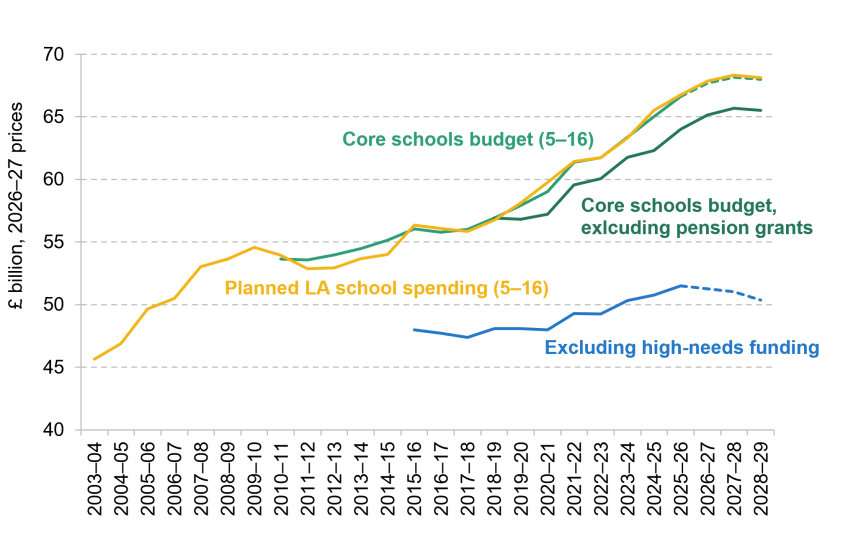
In Figure 1, we show trends in two main measures of overall spending on schools in England. The core schools budget is set by central government and represents the total amount set aside for school funding across various different grants. We also show the planned level of spending by local authorities, which can retain some funding centrally.
Figure 1. Total school spending and funding, actual up to 2025–26 and projected up to 2028–29
Note and source: Core schools budget taken from Department for Education (2025a) and HM Treasury (2025). We add £700 million in additional funding for teacher pay in 2026–27 and £1.1 billion from 2027–28. See the IFS ‘Methods and data’ webpage for a detailed description of the calculation of local authority (LA) spending on schools. This relates to the ‘schools budget’ only and excludes all spending on the early years. High-needs funding is based on Office for Budget Responsibility (2026), with £3.5 billion in additions by 2028–29. See the latest GDP deflators (HM Treasury, 2026).
A top-up to the core schools budget to partly cover the costs of teacher pay awards means that the core schools budget is now projected to increase from £67 billion in 2025–26 to £68 billion in 2028–29 (all in 2026–27 prices), rather than being held constant in real terms. This equates to a real-terms rise of 0.7% per year. This does not include the extra £3.5 billion top-up to the Department for Education budget in 2028–29 to cover high-needs provision. It also does not include the effective £500 million real-terms boost to school funding from not clawing back savings from reduced LGPS employer contribution rates.
This represents a slow-down as compared with the 2.0% per year rise from 2019–20 to 2025–26, when overall funding rose by nearly £7 billion (excluding the effects of pensions grants). It is more similar to the 0.6% per year growth that occurred between 2010–11 and 2019–20 (again, excluding pensions grants).
We exclude the effects of changes to teachers’ pensions grants in recent years as they do not represent an increase in the amount of resources available in schools. In recent years, the government has allocated schools over £2.5 billion in extra funding per year to cover the cost of rising employer pension contributions (which increased from 16.4% in 2018–19 to about 28.7% by 2024–25). Schools then return this funding to government. Employer pension contributions are now set to fall back to about 17.6% from April 2027, and the government will therefore be withdrawing the extra grant funding. The result is that official figures will likely show a drop in total school spending of about £2–3 billion in 2027–28. This will not be a real fall in any sense.
High-needs and mainstream school funding
Whilst there has been growth in school funding in recent years, a large amount of this funding has been taken up by growth in funding for SEND through the high-needs budget, which funds provision for pupils with Education, Health and Care Plans (EHCPs). High-needs funding grew by 55% in real terms between and 2019–20 and 2025–26, or over £4 billion in total. This absorbed over half of the overall growth in school funding over the same period.
This pattern is set to continue. In the white paper and consultation on SEND reform (Department for Education, 2026a), the government set out major planned reforms to the system. It also committed to spending £7 billion extra in cash terms on support for SEND in 2028–29 as compared with 2025–26. This includes:
- £1.4 billion in extra funding per year by 2028–29 to increase provision in mainstream schools – this is occurring through the ‘experts at hand’ service, which will go to local authorities and integrated care boards to fund specialist interventions, and the ‘Inclusive Mainstream Fund’, which will go directly to mainstream schools to increase support;
- £2.1 billion in assumed increases in core funding for SEND through the high-needs budget;
- £3.5 billion in extra funding to cover the expected cost of existing EHCP provision in 2028–29 – this represents an addition to the Department for Education day-to-day budget in 2028–29 only and has not been directly allocated to the schools budget yet.
High-needs funding does reflect real resources being used for pupils’ education. However, this funding is ringfenced for additional provision for a subsection of pupils, so it is not funding that is available for schools to meet core costs. If we exclude the £1.4 billion for increased specialist support and mainstream provision and the £2.1 billion increase in the high-needs budget, then core school funding available to mainstream schools will actually decrease by 2% or £1.2 billion in real terms between 2025–26 and 2028–29.
In principle, the funding for extra SEND provision in mainstream schools through the inclusive mainstream fund is not part of the high-needs budget and it is not supposed to be used for EHCP provision. If we add this back to mainstream school funding, then this total would fall by 1% instead of 2%. However, this funding is intended to deliver over and above what mainstream schools are currently providing as part of their core SEND offer. It is not funding for existing provision or commitments.
Spending per pupil
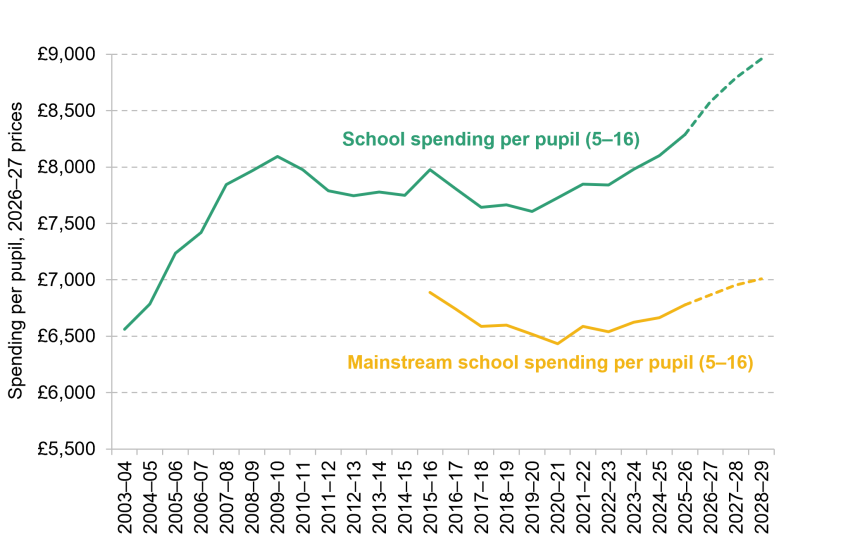
Given significant fluctuations in pupil numbers over time, it is generally more useful to track spending per pupil to understand the real-terms level of school resources available to pupils over the long run. Figure 2 therefore shows the long-term trends in school spending per pupil (based on the longer series for planned local authority spending on schools).
Figure 2. Total school spending per pupil, actual up to 2025–26 and projected up to 2028–29
Note and source: Spending figures taken from Figure 1. See the IFS ‘Methods and data’ webpage. See HM Treasury (2026). No data are available for 2020–21, so this is imputed based on a constant real-terms growth rate between 2019–20 and 2021–22. Figures exclude grants for changes to employer pension contributions and employer National Insurance contributions.
From 2025–26 to 2028–29, we project that per-pupil funding will grow by about 8% in total (2.6% per year). This increases to 9%, or 2.8% per year, if we include the £500 million boost to school funding by not clawing back savings from reduced employer contributions to the LGPS (see below). This is only just below the 2.8% per year real-terms growth rate seen over the 2000s. By 2028–29, we expect that per-pupil spending will be around £1,300 higher in real terms than it was a decade earlier.
This is significantly faster growth than had been expected at the time of last year’s Spending Review (around 1% per year). Partly, this is due to the top-ups to the overall schools budget discussed above. But it also reflects significant revisions to forecasts on pupil numbers, which show a much swifter decline than originally anticipated. Pupil numbers are now expected to fall by over 5% between 2025–26 and 2028–28 (previous projections were for a 3% fall). See Box 1 for further details.
Box 1. Changes in pupil numbers
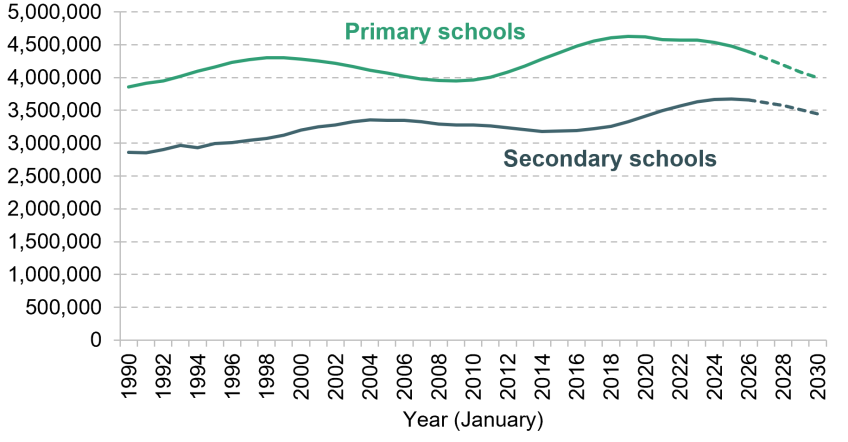
As shown in Figure 3, the number of pupils in stated-funded primary schools has fallen by 5% since 2019, and is projected to fall by a further 11% between 2026 and 2031. These latest projections indicate that pupil numbers are falling around 4 percentage points faster than previously expected, mostly due to lower-than-expected births, but also lower levels of migration.
The number of secondary school pupils has followed a similar pattern, but with a natural lag (see Figure 3). The secondary school population grew by 15% or 500,000 from its low point in 2014 to its high point in 2025. It is now expected to decline by a total of 8% between 2026 and 2031. This is about double the previous projected decline.
Figure 3. Pupil numbers in state-funded schools (full-time equivalent), actual up to 2026 and projected up to 2030
Note and source: Primary and secondary school numbers are taken from Department for Education (2026b) and these statistics from earlier years, and from national pupil projections (Department for Education, 2026c).
Mainstream school funding per pupil
As with overall school funding, the picture for per-pupil spending significantly changes if we exclude funding for SEND. As shown in Figure 2, mainstream school spending per pupil increased by a total of 4% in real terms between 2019–20 and 2025–26, meaning that over half of the 9% growth in total school spending per pupil was taken up by the rising costs of high-needs provision.
This pattern is set to become even more pronounced over the spending review period. The projected 8% real-terms increase in total school funding per pupil between 2025–26 and 2028–29 falls to 3% if we exclude extra funding for SEND and high-needs provision.
Tracking increases to school funding
After accounting for all the changes to school funding and pupil numbers since last year’s spending review, we now estimate that school funding per pupil will effectively grow by 8.6% in real terms between 2025–26 and 2028–29. In Figure 4, we show the individual impact of how different elements of the calculation have changed this forecast.
Figure 4. Changes to projected real-terms growth in school funding per pupil over time
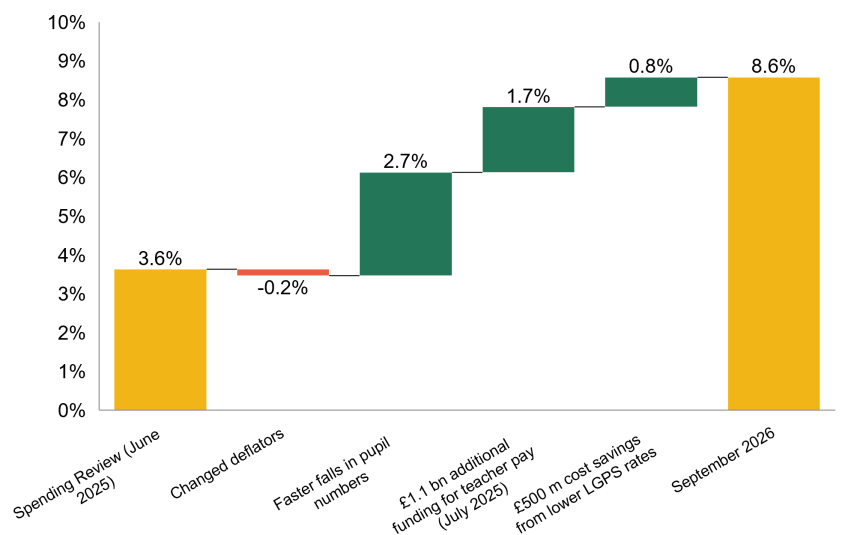
At the time of the 2025 Spending Review, we estimated that school funding per pupil would grow by 3.6% in real terms. Accounting for updated inflation forecasts reduces this growth very slightly to 3.5%. A bigger change occurs when we account for faster projected falls in pupil numbers, which are now expected to fall by 5% instead of 3%. This contributes about 2.7 percentage points to the projected real-terms increase in school funding per pupil. The additional grants for the higher-than-expected teacher pay settlements add a further 1.7 percentage points. Finally, by not clawing back savings from reduced LGPS employer contribution rates, the government has effectively boosted real-terms school funding by about £500 million. This adds a further 0.8 percentage points and takes the projected real-terms increase in school funding per pupil between 2025–26 and 2028–29 up to 8.6%.
This year, we have seen two real-terms boosts to school funding: extra grants announced in July 2026 and confirmation in September 2026 that the government would not be clawing back savings from reduced employer contributions to the LGPS. This is actually part of a longer-term trend. Table 1 shows additional grants provided to schools that have been announced over the past decade to help schools cover growth in costs. In total, there have been ten additional grants over the last ten years. Adding them up, they amount to about £8.7 billion in additional school funding that has been provided outside the spending review period.
Table 1. Additional grants to schools outside the spending review process over last decade
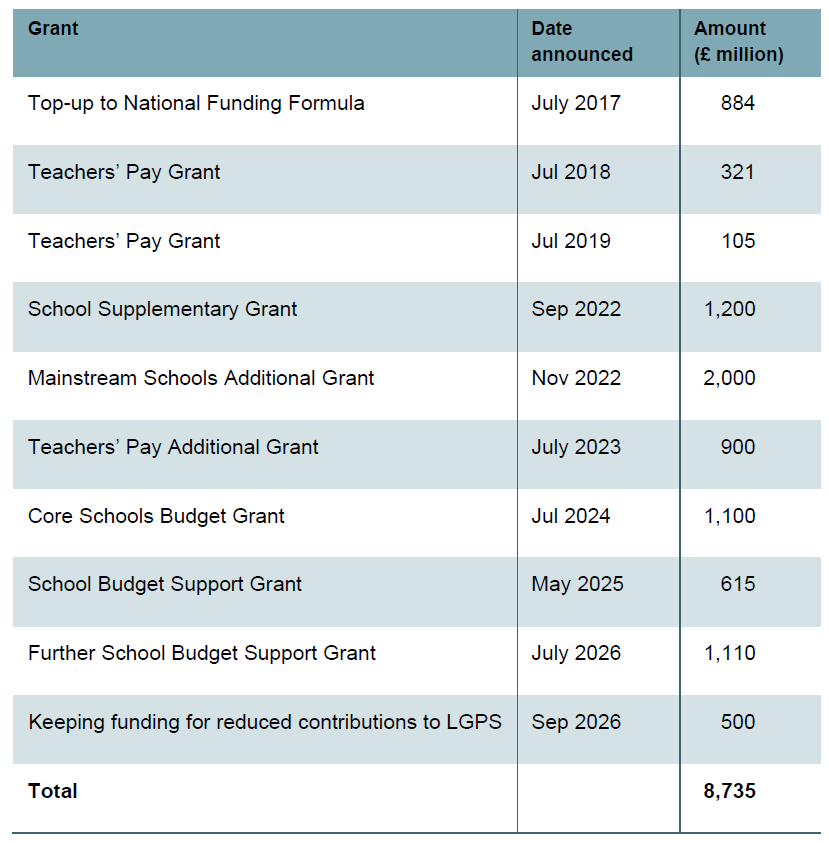
Note and source: Figures relate to total amounts provided over a full financial year (wherever available) and to extra funding for both mainstream schools and high needs funding. Figures relate to: announced extra funding in the National Funding Formula in July 2017 (Education & Skills Funding Agency, 2022); creation and additions to the Teachers’ Pay Grant in July 2018 and July 2019 (Department for Education and The Rt Hon Damian Hinds MP, 2018; Department for Education, 2019); School Supplementary Grant announced in Spending Review 2021, which then effectively became additional funding when the Health Social Care Levy was scrapped in September 2022 (Education & Skills Funding Agency, 2023); £2 billion announced at the 2022 Autumn Statement (HM Treasury, 2022); Teachers’ Pay Additional Grant announced in July 2023 (Education & Skills Funding Agency, 2024); Core Schools Budget Support Grant announced in July 2024 (Department for Education and The Rt Hon Bridget Phillipson MP, 2024); School Budgets Support Grant from May 2025 (Department for Education, 2026d); Further School Budget Support Grant from July 2026 (Department for Education and The Rt Hon Bridget Phillipson MP, 2026); and cost savings from reduced employer contributions confirmed in September 2026 (National Education Union, 2026).
Effectively, governments have, on average, announced about an extra £1 billion per year in school funding for the last decade. Sometimes, these have been additional to the Department for Education budget, such as the £2 billion announced in the 2022 Autumn Statement and £1.1 billion in July 2024. At other times, funding has come from re-allocating funding from other areas in the Department for Education budget.
Regularly allocating funding outside of the spending review process is not ideal. Repeated changes make it harder for schools to plan their budgets effectively, while allowing government to postpone the difficult trade-offs involved in setting public spending levels.
These repeated top-ups are also likely to be linked to the rapid growth in the costs of SEND provision. Growth in SEND funding can account for around half of the overall growth in school funding over time. If this had not occurred to the same level, it is possible that schools would have been in a better position to meet their costs without additional grants.
3. School budgets and costs
A critical question for schools is whether funding increases are sufficient to cover their expected costs. In this section, we therefore provide updated projections for school costs over the next few years, and how these compare with funding increases.
School costs are made up of spending on teachers (52% of expenditure), other staff such as teaching assistants (29%) and non-staff costs such as energy and books (19%). In Table 2, we show the estimated percentage change in each element of costs for 2024-25 through to 2028–29 (actual up to 2025–26, projected for 2026–27 onwards). This covers the costs faced by schools over the course of this parliament.
Table 2. Actual and projected growth in the components of mainstream school costs
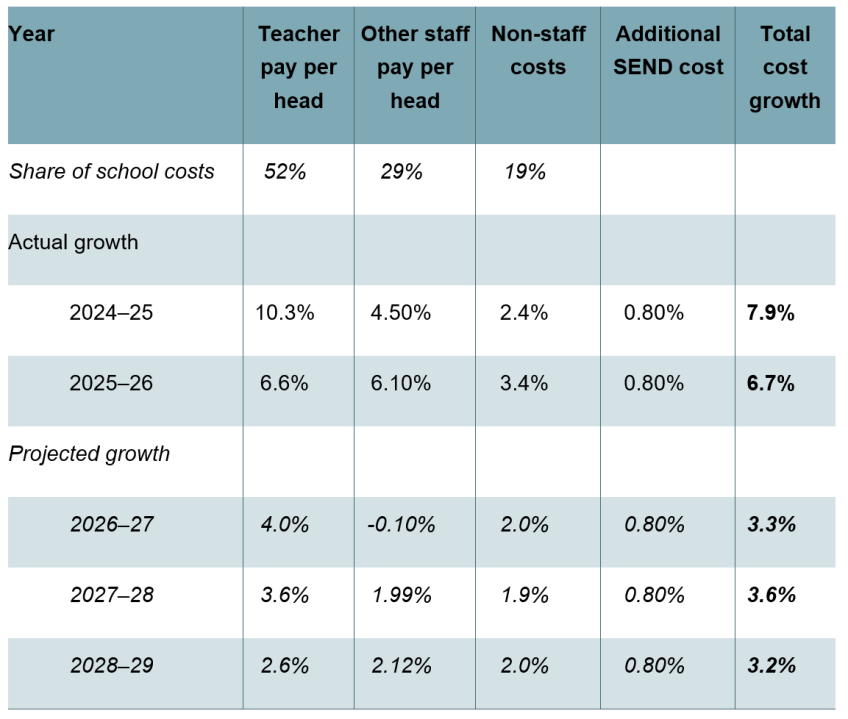
Note and source: School costs are calculated as a weighted average of actual and projected growth in teacher paybill, other staff paybill and non-staff costs, as well as 0.8% per year for growth in the growing costs of SEND provision in mainstream schools. Teacher pay and other staff pay per head reflect actual or proposed pay awards up to 2027–28. Pay offers are assumed to match average earnings growth of 2.1% for 2028–29 (Office for Budget Responsibility, 2026) and 2.2% for 2027–28 for other staff. Estimates for expenditure shares, pay drift, employer National Insurance and pension contributions are taken from the schools’ cost technical notes (Department for Education, 2025b, 2026e). Further details can be found at the IFS ‘Methods and data’ webpage.
The growth in teacher pay per head is based on actual/projected pay awards, government estimates of pay drift and change in employer pension contributions.1 Teacher pay awards apply from September of each year, so the growth in teacher pay over a full financial year therefore reflects a weighted average over the previous and current September. The growth in teacher pay per head was over 10% in 2024–25, which reflected a pay award of 6.5% from September 2024 and a large jump in employer pension contributions in April 2024. The growth in teacher pay per head has since slowed to a projected 4% per year in 2026–27, mainly reflecting the teacher pay award of 3.5% from September 2026. This slows to 3.6% in 2027–28, with a proposed pay award of 3% from September 2027. We then assume a teacher pay award of just over 2% in September 2028, in line with average earnings, which drives a further reduction in growth in pay per head growth to 2.6% in 2028–29.
Other staff are mostly paid according to local government pay scales, with other staff costs per head also reflecting changes in employer pension contributions (including reduced contribution rates in April 2026), employer National Insurance contributions and pay drift. The growth in other staff costs per head increased to over 6% in 2024–25. This is expected to fall to about 3.3% in 2026–27 if the local government pay offer for this year is accepted by staff. We assume it falls further to 2% per year in 2027–28 and 2028–29, in line with projected growth in average earnings.
Changes in non-staff costs are based on CPI inflation. This increased to over 3% in 2025–26, but is forecast to fall to around 2% per year for the next few years.
Finally, like government estimates of school costs, we add additional costs associated with the growing cost of securing SEND provision in mainstream schools. This has added about 0.8 percentage points to school costs for the last two years, which we assume will continue over this spending review period.
Combining these various components (as a weighted average) then gives our estimates of total mainstream school costs per head. This growth has fallen from 7.9% in 2024–25 and 6.7% in 2025–26 to projected growth of 3.3% in 2026–27. We then project cost growth of 3.6% in 2027–28 and 3.2% in 2028–29.
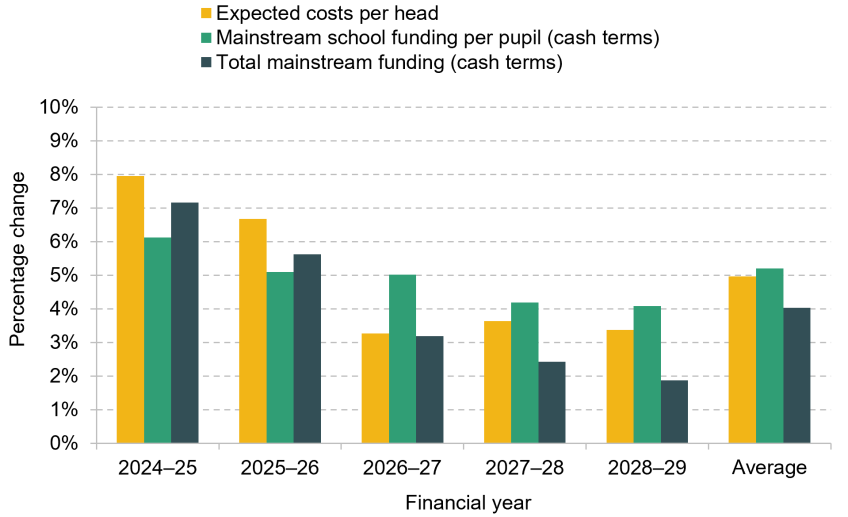
Figure 5 then compares estimated growth in schools costs per head with mainstream school funding per pupil (i.e. stripping out increases in funding for SEND in special schools, but including SEND funding received by mainstream schools).
Figure 5. Estimated and projected cash-terms growth in school costs and funding per pupil over time, actual up to 2025–26 and projected thereafter
Note and source: Cash-terms growth in mainstream school funding is taken from the schools’ cost technical notes (Department for Education, 2025b, 2026e). We add £700 million in additional funding for teacher pay in 2026–27 and £1.1 billion in 2027–28. We further assume that mainstream school funding grows in line with the GDP deflator in 2028–29. Pupil numbers are taken from national pupil projections (Department for Education, 2026c), and exclude pupils in state-funded special schools and alternative provision.
For the last two years, school costs (in yellow) have risen more quickly than mainstream funding per pupil (in green). In 2024–25, mainstream school funding per pupil grew by 6.1%, whilst costs grew by 7.9%. In 2025–26, total mainstream school funding grew by 5.1%, whilst costs grew by close to 6.7%.
This year and for the rest of the spending review period, that picture is set to reverse. For 2026–27, we project that school costs will grow by 3.3%, which is less than 5% growth in mainstream school funding per pupil in the same year. For 2027–28 and 2028–29, we also project that school costs will grow by less than mainstream school funding per pupil.
Over the full period from 2023–24 from 2028–29, we project that school costs per head will have grown 5.0% per year, on average, whilst mainstream school funding will have grown by 5.2% per year, on average, in cash terms. This will leave mainstream schools breaking even, on average, over the five-year period as a whole.
On the face of it, this suggests a return to a situation where mainstream schools are better able to cover their expected costs. There are two main caveats and sources of uncertainty. First, we focus on schools’ expected costs per pupil, in a context where pupil numbers are falling. If schools are not able to perfectly adjust their costs to a smaller group of pupils, that will place upward pressure on per-pupil costs that we do not account for in this analysis. Indeed, cutting costs in line with falling pupil numbers might be harder to achieve in practice given the pressures on the workforce (see the next section).
Second, increases in SEND spending and costs have tended to exceed expectations for the last decade. There are clear risks that this could happen again, particularly if parents apply for EHCPs in anticipation of these being changed or withdrawn from 2029 onwards. However, there is also the possibility that the growth in costs slows down due to reforms to the SEND system and extra support to schools through the experts at hand service and the inclusive mainstream fund.
4. Workforce pressures
Spending on teachers represents over half of day-to-day spending on schools in England. Currently, there are 220,000 teachers working in primary schools and 210,000 in secondary schools, along with 30,000 in special schools and over 60,000 in further education settings. The 2024 Labour manifesto pledged to increase the number of teachers by at least 6,500 by the end of this parliament, though this now excludes primary schools. If achieved, this would represent a 2% increase in the overall number of teachers in secondary schools, special schools and further education.
In this section, we analyse trends in the workforce, in light of this overall target for 6,500 extra teachers, and the competing pressures faced by individual schools due to falling pupil numbers, reforms to the SEND system and proposals to change the curriculum.
Overall workforce trends
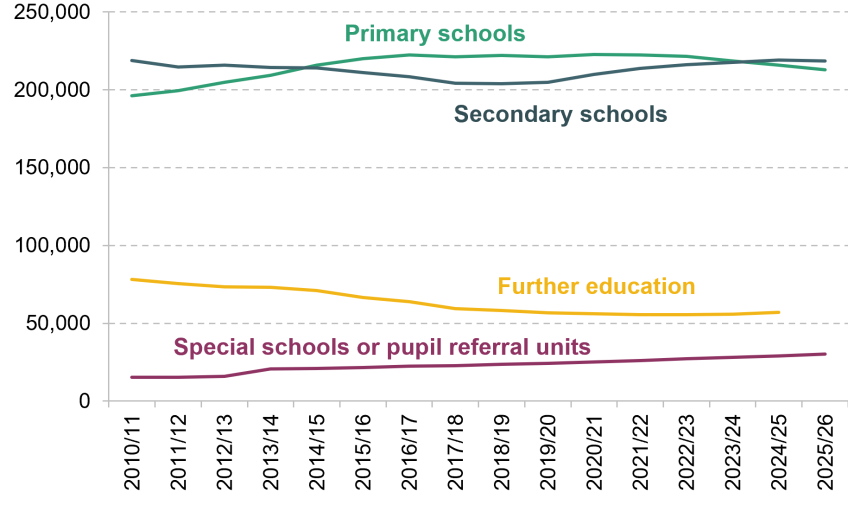
Figure 6 shows trends in the overall numbers of teacher in state-funded schools and further education in England over time. Changes in primary school teacher numbers have largely changed in line with changes in pupil numbers shown in Box 1. If this relationship continues, we may expect to see a falling primary school workforce as pupil numbers decline rapidly over the next few years.
Figure 6. Teacher numbers in state-funded schools (full-time equivalent) and in further education (headcount)
Note and source: Primary, secondary and special school numbers are taken from the school workforce statistics (Department for Education, 2025c), Further education workforce numbers are the headcount of the number of teachers in the statutory sector and taken from further education college workforce analysis (Department for Education, 2026f).
In secondary schools, changes in teacher numbers have been less aligned with changes in pupil numbers. Between 2010–11 and 2018–19, the number of secondary school teachers fell by 7%, just as secondary school pupil numbers rose by 2% over the same period. Since 2018–19, the number of secondary school teacher has risen by 7%, but secondary school pupil numbers rose by 10%. There has therefore been more pressure on the secondary school teacher labour market.
Special school teacher numbers have grown over the whole period, with numbers doubling from 15,000 in 2010–11 to 30,000 in 2025–26. This reflects the rapid growth in the number of pupils in special schools, which seems likely to continue for at least the next few years.
The further education teaching workforce (measured in headcount terms) has fallen significantly over time, with the workforce about 27% smaller in 2024–25 than in 2010–11. There has been modest growth of 3% since 2021–22, but clearly not nearly enough to reverse past declines. Over the same period, the number of young people in further education colleges and sixth forms fell by 10% between 2010–11 and 2018–19, but has since risen to above its 2010–11 level by 2024–25.
The number of teachers in secondary and special schools has grown by 3,000 since 2023–24 (the baseline year for the government’s target for 6,500 additional teachers). Teacher numbers in further education have increased by about 1,600 over the same period (Department for Education, 2026g). Combining these figures gives about 4,600 extra teachers, putting the government close to achieving its target.
Responding to falling pupil numbers
In a pupil-led funding system, falling numbers of pupils will imply falls in total funding levels at individual schools and a need to cut spending, all other things being equal. We can get a sense of how schools and policymakers have managed these choices in the past by looking at how they have responded to the fall in primary school numbers over the last few years.
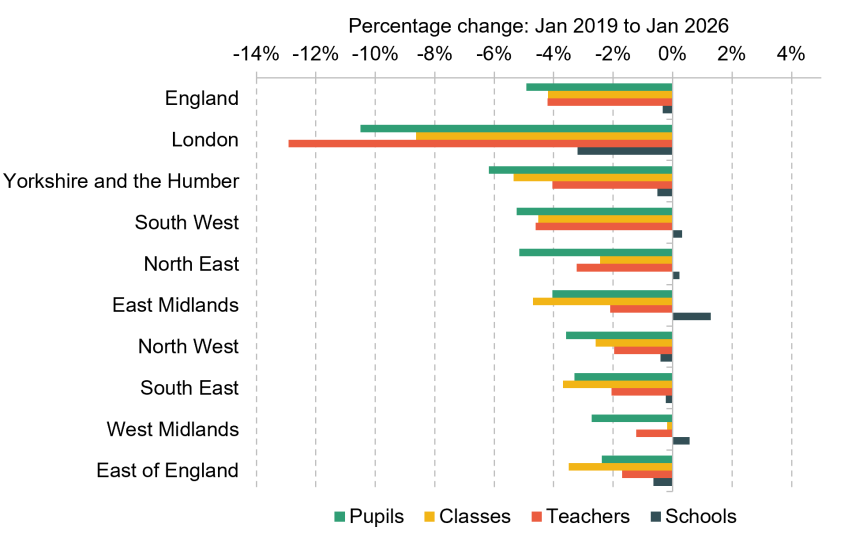
Figure 7 therefore shows the percentage change in primary school pupil numbers, classes, teachers and school numbers across English regions between the peak in primary school pupil numbers (2018–19) through to the most recent year of data in 2025–26.
Figure 7. Changes in primary school pupil, teacher, school and class numbers across England: January 2019 to January 2026
Source: Department for Education (2026b).
Across England as a whole, primary school pupil numbers fell by 5% between 2018–19 and 2025–26. At the same time, both teacher and class numbers fell by 4%. The reduction in the number of schools has been much smaller, with almost no overall reduction in school numbers. This suggests that most of the declines in primary school pupil numbers have mostly been delivered so far through fewer classes and teachers within schools, rather than school closures.
This pattern largely holds across individual regions. London has seen the largest declines in primary school pupil numbers (a 10.5% drop between 2018–19 and 2025–26), with similarly large declines in the number of teachers (13%) and classes (9%). Outside London, the decline in the primary pupil population has varied from a fall of 2% in the East of England to a fall of 6% in Yorkshire and the Humber. For the most part, the number of schools has hardly fallen at all. Instead, the numbers of teachers and classes seem to have fallen by similar amounts, or just less, than the fall in the number of primary school pupils.
In the short run, it seems natural that policymakers would rely on reductions in the numbers of teachers and classes, rather than school closures, in response to falling pupil numbers. This might become less possible as the number of pupils continues to decline. At some point, it will become necessary to reduce the number of schools to deliver savings. Indeed, during previous periods of large declines in pupil numbers during the 1970s and 1980s, policymakers partly responded by closing large numbers of schools (Sibieta, 2025).
We have not seen large reductions in secondary school pupil numbers to date, but these are forecast to fall by 8% between 2025 and 2031. If the government sticks to its target for teacher numbers to be higher at the end of the parliament, though, there will be less scope for schools to reduce costs by reducing teacher numbers. This would add pressure to secondary school budgets.
Additional challenges
In addition to overall targets on teacher numbers, schools may need to adjust their workforce in light of planned reforms to the SEND system and potential changes to the school curriculum.
The government has set out major reforms to increase the role of mainstream schools in the SEND system. Under these reforms, mainstream schools will be expected to undertake more identification of needs and deliver greater levels of SEND provision as part of their ordinary offer. This should in principle offer opportunities for earlier identification, flexibility and efficiency. It is also a big change to the role of schools. It will require existing staff to gain more expertise, and require more staff to work on SEND provision and assessment. This may not require large increases in staff numbers; mainstream schools may be able to redeploy existing teachers and other staff freed up by falling pupil numbers to deliver an expanded SEND offer. However, even without major changes in headcount, this is clearly a significant challenge to staff training and job responsibilities, and so will be an important consideration for schools in planning their workforce needs.
There could also be significant challenges in responding to potential changes to the curriculum.
The government has announced an intention to provide more technical education routes for young people from age 14 onwards. Few details are currently available, including whether this would take place in schools or in colleges, but this would clearly be a radical shift. The delivery of high-quality technical education routes would also require a high-quality teaching workforce. It is not yet clear where this workforce will come from. As shown in Figure 5, the further education workforce has declined significantly over time. We also know that teachers in further education colleges are paid less than teachers in schools. If schools seek to increase the number of teachers in technical subjects, there is a risk that this comes at the expense of the further education college teaching workforce.
There may also be subject-specific curriculum changes that affect workforce decisions. For example, the Francis Review – the curriculum and assessment review (Francis, 2025) – recommended that all pupils who want to study triple science at GCSE should have the opportunity to do so, which could increase demand for science teachers. This comes at a time when a significant proportion of science teaching is already delivered by teachers without a relevant post-A-level qualification. While the pipeline of new science teachers has improved considerably, recruitment remains difficult in some subjects: in 2025–26, physics recruitment met only 78% of the government’s target (see Department for Education, 2025d). Any expansion of science provision would therefore need to be considered alongside schools’ capacity to recruit sufficient specialist teachers.
5. Conclusion
After a period of real-terms cuts to school finding per pupil during the 2010s, there has been a return to significant growth in school funding per pupil since 2019. However, over half of the growth in school funding can be accounted for by increased funding for pupils with SEND, with rapid rises in demand through the system.
This pattern is set to continue going forwards. We now expect school funding per pupil to effectively grow by 9% in total in real terms between 2025–26 and 2028–29. After accounting for expected additions to SEND funding, we expect that mainstream school funding per pupil will grow by around 3% in real terms.
Rising spending and demand for SEND provision has been the most important pressure in the school funding system over recent years, and will continue to be so. The government is planning major reforms to the system, with more provision as part of the ordinary offer in mainstream schools and legally enforced plans reserved for the very highest needs. These reforms are expected to take effect from 2029 onwards. In the meantime, the main challenge will be ensuring mainstream schools can both prepare for these new responsibilities and provide for continued increases in demand within the existing system, all within the current funding envelope.
At the same time, schools will need to adjust to falling pupil numbers – which are now projected to fall even more quickly than had been expected. Policymakers will need to make a choice between maintaining existing funding levels (allowing funding per pupil to rise and class sizes to fall) or using falling pupil numbers to deliver cost savings through reductions in the workforce and number of schools. So far, falls in primary school pupil numbers have mostly been associated with falls in teacher numbers and the number of classes within each school, rather than school closures.
Schools making decisions about their workforce will also need to look ahead to potential changes to the curriculum, especially at secondary level. The recent review of the curriculum and assessment proposed that more pupils should be able to take individual sciences at GCSE level, increasing demand for teachers in subjects that in recent years have struggled to meet recruitment targets. A broader pivot towards technical education routes from age 14 could have even more profound consequences for the shape of the teacher workforce.
References
Department for Education and The Rt Hon Damian Hinds MP, 2018. Government to fund pay rise for teachers. News story, https://www.gov.uk/government/news/government-to-fund-pay-rise-for-teachers.
Department for Education, 2019. School teachers’ pay to rise by 2.75%. Press release, Department for Education, https://www.gov.uk/government/news/school-teachers-pay-to-rise-by-275.
Department for Education, 2025a. School funding statistics, financial year 2024–25. https://explore-education-statistics.service.gov.uk/find-statistics/school-funding-statistics/2024-25.
Department for Education, 2025b. Schools’ costs: 2024 to 2026. Technical note, https://assets.publishing.service.gov.uk/media/67d974935bad4b1a7f01ed62/Schools_costs_technical_note_2024_to_2026.pdf.
Department for Education, 2025c. School workforce in England: reporting year 2025. Annual statistics, https://explore-education-statistics.service.gov.uk/find-statistics/school-workforce-in-england/2025.
Department for Education, 2025d. Initial teacher training census: academic year 2025/26. Official statistics, https://explore-education-statistics.service.gov.uk/find-statistics/initial-teacher-training-census/2025-26.
Department for Education, 2026a. Every child achieving and thriving. Policy paper, https://www.gov.uk/government/publications/every-child-achieving-and-thriving.
Department for Education, 2026b. Schools, pupils and their characteristics: January 2026. Accredited official statistics, https://www.gov.uk/government/statistics/schools-pupils-and-their-characteristics-january-2026.
Department for Education, 2026c. National pupil projections: July 2026. Official Statistics, https://explore-education-statistics.service.gov.uk/find-statistics/national-pupil-projections/2026.
Department for Education, 2026d. Schools budget support grant 2026: methodology. Guidance, https://www.gov.uk/government/publications/schools-budget-support-grant-2026-sbsg-26/schools-budget-support-grant-2026-methodology.
Department for Education, 2026e. Schools’ costs: 2025 to 2029. Technical note, https://assets.publishing.service.gov.uk/media/69a5c57e46e50eda5c46b5b5/Schools_costs_technical_note_2025_to_2029_.pdf.
Department for Education, 2026f. Further education college workforce using teacher pension data: academic year 2024/25. Ad hoc statistics, https://explore-education-statistics.service.gov.uk/find-statistics/further-education-college-workforce-using-teacher-pension-data/2024-25.
Department for Education, 2026g. Further education workforce: academic year 2024/25. Official statistics, https://explore-education-statistics.service.gov.uk/find-statistics/further-education-workforce/2024-25.
Department for Education and The Rt Hon Bridget Phillipson MP, 2024. Government confirms above inflation pay award for teachers. Press release, https://www.gov.uk/government/news/government-confirms-above-inflation-pay-award-for-teachers.
Department for Education and The Rt Hon Bridget Phillipson MP, 2026. Teachers to benefit from multi-year pay deal. Press release, https://www.gov.uk/government/news/teachers-to-benefit-from-multi-year-pay-deal.
Education & Skills Funding Agency, 2022. Mainstream schools additional grant 2023 to 2024. Guidance, https://www.gov.uk/government/publications/mainstream-schools-additional-grant-2023-to-2024.
Education & Skills Funding Agency, 2023. Schools supplementary grant 2022 to 2023: methodology. Guidance, https://www.gov.uk/government/publications/schools-supplementary-grant-2022-to-2023/schools-supplementary-grant-2022-to-2023-methodology.
Education & Skills Funding Agency, 2024. Teachers’ pay additional grant 2023 to 2024: methodology. Guidance, https://www.gov.uk/government/publications/teachers-pay-additional-grant-2023-to-2024/teachers-pay-additional-grant-2023-to-2024-methodology.
Francis, B., 2025. Curriculum and Assessment Review. Department for Education, https://www.gov.uk/government/collections/curriculum-and-assessment-review.
HM Treasury, 2022. Autumn Statement 2022. https://www.gov.uk/government/topical-events/autumn-statement-2022.
HM Treasury, 2025. Spending Review 2025. Policy paper, https://www.gov.uk/government/publications/ spending-review-2025-document/spending-review-2025-html.
HM Treasury, 2026. GDP deflators at market prices, and money GDP (June 2026 update). https://www.gov.uk/government/collections/gdp-deflators-at-market-prices-and-money-gdp.
National Education Union, 2026. NEU secures from Government full funding for teacher pay offer. NEU press release, https://neu.org.uk/latest/press-releases/neu-secures-government-full-funding-teacher-pay-offer?_locale=en.
Office for Budget Responsibility, 2026. Economic and fiscal outlook – March 2026. https://obr.uk/efo/economic-and-fiscal-outlook-march-2026/.
Sibieta, L., 2025. Demographic change and schools across the UK: lessons from history. IFS report, https://ifs.org.uk/publications/demographic-change-and-schools-across-uk-lessons-history.
Acknowledgements
The author gratefully acknowledges the support of the Nuffield Foundation, which has funded this programme of work (grant number EDO/FR-000024394). The Nuffield Foundation is an independent charitable trust with a mission to advance social well-being. It funds and undertakes rigorous research, encourages innovation and supports the use of sound evidence to inform social and economic policy, and improve people’s lives. The Nuffield Foundation is the founder and co-funder of the Nuffield Council on Bioethics, the Ada Lovelace Institute and the Nuffield Family Justice Observatory. This project has been funded by the Nuffield Foundation, but the views expressed are those of the author and not necessarily the Foundation. Find out more at: nuffieldfoundation.org; Bluesky: @nuffieldfoundation.org; LinkedIn: Nuffield Foundation. The author also thanks the Economic and Social Research Council for support via the ESRC Centre for the Microeconomic Analysis of Public Policy (grant number ES/Z504634/1), which underpins much of IFS’s research. The author would like to thank Jonathan Cribb, Christine Farquharson, Darcey Snape and Imran Tahir for their comments and feedback on this report. Any errors are the author’s own.
Endnotes
Authors

Luke Sibieta
Luke is a Research Fellow at the IFS and his general research interests include education policy, political economy and poverty and inequality.
More from IFS
Understand this issue


Policy analysis


Academic research


