
The system of support for special educational needs and disabilities (SEND) in England is broken. Costs are spiralling, the quality of provision is patchy, and almost everyone involved – schools, councils, parents and children – is at breaking point.
This crisis has been building for 10 years and the government is planning to set out major reforms in a White Paper this autumn. But reform could go wrong. If the government simply cuts support and legal rights for children with SEND, without providing serious alternatives, it risks a repeat of what happened with welfare cuts. Furthermore, this could be detrimental to children who benefit from the support they currently receive.
The government has signalled a desire to provide more core support for SEND within mainstream schools. In principle, this could mean better provision at a lower long-run cost – but achieving this will need both a careful strategy to build provision and a commitment to building on the (very thin) evidence base for what works to support children with SEND.
In this comment, we set out the challenges and problems with the current system, before providing new reflections on what the government will need to do to implement its goal of providing more core support within mainstream schools.
Rapid rises in numbers and spending
The rise in the numbers of children with SEND has been staggering. Since 2018, the number of pupils with Education, Health and Care Plans (EHCPs) – legal documents guaranteeing tailored support for individual pupils judged to have the most severe needs – has increased by nearly 80%, from under 3% of pupils to over 5%. Over the same period, high-needs funding has risen by over £4 billion – or more than 50% – in real terms, absorbing more than half of the total increase in school funding since 2019.
And even this big increase in funding has not kept pace with what is actually spent. This is because EHCPs create legally binding entitlements to specific forms of support – with little regard for affordability or whether high-quality support exists. As a result, councils have been running deficits each year. These have accumulated over time, with the latest estimates putting the cumulative total around £8 billion by March 2027. The government is allowing these overspends to be kept off the books to avoid financial collapse. This accounting fudge (technically known as the statutory override) has recently been extended to March 2028, but this is just putting off the inevitable date when these deficits will have to be addressed (almost certainly with a bail-out from central government).
With spending on EHCPs exceeding funding, less money is left for lower-level SEND support. As a result, schools and parents are more focused on securing EHCPs in order to guarantee support. This vicious cycle is not financially sustainable.
What is driving the rapid rise in numbers?
Almost all of the growth in the number of EHCPs reflects rising diagnoses of autism, ADHD, and speech and language needs. These trends are not unique to England; many high-income countries are seeing similar increases in autism and ADHD. There is some evidence of rising needs, but much of the increase reflects improved recognition of needs that were always there. In particular, greater awareness and lower diagnostic thresholds mean that more needs are recognised and understood than was previously the case.
Figure 1. Number of pupils with Education, Health and Care Plans by primary need
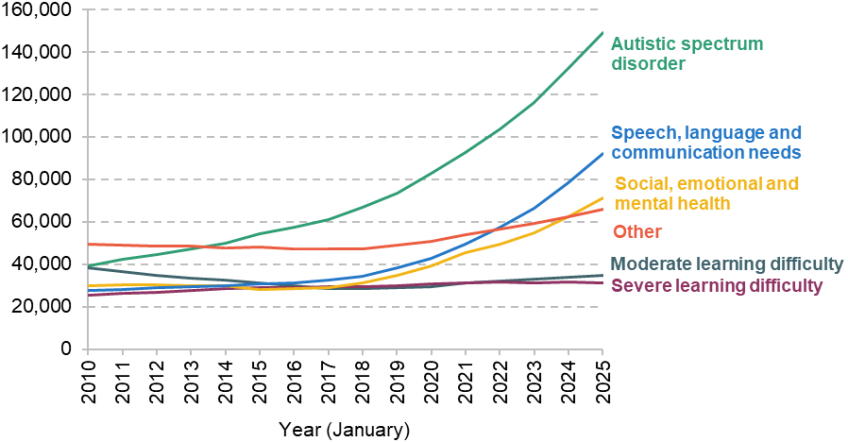
Source: Accredited official statistics, Special educational needs in England: January 2025.
With such large rises in numbers, concerns have been raised about ‘over-diagnosis’. However, the key question is whether greater diagnosis and awareness are leading to intervention and support that allow children to thrive and achieve better outcomes.
Education, Health and Care Plans – good intentions, bad incentives
EHCPs are meant to guarantee help. However, you cannot magic quality into existence by writing it on a legal document. Creating high-quality provision requires system-wide efforts to increase the supply of well-trained staff, structured and planned provision within schools, and a system that can provide support in a flexible and timely way. These have not happened. Instead, provision has been increased piecemeal, pupil-by-pupil, with little thought for supply-side capacity or coherence.
As a result, the quality of current provision is patchy. Many children are pulled out of lessons for support from poorly trained teaching assistants, missing time with qualified teachers. We have almost no way of judging whether the billions in extra funding represent value for money.
The legalistic process for securing EHCPs adds further strain and costs. Many families face months or years of legal fights before their child receives help. Councils, rationally, seek to challenge and delay requests for support because of the huge costs that EHCPs entail. The delays and legal disputes add costs and stress, and stop children getting access to earlier support that might help prevent more severe needs later on. Incentives point towards a system that is financially unsustainable and fails to meet children’s needs.
Capacity in specialist provision
A lack of capacity in state-funded special schools has also increased costs. Over the last decade, the share of pupils attending state-funded special schools has risen by half, from 1.2% to 1.8%.
This rapid rise in demand and a lack of capacity in the state-funded sector have meant that councils have become increasingly dependent on independent special schools. The number of pupils with EHCPs attending specialist independent schools tripled between 2016 and 2025 (from 10,000 to 30,000). And since this provision is legally mandated, it can be extremely expensive. Per-pupil costs are more than twice as high in the independent sector (£62,000 per head, on average) as in the state sector (£24,000). The growth in spending on fees for independent schools accounts for nearly a quarter of the total rise in high-needs spending since 2018.
Reform could be controversial and costly, but doing nothing is very expensive
The government is planning to publish a White Paper on reforming the SEND system later this autumn. This is long overdue, but it is bound to spark debate.
Much of the discussion so far has centred on whether legal rights through EHCPs will be removed or diluted. But changing legal rights does not have to mean removing provision. Indeed, there is little value in a legal entitlement to provision if that provision does not exist. If the government genuinely wants to improve the system, then it first needs to focus on increasing supply-side capacity.
This could still be controversial and costly. But doing nothing is not a cheap or neutral option either. According to the projections, spending on high needs is forecast to rise by £2–3 billion between now and 2028 without any reform. Spending pressures on this scale are entirely credible. The previous government never planned to spend an extra £4 billion a year on SEND – it simply drifted into it. If that money had been invested in a coherent transformation of provision, the system would be in far better shape today. Policymakers cannot afford to miss the opportunity again.
With the schools budget already set through to 2028, the real challenge now is how to use that money better.
Improving supply-side capacity
Given the rising demand for specialist provision – and forecasts suggesting it will only grow – one obvious solution is to build more state-funded special schools. This could help meet demand and reduce costs compared with relying on independent provision.
But while some pupils will always need specialist settings, most pupils with EHCPs today are educated in mainstream schools. The government has indicated it wants to embed more support in mainstream schools. Delivering this effectively will require expanded supply-side capacity, clearer expectations on outcomes and a genuine shift in school culture.
The first step to improving supply-side capacity in mainstream schools would be better training for teachers and support staff to meet a broad range of needs in the classroom. This would ideally be grounded in evidence on effective support. Whilst there is some evidence on effective interventions and practice, the evidence base is worryingly thin at present. Schools would also need to make SEND provision a core part of their offer, with flexibility to meet varied needs as and when they are identified. Additional SEND provision in mainstream schools would also require partnerships with special schools, with joint placements or the sharing of expertise. Some schools already do this well – but it is far from standard. If the government is serious about improving provision, this is where any increase in funding should be targeted.
Second, effective provision requires proper accountability on outcomes and quality. Currently, accountability is focused on inputs and spending: EHCPs create legal obligations to deliver spending and inputs in very specific ways. However, there is very little, if any, accountability for outcomes and quality. Improving accountability will be complicated, as there is no clear definition of outcomes and there is a wide diversity of needs. But that is no excuse not to have an open discussion about what provision is seeking to achieve and how to measure it. Without clear definitions of outcomes and accountability for quality, it is hard to imagine quality improving.
Third, real change depends on shifting attitudes. Despite a 20-year focus on inclusive provision in Scottish schools, an independent review of special educational needs support in Scotland found many teachers did not believe that supporting special educational needs was part of their job. In practice, many teachers in England today are already supporting special educational needs in their classrooms – and there is scope for better training, funding and practice to make this easier rather than harder. But if the government is serious about mainstreaming high-needs provision, it will need all schools, teachers and other staff to believe that supporting special educational needs is a core part of their job, and feel supported to do this.
Avoiding welfare reforms mark 2
Given the current state of the SEND system in England, the government’s planned White Paper on reform is long overdue. Any reforms are likely to generate controversy. If the focus is on reducing legal rights to cut short-term costs, this could easily turn into welfare reforms mark 2.
To avoid this, the government needs to be candid: the current system is failing many of the children it is meant to support, despite billions in additional spending and a complex framework of legal entitlements. A successful reform should articulate a clear vision for a system that supports all children while delivering better value for money.
Authors

Luke Sibieta
Luke is a Research Fellow at the IFS and his general research interests include education policy, political economy and poverty and inequality.

Darcey Snape
Darcey joined the IFS in 2024 as a research economist in the Education and Skills sector.
More from IFS
Understand this issue


Policy analysis


Academic research


