
This month, adults across England can begin applying for funding under the new Lifelong Learning Entitlement (LLE) for courses starting from January 2027. The LLE is intended to make it easier for adults to return to education and training throughout their working lives. With its origins in the Augar Review of post-18 education, it represents a significant reform to the way student finance works.
What is the Lifelong Learning Entitlement?
The LLE gives learners in England access to a loan entitlement equivalent to four years of full-time study. It is worth £39,160 in 2026–27, reflecting four years of undergraduate university study at the current tuition fee cap. Learners can draw on this loan entitlement over their working lives, up to the age of 60 (for further details, see the Department for Education policy paper). Those studying in person can also apply for a maintenance loan towards living costs, provided they have tuition fee entitlement remaining.
The LLE covers study at levels 4 to 6 – from Higher Technical Qualifications to bachelor’s degrees (or equivalents) – and, for the first time, allows learners to borrow for individual modules, rather than only for courses leading to complete qualifications. Repayment terms follow the same income-contingent ‘Plan 5’ terms that apply to new higher and further education loans, under which borrowers repay 9% of earnings above £25,000 a year.
For most learners, the system will feel much the same. School leavers starting undergraduate degrees under the LLE, from 2027 onwards, will have the same loan entitlement on the same repayment terms as under the current system. Those partway through a higher-level course, or who have already finished one, will transfer on to the LLE with a residual entitlement reflecting the funding they have already used, again on unchanged repayment terms.
The amount of entitlement available to someone who has already studied depends on when they studied and what they studied. For study before 2012, the entitlement is reduced based on the number of years studied to reflect that tuition at that time was more heavily subsidised by the state. For study since 2012, it is reduced according to the amount borrowed, adjusted to current fee levels. In practice, the rules mean that someone who has already completed a three-year full-time undergraduate degree in the UK will generally have around one year of LLE entitlement remaining regardless of when they studied.
What changes is the range of study this funding can be used to support. The LLE brings together three reforms (see an analysis by Ogden and Tahir).
- It merges the two existing loan schemes – higher education student loans and advanced learner loans for further education courses – into a single system.
- It removes the Equivalent or Lower Qualification (ELQ) restrictions, which currently prevent adults from accessing funding for a course at the same or a lower level than they have already attained.
- It introduces modular funding, enabling learners to borrow for individual modules and short courses rather than only for complete qualifications.
The first change brings the two loan schemes into a single system. Its main practical effect is to extend maintenance support to level 4 and 5 further education courses, which until now have carried support for tuition but not living costs. In principle, a full-time learner studying one of these courses in the next academic year could access a maintenance loan of up to £10,830 a year for living costs (for those living away from home outside London), on the same means-tested basis as higher education students (see Department for Education guidance). For part-time or modular study, the amount is scaled down in proportion to the intensity of study. However, maintenance support will still not be available for level 3 study (i.e. A level or equivalent courses), which accounted for around 62% of advanced learner loan funding in 2024–25.
The second and third reforms more substantially change the opportunities available to adult learners. Removing ELQ restrictions extends loan eligibility to potential learners previously excluded from public support. The restrictions were intended to prevent public funding supporting study at a level a learner had already reached, but they also blocked adults who wished to retrain for a different career by studying a different subject at the same level they had already attained. Removing these restrictions means people can use any remaining LLE entitlement to retrain, even where the course is at or below the level of a qualification they already hold. Whether this is ultimately beneficial will depend on whether the benefits of enabling more people to retrain at these levels outweighs the cost of additional funding.
The introduction of modular funding allows learners to build qualifications over time rather than committing immediately to a full multi-year course. However, the flexibility offered by the LLE is more limited than its name might suggest. Eligible modules must be part of a fuller qualification that already exists rather than standalone short courses; be in specified priority subject areas (mainly technical fields such as engineering, computing and construction) within the government’s Industrial Strategy; carry at least 30 credits (equivalent to a quarter of a full-time year of study); and lead to a standardised transcript, so that credits earned can count towards a fuller qualification later.
Why introduce the Lifelong Learning Entitlement?
The government presents the LLE as a way of helping people ‘learn, upskill and retrain across their working lives’ and so contribute to economic growth across the country. Underpinning this is the government’s diagnosis, set out in the Post-16 Education and Skills white paper, that too few adults return to education once they have entered the labour market to gain the higher-level skills the economy needs.
Assessing adult participation in this type of education is not straightforward. Adult learners are spread across different levels, subjects and modes of study, and no single statistic captures participation in lifelong learning. Part-time undergraduate study nevertheless provides one useful indicator: it is predominantly undertaken by mature learners returning to education after spending time in the labour market, often alongside work and other commitments.
As Figure 1 shows, part-time entry to first degrees declined until the mid-2010s before recovering close to its 2010–11 level by 2020–21, then falling again to sit somewhat below it. The steeper fall has been in ‘other undergraduate’ provision – study below bachelor’s level, such as Higher National Certificates and Diplomas – where entry fell by around three-quarters in the 15 years after 2010, to just over 60,000 in 2024–25, with the sharpest declines in the shortest and least intensive courses. By comparison, in 2024–25 there were 660,000 full-time entrants in UK higher-education providers, and 43 million 16- to 64-year-olds in the UK – meaning that part-time entrants accounted for just 0.3% of the working-age population.
Figure 1. Number of part-time entrants at UK higher-education providers
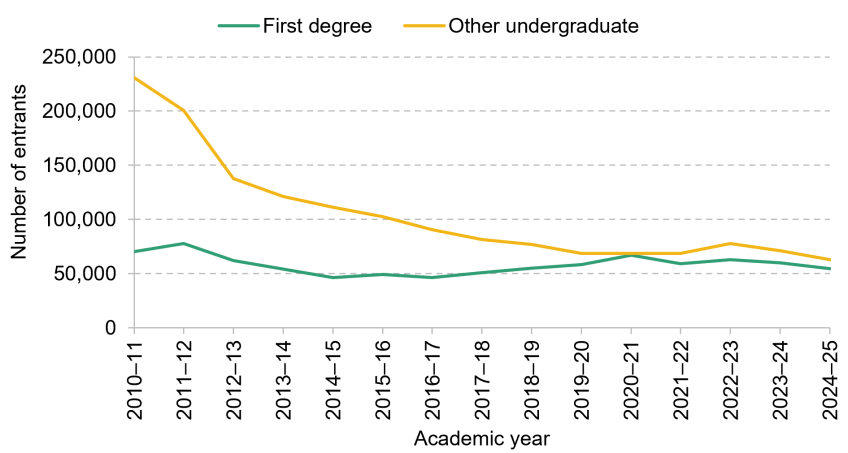
Note: Figures show first-year student enrolments by part-time students at UK higher-education providers, by level of study. ‘First degree’ covers bachelor’s-level undergraduate qualifications. ‘Other undergraduate’ covers all undergraduate study below first-degree level, including foundation degrees, HNCs/HNDs and Certificates and Diplomas of Higher Education.
Source: For 2010–11 to 2014–15, figures are from Higher Education Statistics Agency (HESA) annual Statistical First Releases, ‘Higher education student enrolments and qualifications obtained at higher education providers in the United Kingdom’, Table 2 (first-year student enrolments by level of study, mode of study and domicile). For 2015–16 to 2019–20, figures are from HESA, ‘Higher Education Student Statistics: UK, 2019/20’ (SB258). For 2020–21 to 2024–25, figures are from HESA, ‘Higher Education Student Statistics: UK, 2024/25’ (SB273).
Alongside this fall in participation lies a concern about the shape of post-18 education in England. Under the current system, participation is heavily weighted towards three-year bachelor’s degrees, with comparatively little study at levels 4 and 5 – the ‘missing middle’. Adults in England are around half as likely as those in Germany, and a quarter as likely as those in the United States, to start an advanced technical qualification at this level (see the article in the IFS Deaton Review of Inequalities by Farquharson, McNally and Tahir on education inequalities). In 2025, the government set a target of at least 10% of young people entering higher technical education or an apprenticeship by age 25 by 2040, roughly double the current share (see the analysis by Ogden and Tahir). The LLE, though its announcement predates this target, is one of the levers intended to support this goal.
What impact might the Lifelong Learning Entitlement have?
The theory of change behind the LLE is that loosening the conditions on student finance will reduce the barriers to adult learning. Whether it does so depends in part on how important financial barriers are in preventing adult learning. Among UK adults not recently engaged in learning, the share who cited cost as a major barrier rose from 8% in 2019 to 24% in 2025 (see the Adult Participation in Learning Survey), which suggests that finance is an important consideration. But cost ranks behind two more commonly cited factors – feeling too old to learn (31%) and simply not wanting to (29%) – which reflect a lack of inclination rather than an obstacle that could be removed. Among those who are interested in learning, then, cost is likely one of the most significant barriers. But it is not the only one the survey identifies: time pressures (15%) and low confidence (10%) are also commonly cited barriers, which are unlikely to be addressed by extending loan funding.
Evidence from recent Department for Education trials of modular learning offers an early indication of demand. A 2022–23 higher education short course trial, designed to test demand for shorter, more flexible study, expected over 2,000 enrolments but drew only 125 learners. A second trial in 2024–25, the Modular Acceleration Programme, enrolled 352 against an expectation of 1,800, despite tuition being free. These figures suggest demand for the type of modular learning that the LLE will support is weak at present, but they are an imperfect guide to the longer term. Take-up may build as provision becomes more established and as any employer demand becomes clearer.
Whether that demand materialises will also depend on the value of the provision, and whether it offers a route to further qualifications or employment. This will depend in part on whether employers and learners come to value modules in their own right. It will also depend on whether individual modules can be combined into recognised pathways and whether suitable courses are available locally. Beyond requiring a standardised transcript, the government has left much of the development of these pathways to providers and the market. The extent to which useful, valued modular provision develops will therefore be important in determining whether the LLE generates sustained demand for a new type of learning.
The changes brought about by the introduction of the LLE will also have implications for the cost of student finance, but it is not at all clear what the eventual fiscal cost of these changes will be. If the LLE has little or no effect on the training that adults undertake, the government will spend somewhat more on maintenance support (in the form of loans) for level 4 and 5 courses and loan funding for modular courses, but overall short-run spending on tuition will be broadly unchanged. If the LLE encourages significantly more training and study, including new demand for modular training, the total short-run cost could rise quickly. Over the longer term, impacts on people’s earnings – and thus their loan repayments – will also have a major effect on the overall cost. So far, the government has not provided any estimate of either the additional loans it expects to issue or the share of these that will ultimately be written off.
Summary
The LLE brings together several changes to the post-18 education funding system. Whether the benefits of these changes will outweigh the costs to the state is not clear. Removing ELQ restrictions and introducing modular funding should make the system more flexible and provide adults with more opportunity to retrain. But the LLE is ultimately a change to the terms on which student finance is offered, and finance is only one of the barriers that prevent adults from participating in education. For some of the learners it is intended to reach, a loan may not be the instrument most likely to change behaviour. Its impact will also depend on whether modular study leads to recognised qualifications, employment and worthwhile returns, with much of this left to the market to determine. How far the LLE shifts participation will therefore depend as much on these conditions as on the funding it provides.
Authors

Imran Tahir
Imran joined the IFS in 2019 and works in the Education and Skills sector.
More from IFS
Understand this issue


Policy analysis


Academic research


