
The Chancellor, Rachel Reeves, is widely thought to be faced with a much-increased forecast for borrowing ahead of this November’s Budget. This means she must cut spending and/or increase tax revenues in order to stay within her fiscal rules. Ms Reeves hassaid that she is considering both options. There has been some speculation that any spending adjustment could include cuts to departmental spending plans (as well as, or instead of, changes to spending on benefits).
Cutting departmental spending plans could deliver significant savings to the exchequer. Cuts to the planned level of day-to-day spending would help the government to meet both of its fiscal rules: the debt rule, according to which debt must be forecast to fall as a share of national income in 2029–30, and the borrowing rule, according to which the government must be forecast to achieve a current budget surplus in 2029–30. Cuts to the planned level of investment spending would help to meet the debt rule, but not the borrowing rule, which excludes investment spending.
In this piece, we discuss some of the options available to the Chancellor on departmental spending and the associated challenges, including whether any paring back of spending plans would be seen as credible and deliverable, and how any changes could affect the Spending Review process going forward.
Current plans for departmental spending
Departmental spending is composed of two parts: day-to-day (or resource) spending and investment (or capital) spending.1 This year, day-to-day departmental spending is planned to be £520 billion, while departmental investment spending is planned to be £130 billion. Figure 1 shows how both are planned to change over the rest of this parliament. Day-to-day spending (shown by the green bars) is set to grow at 1.8% in real terms (i.e. over and above inflation) between 2025–26 and 2026–27 and then by 1.0% per year up to 2029–30, equating to an average of 1.2% per year over the period as a whole. Investment spending (shown by the yellow bars) is set to grow slightly more quickly over this period, at an average of 1.8% per year in real terms. Growth is planned to be highest in 2026–27, at 6.9%, and much lower in later years. Plans for both day-to-day and investment spending are ‘front-loaded’, with faster growth in earlier years and slower growth later.
Figure 1. Planned annual real-terms growth rates in departmental spending, 2026–27 to 2029–30

Note: HM Treasury measure of Resource DEL excluding depreciation and Capital DEL.
Source: Authors’ calculations using Spending Review 2025 and GDP deflators September 2025.
At the Spending Review in June, the government allocated these total spending envelopes to individual government departments. Day-to-day spending was allocated to departments until 2028–29, with no department-level allocation for day-to-day spending in 2029–30. The government allocated capital spending to departments for an additional year, meaning that detailed departmental allocations exist for investment spending over the whole period.
Cutting day-to-day spending in 2029–30
The path of least resistance for the Chancellor might be to cut the overall level of day-to-day spending planned for 2029–30. Because departmental allocations have not yet been agreed for that year, she would not need to specify exactly where the cuts would fall; she would simply reduce the overall total (the ‘envelope’). This would also avoid the need to reopen the settlements painstakingly agreed with her Cabinet colleagues in June, which were set for the next three years in order to provide departments and public service providers with greater certainty over their budgets.
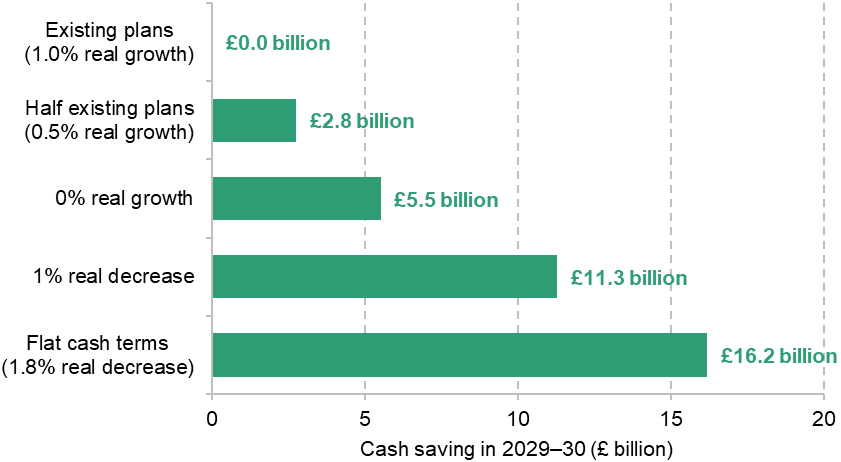
Figure 2 shows the savings that could be made under various scenarios for cuts to day-to-day spending plans. Current plans imply that day-to-day spending will grow at 1.0% in real terms between 2028–29 and 2029–30. Halving this growth to 0.5% would deliver a £2.8 billion saving, while holding spending flat in real terms would deliver a £5.5 billion saving (under the Office for Budget Responsibility (OBR)’s March inflation forecast). The government could, of course, go further – for example, holding spending flat in cash terms, equivalent to a 1.8% real-terms decrease under the OBR’s March forecast, would save £16.2 billion in 2029–30.
Figure 2. Savings from various changes to day-to-day departmental spending plans in 2029–30
Source: Authors’ calculations using Office for Budget Responsibility’s March 2025 Economic and Fiscal Outlook, HM Treasury’s Spending Review 2025, and GDP deflators September 2025.
The problem with pencilling in tighter spending totals in 2029–30 alone is that it could lack credibility: observers – including bond market investors and the OBR – might conclude that those cuts are unlikely actually to happen. This would be particularly true if plans were reduced substantially with no sense of how cuts would be delivered. This is for two main reasons.
First, just staying within existing plans in 2029–30 might require real-terms cuts to departments outside of the NHS and the Ministry of Defence. Reducing the spending envelope for 2029–30 would make these real-terms cuts to some areas even more likely, making overall spending plans harder to allocate and deliver. If spending plans are not viewed as deliverable, they will not be viewed as credible, with implications for how the government’s wider fiscal forecasts and policy package are viewed.
Second, past experience strongly suggests that if the government were to pare back planned spending levels in 2029–30 without giving any detail, the most likely outcome is spending top-ups further down the line. Successive governments have pencilled in slower spending growth in future years and gone on to top up plans when it came to actually allocating funding to departments. Since 2016, in particular, departmental spending has consistently exceeded what was originally planned, which has been a key reason why borrowing has tended to overshoot OBR forecasts.
There is an additional consideration at this Autumn Budget. Since last year, the OBR has explicitly been allowed to forecast departmental overspends as well as departmental underspends. Given the relatively slow growth already pencilled in for 2029–30, and the weight of historical experience when it comes to plans being topped up, the OBR might plausibly choose to make use of this new power and assume some portion of the cuts would be offset by a departmental overspend. In this case, the savings in the official forecasts would be much reduced.
Cutting budgets already allocated to departments
One alternative to cutting unallocated day-to-day spending in 2029–30 alone would be to change spending plans over the whole parliament, including those years covered by the 2025 Spending Review. We show a (non-exhaustive) set of scenarios for a cut in average spending growth over the period in Figure 3.
Figure 3. Savings from changing spending plans between 2025–26 and 2029–30

Note: Real growth rates here refer to annual average real growth rates between 2025–26 and 2029–30.
Source: Authors’ calculations using Spending Review 2025 and GDP deflators September 2025.
Starting with day-to-day spending (the green bars), current plans imply an average growth rate of 1.2% per year in real terms between 2025–26 and 2029–30. Reducing that to 1.0% would save £3.7 billion in 2029–30, while halving it to 0.6% would save £13.3 billion. Holding day-to-day spending flat in real terms would deliver a much larger £26.3 billion.
The yellow bars show a set of savings that could be made from different cuts to investment spending plans. Reducing the planned real-terms growth rate from 1.8% per year to 1.5% between 2025–26 and 2029–30 would save £1.8 billion in 2029–30, while halving it to 0.9% would save £5.3 billion. Holding investment spending flat in real terms could save £10.5 billion by 2029–30. It is worth noting that while investment spending cuts would save the government money, they would not make it any easier to meet the government’s borrowing rule (the fiscal rule that currently binds), as it excludes borrowing for investment.
This option would be more transparent than only pencilling in unspecified cuts to overall day-to-day spending in 2029–30, and would likely be viewed as more credible (i.e. likely to happen) as a result. It would also avoid any sharp cut between 2028–29 and 2029–30, by instead smoothing any cuts across the period.
Reopening Spending Review settlements so soon after having agreed them, though, would be far from optimal. The point of a multi-year Spending Review is to provide certainty and stability to departments so they can plan their spending more effectively. Making significant changes so soon after agreeing them would clearly undermine that, and would likely undermine the effectiveness of, and trust in, the Spending Review process more generally. One intermediate option might be to reopen only the settlement for 2028–29, as these settlements will be revisited at the 2027 Spending Review in any case, and this would still leave departments with more certainty for the next two years. It would, however, still require either a negotiation with departments (if cuts for 2028–29 are spelled out) or an unspecified cut that would do little to build credibility (if they are not).
Importantly, this government’s existing plans for public service improvements are reliant on delivering historically high productivity gains. It is unlikely that spending plans could be substantially cut back and the same level of public service performance achieved. If the Chancellor were to cut back departmental spending considerably, that would need to be accompanied by a reduction in ambition for at least some areas of public service performance.
Conclusion
Cutting the planned level of departmental spending, so that it grows more slowly, is one way that Rachel Reeves could deliver a fiscal consolidation at this November’s Budget. This could deliver considerable savings and reduce the extent to which tax rises are required. That would be a reasonable choice. The challenge is that detailed department-level spending plans up to 2028–29 were published very recently, at June’s Spending Review.
The Chancellor could reopen the settlements agreed over the summer and cut back departments’ budgets for the next few years, but would have to accept reduced public service performance, a backlash from Cabinet colleagues, and potential damage to the Spending Review process itself (which is, after all, supposed to provide certainty and stability to public service leaders).
Alternatively, she could pencil in unspecified cuts to day-to-day spending for the next Spending Review period, and avoid having to spell out where the cuts will fall. That might be the path of least short-term resistance, but would risk a sceptical reaction from both bond market investors and the Office for Budget Responsibility – who might reasonably look at past experience and conclude that such cuts are simply unlikely to happen. That risk would be especially high if the planned spending cuts were substantial and formed a large part of any fiscal consolidation package.
Endnotes
Authors

Bee Boileau
Bee joined the IFS in 2021 as a Research Economist and works in the Retirement, Saving and Ageing sector.

Max Warner
Max joined the IFS in 2020. His work covers health and social care, public spending and public sector productivity.

More from IFS
Understand this issue


Policy analysis


Academic research


