
Downloads
Download the report as a PDF
PDF | 1.06 MB
Preface and note on interviews
The author gratefully acknowledges the financial support of the Joseph Rowntree Foundation (240302AD), the ESRC Centre for the Microeconomic Analysis of Public Policy (ES/Z504634/1) and the ESRC Impact Acceleration Account (ES/X005283/1).
The project benefited enormously from discussions and interviews with a range of experts and stakeholders, all of whom were generous with their time and feedback. The author is hugely grateful to all who agreed to participate. Some wished to remain anonymous; a list of all other interviewees is provided in the appendix. The views and opinions expressed in this report do not reflect those of the interviewees (indeed, some expressed misgivings about the proposals), and any mistakes and/or analytical errors are entirely the author’s own.
The author expresses particular thanks to Chris Belfield and Alfie Stirling at the Joseph Rowntree Foundation, Helen Miller and Nick Ridpath at IFS and an anonymous referee for valuable feedback on an earlier draft, and to the wider IFS staff for their support throughout.
Executive summary
The central contention of this report is that the UK fiscal framework has some desirable features but is not delivering good outcomes. We are in a bad equilibrium.
The UK’s fiscal framework is based around a set of pass–fail, numerical fiscal rules. The fiscal debate is overly fixated on the amount of ‘headroom’ the government has against the most binding of those rules. The system incentivises the government to operate with the smallest amount of ‘headroom’ possible, with policy often fine-tuned according to the central point estimate of a highly uncertain forecast from the Office for Budget Responsibility. When the forecast improves, any additional ‘headroom’ is typically spent; when the forecast worsens, Chancellors of all political hues are adept at meeting the letter of the rolling fiscal targets by promising spending cuts or tax rises for future years – or the rules simply get changed.
Put differently, the framework and the way it has come to be operated mean that when forecasts move around – as they inevitably do – policy has to respond, often in a rush and with a spurious degree of precision. This does not make for good policymaking, it does not ensure sustainable public finances, and it stretches credulity and credibility with financial markets. We are living through a tough fiscal moment, but it is hard to believe this is the best we can do.
This report argues that the UK would be better served by a new framework based around a set of ‘fiscal traffic lights’, used to monitor performance against broad fiscal objectives and principles set out in a high-profile Statement of Fiscal Strategy at the start of each parliament. The overarching aim would be to create the conditions for better fiscal policymaking and a better fiscal debate while maintaining – or building – credibility with bond market investors.
This is a proposal for the medium-to-long term, and not an argument for immediate reform. The current set-up has its shortcomings, but to abandon the current fiscal rules at the present moment would very likely be interpreted by financial markets merely as an attempt by the government to relax its fiscal constraints and borrow more – which is not the point of this proposal. Only from a position of strength and credibility – ideally having delivered a current and/or primary budget surplus – should such a change be considered. In the nearer term, a set of fiscal traffic lights could be developed and operated in parallel with the existing system over the remainder of this parliament, to iron out issues, build understanding, and facilitate a full transition at the point when the fiscal rules next come under review.
Key findings
- There is no such thing as an ‘optimal’ fiscal framework: there are always trade-offs between competing objectives. It is not possible for a fiscal rule to simultaneously be (1) simple and easily communicable, (2) flexible enough to allow for countercyclical fiscal policy and appropriate responses to adverse shocks, and (3) enforceable as a binding constraint on policy.
- Nor is there a single measure that can tell you whether a country’s public finances, or its fiscal policy, are sustainable – and excessive focus on a particular measure can create perverse policy incentives. While driving, you cannot assess whether you are driving safely solely by looking at the speedometer: you also need to worry about traffic conditions, the state of the roads, the condition of the car, the weather, and much else. So it is with fiscal sustainability.
- The current UK fiscal framework has some attractive features and is by no means a disaster. The broad division of responsibilities between HM Treasury and the Office for Budget Responsibility (OBR) should be retained, as should the commitments to holding a single major fiscal event per year and to setting out multi-year departmental budgets at biennial Spending Reviews. The adverse shocks of the last two decades would have posed challenges to any framework. But we are in a bad equilibrium.
- Under the current system, the limit on borrowing imposed by the fiscal rules has instead become a target. There is an extremely unhelpful focus on the amount of so-called ‘fiscal headroom’ against this single, moving numerical target under the OBR’s central forecast, and policy is overly responsive to changes in estimated ‘headroom’. Any increase in ‘headroom’ from a forecast improvement tends to get spent. Whenever a particularly bad shock comes along, or the government changes, the rules are changed, which undermines their credibility. The targets are typically expressed on a rolling basis, the result being that any policy tightening is always promised in future but rarely – if ever – actually delivered. This framework is achieving neither sustainable public finances nor credibility with financial markets. Nor does it deliver policy stability or incentives for good policymaking. We can and should do better.
- Many of these problems stem from the combination of having a hard, numerical, ‘bright line’ rule and aiming to meet it almost exactly (with small amounts of so-called ‘headroom’). Macroeconomic forecasts are inevitably volatile. The issue is that under the current set-up, forecast volatility feeds through almost one-for-one into policy volatility. That is, tax and spending policy is tweaked and fine-tuned in response to movements in the OBR’s central forecast. This makes for rushed and lower-quality fiscal policymaking, undermines the credibility of the broader framework and unnecessarily adds to economic uncertainty.
- Recent moves to modestly increase the amount of ‘headroom’ and to have a single annual assessment of performance against the fiscal rules are an improvement on the previous status quo, but are an unsatisfactory solution to the underlying problem. Even if a larger buffer can be maintained in the face of acute spending pressures, the unhelpful concept of ‘headroom’ will remain entrenched at the centre of the fiscal debate and policymaking process. There is also a risk that some other arbitrary amount of ‘headroom’ will take on undue significance as the new focal point dominating the debate: it might simply move the line in the sand. And while having only one ‘headroom’-focused, forecast-chasing fiscal event per year is better than having two, it would be better still to address the source of the dysfunction.
- The central argument of this report is that the UK would be better served by a new framework based around a set of fiscal principles or standards, monitored by a set of ‘fiscal traffic lights’. Under this proposal, at the start of each parliament, and then at regular intervals (perhaps every three years), the Chancellor would give a high-profile set-piece speech, called something like a Statement of Fiscal Strategy. Here, he or she would outline the government’s broad fiscal strategy and high-level objectives. These objectives would be expressed in narrative terms as a direction of travel for the parliament, rather than as precise numerical targets with dates attached. This approach would draw from the concept of ‘fiscal standards’ (previously proposed for the EU), and from the ‘principles of responsible fiscal management’ underpinning the fiscal framework in New Zealand. One aim of this would be to give financial markets a better sense of the government’s fiscal policy reaction function, and what the Chancellor thinks good, responsible fiscal policy looks like.
- In an accompanying document, the Treasury would specify a set of economic and fiscal indicators (perhaps eight to ten) against which fiscal policy would be assessed and monitored. These would vary depending on the context and the government’s broad objectives, but would in all cases be expected to include measures of borrowing, debt and debt interest, and to be constructed for multiple years of the forecast. At each fiscal event, the OBR would be tasked with producing forecasts for each of these indicators, and describing the outlook for each using a gradated red–amber–green traffic light system (with the definitions of what constitutes red, amber and green provided by the Treasury, not the OBR, ideally after consulting externally), to help communicate the broad fiscal picture in an intuitive and understandable format. These traffic lights would become the centrepiece of the OBR’s assessment at each fiscal event (rather than the pass–fail judgement of performance against the single most binding rule, which takes centre stage at present). This approach would draw upon the methods used by the International Monetary Fund to assess fiscal space, and upon the assessments of debt risk carried out by credit rating agencies. An illustrative set of traffic lights can be found in the report.
- This is not an argument that the government ought to be running a different fiscal stance, and the point is not to introduce a multitude of precise, pass–fail targets. Instead, the aim is to shift the focus and emphasis onto a broader assessment and a wider set of indicators, and in so doing reduce the extent to which policy – and the policy debate – focuses on a single metric above all else. It would, hopefully, allow for a more nuanced and holistic debate, and one less focused on unhelpful discussions about ‘fiscal headroom’, ‘election war chests’ and ‘black holes’. The government might choose to argue that having indicator 1 flashing red is fine, because indicators 2 and 3 are flashing green, for example.
- The overarching objective would be to maintain – or improve – credibility with financial markets while improving the incentives facing policymakers. Credibility would be based upon transparency and an intelligent explanation of conduct and thinking, rather than on an arbitrary mathematical rule. There would be less incentive to contort policy in pursuit of a precise value for a single imperfect metric in a single year of the forecast, and – depending on the indicators chosen – there could be more incentive to address longer-term challenges and issues that are generally ignored by the current framework. At a minimum, a reformed framework could take some of the sharper edges off the most unhelpful incentives facing policymakers. It would formalise and make explicit the fact that governments pursue multiple fiscal policy objectives, beyond just the fiscal rules. And, by reducing the emphasis on a single ‘headroom’ number, and the sensitivity of policy to it, such an approach would also help to address the perception that the OBR’s forecasting judgements are de facto setting government policy.
- Such an approach would not be without downsides – there is, after all, no such thing as an optimal framework – and would undoubtedly create new challenges. The key risk is that a traffic light approach might provide less of a guard against deficit bias. This is a legitimate concern, though the bond market would remain as the ultimate constraint on government policy, and any downsides (a reduced guard against deficit bias) need to be weighed against potential benefits (a less dysfunctional approach to fiscal policymaking). There will always be trade-offs; the argument here is that they are trade-offs worth making. Other risks, practical concerns and alternative approaches are discussed in the report.
- Ultimately, there is no substitute for good governance, and a government determined to do so could find a way to abuse this – or any other – framework. But the current equilibrium is producing such dysfunction that the time has come, in this author’s view, to try something new.
- It is crucial to note that this is not a proposal for reform in the short term. Only from a position of strength and well-established credibility should such a change be considered. Ideally, the government would have delivered and sustained a primary surplus and/or current budget surplus before making the move to a traffic light system. These proposals are therefore aimed more at the next (post-2029) parliament, on the assumption that the UK’s fiscal credibility – still damaged by the events of 2022 – has been restored by that point. In the nearer term, there would be a strong case for running the traffic light process in parallel with the current system for the remainder of this parliament, to iron out issues and build understanding ahead of a full transition at an opportune moment in future.
1. Introduction
Fiscal policy is difficult. Policymakers invariably face multiple competing objectives and operate under a cloud of uncertainty about the future. The economics is inextricably bound up in political questions of fairness and the distribution of resources; long-term considerations can bump up against short-term imperatives; and the tools available are often blunt and slow to take effect. The starting point for any discussion of fiscal policymaking has to be that none of this is easy and that there are no unambiguously right answers.
It is, all the same, difficult to escape the conclusion that the UK is in a bad equilibrium when it comes to fiscal policy. The fiscal framework, the norms which have developed around it, and the way in which policy is debated and made all leave much to be desired. This point should not be overblown: the current set-up has many attractive features, and we could certainly do far worse. But we could also surely do better.
The UK’s fiscal framework is based around a set of pass–fail, numerical fiscal rules. The fiscal debate is almost entirely fixated on the unhelpful concept of ‘fiscal headroom’: the amount by which the most binding of those rules is being met under the Office for Budget Responsibility (OBR)’s central forecast. Relatedly, and more concerningly, policy is increasingly dictated by changes in ‘fiscal headroom’. Governments are generally incentivised to operate with the smallest possible amount of ‘headroom’ and aim to meet their rules almost exactly, which means when macroeconomic forecasts move around – as they inevitably do – policy has to respond, often in a rush, and with a spurious degree of precision.
In other words, the current framework means that macroeconomic volatility is mainlined into policy volatility, which adds unnecessarily to economic uncertainty and makes good policymaking less likely. There is also a problem of asymmetry: when the forecast improves, any additional ‘headroom’ is typically treated as free money and happily spent. Yet when the forecast worsens, the rules tend to get changed or ‘gamed’: Chancellors of all political stripes have proved adept at promising future tax rises or spending cuts which are unlikely to be delivered, but which allow them to meet the letter of their rolling fiscal targets.
All this is to say, the current framework is not delivering good outcomes. It is not achieving sustainable public finances, it has limited credibility with financial markets, and it is not creating the conditions for good policymaking or for a high-quality public debate about the important issues at play. It seems likely that any framework, left in place for long enough, will start to create problems in practice, as unhelpful norms emerge and actors find ways to game the system. Just as the tendency of HM Treasury to fudge its forecasts in the 2000s was one reason for the creation of the OBR as a corrective mechanism, the dysfunction around the current framework necessitates a change in thinking and approach.
The point of this report is to lay out the problems with the UK’s existing fiscal framework and to provide a constructive suggestion of how we might do things differently – acknowledging throughout that there is no such thing as an ‘optimal’ framework, that reasonable people can disagree on the right route forward, and that the timing of and context for any reform would be of critical importance. This is not an argument for the UK running a different fiscal stance. Nor is it an argument for immediate reform, given bond market fragilities at the time of writing. It is an argument that in the longer term, the UK would be better served by a broader framework which breaks us out from our unhelpful obsession with ‘fiscal headroom’, and that we should start thinking now about how to get there.
I start in Chapter 2 by considering why governments have fiscal rules at all and by discussing the trade-offs inherent to the design of any fiscal framework. I then provide an analysis of the problems with the UK’s current fiscal framework in Chapter 3, with a particular focus on the problems associated with the obsession with ‘fiscal headroom’. I then suggest a proposal for reform in Chapter 4, with an outline of an alternative framework based on two pillars: the introduction of a principles-based Statement of Fiscal Strategy, coupled with a ‘traffic light’ approach to monitoring. In Chapter 5, I consider a range of counterarguments against this proposal, and some of the practical concerns it might raise. While trade-offs are inevitable, I argue in each case that a traffic light approach would be preferable to the alternatives and an improvement on the current state of affairs. Chapter 6 concludes.
2. Trade-offs in the design of a fiscal framework
Fiscal rules are constraints on fiscal policy defined in terms of a numerical limit on some sort of budgetary aggregate (such as borrowing, debt or spending). They are a widely used policy tool: more than 100 countries had at least one fiscal rule at the end of 2021 (Davoodi et al., 2022). In this chapter, I briefly discuss the rationale behind fiscal rules, before considering some of the key trade-offs in their design and operation. This is important context for the discussion and recommendations which follow.
2.1 Why have fiscal rules?
Fiscal rules as a commitment device
The canonical justification for fiscal rules comes from the concept of ‘deficit bias’. Simply put, this is the idea that, left to their own devices, governments will tend to spend more and/or tax less than is in the country’s long-term interests.
Why do governments display deficit bias? The classic explanation lies in the concept of ‘time inconsistency’.1 Governments – like people – care more about the present than the future. A government might decide to spend more and/or tax less in the short term (to a degree not justified by a countercyclical response to macroeconomic conditions) and then plan to behave more responsibly in future. The problem is that when the future comes around and becomes the present, they no longer wish to behave responsibly.2 What might have appeared optimal at one point in time no longer appears optimal when viewed later on. This plays on repeat, and the result is short-termism and deficit bias. This can be exacerbated by the electoral cycle, with governments particularly unwilling to cut spending or raise taxes in the run-up to an election, preferring to defer any tough choices for further down the line (especially if it is an election the government expects to lose).3 This is not a universal law – there have been occasions in the UK, for example, where politicians have sought to make a virtue of tighter fiscal policy – but deficit bias is a commonly observed and well-established phenomenon.
Fiscal rules are one means of counteracting deficit bias, by serving as a commitment device. They tie policymakers’ hands, and limit their ability to tax less or spend more than is socially optimal – even when the government is tempted to do so. By constraining policymaker discretion in this way, fiscal rules can curtail growth in government debt.4
Fiscal rules can be a particularly effective commitment device when they are consistently adhered to for an extended period. That is, a government may follow the rule because it does not want to set a precedent for future governments that the rule can be abandoned when politically expedient. Sticking to the rule raises the costs to future governments of breaking the rule, and it becomes self-reinforcing. Conversely, one government breaking the rule might make it easier for the next government to break the rule, meaning that rules that are frequently changed are less effective as a commitment device.
Fiscal rules as a signal to voters
Fiscal rules can also be used by governments as a signal to voters of their intention to maintain fiscal discipline. The core idea is that when there is asymmetric information between government and the voting public (i.e. voters do not have complete information about politicians’ motivations and competence), fiscal rules are a way for policymakers to signal that they are competent and will not be profligate with public money. Debrun and Kumar (2007a) present a model in which fiscal rules, by acting as a signalling mechanism, encourage policymakers to behave in a manner consistent with voters’ underlying preferences for good fiscal behaviour, and strengthen the electoral reward for such behaviour. Debrun and Kumar (2007b) find some empirical evidence consistent with this hypothesis. In some sense, this is in tension with the idea that people – voters and politicians alike – tend to be present- and deficit-biased. However, the prominence of fiscal rules in UK political debates and election campaigns suggests that politicians do see fiscal rules as a means of signalling their fiscal prudence and credibility to voters, even if those same politicians display deficit bias once in office.
Fiscal rules as a signal to financial markets
Governments are ultimately constrained by the need to service their debt and by what financial markets are willing to lend them (and at what price). It therefore matters how financial market participants perceive government fiscal policy. Fiscal rules can be thought of as a means by which governments signal to financial markets that they intend to behave responsibly. There are multiple ways to frame this argument, but the key idea is that by signalling fiscal restraint in a credible way, governments can reduce the risk premiums on their debt and so bring down borrowing costs. In other words, a credible pre-commitment to fiscal discipline can act to (marginally) loosen the government’s fiscal constraint. Fiscal rules are one way (but not the only way) that governments seek to make such a pre-commitment, and there is some academic evidence to support the idea that fiscal rules can reduce sovereign risk premiums and borrowing costs (Iara and Wolff, 2014; Badinger and Reuter, 2017; Afonso and Jalles, 2019; Potrafke, 2025). Financial market participants’ views of the UK’s fiscal rules and fiscal framework are discussed in more detail in Box 3.1.
Fiscal rules as a means of encouraging better use of borrowing
One way to think about fiscal rules is as a tool for making it easier for governments to borrow for good reasons, but harder to borrow for bad reasons (Emmerson and Stockton, 2021). There are some circumstances where deficit finance is appropriate or desirable – for example, borrowing to stimulate the economy during a downturn or to finance spending that delivers long-term benefits to future generations – and fiscal rules can be designed, in theory, to facilitate or encourage this, while discouraging irresponsible borrowing which lacks an economic rationale.
This can bring benefits. Academic evidence suggests, for example, that by constraining policymakers’ ability to implement large tax or spending changes unrelated to the economic cycle, fiscal rules can reduce macroeconomic volatility and raise the rate of economic growth (Fatás and Mihov, 2003 and 2013). A well-designed set of fiscal rules could provide incentives for policymakers to respond appropriately in a crisis – for example, by encouraging a gradual rather than sharp fiscal adjustment, as suggested by tax smoothing theory (Barro, 1979), or by encouraging (or at least facilitating) a fiscal stimulus in the case where interest rates are at the zero lower bound (Portes and Wren-Lewis, 2015; Furman, 2016; Hill and Nangle, 2020). Poorly designed rules could, of course, provide poor incentives.5
Fiscal rules as a tool for spending control
One source of deficit bias within governments is the common pool problem, which can be thought of as a version of the ‘tragedy of the commons’. This occurs when different actors – for example, political parties in a coalition or spending ministries within a government – lobby for more spending on their particular area, without internalising the shared financing costs. It can also be thought of as coming from voters themselves, with interest groups vying for spending that benefits them under the assumption that the taxes will be paid mostly by others, or by future generations (Wyplosz, 2012).
This relates to another function of fiscal rules: they are a means of dealing with the common pool problem by strengthening the hand of the finance ministry (in the UK’s case, HM Treasury) in spending negotiations. In other words, they make it easier for HM Treasury to say ‘no’ to spending departments. This is particularly true when the government is operating with minimal room for manoeuvre against its numerical rules (a point to which I shall return below).
Put differently, fiscal rules are one way to get Cabinet ministers to coordinate and sign up to an overall constraint on borrowing, and force them to (better) internalise the costs of their actions and to make trade-offs. Or, in an election campaign, the inclusion of fiscal rules in a party’s manifesto is one means of forcing MPs to sign up to an accepted budget constraint (as well as a means of signalling to voters). This internal function for fiscal rules is less prominent in the academic literature but is crucial for understanding their appeal to HM Treasury in practice.
2.2 Trade-offs and trilemmas
Commitment versus flexibility
There is an inescapable trade-off when it comes to fiscal rules. Governments with full discretion to set fiscal policy will be prone to deficit bias. Fiscal rules aim to counteract the short-term incentives inherent to policymaking and act as a guard against deficit bias. But stringent fiscal rules limit governments’ ability to respond to shocks. Because not all shocks can be conceived of and planned for ahead of time, it is desirable to retain some degree of policymaker discretion – but the greater the degree of discretion, the less of a guard is provided against deficit bias. This central trade-off is often described as being between commitment on the one hand and flexibility on the other (Yared, 2019). All attempts to put constraints on fiscal policy require making trade-offs between these competing goals.
Put differently, economic theory suggests that constrained discretion over fiscal policy is likely to deliver the best outcomes. But that still leaves the question of how much constraint and how much discretion, and how to operationalise this in practice.
The fiscal rule trilemma
One particularly useful way of thinking about the trade-offs inherent to the design of fiscal rules comes from Debrun and Jonung (2019). The authors argue that there are three desirable properties of fiscal rules:
- simplicity, so that rules can be understood by policymakers and communicated to markets, members of the government and the public;
- flexibility, so that governments have the ability to respond appropriately to shocks and support other macroeconomic objectives;
- enforceability, so that the rule acts as a binding constraint and can be used to compel observance or compliance.
The challenge is that it is not possible to simultaneously achieve all three.6
To see this ‘trilemma’ in action, consider the following. Balanced budget targets with fixed dates attached are more enforceable, but provide less flexibility to respond to shocks that occur close to the target date. That is, they might ensure that borrowing is at the target level, but at the cost of constraining fiscal policy when it ought not to be constrained (e.g. in a recession). An escape clause could be written into the rules to add flexibility for countercyclical policy in the case of a recession without the rule being breached, but this would add complexity. Similarly, defining the target in terms of a cyclically adjusted borrowing target, or in terms of borrowing over the business cycle, might bring additional flexibility, but would make the rules more complex and harder to explain. A rolling target for the (non-cyclically-adjusted) deficit provides more flexibility to respond to short-term shocks and is (somewhat) simpler, but serves as less of a binding constraint: any tightening can be continually pushed further into the future. And so on.
The point is that these objectives are in tension with one another, and governments must strike a balance between the three. This is difficult. In the words of Olivier Blanchard, former Chief Economist at the International Monetary Fund, ‘don’t ask me for a simple rule. Any simple rule will be too simple… And do not ask me for a complex rule. It will never be complex enough’ (Blanchard, 2022). Different countries, at different points in time, will likely wish to strike a different balance between the three – there is no such thing as a one-size-fits-all ‘optimal’ fiscal framework. And country-specific factors (such as institutional structure, or the excessive focus in UK politics on ‘fiscal headroom’ discussed in Chapter 3) need to be taken into account in the design of the system.
2.3 There’s no magic number and no magic metric
Another challenge in the design of numerical fiscal rules is that there is no single metric or number that can tell you whether a country’s public finances are sustainable. There is a risk of losing important nuance if the assessment of fiscal sustainability is boiled down to a single pass–fail rule or to a single number.
There is not, for instance, a single value below which debt becomes unconditionally safe. Nor is there a particular level of borrowing that will deliver sustainable public finances in all states of the world (see Box 2.1 for a further discussion of this point using the standard debt dynamics equation). This is not to say that fiscal rules and fiscal frameworks more generally are useless. As discussed above, they can (if well designed) serve a useful purpose, most obviously in acting as a counterweight to deficit bias. But adherence to a fiscal rule should not be misinterpreted as being sufficient to deliver sustainable public finances.
Box 2.1. Debt dynamics and debt sustainability
Consider the standard debt dynamics equation:
where is the real interest rate, is the real growth rate of GDP, and the primary balance is defined as revenues minus non-interest spending (such that a positive value denotes a primary surplus, and a negative value a primary deficit). The increase in the debt-to-GDP ratio between periods and depends on the difference between the rate of growth and the rate of interest , the debt-to-GDP ratio in period , and the primary balance (the level of borrowing) in period .
When thinking about long-run sustainability, it can be helpful to think about the equilibrium or ‘steady state’. Let us suppose that the government aims for a stable debt-to-GDP ratio (so that the left-hand side of the equation above is equal to zero). We can then rewrite the equation in steady state as
So, if interest rates exceed growth rates then the government needs to run a primary surplus – a positive primary balance – to keep debt stable, and this interest–growth differential matters more when debt is high.a If instead growth rates exceed interest rates (, as was the case until recently), the government can operate with a primary deficit – a negative primary balance – and still maintain a stable debt-to-GDP ratio. If then a primary balance of zero is the debt-stabilising primary balance.b
From this, we can see that a level of debt that is perfectly manageable when growth is high and interest rates are low may become less manageable when the opposite is true, because it would require running a large primary surplus to avoid debt being on an unsustainable path (which may not be politically sustainable). Similarly, having a target for primary balance might be a good rule of thumb when , but in other situations (i.e. for other combinations of and ) it would be inappropriate.
From this we can also see that if there is an upper limit on the primary surplus that a country can sustain (for either economic or political reasons), then it follows that there is a maximum possible sustainable debt ratio. If we define the upper limit on the primary balance as a share of GDP as , we can see that
where is the highest sustainable debt ratio. The problem is, while there are good reasons to suppose there does exist some – not least due to the spending pressures that come with an ageing population and associated political challenges – it is not possible to know exactly where it is. It requires a judgement about future (country-specific) economic and political developments. And, in any case, the maximum sustainable debt ratio still depends on and .
Another way to consider this is through the government’s intertemporal budget constraint, which requires that the net present value of all future primary balances is large enough to pay back the initial level of debt (in period 0). This can be written as
This can equivalently be expressed in terms of the transversality condition, which states that the present value of the debt-to-GDP ratio must remain finite and decline towards zero. Interested readers seeking a formal derivation and discussion are advised to consult Escolano (2010). The key point is that whether or not this condition is satisfied depends on the starting level of debt, but also on the future path for borrowing, on and on . Looking simply at today’s debt-to-GDP ratio or at the level of borrowing is not sufficient.
Put differently, making an assessment of debt sustainability requires long-run forecasts for borrowing (the primary balance), for the real interest rate and for the real growth rate . To forecast any of these is to confront Knightian uncertainty – or ‘unknowable unknowns’. Such a forward-looking exercise is an art, not a science (Wyplosz et al., 2019), and there are a range of possible outcomes for each variable, meaning that such an assessment cannot be boiled down to a single number or metric. In the words of Blanchard, Leandro and Zettelmeyer (2021), ‘there is no single, time-country-invariant, magic debt or deficit number … debt sustainability is fundamentally a probabilistic statement’.
a. For context, the UK government has not achieved a primary surplus since 2001–02.
b. Note also that when the debt-to-GDP ratio is close to 100%, as is currently the case in the UK, and is small (such that ), as is also the case in the UK, then the debt-stabilising primary balance is approximately equal to . So if real interest rates are around 3% and real growth is around 2%, a primary balance of around 1% of GDP stabilises debt. This can be a helpful rule of thumb.
Put differently, to make a meaningful assessment of fiscal sustainability requires looking at a range of fiscal metrics, considering the economic context and forming forecasts of an inherently uncertain future (see Box 2.1). When forming a view as to a government’s ‘fiscal space’ (defined by the International Monetary Fund (2018) as the room for undertaking discretionary fiscal policy relative to existing plans without endangering market access and debt sustainability), measures of financing availability also need to be considered alongside classic measures of debt and deficits. That means also monitoring things such as sovereign bond spreads, the share of debt that is short-term, and the share of debt that is held by non-residents (International Monetary Fund, 2018).
To employ a slightly tenuous analogy to which I shall nonetheless return, while driving, you cannot assess whether you are driving safely solely by looking at the speedometer: you also need to worry about traffic conditions, the state of the roads, the condition of the car, the weather, and much else. So it is with fiscal sustainability. But in the UK, as noted in the recent external review of the Office for Budget Responsibility, the ‘fiscal debate [can] all too readily be reduced to a headline assessment of whether the government will enjoy any “fiscal headroom”’ (van Geest, 2025) – the equivalent of a narrow focus on the speedometer.
There is a further risk of focusing too much on any single metric, which is that it adds to the incentives for government to engage in creative accounting or to design policy in such a way as to ‘game’ the rules (Tetlow, Bartrum and Pope, 2024). In the UK, for example, a narrow focus on debt in the 2010s incentivised the government to sell off the student loan book – allegedly for less than it was worth – in order to reduce the measure of public sector debt used in the fiscal rules (Zaranko, 2023). Further into the past, the widespread use of the Private Finance Initiative (PFI) was motivated at least in part by the fact that the liabilities associated with the PFI did not count (at the time) towards the national debt and the fiscal rules.
This relates to Goodhart’s Law: the adage that when a measure becomes a target, it ceases to be a good measure.7 But in addition to that, every measure – whether a target or not – will be a less appropriate measure in certain states of the world. This is another argument for reducing the attention and focus on any single measure, and instead looking at a range of metrics.
3. Problems with the UK’s current approach
3.1 The UK fiscal framework at present
The Budget Responsibility and National Audit Act 2011 provides the basis for the UK’s fiscal framework. In short, the Act requires the government to set out its fiscal objectives and approach in a ‘Charter for Budget Responsibility’ (which must be approved by the House of Commons), and provides the Office for Budget Responsibility (OBR) with powers to independently examine and report on the sustainability of the public finances. Within this overall framework, different governments have adopted slightly different approaches and fiscal rules (and updated the Charter accordingly).
The current government has based its fiscal approach around two fiscal rules:
- A ‘flow’ rule for the current budget: the current budget must be in surplus in 2029–30, until 2029–30 becomes the third year of the forecast period. From that point, the current budget must then remain in balance or in surplus from the third year of the rolling forecast period.8
- A ‘stock’ rule for public sector net financial liabilities (PSNFL): debt, defined as PSNFL, must be falling as a share of GDP by 2029–30, until 2029–30 becomes the third year of the forecast period, at which point debt should then fall by the third year of the rolling forecast period.
Performance against these fiscal rules is assessed by the independent OBR on the basis of its central forecast (which is central conditional on stated government policy).9
There are a number of other notable features, some of which are recent innovations:10
- A commitment to the principle of holding one major fiscal event per year, coupled with an announcement at the November 2025 Budget that performance against the fiscal rules will from now on be assessed only once a year (with the second forecast to be an ‘interim update on the economy and public finances’) (HM Treasury, 2025 and 2026a).
- A commitment to hold a Spending Review every two calendar years, setting departmental expenditure limits (DEL) in cash terms for a minimum of three years of the five-year forecast period.
- A ‘welfare cap’, intended to act as a cash limit on certain types of social security benefits and tax credits in the final year of the parliament.
- An escape clause, such that in the event of an emergency or significant negative economic shock to the UK, the Chancellor can (after explaining themselves to the OBR and to parliament) suspend the fiscal rules.
- A ‘fiscal lock’, which triggers an ability for the OBR to produce a new forecast without being asked if the government announces permanent, fiscally significant measures outside of a formal fiscal event (with ‘fiscally significant’ defined as having a gross costing – in either direction – of at least 1% of GDP in any financial year).
- A requirement for the OBR to independently analyse and comment on fiscal sustainability with reference to a broader set of metrics (including, but not limited to, alternative measures of the public sector balance sheet).
There are attractive features of this system. There are benefits to having the economic and fiscal forecasts produced by the OBR, independently of HM Treasury, and to the additional transparency that results from the OBR’s scrutiny of policy costings and consideration of risks to the forecast. The new fiscal rules have been thoughtfully designed, and some of the recent reforms address some of the weaknesses of the previous framework. In particular, the commitment to hold a three-year Spending Review every two years makes it more likely that the forecast will be underpinned by credible and deliverable spending plans. Combined with the gradual move from a five-year to a three-year rolling target, this will make it harder to game the rules by promising a fiscal tightening in future years which the government has no intention of delivering. Holding only one major fiscal event per year would be an improvement, if the government can stick to it.
In sum, we could certainly do worse. But this framework, and in particular the way it has come to be operationalised, is producing dysfunctional outcomes. It would be possible to do better. The following sections set out why.
3.2 The ‘headroom’ problem
One major shortcoming of the existing fiscal framework is the amount of focus and emphasis it places on the concept of ‘fiscal headroom’. Defined as the numerical margin by which the government is meeting whichever of its fiscal rules happens to be most binding under the OBR’s central forecast, the concept of ‘fiscal headroom’ has come to dominate the UK fiscal debate (e.g. see Conway (2024)). Even more concerningly, this single, spuriously precise number increasingly appears to be driving fiscal policymaking decisions.
To be clear, the number is not entirely meaningless. There does, ultimately, need to be a central forecast – the government has to make decisions about the future based on something – and if there is a numerical limit imposed on borrowing, then it is helpful to have a sense of how close the government is to hitting that limit. But particular problems arise when governments leave themselves minimal amounts of ‘headroom’, deliberately aiming to meet their numerical rules almost exactly – and this has become the norm.
This is a relatively new phenomenon: Figure 3.1 shows that prior to November 2022, the average amount of ‘headroom’ under the OBR’s forecast was almost three times larger than it has been since (around £33 billion, in today’s terms, versus around £12 billion). There are two primary reasons for this change. The first is that the context has become (even) more difficult, as continued sub-par economic performance has combined with higher debt interest spending, building demographic pressures, and a need for additional spending on defence. The second is policy asymmetry: eroding ‘headroom’ is far easier than rebuilding it. The reduction in ‘headroom’ under the Conservative government in late 2022 has proved difficult to reverse.
Figure 3.1. ‘Headroom’ against fiscal targets in successive OBR forecasts
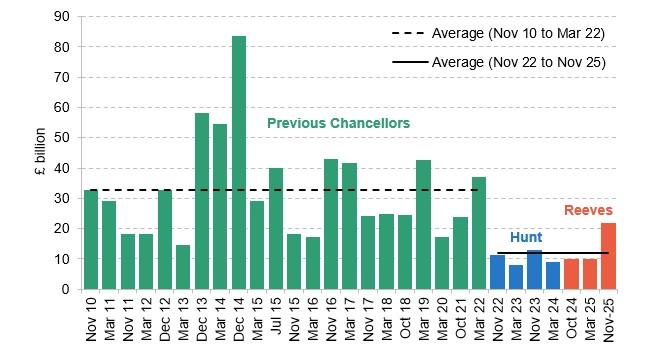
Note: For comparability with ‘headroom’ against the current fiscal mandate, the OBR calculates past margins in per cent of GDP as forecast at the time and multiplies by the latest forecast for nominal GDP. Values for November 2016 and March 2020 use the fiscal rules proposed at the time rather than those legislated. November 2020 and March 2021 are not shown, as the fiscal rules were effectively suspended due to the pandemic.
Source: Chart 7.3 of Office for Budget Responsibility (2025b).
The government, to its credit, increased its ‘headroom’ to around £22 billion at the November 2025 Budget, or around 0.6% of GDP. Putting aside the fact that this is premised on a tight set of spending plans and an assumption that net migration to the UK will remain elevated, it is important to note that this is not an enormous number in the context of the overall public finances. Across the 32 forecasts produced by the OBR since its inception, the average underlying forecast revision in the fourth year of the forecast (i.e. those not caused by classification or policy changes, but by updates to the outlook) was 0.6% of GDP (including revisions in both directions). That is the same size as the ‘headroom’.
Or another way to think about it is that over the period since the creation of the OBR, ‘headroom’ of 0.3% of GDP (as was the case at the March 2025 Spring Statement) would have been wiped out between forecasts on 34% of occasions. ‘Headroom’ of 0.6% of GDP (as was the case at the November 2025 Budget) would have been wiped out between forecasts on 19% of occasions.
The broader issue is that operating with a slightly larger amount of ‘headroom’ would not adequately address the weaknesses of the existing system (something I discuss in more detail in Chapter 5). Next, I discuss some of the specific problems associated with the UK’s focus on ‘headroom’.
The role of ‘fiscal headroom’ in driving policy volatility
Macroeconomic forecasts are inevitably volatile: this is an unescapable feature of making policy in an uncertain world. Bond markets can also be volatile. Similarly, and relatedly, market expectations for the future path of the Bank of England’s policy rate (Bank Rate) have proved volatile in recent years, and these have become an increasingly important determinant of forecasts for the government’s future debt interest bill and fiscal position.11
When governments operate with extremely fine margins against their fiscal rules, as has generally been the case since 2022, even a modest change in the forecast can be enough to shift the government from being just on the right side of its pass–fail fiscal rule to being on the wrong side. If, because of the weight placed on this pass–fail rule by the fiscal framework, the government feels it cannot be on the wrong side of the line, it then adjusts policy (raising taxes or cutting spending plans) in response to that change in ‘headroom’.
As a result, under the current fiscal framework (and the way it is operationalised), forecast volatility feeds through almost one-for-one into policy volatility. Put differently, the government has set up a system where, in effect, any volatility in the outlook for the economy and/or interest rates is mainlined straight into the policymaking process.
When there is a meaningful shock to the outlook for the economy and the public finances, or a succession of structural shifts that put the government’s finances on a materially different path, then policy absolutely should respond. The argument is not that fiscal policymakers should entirely ignore forecast changes. The point is that, as it stands, policy is over-responsive to relatively small changes in the forecast, and that this is a problem, for reasons I discuss next.
Why policy volatility is a problem
One could be forgiven for thinking that this all sounds terribly niche, and something that is unlikely to matter to the real economy. Even if it winds up the fiscal wonks (like this author), does it matter if the government tweaks a spending plan here, or a tax threshold there, in response to new information from the OBR? Yes, it does, for four main reasons.
Policy volatility is economically damaging
First, policy volatility is itself damaging. In one well-published international study, Fatás and Mihov (2013) found that policy volatility exerts a strong and direct negative impact on economic growth.12 Policy uncertainty, a close cousin of policy volatility, and another consequence of the ‘headroom’-based speculation machine, is also damaging, especially if businesses put off investment decisions until they are more certain of the tax environment they will face. Indeed, in another well-published study, Baker, Bloom and Davis (2016) found that policy uncertainty is associated with lower investment and employment in policy-sensitive sectors. The IMF recently noted that ‘a lack of stability in the conduct of fiscal policy can create uncertainty for financial markets and the public … In turn, heightened fiscal uncertainty has the potential to drive borrowing costs higher and dampen economic activity’ (International Monetary Fund, 2025a).
Rachel Reeves has placed economic stability at the centre of her plan for growth, describing stability as the first of her three pillars for growth in her 2024 Mais Lecture (Reeves, 2024a). And when responding to the House of Lords Economic Affairs Committee (2024) report on the national debt, which recommended a debt target with a fixed date, Rachel Reeves defended her rolling target on the grounds that ‘it avoids the need to make sharp policy adjustments in response to small changes in the forecast or economic shocks’ (Reeves, 2024b). Yet the current set-up all but guarantees policy adjustments in response to small changes in the forecast. As I discuss later, this is arguably more the result of how governments have chosen to operate the framework than the result of how it is designed – but the two are difficult to disentangle.
It is true that with a rolling target, any policy adjustments do not have to come into effect immediately: the government can cut back future spending plans, for example, rather than make sharp, immediate tax or spending changes. But even if the government responds to changes in ‘headroom’ by tweaking spending plans for later years of the forecast in order to make the spreadsheet add up, this is still unhelpful: over time, such actions undermine the credibility of the forecast and the framework around it. This is noticed and taken into account by financial markets (see Box 3.1). Frequent changes to future departmental spending totals are also likely to undermine public service leaders’ ability to plan for the future (including in the devolved nations), if they have a lesser degree of certainty around their likely future budgets.
Box 3.1. Financial markets and fiscal rules
Financial market participants are not a homogeneous group. Opinions differ – as was evident in the interviews conducted as part of the research for this project. None of what follows should be taken as indicative of the views of any of the individuals to whom I spoke for this project.
To the extent that the ‘financial market view’ on fiscal rules can be summarised, it is as follows: the fiscal rules matter only to the extent that they (1) provide a signal of how much the government intends to borrow or (2) add credibility or predictability to government forecasts and plans.
On (1), the key point is that changes to the rules are particularly important, because the fact that they have changed sends an unambiguous signal that the government’s plans for borrowing have changed.
On (2), the key point is that fiscal rules that are seen as too easily gamed, or that are changed at the first sign of fiscal trouble, do less to buttress the credibility of government forecasts. Here, it is relevant that UK fiscal rules are changed so frequently, and that promises of future tax rises or spending cuts do not tend to materialise (see below). A bad framework, especially one that is widely believed to have a short shelf life, does not build credibility. The wider institutional set-up (and, in the UK, the role of the OBR) is generally seen as more important than the fiscal rules in establishing fiscal credibility: several of those I spoke to stressed that Liz Truss and Kwasi Kwarteng’s decision to sideline the OBR was far more significant in damaging their credibility than the decision to break the fiscal rules they inherited.
Ultimately, financial market analysts care about the fundamentals. There is a substantial section of the market that cares about the short-term path for gilt issuance, and very little else: for this group, fiscal rules only matter if they provide information about the government’s plans for issuance or, more specifically, a signal about a change in planned issuance. There are others who take a longer-term view, but when forming a view on a government’s commitment to fiscal discipline, market participants look at far more than performance against the fiscal rules, and care in particular about prospects for economic growth and productivity. Several of those I spoke to suggested that markets place less weight on fiscal rules than in the past, owing to the frequency with which they are changed, and increasingly look ‘beneath the surface’. Several also suggested that the over-fixation on ‘headroom’, and the decision to operate with so little of it, is unhelpful. International investors – who are increasingly important as buyers of UK government bonds – tend to be far less familiar with and/or interested in the specifics of the rules (e.g. the particular measure of borrowing or debt) and prefer to compare like with like across countries.
The existing set of fiscal rules clearly do serve a purpose in communicating to financial markets – not least in the sense that if they were jettisoned or significantly loosened, market participants would conclude that the government plans to borrow substantially more and reprice UK government debt accordingly (see also the discussion in Section 4.3 on this point). Financial markets do not, as a rule, like surprises, and fiscal rules can be a helpful way of anchoring expectations. But it is important to note that numerical fiscal rules are not the only means of communicating with financial markets about government intentions, and are not the sole means of establishing credibility and a reputation for fiscal discipline.
The ‘headroom’ obsession contributes to rushed policymaking
Second, designing policy in a rush, because the OBR’s initial pre-Budget forecast shows the government is missing its fiscal rules by some margin, and calibrating policy changes to match the change in ‘headroom’, does not lend itself to good policymaking. This is especially true when it comes to thorny and sensitive areas such as the design of the social security system. The experience of the 2025 Spring Statement, when a swiftly assembled package of welfare changes unravelled just as swiftly, should be a cautionary tale. In such a scenario, there would be considerable advantages were the government able to take stock, provide financial markets with assurances that it takes the issue seriously and will take whatever action is necessary to deliver fiscal sustainability, and then take its time in designing an appropriate policy response.
‘Headroom’-induced policy panic takes up valuable bandwidth
Third, senior politicians and officials in HM Treasury, Number 10 and elsewhere only have so many hours in the day and so much bandwidth. More time spent worrying about whether and how to tweak policy in response to a minor revision to the OBR forecast, and whether the ‘headroom’ has been fully restored, is less time thinking about how to deal with the UK’s deeper, structural challenges. Moving to a single annual assessment of the fiscal rules alongside a single major fiscal event does at least mean that – in theory – this will happen once per year rather than twice.
A lower-quality debate
Fourth, the incessant speculation ahead of fiscal events – exacerbated by the focus on ‘headroom’ – does not lend itself to a fruitful political or policy debate. This speculation is increasingly fuelled by financial market analysts, who have cottoned on to the fact that ‘headroom’ appears to govern policy, and so generate their own predictions of where the OBR forecast might land (see Box 3.1 for a broader discussion of how financial market participants perceive the fiscal rules). But as Andrew Bailey, Governor of the Bank of England, put it to the House of Lords Economic Affairs Committee, ‘having the financial markets marking fiscal policy to market on a daily basis is not a good state of affairs’ (Bailey, 2025). If we could dial back the breathless speculation about ‘fiscal headroom’, there might be more space for discussion of other, bigger issues and potential reforms.
Asymmetric responses to shocks and the ‘magnet effect’
Emmerson et al. (2023) show that since 2010, when the OBR has presented the government with increased ‘headroom’ – i.e. improved public finance forecasts – successive Chancellors have tended to spend the majority of it, mainly by topping up their spending plans in a manner that is difficult to reverse. But when public finance forecasts have got worse (i.e. ‘headroom’ has reduced), Chancellors have tended to accept higher borrowing rather than announce offsetting tax rises or spending cuts.13 The result was higher borrowing, higher debt and higher spending than would have been the case if Chancellors responded symmetrically to good and bad news.
Another problem with the notion of ‘headroom’ is that it exacerbates this tendency to behave asymmetrically, by placing enormous focus on the change between fiscal events and making it seem as though any increase in ‘headroom’ is free money waiting to be spent. Indeed, any increase in ‘headroom’ is sometimes described as having been ‘awarded’ by the OBR (an unhelpful development noted by van Geest (2025) in her external review of the OBR). One Special Adviser within HM Treasury in the 2010s described how an unexpected £10 billion improvement in the OBR fiscal forecast in the run-up to a Budget was treated as ‘an extra £10 billion in your pocket to spend’.14
This relates to a broader problem with numerical fiscal rules, not specific to the UK, which is that rules originally intended to act as limits have a tendency to become targets. Caselli et al. (2018) observe that the 3% deficit ceiling in the European Union introduced as part of the Stability and Growth Pact exerted a ‘magnet effect’: countries converged towards that threshold. Fewer countries recorded very large deficits and fewer countries recorded very large surpluses. Eyraud et al. (2018) note in a companion paper that governments identified by the rule as ‘overperformers’ likely find it more difficult to resist pressures to cut taxes or raise spending.
It is conceivable, therefore, that having a numerical target with much-publicised estimates of ‘headroom’ could, in some circumstances, lead to looser fiscal policy.
3.3 Other problems with the framework
Incentives (and willingness) to game the rules
The Institute for Government define ‘gaming’ of the fiscal rules as making changes that appear to improve the targeted fiscal measures without strengthening underlying sustainability (Tetlow, Bartrum and Pope, 2024). The incentives to engage in such behaviour are heightened when so much hinges on a single, pass–fail rule based on a single indicator, as discussed in Chapter 2. This is especially the case for a fiscal rule couched in terms of debt (because of the incentives it creates for asset sales or the use of ‘off balance sheet’ vehicles), but borrowing targets can also be gamed, especially when they are defined on a rolling basis.
Excessive focus on particular metrics in particular years
The system as currently configured places too much weight on some metrics – whichever happen to be in the fiscal rules at the time – and too little on others. It can also affect policy decisions that have costs and pay-offs on different sides of the forecast horizon.
Take the example of the liabilities associated with public service pensions, which amounted to around £1.4 trillion in 2022–23 (HM Treasury, 2024c), but which are not included in traditional measures of government debt. Public sector pensions are far more generous than those on offer in the private sector, and there is a strong economic case for rebalancing public sector remuneration away from pensions and towards pay (Boileau, O’Brien and Zaranko, 2022). This could be done in a cost-neutral way, with higher expenditure on pay in the short term offset by lower spending on pensions later on, when those workers retire. But because higher spending on pay in the short term would show up in borrowing, and the offsetting reduction in public sector pension liabilities would not be reflected in any of the headline metrics, the fiscal framework strongly discourages any such change – even though it could be a cost-neutral way of improving public service performance via improved recruitment and retention. In contrast, a framework that took a broader, multifaceted view of the government’s fiscal position might allow for such change.
Promising fiscal consolidations which never arrive
Another issue with the current fiscal framework is that, with targets expressed on a rolling basis, governments have a tendency to announce tax cuts or spending increases in the short term, with a fiscal tightening promised for later years of the forecast. But when it comes to it, those fiscal consolidations are rarely – if ever – implemented. This is an example of the time inconsistency problem discussed in Chapter 2. It means that the fiscal rules have become a way for the government to sound tough on fiscal discipline, without having to actually be tough.
This can be seen in Figure 3.2, taken from the most recent (July 2025) OBR fiscal risks and sustainability report (Office for Budget Responsibility, 2025a). Published plans show, on average, that debt will rise for two years before falling gradually thereafter. In the event, however, debt has instead increased in the first two years, and then continued to rise throughout the forecast period.
Figure 3.2. Average forecast and out-turn profile for public sector net debt (PSND)
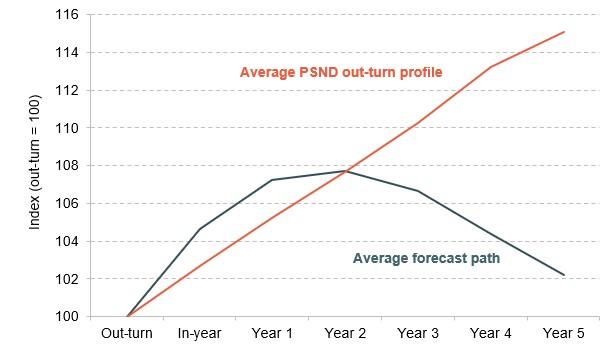
Note: Data are for the period between June 2010 (when the OBR started producing forecasts) and March 2025.
Source: Office for Budget Responsibility, 2025a.
In part, the pattern shown in Figure 3.2 reflects the multiple adverse shocks that have hit the UK economy over the past 15 years. But it also reflects the fact that planned fiscal consolidations have repeatedly been cancelled, in some cases alongside a change to the fiscal rules. This means that the fiscal rules do little to buttress the credibility of government forecasts (see Box 3.1 for why this matters).
3.4 A bad equilibrium
The current UK fiscal framework has some attractive features and is far from a disaster. The adverse shocks of the last two decades would have posed challenges to any framework. And the problem is perhaps less the design of the framework itself than the entrenched and unhelpful norms around how it is operationalised and debated. We are, all the same, in a bad equilibrium. The current approach is achieving neither sustainable public finances nor credibility with financial markets. Nor does it deliver policy stability or incentives for good policymaking. There is a strong case for doing something different.
This need not require a complete and total overhaul of the framework. There continues to be a strong case for the division of responsibilities between the OBR and HM Treasury, for a single major fiscal event per year, for biennial Spending Reviews, and for the broader institutional arrangements set out in the Budget Responsibility and National Audit Act 2011. And – as I will argue – the framework should not be overhauled immediately. But my argument is that to break out of our equilibrium, shed unhelpful norms, and create the conditions for better-quality debate and policymaking, will require a decisive shift in how fiscal policy is conducted in the UK. The next chapter sets out what that could look like.
4. A proposal for reform
4.1 Pillar one: a Statement of Fiscal Strategy at the start of each parliament
At the start of each parliament, the Chancellor should give a high-profile set-piece speech, called something like a Statement of Fiscal Strategy. This would be an opportunity for the government to set out its broad fiscal objectives and to explain its thinking around what good fiscal policy looks like.15 To some extent, this happens when the government updates its fiscal rules and a new Charter for Budget Responsibilityis put before parliament but, at present, these important issues are subject to minimal debate. It would be valuable to formalise the presentation of the government’s fiscal strategy to parliament and to raise its profile. The aim would be for it to have at least the prominence of a Mais Lecture or Mansion House Speech, and ideally something approaching that of a Budget or Spending Review in terms of its perceived importance.16
This strategy should be expressed as a narrative, principles-based argument, and as a broad-brush direction of travel for the next five (plus) years, and not as a precise numerical target with a date attached. That is, numerical fiscal rules should be dropped in favour of something closer to the ‘fiscal standards’ proposed by Blanchard, Leandro and Zettelmeyer (2021), defined by the authors as ‘qualitative prescriptions that leave room for judgement together with a process to decide whether the standards are met’.17 This approach would also be closer to the ‘principles of responsible fiscal management’ underpinning the fiscal framework in New Zealand (New Zealand Treasury, 2015).
The challenge is to provide a high-level objective or standard that is not so specific as to imply a precise numerical target (which then risks being treated as pass–fail), but not so broad as to provide no constraint on policy whatsoever. The existing Charter for Budget Responsibility already features a section on ‘principles for fiscal policy’: these are (1) ‘to move towards only borrowing for investment’ and (2) ‘to keep debt on a sustainable path’ (HM Treasury, 2026a). The point would be to develop these rather parsimonious principles into a broader fiscal strategy and high-level set of objectives or standards, linked explicitly to the set of fiscal indicators to be used in the ‘fiscal traffic lights’ (discussed below). These need not be limited solely to issues around fiscal sustainability: the government could have stronger automatic stabilisers as an explicit objective and desired direction of travel, for example.18 Box 4.1 sets out more detail on the New Zealand fiscal framework, as an example of a somewhat similar approach in practice.
Box 4.1. The New Zealand fiscal framework
New Zealand’s fiscal framework is based on a set of principles of responsible fiscal management in the conduct of fiscal policy, and explicitly rejects the approach of having a legislated fiscal rule in favour of a ‘transparency-based approach’ (New Zealand Treasury, 2015). The government is required to pursue its fiscal policy objectives according to the following principles, originally set out in the Public Finance Act 1989:
- Reducing total debt to prudent levels so as to provide a buffer against factors that may impact adversely on the level of total debt in the future by ensuring that, until those levels have been achieved, total operating expenses in each financial year are less than total operating revenues in the same financial year.
- Once prudent levels of total debt have been achieved, maintaining those levels by ensuring that, on average, over a reasonable period of time, total operating expenses do not exceed total operating revenues.
- Achieving and maintaining levels of total net worth that provide a buffer against factors that may impact adversely on total net worth in the future.
- Managing prudently the fiscal risks facing the Government.
- When formulating revenue strategy, having regard to efficiency and fairness, including the predictability and stability of tax rates.
- When formulating fiscal strategy, having regard to the interaction between fiscal policy and monetary policy.
- When formulating fiscal strategy, having regard to its likely impact on present and future generations.
- Ensuring that the Crown’s resources are managed effectively and efficiently.
Guided by these overarching principles, the government of the day is required to come up with its own assessment of what constitutes good fiscal policy by publishing and justifying a set of short-term intentions (for the next 4 years) and long-term fiscal objectives (for the next 15 years). This is to ensure political commitment to the fiscal path, while retaining flexibility. The most recent set of intentions and objectives, as at December 2025 (New Zealand Treasury, 2025a and 2025b), are reproduced in Table 4.1.
Table 4.1. New Zealand government’s short-term fiscal intentions and long-term fiscal objectives
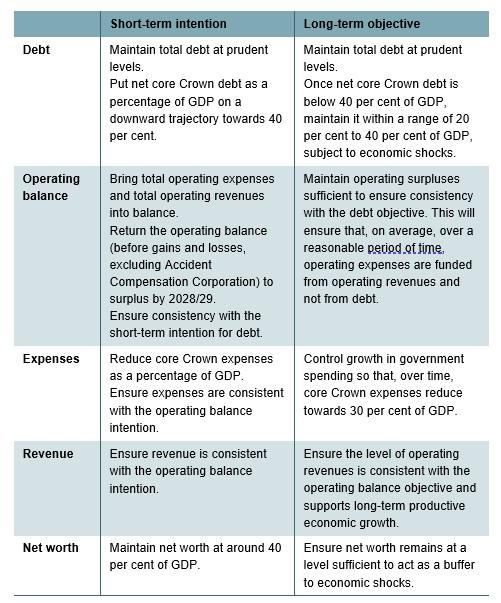
Source: Reproduced from New Zealand Treasury (2025a and 2025b).
As can be seen, the short-term intentions for operating balance does have a date attached, and is akin to a numerical, ‘bright line’ fiscal rule. It is my understanding that this intention has tended to act as the binding constraint on policy (though with greater flexibility than with a legislated rule – it is, after all, only an intention). Its inclusion perhaps reflects a deliberate desire to place at least some weight on ‘enforceability’ (as per the Debrun and Jonung (2019) trilemma) – though the distinction between an ‘intention’ and a ‘rule’ is an important one. And most of the intentions are defined in broader terms without a specific time frame (e.g. ‘on a downward trajectory towards …’, ‘maintain net worth at around …’, ‘reduce core Crown expenses as a percentage of GDP’).
The most recent IMF Article IV Consultation for New Zealand noted that ‘debt sustainability risks remain low … and tight sovereign spreads signal continued investor confidence in New Zealand’ – indicating that countries can maintain fiscal discipline in the absence of numerical fiscal rules (International Monetary Fund, 2025b). The same consultation did also note, however, that ‘repeated delays in restoring the operating surplus and frequent changes in fiscal objectives, while well-justified in the government’s budget policy statements and still consistent with maintaining total debt at prudent levels, can potentially create uncertainty around the fiscal policy framework and complicate the tracking of fiscal performance and commitments’. As argued throughout, there is no such thing as perfect or ‘optimal’ fiscal framework.
The government does, of course, need to set out detailed plans for tax and spending in its first fiscal event. Those decisions would need to be governed by some sort of judgement about the appropriate path for borrowing and debt. In that sense, the government would need to ‘pick a number’ and this could be perceived as revealing an implicit fiscal rule. But the point is not to have everything hinge on a particular number in a particular year, and whether the forecast for borrowing or debt is slightly above or slightly below it. The aim is to build a reputation for being fiscally sensible without having to respond to every minor development or movement in the forecast. If the path for debt or borrowing deviates from the path that was deemed appropriate, the government can explain why, and what it plans to do about it. Credibility would come from an intelligent explanation of conduct, and from actions, rather than an arbitrary numerical rule. It is the fundamentals that matter.
The Chancellor ought to revisit his or her Statement of Fiscal Strategy on a regular basis (perhaps every three years). This would be an opportunity to provide an update and assessment of what has happened since the beginning of the parliament, and to explain what the government is doing in response to those economic and fiscal developments. The principles and associated fiscal indicators (discussed below) could also be updated at that point – though the underlying principles would ideally be longer-lasting. Such an update would also be expected to occur after major shocks that change the economic and fiscal fundamentals (such as a pandemic or financial crisis) or after general elections.
4.2 Pillar two: monitoring via a set of fiscal traffic lights
The traffic light proposal
Having set out its high-level fiscal principles and objectives, the government would also specify a set of economic and fiscal indicators to be used to monitor progress against those objectives, and to monitor the government’s fiscal position more broadly. The OBR would then be tasked with producing a forecast for each of these and assessing them according to a set of ‘fiscal traffic lights’ which would be the centrepiece of the fiscal assessment within the Economic and Fiscal Outlook published alongside each fiscal event.19
Importantly, the Treasury would pick the indicators it wishes to be included in the assessment (though there could be a case for having a ‘core’ subset fixed over time or decided by the Treasury Select Committee) and how those would be assessed – i.e. what would constitute different shades of red, amber and green. It would not be left to the OBR to determine what sustainable fiscal policy looks like. The OBR would monitor and provide an assessment based on the criteria set by the Treasury (as is the case now).20 Potential challenges associated with the choice of indicators and thresholds are discussed below.
The overarching objective would be to maintain – or improve – credibility with financial markets while improving the incentives facing policymakers and enhancing the quality of the debate. More specifically, such a shift would aim to:
- Move beyond ‘fiscal headroom’. Because there would not be a single pass–fail rule upon which the OBR’s assessment hinges, there would be nothing to measure ‘headroom’ against. This would, at a stroke, break us out of our current ‘headroom’-obsessed equilibrium, and help to deal with many of the problems described in Chapter 3, such as the degree of policy volatility and the ‘magnet effect’.
- Shift to a broader assessment of the public finances. As discussed in Chapter 2, no single metric or number can tell you whether a country’s public finances are sustainable or not. Recognition of this would be at the heart of the traffic light framework, which would be closer to the sorts of assessments made by credit rating agencies, closer to the sorts of risk registers used by many companies, and closer to the dashboard of indicators already produced by the OBR but buried in the depths of its reporting (see Chapter 5).
- Reduce the incentive for the government to engage in ‘fiscal fiddling’. Because there would be less emphasis on a single fiscal metric in a single fiscal year, to the exclusion of everything else, there would be less incentive to contort policy to deliver a spuriously precise value for that metric. With more measures, given countervailing effects on different indicators, it would also be harder to fiddle all of them at once.
- Allow for a more intelligent, nuanced debate, by shifting the nature of the OBR’s centrepiece fiscal assessment. The government might choose to argue that having indicator 1 flashing red is fine, because indicators 2 and 3 are flashing green, for example.
- Formalise and make explicit the fact that the government has multiple fiscal policy objectives. Policy decisions are already made on the basis of more than just the fiscal rules (even if the rules loom large). This would recognise that reality.
- Pay more attention to longer-term challenges. Depending on the indicators chosen, and depending on the forecasting horizon, there could be more incentive to address longer-term challenges and issues that are generally ignored by the current framework.
- Communicate a complex, multifaceted picture in an intelligible and intuitive way. Simplicity is a virtue, but overly simple rules bring considerable downsides. A framework based around multiple indicators is necessarily more complex, but the hope is that the use of traffic lights will aid with communication – one does not need to be a fiscal expert to know that a bank of flashing red lights is a bad sign, or that a shift from amber to green is good news, whether or not one understands the intricacies of the underlying measures.
- Recognise that the path as well as the destination matters, by displaying values for the fiscal indicators at multiple points in the forecast.
- Take some of the political pressure off the OBR’s central forecast. As noted above, the UK is relatively unusual in having the OBR so integrated into the Budget process. This means that policy is based on independent, credible forecasts, but means that those forecasts come under additional political pressure. By moving away from the focus on a numerical pounds billion ‘headroom’ figure, a traffic light approach would reduce the extent to which an OBR forecast improvement is seen as ‘awarding’ the government cash to spend or the extent to which an OBR forecast downgrade is seen as forcing an offsetting policy response.
- Make it easier to stick to a single major fiscal event per year, by reducing the likelihood that the government feels obliged to react to a Spring Forecast that shows it narrowly missing a pass–fail rule (because there would be no such pass–fail rule).
Questions this raises
Which indicators?
It is an important feature of this proposal that the government of the day would choose the indicators it wished to be included in the traffic light assessment. It would be highly desirable for the underlying principles and long-term objectives to survive across governments with cross-party support, but the indicators might reasonably shift over time according to policy objectives and context.
It is useful, all the same, to consider some of the potential candidates for inclusion:
- Measures of borrowing, such as public sector net borrowing, current budget balance, primary balance, or the cyclically adjusted current balance.
- Measures of spending: most obviously spending on debt interest (expressed as a percentage of either GDP or total government revenues), but potentially also spending on specific items of interest. Economists at the National Institute of Economic and Social Research (NIESR) have argued that the government should target a minimum level of public investment (Millard, 2025); this could be included as an indicator, if desired.
- Measures of the public sector balance sheet, the obvious examples being public sector net debt, public sector net debt excluding the Bank of England, public sector net financial liabilities, and public sector net worth. Long-term liabilities (such as those associated with public service pensions or nuclear decommissioning) could also be included.21
- Measures of financing needs and availability, such as the government’s gross financing needs, net gilt issuance, the change in private sector holdings of gilts, gilt yields, sovereign bond spreads, the share of debt owned by non-residents, the share of short-term debt, or average debt maturity. Several of these are outside of the government’s direct control but are important indicators of risks to the government’s fiscal position.
- Longer-term sustainability metrics, such as the estimated adjustment to the cyclically adjusted primary balance required to stabilise the debt-to-GDP ratio in the long term, the difference between the forecast primary balance and the primary balance estimated to be consistent with stable debt, or the estimated probability of having stable debt under a stochastic debt sustainability analysis.
- Measures of the macroeconomic context, given that the appropriate fiscal stance will depend on the state of the economy. If the measures of borrowing used as indicators are not cyclically adjusted, there might be a case for directly including an estimate for the output gap, for example, or a government concerned about the UK’s reliance on the ‘kindness of strangers’ (Carney, 2017) might wish to include a measure of the current account deficit.
- Estimates of policy impact, such as the OBR’s assessment of the long-term growth impact of policy announced at the fiscal event, if there is a desire to enhance the incentives for government to pursue growth-friendly policies. This would necessarily be imperfect, as not all growth-friendly policies will have an impact that can be quantified or ‘scored’ – and the process of having the OBR attempt to produce such estimates creates its own set of issues (not discussed here). Nevertheless, this could help to encourage governments to place more weight on such considerations in the policymaking process. Or a government aiming to increase the strength of the automatic stabilisers (Orszag, Rubin and Stiglitz, 2021) may want to directly include some relevant measure of that.
Clearly not all of these potential indicators could be simultaneously included, but there would be a strong argument for including a broad range. In particular, it would be wise to supplement traditional measures of borrowing, debt and debt interest with a long-term sustainability metric (as recently argued by van Geest (2025) in her external review of the OBR) and with a measure of gross financing need (as recently argued by the International Monetary Fund (2025a)).22 In its framework for assessing fiscal space, the IMF includes measures of financing availability with indicators of debt sustainability and the medium-term adjustment required to stabilise debt (International Monetary Fund, 2018); the UK framework might sensibly do the same. There may also be a case that once a government has chosen an indicator, the OBR should continue to report on it in perpetuity, even if it no longer features in the traffic lights that form the centrepiece of the OBR’s assessment alongside each fiscal event. That way, an indicator that was scrapped because it was inconveniently flashing red would still show up somewhere in the OBR’s reporting.
The appropriate time horizon would depend on the measures chosen. Figure 4.1 shows an example set of fiscal traffic lights, with an illustrative set of indicators, with a combination of in-year values, values at a one-, three- and five-year horizon, and summary measures for indicators for which a single year does not make sense. This example design should not be interpreted as a definitive recommendation for what a traffic light dashboard ought to look like, or which indicators it ought to include. It is intended instead to illustrate some of the key features it might helpfully include, and to aid the reader in understanding how it could look and work in practice.
Figure 4.1. An example set of fiscal traffic lights

Note: Average real-terms growth in public sector current expenditure refers to the period between 2025–26 and 2030–31. The share of debt owned by non-residents is for 2024 Q3. The 10-year bond spread over Bunds and Treasuries is a simple average accurate as of early February 2026; in practice, it would make more sense to take the average over a longer period. ‘PSNB’ denotes public sector net borrowing. ‘PSND ex. BoE’ denotes public sector net debt excluding the Bank of England. ‘PSNW’ denotes public sector net worth and is inverted so as to aid comparisons against other balance sheet metrics. Thresholds have been chosen for simplicity; details can be found in the appendix.
Source: Author’s calculations using Office for Budget Responsibility (2025a and 2025b), OBR Public Finances Databank (accessed January 2026) and Financial Times market data.
How might the traffic lights be presented and the colours be determined?
The government of the day would choose the indicators to be included in the traffic lights, and the time horizon over which they would be assessed. These choices would have design implications. To illustrate one option, the example design shown in Figure 4.1 includes indicators in four different categories (financing, balance sheet and sustainability, spending growth, and debt risk). It shows the vulnerability of the government’s borrowing and debt position this year, and how this is forecast to change over time (showing, for instance, that the current budget is forecast to move into surplus by the third year of the forecast). Also included are standalone indicators of things such as average projected real-terms growth in current (non-investment) spending, the share of debt owned by non-residents, and average bond spreads over and above those of Germany and the US. While not shown here, there could also be a case for including information on the change in each value since the last forecast (perhaps denoted by a small chevron within each traffic light). There are six traffic light colours to allow for nuance, reduce the significance of any single threshold, and avoid the middle colour becoming the default.
The thresholds in this case have been set for simplicity (see the appendix for details). There is a lot of red (at the left-hand end of the legend in Figure 4.1), but this is an accurate reflection of the weakness of the UK’s current fiscal position. Were this system to be introduced, the thresholds would be determined by HM Treasury based on the judgement of the government of the day.23 One might worry about these thresholds being gamed, to flatter the government’s position. This risk would be somewhat mitigated by the fact that the choice of thresholds would need to be explicitly justified (e.g. the government would have to explain why a large budget deficit corresponds to a green traffic light), and the hope is that these choices would be subject to considerable external scrutiny (including by financial markets). The risk of constant tinkering would be reduced if, as recommended here, the thresholds were set only every three years alongside the Statement of Fiscal Strategy. This would strike a balance between a desire to provide a degree of certainty over the government’s fiscal approach and the advantages of having these choices subject to regular scrutiny. There could also be a requirement that the thresholds are symmetric.
Even with these features, there might still be a concern that the government could set the thresholds in such a way as to avoid embarrassment (e.g. set overly wide amber bands, so that the lights never flash red). Fixing the thresholds so that the lights effectively always flash amber would reduce their informational content and make them considerably less useful to a lay user: it is an important feature of this proposal that even though the traffic lights would be more complex than a single pass–fail rule, the colour scheming would still be intuitively understandable to non-specialists.
One means of addressing this concern would be for HM Treasury to consult on the thresholds. If a range of external economists, forecasters and organisations were asked to submit and publish the thresholds they would use (i.e. what they would view as ‘green’ or ‘red’) for the government’s chosen indicators, it would make it more difficult for the government to choose values that meaningfully deviate from the consensus. This would bear some similarity to the comparison of independent economic forecasts collated each month (HM Treasury, 2026b), though would take place only every three years (or whenever the Statement of Fiscal Strategy is updated). This would have much to commend it.
Another potential way to address the risk, and reduce the scope for the gaming of thresholds, could be to employ probabilistic thresholds for at least some indicators. That is, the thresholds could be based on different points of the forecast distribution (e.g. have the debt indicator flash green if debt is falling with 75% probability – see Box 4.2 for a discussion of the probabilistic assessments already carried out by the OBR). One might worry about making the system (even) more complex, and about relying too heavily on the past distribution of shocks for the construction of probabilities (given Knightian uncertainty about the future). On the other hand, forcing the government to put a percentage number on what it considers ‘red’ or ‘green’ might discourage some forms of gaming. It would also have the benefit of (further) reducing the focus on the central point estimate of the forecast by shifting attention to other parts of the distribution.
Box 4.2. Probabilistic assessments
The future is uncertain, economic forecasting is difficult, and forecasts are invariably wrong – or, more specifically, the central point estimate of a forecast is invariably wrong. The level of government borrowing in three, four or five years’ time, for example, depends on countless factors and variables, and there is a range of possible values for each. Forecasts for government borrowing (and debt, and other such metrics) are therefore inherently uncertain. The challenge is how best to communicate that and how to communicate the level of uncertainty.
One means of doing so is to use the past distribution of forecast errors (and shocks) to estimate a probability distribution. The OBR, to its credit, already reports the probability of the government meeting its current budget and debt targets, based on past forecast errors. The government’s current fiscal mandate requires it to have (in the OBR’s view) a greater than 50% chance of running a current budget surplus in 2029–30. The focus on whether government borrowing is just below or just above a particular level under the OBR’s central forecast is equivalent to a focus on whether the probability is just above or just below 50%. In November 2025, the OBR judged the government had a 59% probability of meeting its fiscal mandate (with the probability being higher than 50% due to the £22 billion margin by which the rule was met). Notably, Figure 4.2 shows that for most of the 2010s, the probability of meeting the rules tended to be between 60% and 80% (only falling below 60% on three out of nineteen occasions, between July 2015 and March 2016). The lower percentage probability in recent years is the corollary of the unusually small amount of ‘headroom’ (Figure 3.1).
Figure 4.2. OBR-assessed probability of the government hitting its fiscal mandate
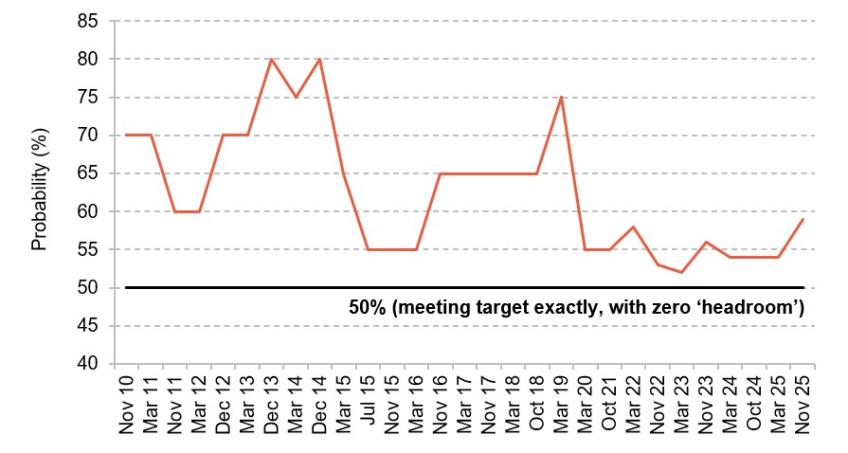
Note: November 2020 and March 2021 (the fiscal events held during the peak of the COVID-19 pandemic) are not shown.
Source: Chart 7.3 of Office for Budget Responsibility (2025b).
The key point here is that the colours in (some of) the fiscal traffic lights could correspond to the percentage probability of the indicator being below a certain level in the year in question. This could help to draw attention to the fact that a government serious about meeting a fiscal objective might want to have considerably greater than 50% chance of doing so under current policy. It might also, as discussed in the main text, make it more difficult for the government to choose unnecessarily wide bands between thresholds, if it is forced to specify the associated percentage numbers.
Another option, not advocated here, would be to employ fewer colours (e.g. just a red and green) and rely on the fact that having a larger number of indicators would reduce the degree to which the exercise is perceived as pass–fail. Another, also not advocated here, would be to hand greater control over the thresholds to an independent commission or to the OBR. My preference would be to instead rely on a combination of external scrutiny, regular reviews and probabilistic thresholds to discourage gaming, but this would ultimately be a choice for the government.
Maintaining spending control
As discussed in Chapter 2, for HM Treasury, one attraction of having pass–fail, numerical fiscal rules and operating with minimal ‘headroom’ against them is that it makes it easier to exert spending control. The argument is that fiscal rules, and the fact that they are close to being missed, make it easier for requests for additional spending to be rebuffed and for the government to maintain fiscal discipline.24 A numerical fiscal rule may also serve as a clearer indication to other Cabinet members of what fiscal stance they have collectively signed up to.
There is certainly some truth to this, and several of those I interviewed stressed the value of numerical fiscal rules as an internal tool for tackling deficit bias, especially in an era where many governments are struggling to maintain fiscal discipline.
There are two key questions. The first is whether the current configuration of fiscal rules is necessary for HM Treasury to effectively control spending. Fiscal rules are not the sole means by which the Treasury exerts spending control. In particular, the Spending Review process, with a top-down cash envelope fixed in advance, is central to this. Continuing with the practice of concluding the Spending Review outside of the fiscal event (as was the case in 2025) may also help, as it makes it easier for the Treasury to resist the temptation to expand the spending envelope in order to facilitate more generous final settlements. Enshrining this practice would be one means of making it more likely that top-down spending plans are stuck to.
In the 1990s, before the advent of numerical fiscal rules, the government had an explicit objective for public spending to grow by less than the economy as a whole over the economic cycle, and set detailed spending plans such that real-terms growth in the ‘new control total’ would not exceed 1.5% per year in real terms.25 This objective was met without the aid of a numerical fiscal rule. One option for a Chancellor seeking to buttress their ability to control spending might be to directly include a measure of real-terms spending growth as one of the fiscal traffic lights, and set the colour thresholds in order to clearly signal what is and is not judged to be acceptable and sustainable. The example in Figure 4.1 includes the average real-terms growth rate in public sector current expenditure as an indicator, but this could just as easily be a measure of departmental spending or social security spending.
The second question is whether the advantages of using numerical rules to enhance spending control outweigh the problems associated with the current approach (discussed in Chapter 3). On this, reasonable people may disagree, but my judgement is that the advantages do not outweigh the problems and that it would be possible to control spending to a satisfactory degree within the fiscal framework outlined in this report. Of course, this would need to be kept under review.
The overarching question of whether the approach suggested here would provide a sufficient guard against deficit bias is discussed at more length in Chapter 5.
4.3 Why this is not a proposal for immediate reform
As set out in Chapter 3, there are good reasons to think that the UK’s current fiscal framework is not functioning particularly well. This assessment seems to be widely, though not unanimously, shared. The central argument of this report is that it might be possible to design a framework that functions better. But it does not follow that now is the right time to overhaul the current framework. In fact, there is a very good argument that now would be a bad time to scrap the existing fiscal rules in favour of a traffic light approach.
This is because to scrap the government’s current set of fiscal rules in the current economic and fiscal context, so soon after announcing them and setting so much store by them, and only a few years after the ‘mini Budget’ debacle of 2022, would send an adverse signal to financial markets. It would be interpreted as an admission that the government is unwilling or unable to deliver on its planned fiscal consolidation and that it intends to borrow more. The risks of this would be heightened in the present environment, amidst what has been described as a ‘global bond glut’ (Schnabel, 2025).26 UK borrowing remains above its pre-COVID level, borrowing costs are already elevated (though, at the time of writing in early 2026, they have come down some way from their peak), there are increasing signs of investor concern about sovereign debt and the risk of fiscal dominance (Brooks, 2026), and now is not a propitious time to be either borrowing more or signalling that we intend to.
In short, although the current rules and framework produce all manner of perverse incentives and outcomes, we face a problem of path dependency. To avoid any reforms to the framework being interpreted purely as an attempt by the government to loosen its fiscal constraints, it would be advisable to pursue any reforms only from a position of strength. There is a strong argument that the government ought to deliver its planned fiscal consolidation, and achieve (and sustain) a primary surplus and/or current budget surplus, before considering a wholesale switch to a traffic light approach. The Chancellor in question would also ideally have a well-established reputation for fiscal credibility, in order to minimise the risk of the move being interpreted simply as a means of allowing for a looser fiscal stance.
Given that, these proposals are aimed more at the next parliament (expected to run from 2029), on the assumption that the UK’s fiscal credibility has been well restored by that point. In the nearer term, there could be a case for running the traffic light process in parallel with the current system during the latter years of this parliament. This would allow political actors, financial market analysts, media commentators and the public to become more familiar with the new framework (making nasty surprises less likely), and would provide time for any technical issues to be ironed out. The numerical pass–fail rules could then be dropped, and the fiscal traffic lights made the centrepiece, at an opportune moment in future.
5. Counterarguments and potential challenges
As noted throughout this report, no fiscal framework or fiscal rule is perfect or ‘optimal’. Any framework, including the one proposed here, would have downsides. Here, I discuss some of the possible objections to the traffic light proposal and potential challenges it could produce (many of which were raised and eloquently expressed by those I interviewed as part of this project). It is useful to group these into two buckets: (1) objections on the grounds that an alternative approach or solution would be better and (2) practical objections and concerns about how it might work in practice. I take each in turn, and explain why I still believe the traffic light approach would be preferable to these alternative approaches and an improvement on the current state of affairs, and how concerns could be addressed.
5.1 Alternative approaches
Why not just operate with more ‘headroom’?
As discussed in Chapter 3, many of the problems with the existing framework stem from the combination of numerical, pass–fail rules and the government aiming to meet those rules almost exactly – with minimal ‘fiscal headroom’. Rather than embark on a newfangled traffic light approach, would it not be simpler to stick to the current framework but operate with a larger amount of ‘headroom’?
There is certainly something to this argument. If the government operated with more ‘headroom’, its tax and spending plans would be less easily buffeted by global economic events, and the degree of policy volatility would very likely be reduced. This would be an improvement on the current state of affairs. The government’s decisions at the November 2025 Budget made a welcome move in this direction (though still leave a smaller buffer than was previously standard – see Figure 3.1).
Suggesting that we simply ought to operate with more ‘headroom’ as standard is an unsatisfactory solution, however. One issue is that building in and maintaining additional ‘headroom’ is politically difficult – perhaps unrealistically so – and made all the more difficult now that the concept of ‘headroom’ has become so entrenched in the debate. It requires lower spending and/or higher taxes, not in order to offer anything new to voters, but simply to build in a larger fiscal buffer (one that Chancellors may fear, with justification, would simply be spent by their successor). The fact that Rachel Reeves was able to increase her ‘headroom’ at the November 2025 Budget owed a great deal to the smaller-than-expected downgrade in the OBR’s forecast for tax receipts (Miller, 2025) – a larger downgrade might have made the increase in ‘headroom’ unfeasible. With time, one suspects that she will come under enormous pressure from her government colleagues to instead spend this additional ‘headroom’ on worthy causes and programmes. It is considerably easier to run down the government’s ‘headroom’ than it is to rebuild and maintain it.
There is also the fact that any particular value for ‘headroom’ can become the focal point for discussion and take on outsized significance. If the government gave even a hint of its preferred amount of ‘headroom’ (e.g. ‘we will maintain a buffer of at least 1% of GDP’) then there is every chance that this new amount would become the new ‘bright line’.27 It could also be that some other arbitrary value (e.g. the £22 billion in the November 2025 Budget) comes to be seen as the new minimum. Things would proceed in the same way that they do now, only with the focus on a slightly different arbitrary number (e.g. feverish speculation about which taxes may need to rise to restore the government’s desired amount of ‘headroom’, given recent changes in market interest rates). We would simply have moved the line in the sand. Furthermore, the focus would still be on a single metric to the exclusion of all others, with all of the perverse incentives that brings.
Finally, there is the fact that the concept of ‘headroom’ would continue to dominate the debate even if it were slightly larger. It has been internalised by journalists, politicians and market participants as the centrepiece around which fiscal policy is organised, and this might be difficult to undo within the existing framework. We might wish that ‘headroom’ had never been reduced to such puny levels, and that it had never taken on its undue significance, but we are where we are. A move to a traffic light approach would break the obsession in one fell swoop, because there would cease to be a single threshold to measure ‘headroom’ against.
In sum, a world where the Chancellor maintained the current framework but operated with a larger amount of ‘headroom’ as standard, or one where the Chancellor built in a large amount of ‘headroom’ at the start of a parliament to provide a buffer against subsequent economic and political events, would be an improvement on the current state of affairs. But it would still be an unsatisfactory solution to the underlying problem.
Doesn’t the move to a single annual assessment solve things?
In November 2025, the government announced that, in order to support its commitment to hold only one major fiscal event per year, it would legislate to ensure that the OBR assesses performance against the fiscal rules only once per year, alongside the Budget (HM Treasury, 2025 and 2026a). The OBR will still produce a second forecast each spring to inform the Debt Management Office’s financing remit and to provide an ‘interim update on the economy and public finances’. This, combined with an increase in ‘headroom’ from £10 billion to £22 billion, ought to reduce the degree of policy volatility (by making it less likely that policy will be adjusted in the spring and by providing a slightly larger buffer against forecast fluctuations). In that sense, it is welcome. But even putting aside the potentially shaky assumptions upon which the £22 billion of ‘headroom’ depends, this change only goes so far to improving things.
One quirk of this new arrangement is that while the OBR will not provide a formal assessment of performance against the fiscal rules at the spring forecast, it will still – presumably – produce a forecast for borrowing and debt, meaning that anyone with the ability to download and read a spreadsheet will be able to make their own assessment of whether the government is on track to meet its rules. The thinking behind the change seems to be that if the OBR were to produce a forecast for a current budget deficit, this would not be a formal breach of the rules, and the Chancellor could simply say that she intends to take corrective action in the autumn should it still be required. That is perfectly reasonable – but it remains to be seen how the tension between two forecasts and one rule assessment will play out in practice.
For example, if the government is missing its rules by £10 billion in the spring, that might be seen by HM Treasury as being an insufficiently large enough margin to justify an immediate response.28 It does mean, however, that any further forecast deterioration between spring and autumn would move the dial even further into the red. Market participants may view a forecast for a £10 billion deficit in spring as the government being £10 billion closer to a world where, come autumn, the shortfall is sufficiently large (and a correction sufficiently difficult) that the rules get abandoned entirely – and may price in the risk of higher gilt issuance accordingly.
More generally, and more importantly, while having only one ‘headroom’-focused, forecast-chasing fiscal event per year is better than having two, having no such events would be better still. The dysfunction associated with the UK’s current approach would remain. A move to a traffic light approach, retaining the sensible commitment to a single fiscal event per year, would help to break the obsession with ‘headroom’, create new norms, and lay the groundwork for a more considered debate and far-sighted policymaking.
Wouldn’t it be better to make fiscal policy more technocratic?
In the UK and elsewhere, control over monetary policy has been successfully delegated to an independent central bank. It is sometimes suggested that fiscal policy might benefit from a greater degree of technocratic input. In particular, it is sometimes suggested (including by several of those I spoke to while researching for this project) that the decision of how much to borrow could be ‘taken out of politics’, with the elected government then responsible for deciding the appropriate mix of tax and spending policies needed to achieve that level of borrowing. It is also sometimes suggested that an independent committee ought to play a greater role in advising the government of the day how much to borrow. Proposals along these lines include the following:
- Debrun and Jonung (2019) suggested that the centre of a rule-based fiscal framework ought to be a Fiscal Taylor Rule: a simple formula that provides a ‘rule of thumb’ estimate of what government borrowing ‘ought’ to be.29 This could be based, for example, on estimates of the output gap and the desired level of public debt as a share of GDP. This would serve as a benchmark against which fiscal performance could be easily assessed. The government could deviate, by borrowing more or less if it wished to; Debrun and Jonung (2019) envisaged that ‘unwarranted’ deviations would be discouraged by an independent fiscal institution (which in the UK would be the OBR) ‘raising the alarm’ and imposing reputational costs.
- Wyplosz (2005) proposed that fiscal policy could mimic monetary policy, by introducing a Fiscal Policy Committee composed of independent, unelected experts appointed for a fixed duration. The committee would be tasked with achieving a debt target set by the political authorities and be given the authority to decide on the level of borrowing consistent with that debt target under the prevailing GDP forecast. The paper also considers a version of this proposal where the committee is advisory only, with the power only to issue non-binding recommendations (perhaps as a stepping stone to the more radical version with full delegation).
- More recently, the New Economics Foundation (NEF) proposed that fiscal rules be replaced by an independent advisory committee within the OBR or elsewhere, with responsibility for setting a target range for the primary balance (i.e. the level of borrowing, excluding spending on debt interest), leaving the government to choose the combination of taxes and spending needed to achieve it (van Lerven, Stirling and Prieg, 2021). The elected government would have the option to pursue a different fiscal stance from that recommended by the committee but would have to explain itself to parliament.
- Also in the UK, the Social Market Foundation (SMF) proposed that an independent Fiscal Policy Committee should recommend a target range for government borrowing and that ‘we should complete the process of delegating demand management to technocrats’ (Bhattacharya, 2022). Under this proposal, the recommendations of the Fiscal Policy Committee would be given some sort of statutory basis – meaning that the government of the day would have to comply.30
The premise of these proposals is that although tax and spending policies are inherently political in nature and unsuitable for delegation to an independent authority, this is not true of the government’s overall fiscal stance. Politicians would be advised (or, in the case of the SMF proposal and the stronger form of the Wyplosz proposal, told) how much to borrow, but would then be free to set whatever mix of tax and spending policies they saw as the best way of achieving that level of borrowing. One way to think about this is that debt sustainability is a requirement of policy, not a choice, and should be separated from the political questions of distribution. Another is to argue that the question of how much to borrow is one with a ‘right’ answer and that a committee of experts or a calibrated policy rule would be more likely to reach it.31
Ultimately, this boils down to whether one believes there is such a thing as the ‘right’ level of borrowing, in a technical sense, or whether it is inherently political. In my view, the level of borrowing cannot be detached from politics.
In the case of a Debrun and Jonung (2019) style Fiscal Taylor Rule, such a rule would have to be calibrated to determine, for instance, how responsive fiscal policy should be to output gaps (i.e. how aggressive countercyclical policy ought to be) and what the desired level of public debt, to which the rule would seek to converge, is for the country in question.32 There is no value for either of these parameters upon which economists would agree: both would be subject to heated debate. In particular, the choice of how much debt to leave for the next generation (i.e. what the target level of debt should be) is bound up in political judgements about intergenerational equity. It would not be appropriate, for example, for a non-elected body to decide how much of the investment in the transition to net zero should be paid for out of taxes versus borrowing. A Fiscal Policy Committee would suffer from the same shortcoming: it would be seeking technical answers to what are inescapably political questions.
Even if politicians were free to deviate from the benchmarks or recommendations produced by a Fiscal Taylor Rule or Fiscal Policy Committee, they might struggle to do so in practice, raising questions around democratic legitimacy. The NEF proposal is a little different, in that committee members would each publish their recommendation, to make clear the diversity of views and provide more political cover for a broader range of policy choices. But even here, governments might find it difficult to deviate from the central or majority decision – or may simply pursue the loosest possible position consistent with the recommendation of at least one committee member. In turn, we might worry about appointments to the body responsible for calibrating the rule or recommending the target level of borrowing becoming politicised – thereby running the risk of having neither the independent, evidence-based scrutiny of an independent and apolitical advisory committee nor the democratic accountability of elected politicians.
In sum, it would be inappropriate, in my view, to take greater steps towards ‘taking the politics out of’ fiscal policy, and there are major issues with other proposals for stronger fiscal advisory committees. We should focus instead on improving the framework within which elected politicians make fiscal policy decisions.
Isn’t the debt-to-GDP ratio the only thing that matters?
One argument against a dashboard or traffic light approach is that, in the end, only the trajectory for the debt-to-GDP ratio matters for fiscal sustainability.33 Preventing debt from being on an explosive upwards trajectory is a necessary condition for sustainable fiscal policy, and this should not be confused with other ‘nice to have’ objectives. On this view, the government’s fiscal framework should be based around a desired path for debt-to-GDP and little else.34 This is sometimes referred to as having a ‘debt anchor’ as the government’s medium-term objective (Eyraud et al., 2018).
It is quite right that the debt-to-GDP ratio is at the heart of debates around fiscal sustainability. It is an important indicator and one that absolutely should feature in the framework. A debt explosion must be avoided, and there is a lot to be said for having the organising principle that debt ought to be steadily falling as a share of GDP in ‘normal times’ so as to leave fiscal space for responses to future shocks. But there are a number of issues with a framework that focuses solely on the debt-to-GDP ratio.
The first is that the debt-to-GDP ratio does not itself tell you whether a government’s fiscal position is sustainable. It is not, by itself, a sufficient indicator. A particular debt ratio can be more or less manageable depending on the prevailing interest rate and the economy’s growth rate – or, more accurately, on the difference between the two. This is discussed in Box 2.1.
Another way to think about this is through the lens of debt interest. The main effect of debt on the government’s fiscal position is indirect: it is through the cost of servicing the debt. This depends on factors other than the debt-to-GDP ratio. In 2000–01, the UK spent 2.4% of GDP on debt interest, with a debt-to-GDP ratio of around 28%. In 2019–20, the UK spent 1.7% of GDP on debt interest, with a debt-to-GDP ratio (excluding the Bank of England) of around 77%. Looking at the debt ratio alone is not enough to judge fiscal sustainability.
It is also the case that if what we need to avoid is debt being on an explosive path, then it does not necessarily follow that the government ought to target a particular level of debt-to-GDP. Instead, policy must (also) have regard for the underlying drivers that could put debt on an explosive upwards path.
Another argument against directly targeting the debt-to-GDP ratio is that tax smoothing theory (Barro, 1979) suggests that any adjustment in debt should be gradual, and in the event of an adverse shock, a target couched in terms of debt might require sharp policy adjustments for it to be achieved (Portes and Wren-Lewis, 2015). Such a sharp fiscal contraction may have damaging economic impacts (potentially interfering more with other macroeconomic objectives) or be so unrealistically large that the target is abandoned, thereby making the framework less robust to economic shocks.
Others have raised conceptual issues with the debt-to-GDP ratio as a measure. Furman and Summers (2020) noted that debt is a stock and GDP is a flow, making it an unusual measure which does not capture the fact that debt can be repaid over time. They argue that it would make more sense to do a ‘stock–stock’ analysis, such as comparing the stock of debt with the net present value of future GDP (i.e. the stock of future GDP flows), or a ‘flow–flow’ analysis, comparing the flow of debt interest costs with the flow of GDP. This relates to the point discussed in Section 2.3: debt dynamics depend on future interest rates and growth rates, and a narrow focus on the debt ratio today ignores the fact that with lower interest rates the net present value of future GDP is higher and that debt is more affordable today (or vice versa with higher interest rates).
Furman and Summers (2020) also noted that the debt-to-GDP ratio is backwards looking, reflecting (in effect) the sum of borrowing to date, and does not reflect things such as future government spending promises or ability to raise taxes. This is especially relevant in the UK, where non-debt liabilities (such as public service pension commitments) are large relative to the traditional debt stock.35
Another critique of debt-to-GDP as a fiscal indicator is that it largely ignores government assets, and in doing so focuses only on one side of the government balance sheet. This is an argument often made by those in favour of targets based on a more comprehensive measure of the government balance sheet, such as public sector net worth (e.g. Hughes et al., 2019; Haldane, 2023; Chai, Harris and Tieman, 2024). There is merit to this argument, though for reasons explored in depth in Zaranko (2023), there are very good reasons not to have a fiscal target defined in terms of public sector net worth.
Even if one does believe the debt-to-GDP ratio to be all-important, it is important to note that meeting the government’s existing debt-to-GDP target does not actually ensure that debt is on a sustainable path. This is because the rule, as currently designed, requires only that debt is forecast to fall in several years’ time. It is possible that as the target rolls forward, any fiscal tightening will be continually pushed into the future, and debt will never actually fall, while the letter of the rule continues to be met (see Figure 3.2). Even if debt did start to fall in three or four years’ time, it is possible that the increases in debt in the short term would more than outweigh any subsequent reductions, meaning that debt would still rise over the parliament.
Finally, as argued throughout, too much focus on any single measure creates incentives for the government to game its rules (Tetlow, Bartrum and Pope, 2024). In the case of a narrow focus on debt, that might result in creative use of ‘off balance sheet’ measures or in asset sales that represent poor value for the taxpayer. A core argument of this report is that a framework based around a broader assessment of metrics could reduce the incentives to engage in such behaviour.
Why not focus solely on the current budget balance?
Just as some argue that fiscal objectives ought to be based only on a path for the debt-to-GDP ratio, others have argued that the government’s sole fiscal rule should be a so-called ‘golden rule’ defined in terms of the current budget (e.g. requiring day-to-day spending to be covered by tax revenues) (Wren-Lewis, 2023, 2024a and 2024b). According to this view, the inclusion of any other fiscal metric in a fiscal rule is superfluous. The argument has three parts.
First, while it is clear that having debt on an accelerating upwards path cannot be sustained forever, we do not know the safe upper limit for the debt-to-GDP ratio, nor is there any single ‘optimal’ level to aim for. And, as discussed above, a numerical target for debt is more likely to induce sharp policy adjustments which run contrary to tax smoothing theory and/or interfere with other macroeconomic objectives (Barro, 1979; Portes and Wren-Lewis, 2015). For this reason, the argument goes, it is better to target some measure of the deficit than debt.
Second, if the target is defined in terms of overall borrowing (the total deficit), whenever a tightening is required, politicians will be tempted to cut capital investment rather than day-to-day spending, because it is easier to (for instance) cancel an infrastructure project that has not started yet than to lay off public sector workers or cut social security spending. To avoid this, it makes sense to target the current deficit rather than the total deficit.36
Third, while a so-called ‘golden rule’ places no limit on the amount of borrowing for investment, that is a desirable feature. The argument here is that when extra borrowing is for public investment, there is no need to worry about the impact on debt: the additional public sector investment creates public sector assets, leaving a broader measure such as public sector net worth unchanged. Proponents of this view argue that investments for which there is a good economic or social case should go ahead regardless, and not be constrained by a fiscal rule – and that any fiscal rule that does provide a constraint on public investment must be a bad fiscal rule (Wren-Lewis, 2022).
As a rough rule of thumb, the idea that day-to-day spending ought to be covered by tax revenues outside of exceptional periods, with borrowing only for capital investment, is a reasonable one. As guiding principles for fiscal policy go, we could do a lot worse. It is true that the current budget could be in balance and debt be on an unsustainable trajectory (depending on the differential between growth rates and interest rates, , as discussed in Box 2.1). But this is a surmountable objection: there is no magic in a current budget deficit of zero, and the current budget target could be reparameterised based on judgements about the long-term rates of and , and the assumed trend level of public investment, so as to be consistent with debt sustainability (e.g. it could become a target for a current surplus of 1% of GDP). This would somewhat subtract from the simplicity and intuitive generational equity-based argument for a ‘golden rule’ requiring all day-to-day spending to be met from revenues. That said, it would still remain considerably simpler than the traffic light framework proposed in this report.
There are, however, two issues raised by such a proposal.
First, if debt is on a rising path, it is not enough to simply point to the fact that all of the borrowing is for investment. Whenever the government takes on additional debt, that debt needs to be financed (i.e. it incurs interest costs), whatever its purpose. Just because it is invested in public sector assets does not give the government a free pass.37 In many cases, those assets do not produce any sort of financial return for the government, nor will they bring indirect benefits via increased economic growth, nor can they generally be sold in a financing crunch. This is perhaps truer than ever when an increasing portion of the government’s capital budget is going towards defence. The crux is that however socially valuable, public sector assets are of limited relevance to the government’s ability to access capital markets or service its debt (see Zaranko (2023) for a more detailed exposition of this argument). For that reason, traditional measures of debt and debt interest cannot be ignored entirely.
Second, the absurd focus on ‘headroom’ would remain. If we employed the existing framework but with a sole target for the current budget, we would still suffer from many of the same issues. We would still have excessive policy volatility in response to movements in the forecast, and the focus on a single metric, in a single year, to the exclusion of all others would still provide incentives to game that metric via creative accounting or policy design. We would be in the same equilibrium, the only difference being that we would have less of a constraint on borrowing for spending classified as public investment.
So, while a ‘golden rule’ has much to commend it, and could be the organising principle at the centre of a reasonable fiscal framework, such an approach is not without downsides. Most significantly, it would do nothing to break the UK out of its unhelpful obsession with ‘headroom’. This is why, even for proponents of a ‘golden rule’, the approach set out in this report is worth considering.
5.2 Practical objections and concerns
There are also a number of practical concerns about how a traffic light approach would work in practice, which are now considered in no particular order.
It would provide less of a guard against deficit bias
A key objective of any fiscal rule is to provide a guard rail against deficit bias and to therefore make sustainable public finances more likely. One attraction of a numerical, pass–fail rule is that it provides a clear constraint on government and an unambiguous statement of the fiscal stance to which Cabinet ministers and party MPs have collectively signed up, making it a stronger guard rail against deficit bias. One concern about a principles-based framework, with a monitoring system based on traffic lights, is that by introducing more flexibility and room for judgement, it would provide less of a binding constraint on policy and result in less willingness to confront fiscal trade-offs – in short, that it would result in more borrowing.
This is a legitimate concern. While there are circumstances in which, by removing the ‘magnet effect’ (see Chapter 3), the absence of a numerical fiscal target could conceivably lead to tighter policy, it is possible that the approach set out in this report would in general provide less of a counterweight to deficit bias. It does seem likely that the prospect of one indicator tipping from green to amber, or from amber to red, would provide less of a bulwark against additional spending demands than would the prospect of breaching a pass–fail fiscal rule. To break out of the obsession with ‘fiscal headroom’ and to shift the focus to a broader assessment of the fiscal position does, by necessity, require introducing an additional degree of nuance, judgement and ambiguity. But it is a fair observation that a government which wished to do so could no doubt take advantage of that in order to borrow more. Of course, under the current system, a government which wishes to borrow more can do so: it is hardly as though the fiscal rules provided a meaningful constraint on the short-lived Liz Truss government, for example, and even a cursory glance at the recent path for UK debt-to-GDP suggests that numerical fiscal rules have not entirely curbed politicians’ proclivity for borrowing. All the same, it is possible that a traffic light framework would provide even less of a constraint on irresponsible fiscal behaviour.
There are five points worth making in response.
The first is that whatever the fiscal framework, the government would continue to be subject to external scrutiny on its fiscal decision-making, and would still be subject to the discipline of the market – which is the ultimate constraint on fiscal policy.
The second is to note that, as argued throughout, there is no such thing as an ‘optimal’ fiscal framework. Reducing deficit bias (or enhancing ‘enforceability’) is only one corner of the Debrun and Jonung (2019) trilemma discussed in Section 2.2, and reasonable people can disagree about the weight that ought to be placed on this versus other objectives. The explicit argument of this report is that a traffic light approach could strike a better balance across these trade-offs. Any costs of this proposal (such as the potential for less of a guard against deficit bias in some circumstances) need to be considered in conjunction with the potential benefits (a less dysfunctional and more thoughtful approach to fiscal policymaking). Put differently, even if – and I would argue it is an if – this framework does less to counteract deficit bias, this is not in and of itself a fatal flaw of the proposal.
Third, as previously argued by the International Monetary Fund (2023), the UK benefits from strong fiscal institutions and a culture of fiscal transparency, leaving it well placed to benefit from a principles- or standards-based approach.
Fourth, a key feature of the traffic light framework is that it would display the government’s fiscal position at multiple points over the forecast period. Present-biased politicians may still be comfortable with (or feel able to withstand) multiple indicators flashing red in the short term, as long as they can point to them turning green later in the forecast (see Figure 4.1 for an example) – but the short-term red would at least show up somewhere, rather than being ignored entirely by a fiscal rule that looks only at the forecast for three, four or five years ahead. This could conceivably heighten the focus on the in-year numbers for borrowing and debt, and so do more to deter unjustifiably high borrowing in the short term.
Finally, and relatedly, fiscal rules, however well designed, are no substitute for good governance nor for wider public and political support for the ultimate objectives of the rule (Eyraud et al., 2018). The hope – perhaps the naive hope – behind this proposal is that by improving and broadening the terms of the fiscal debate, by empowering politicians to take principled decisions and justify them to the public and markets, and by removing some of the sharpest incentives created by the existing system, a reformed fiscal framework along the lines of the proposal in this report could help to make good governance and public buy-in more likely.
It’s too complicated
Fiscal sustainability is a nuanced issue, and the traffic light framework described above seeks to paint a suitably nuanced picture of the government’s fiscal position, in order to encourage a nuanced debate and better policymaking. One consequence is that it is undeniably more complicated than a pass–fail fiscal rule. This could make the government’s fiscal policy more difficult to communicate.
This is a valid concern, though it is worth distinguishing here between different audiences. Financial market participants are sophisticated actors. Many firms produce their own assessments of the government’s fiscal sustainability anyway, rather than relying on adherence to the fiscal rules as an adequate measure. Furthermore, a traffic light approach would bear some similarity to the approach already employed by credit rating agencies. Box 3.1 described the importance of fiscal rules as a signal to financial markets of the government’s borrowing intentions. Under this proposed framework, the government would still communicate its intentions and seek to convince financial markets of its credibility; it would just be using a different toolkit, one that better reflects the complexity of the underlying issue.
There is a risk that without a numerical fiscal rule, it would be harder to anchor and coordinate financial market expectations. A more complicated fiscal framework could conceivably increase the chance of larger market reactions on Budget Day if markets are less able to accurately predict government policy in advance (though governments have become increasingly adept at ‘pitch-rolling’ to avoid surprises). This is why it would be important to have a clear Statement of Fiscal Strategy, to set a direction of travel and to provide guidance on what the government is trying to achieve, but without a need to over-respond to forecast fluctuations or target a spuriously precise estimate of ‘headroom’.
In terms of communication with the wider public, several of those I spoke to for this project suggested that it might be no bad thing if the new framework was sufficiently complicated that political journalists are unable to boil down the entire fiscal debate to a single ‘headroom’ number. And for the public themselves, it is hardly as though the current rules are well understood. Polling from Ipsos in May 2025 found that a large majority of people report either having not heard of the fiscal rules or not knowing very much about them (Ipsos, 2025). When asked to identify the government’s fiscal rules from a list, around one-in-four chose the right option(s); a larger percentage opted for ‘don’t know’ or for the government’s fiscal rule being to close the £22 billion ‘black hole’. The public can be forgiven, not least due to how often the rules have been changed over time, but this does suggest that there is not an enormous amount of public understanding to lose by switching to a slightly more complicated framework. And the hope is that the colours on a set of fiscal traffic lights are sufficiently intuitive to be understood even by those who are not subject experts.
Ultimately, the costs of greater complexity would need to be weighed against the potential benefits brought about by a more flexible framework – one which reduces policy volatility and provides fewer perverse incentives for policymakers.
It would make matters worse by replacing one ‘bright line’ with many
Another potential concern is that the cut-offs between different colours on the traffic light spectrum will themselves become ‘bright lines’ around which policy is fine-tuned. For example, if the government started the parliament with five indicators flashing green, that could be interpreted as the baseline, and the government may feel that it needs to adjust policy in order to avoid a shift to only four indicators flashing green. The risk, then, is that instead of getting rid of the ‘bright line’ binding constraints, we move to a world with more of them (in this example, five) and succeed only in making the system even more complicated.
This is a risk – one which is difficult to fully rule out without having tried the system in practice. The risk could be somewhat mitigated through sensible design of the framework. In particular, having a larger number of traffic light colours (e.g. the example in Figure 4.1 has six), rather than just three, somewhat lessens the significance of each threshold. In addition, with a broader mix of indicators, it may be more difficult to game all of them at once. Some potential traffic light indicators (such as bond spreads or the share of debt owned by non-residents) would be outside of the government’s direct control; with time, one would hope that media commentators would grasp that and stop expecting an immediate policy response if one indicator was to move in either direction. Sometimes, the appropriate response to a deterioration in the forecast will be for policy to swiftly respond to offset it: the aim here is for that judgement to be based on a broader assessment, across a wider set of indicators – but not for policy to respond one-for-one in all cases where any single one of those indicators worsens.
Choosing colour thresholds would be too difficult
Under this framework, an important part of the process would be the government deciding what it thinks sensible, sustainable fiscal policy looks like and setting its indicators and colour thresholds accordingly. In my view, if this exercise were carried out in good faith by any government, then at the time of writing the assessment of the UK’s fiscal position would include a lot of red – or, at best, amber – lights. That would be an accurate depiction of where we are – but several of the people I spoke to suggested that the government would be exceedingly unlikely to introduce a dashboard that showed an alarming bank of flashing red lights. This could increase the incentive to choose indicators that are easier to meet, shunning those that speak to the more worrying aspects of the UK’s fiscal position, or to game the thresholds themselves.
This is another reason why, as discussed in Chapter 4, this framework should be introduced from a position of strength: if the government has delivered a primary surplus or current budget surplus, it would be able to point to that as a strong starting fiscal position (flashing green). Having the thresholds set only once every three years or so, or at the start of a parliament, alongside the Statement of Fiscal Strategy would also reduce the degree to which they could be fine-tuned. Running the traffic light system in parallel with the current framework for a period could also help.
More generally, as was discussed in Chapter 4, the colour thresholds could be chosen (at least for some indicators) to correspond to different points of the forecast distribution. This could make the thresholds more difficult to game, and it would be no bad thing if the debate moved towards a discussion of what percentage probability of delivering falling debt constitutes ‘safe’ or a ‘green light’, rather than an incessant discussion of how much ‘headroom’ the government may or may not have. Choices over thresholds would also be an important way in which governments signal their fiscal intent to markets.
We change our rules too often as it is – we should stick with the ones we have
As discussed in Chapter 4, there is a very good argument that now would be a poor time to scrap the existing fiscal rules in favour of a traffic light approach, due to the precariousness of the UK’s fiscal position and the likelihood that it would be perceived, in the present moment, as an attempt to allow for higher levels of borrowing. It is also true that the frequency with which the UK has changed its fiscal rules has undermined the credibility of the framework and made them less effective. So, having set out ‘non-negotiable’ fiscal rules and set so much store in meeting them, there is a strong case for this government to stick to them and stay the course for the rest of the parliament. But, looking beyond the next few years, and noting the shortcomings of the UK’s current approach, there is an opportunity to build a modernised framework – one which would hopefully prove longer-lasting.
Doesn’t the government do this already?
HM Treasury’s Charter for Budget Responsibility already requires the government to ‘consider a wide range of metrics to inform a full assessment of the sustainability of the public finances’ (HM Treasury, 2026a) and the OBR already produces its own ‘dashboard’ of various fiscal metrics (see Figure 5.1). In some sense, then, the government already has a policy of assessing fiscal sustainability on a broader basis. So why the need for a change?
Figure 5.1. OBR dashboard of balance sheet and fiscal affordability indicators (November 2025)
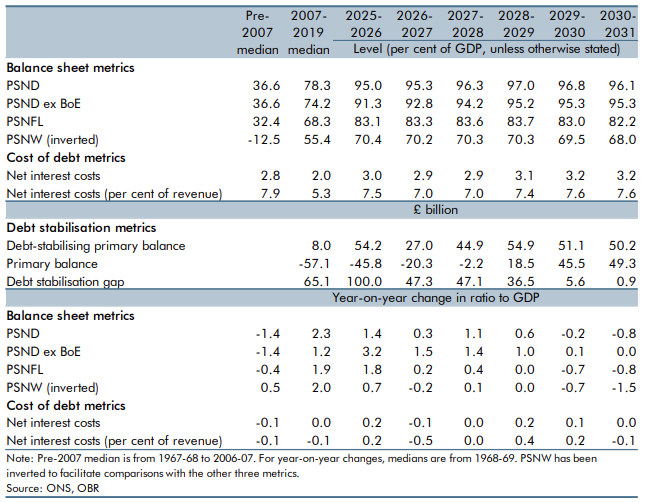
Source: Table 7.3 of Office for Budget Responsibility (2025b).
It comes down to a question of emphasis. HM Treasury may officially ‘consider’ a broad range of metrics, and feed this into the policy advice provided to the Chancellor, but in practice, when push comes to shove, only one or two – those chosen for the fiscal rules – matter for policy. The others are effectively disregarded. And although the OBR does produce forecasts for alternative measures of the balance sheet and net interest costs, these are buried in chapter 7 of the document, receiving very little attention as a result. Almost all of the focus is on the ‘fiscal headroom’ number, which is placed front and centre.
This focus on ‘headroom’ is not inevitable. It is within the government’s gift to tell people – whether it is the media, financial market participants or members of the general public – where to look. To an extent, the excessive focus on ‘headroom’ is self-fulfilling: financial market analysts focus on, and spend time trying to predict, the amount of ‘headroom’ because the government has made clear that it cares about it and that policy will depend on it, and because it is discussed so furiously in the press. The government could, if it wished to, shift the emphasis and focus elsewhere. The fact that whenever the fiscal rules change, commentators and analysts immediately forget the old rules, and shift to a discussion of ‘headroom’ against the new rules, is testament to that.
In addition, while the OBR dashboard (Figure 5.1) does cover a slightly broader range of metrics, and a broader range than in the recent past, these are still limited to balance sheet metrics, debt stabilisation metrics and net interest costs.38 Other measures of undoubted importance to an assessment of fiscal sustainability – borrowing, most obviously, but also things such as the cost of new borrowing (rather than net interest costs, which largely reflect past decisions) and average debt maturity – do not feature.
The set of fiscal traffic lights envisaged under the proposal in this report would cover a broader range of metrics than currently included in the OBR dashboard and, importantly, would be the centrepiece of the OBR’s assessment of the government’s fiscal position.
5.3 Summing up: trade-offs worth making?
It is hard to know how a framework based around fiscal traffic lights would work in practice before it is tried. With time, officials would no doubt find ways to manipulate or game the new system (just as how, with time, weaknesses of previous frameworks and the existing framework emerged and began to be exploited). Other challenges, not yet anticipated, may arise in addition to those discussed above. In some cases, these challenges and concerns can be addressed: including real-terms spending growth as an indicator might allay HM Treasury concerns about losing spending control, for instance. In other cases, we would simply have to accept that trade-offs are inevitable. My argument is that these are trade-offs worth making. The framework will not solve everything (no framework could), but it would at least take some of the sharper edges off the unhelpful incentives facing policymakers, reduce the amount of policy volatility, and – hopefully – improve the quality of debate and policymaking in the process.
6. Conclusion
The UK’s fiscal framework has been thoughtfully designed and has some desirable features. It might be possible to build on those and, through marginal adjustments, deliver better outcomes without the need for a more radical overhaul. This was the approach taken at the November 2025 Budget, which provided for a modest increase in the amount of ‘fiscal headroom’ and announced that performance against the fiscal rules will be formally assessed by the OBR once, rather than twice, per year. Taken together, these are modest improvements on the status quo. But for as long as the amount of ‘headroom’ remains at the heart of the UK fiscal debate and policymaking process, dysfunction will follow. The norms and expectations that have developed around the current framework make that all but inevitable. It is therefore time to consider a rethink.
There is only so much that can be achieved through a technical change to the framework: any government determined to abuse it will find a means of doing so, and the underlying fiscal challenges facing the UK government will remain in any case. But I believe that the proposals presented here could provide the basis for an alternative approach – one with the potential to shift the entrenched norms and assumptions, and to reshape how fiscal policy is debated and conducted in the UK. The proposals could undoubtedly be refined and improved, but at a minimum I hope to spark debate, inside and outside of government, on whether the current state of affairs is truly the best we can do.
I conclude with two notes of optimism regarding the potential for reform.
First, the UK experience since 1997 suggests that the lifespan for any particular set of fiscal rules is quite short. It is unlikely to be decades until the opportunity for a change in the fiscal framework comes about. The aim should be for whatever comes next to be more durable and robust.
Second, when the government does change its fiscal rules, the debate immediately shifts to the amount of ‘headroom’ against whatever now happens to be the most binding, with the previous rules completely disregarded. For instance, when Rachel Reeves introduced her new rules in the autumn of 2024, journalists and financial market analysts immediately switched to analysing the amount of ‘headroom’ against the new current budget target, and happily forgot all about the old measure of debt, which had until that moment been the basis of all ‘headroom’ calculations.
The point is, the government can tell people where to look and what they should be focusing on. If the government stopped obsessing about the amount of ‘headroom’ against a single, moving, point estimate of an uncertain forecast, then others would too. It is within the Chancellor’s control. What is lacking is the will, the right moment, and a credible alternative that can secure wide support. I hope to have provided at least the beginnings of the latter.
Appendix
List of interviewees
Some of those I interviewed wished to remain anonymous. The views and opinions expressed in this report do not reflect those of the interviewees, anonymous or otherwise, and any mistakes and analytical errors are my own. In addition to those who wish to remain anonymous, I am extremely grateful to:
Sir Charles Bean
Peder Beck-Friis
Chris Belfield
Lord George Bridges
Lord Terry Burns
Sir Robert Chote
Theo Morris Clarke
Victoria Clarke
Ruth Curtice
Xavier Debrun
Sam Freedman
Simon French
Chris Giles
Rupert Harrison
Daniel Herring
Andy King
Lord Mervyn King
Tim Leunig
Imran Malik
Lord Gus O’Donnell
Jonathan Portes
Owen Roberts
Alfie Stirling
Georgios Tsapouris
Lord Andrew Turnbull
Simon Wren-Lewis
Thresholds in example traffic lights
The colours in the traffic lights presented in Figure 4.1 are based on the numerical thresholds in Table A.1. These have been chosen largely for simplicity and transparency. A government using this framework in practice would set its own thresholds and keep these under review. The thresholds on public sector current expenditure, in particular, would need to reflect the attitude of the government of the day towards public spending and the size of the state.
Table A.1. Numerical thresholds used for the traffic lights in Figure 4.1
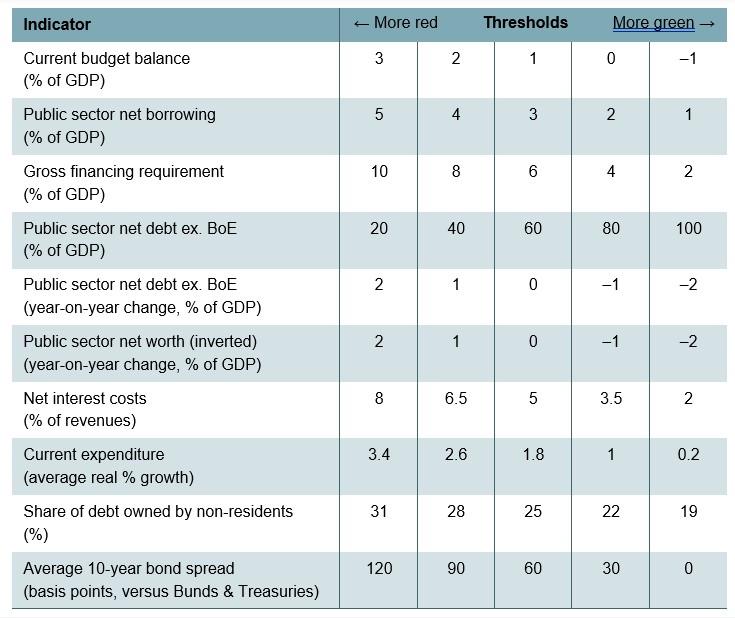
References
Afonso, A. and Jalles, J. T., 2019. Fiscal rules and government financing costs. Fiscal Studies, 40, 71–90, https://doi.org/10.1111/1475-5890.12182.
Alesina, A. and Tabellini, G., 1990. A positive theory of fiscal deficits and government debt. The Review of Economic Studies, 57, 403–14, https://doi.org/10.2307/2298021.
Badinger, H. and Reuter, W. H., 2017. The case for fiscal rules. Economic Modelling, 60, 334–43, https://doi.org/10.1016/j.econmod.2016.09.028.
Bailey, A., 2025. Oral evidence to House of Lords Economic Affairs Committee. https://committees.parliament.uk/oralevidence/16174/html/.
Baker, S. R., Bloom, N. and Davis, S. J., 2016. Measuring economic policy uncertainty. The Quarterly Journal of Economics, 131, 1593–636, https://doi.org/10.1093/qje/qjw024.
Bank for International Settlements, 2025. BIS Annual Economic Report 2025. https://www.bis.org/publ/arpdf/ar2025e.htm.
Barro, R. J., 1979. On the determination of the public debt. Journal of Political Economy, 87, 940–71, https://doi.org/10.1086/260807.
Bhattacharya, A., 2022. Full fiscal autonomy: the democratic case for independent fiscal policy. Social Market Foundation, https://www.smf.co.uk/publications/full-fiscal-autonomy/.
Blanchard, O., 2022. Deciding when debt becomes unsafe. International Monetary Fund, https://www.imf.org/en/Publications/fandd/issues/2022/03/Deciding-when-debt-becomes-unsafe-Blanchard.
Blanchard, O., Leandro, A. and Zettelmeyer, J., 2021. Redesigning EU fiscal rules: from rules to standards. Economic Policy, 36, 195–236, https://doi.org/10.1093/epolic/eiab003.
Boileau, B., O’Brien, L. and Zaranko, B., 2022. Public spending, pay and pensions. In C. Emmerson, P. Johnson and B. Zaranko (eds), The IFS Green Budget: October 2022. https://doi.org/10.1920/re.ifs.2022.0219.
Brooks, R., 2026. What does a debt crisis look like in the G10? https://open.substack.com/pub/robinjbrooks/p/what-does-a-debt-crisis-look-like?utm_campaign=post-expanded-share&utm_medium=post%20viewer.
Calmfors, L. and Wren-Lewis, S., 2011. What should fiscal councils do? Economic Policy, 26, 649–95, https://doi.org/10.1111/j.1468-0327.2011.00273.x.
Carney, M., 2017. A fine balance. Bank of England, https://www.bankofengland.co.uk/-/media/boe/files/speech/2017/a-fine-balance.pdf.
Carnot, N., 2014. Evaluating fiscal policy: a rule of thumb. European Economy, Economic Paper 526, http://dx.doi.org/10.2765/70540.
Caselli, F., Eyraud, L., Hodge, A., Kalan, F. D., Kim, Y., Lledó, V., Mbaye, S., Popescu, A., Reuter, W. H., Reynaud, J., Ture, E. and Wingender, P., 2018. Second-generation fiscal rules: balancing simplicity, flexibility, and enforceability – technical background papers. International Monetary Fund, https://www.imf.org/-/media/files/publications/sdn/2018/sdn1804-technical-background-papers.pdf.
Chai, H., Harris, J. and Tieman, A., 2024. Beyond debt: net worth fiscal anchors. International Monetary Fund, Working Paper WP/24/137, https://doi.org/10.5089/9798400280290.001.
Conway, E., 2024. How fiscal headroom has come to dominate Westminster and why it could decide the next election. Sky News, https://news.sky.com/story/how-fiscal-headroom-has-come-to-dominate-westminster-and-why-it-could-decide-the-next-election-13054662.
Crawford, R., Johnson, P. and Zaranko, B., 2018. The planning and control of UK public expenditure, 1993−2015. IFS Report, https://ifs.org.uk/publications/planning-and-control-uk-public-expenditure-1993-2015.
Davies, D., 2024. The Unaccountability Machine: Why Big Systems Make Terrible Decisions – and How the World Lost Its Mind. Profile Books, London.
Davoodi, H., Elger, P., Fotiou, A., Garcia-Macia, D., Han, X., Lagerborg, A., Lam, W. R. and Medas, P., 2022. Fiscal rules and fiscal councils: recent trends and performance during the COVID-19 pandemic. International Monetary Fund, Working Paper WP/22/11, https://doi.org/10.5089/9798400200472.001.
Debrun, X. and Jonung, L., 2019. Under threat: rules-based fiscal policy and how to preserve it. European Journal of Political Economy, 57, 142–57, https://doi.org/10.1016/j.ejpoleco.2018.09.001.
Debrun, X. and Kumar, M., 2007a. The discipline-enhancing role of fiscal institutions: theory and empirical evidence. International Monetary Fund, Working Paper WP/07/171, https://doi.org/10.5089/9781451867350.001.
Debrun, X. and Kumar, M., 2007b. Fiscal rules, fiscal councils and all that: commitment devices, signaling tools or smokescreens? SSRN Journal, https://doi.org/10.2139/ssrn.2004371.
Emmerson, C., Miller, H. and Zaranko, B., 2025. How frequently should the OBR produce forecasts? IFS Comment, https://ifs.org.uk/articles/how-frequently-should-obr-produce-forecasts.
Emmerson, C. and Stockton, I., 2021. Rewriting the fiscal rules. In C. Emmerson, P. Johnson and B. Zaranko (eds), The IFS Green Budget: October 2021. https://ifs.org.uk/books/rewriting-fiscal-rules.
Emmerson, C., Stockton, I., van de Schootbrugge, S. and Zaranko, B., 2023. Chancellors’ responses to economic news. In C. Emmerson, P. Johnson and B. Zaranko (eds), The IFS Green Budget: October 2023. https://ifs.org.uk/publications/chancellors-responses-economic-news.
Escolano, J., 2010. A practical guide to public debt dynamics, fiscal sustainability, and cyclical adjustment of budgetary aggregates. International Monetary Fund, Technical Note, https://www.imf.org/external/pubs/ft/tnm/2010/tnm1002.pdf.
Eyraud, L., Debrun, X., Hodge, A., Lledó, V. and Pattillo, C. A., 2018. Second-generation fiscal rules: balancing simplicity, flexibility, and enforceability. International Monetary Fund, Staff Discussion Note, https://www.imf.org/en/Publications/Staff-Discussion-Notes/Issues/2018/04/12/Second-Generation-Fiscal-Rules-Balancing-Simplicity-Flexibility-and-Enforceability-45131.
Fatás, A. and Mihov, I., 2003. The case for restricting fiscal policy discretion. The Quarterly Journal of Economics, 118, 1419–47, https://doi.org/10.1162/003355303322552838.
Fatás, A. and Mihov, I., 2013. Policy volatility, institutions, and economic growth. Review of Economics and Statistics, 95, 362–76, https://doi.org/10.1162/REST_a_00265.
Furman, J., 2016. The New View of fiscal policy and its application. https://obamawhitehouse.archives.gov/sites/default/files/page/files/20161005_furman_suerf_fiscal_policy_cea.pdf.
Furman, J. and Summers, L., 2020. A reconsideration of fiscal policy in the era of low interest rates. Discussion Draft, https://www.brookings.edu/wp-content/uploads/2020/11/furman-summers-fiscal-reconsideration-discussion-draft.pdf.
Goodhart, C. A. E., 1984. Problems of monetary management: the UK experience. In C. A. E. Goodhart, Monetary Theory and Practice, Macmillan Education UK, London. https://doi.org/10.1007/978-1-349-17295-5_4.
Haldane, A., 2023. The case for rethinking fiscal rules is overwhelming. Financial Times, https://www.ft.com/content/d57567c3-cd97-4cbe-be00-6cf50886b308.
Hill, N. and Nangle, T., 2020. A better fiscal rule. Society of Professional Economists, https://spe.org.uk/reading-room/articles/7414/a-better-fiscal-rule.
HM Treasury, 2024a. A strong fiscal framework. https://www.gov.uk/government/publications/a-strong-fiscal-framework.
HM Treasury, 2024b. Charter for Budget Responsibility: Autumn 2024. https://www.gov.uk/government/publications/draft-charter-for-budget-responsibility-autumn-2024.
HM Treasury, 2024c. Whole of Government Accounts, 2022-23. https://www.gov.uk/government/publications/whole-of-government-accounts-2022-23.
HM Treasury, 2025. Budget 2025. https://www.gov.uk/government/publications/budget-2025-document.
HM Treasury, 2026a. Draft Charter for Budget Responsibility: Autumn 2025. https://www.gov.uk/government/publications/draft-charter-for-budget-responsibility-autumn-2025.
HM Treasury, 2026b. Forecasts for the UK economy. https://www.gov.uk/government/collections/data-forecasts.
House of Lords Economic Affairs Committee, 2024. National debt: it’s time for tough decisions. https://publications.parliament.uk/pa/ld5901/ldselect/ldeconaf/5/502.htm.
Hughes, R., Leslie, J., Pacitti, C. and Smith, J., 2019. Totally (net) worth it: the next generation of UK fiscal rules. Resolution Foundation, https://www.resolutionfoundation.org/publications/totally-net-worth-it/.
Iara, A. and Wolff, G. B., 2014. Rules and risk in the Euro area. European Journal of Political Economy, 34, 222–36, https://doi.org/10.1016/j.ejpoleco.2014.02.002.
Ilzetzki, E. and Thysen, H. C., 2025. Fiscal rules and market discipline. IMF Economic Review, 73, 45–85, https://doi.org/10.1057/s41308-024-00265-8.
International Monetary Fund, 2018. Assessing fiscal space: an update and stocktaking. IMF Policy Paper, https://www.imf.org/en/Publications/Policy-Papers/Issues/2018/06/15/pp041118assessing-fiscal-space.
International Monetary Fund, 2023. United Kingdom: 2023 Article IV Consultation. https://www.imf.org/en/Publications/CR/Issues/2023/07/10/United-Kingdom-2023-Article-IV-Consultation-Press-Release-Staff-Report-and-Statement-by-the-535878.
International Monetary Fund, 2025a. United Kingdom: 2025 Article IV Consultation. https://www.imf.org/en/Publications/CR/Issues/2025/07/24/United-Kingdom-2025-Article-IV-Consultation-Press-Release-Staff-Report-and-Statement-by-the-568905.
International Monetary Fund, 2025b. New Zealand: 2025 Article IV Consultation. https://www.imf.org/en/Publications/CR/Issues/2025/05/23/New-Zealand-2025-Article-IV-Consultation-Press-Release-Staff-Report-and-Statement-by-the-567168.
Ipsos, 2025. Fiscal rules polling, May 2025. https://www.ipsos.com/en-uk/just-1-5-would-support-chancellor-breaking-her-fiscal-rules-support-increases-if-it-means-more.
Kydland, F. E. and Prescott, E. C., 1977. Rules rather than discretion: the inconsistency of optimal plans. Journal of Political Economy, 85, 473–91, https://doi.org/10.1086/260580.
Millard, S., 2025. Reforming the UK fiscal framework and boosting public investment. In B. van Ark, S. Millard, A. Pabst and A. Westwood (eds), Joining Up Pro-Productivity Policies in the UK, National Institute of Economic and Social Research, Occasional Paper 65, https://niesr.ac.uk/publications/pro-productivity-policies?type=occasional-papers&hss_channel=lcp-591969.
Miller, H., 2025. IFS analysis of Autumn Budget 2025, opening remarks, https://ifs.org.uk/collections/autumn-budget-2025.
New Zealand Treasury, 2015. An introduction to New Zealand’s fiscal policy framework. https://www.treasury.govt.nz/publications/guide/introduction-new-zealands-fiscal-policy-framework.
New Zealand Treasury, 2025a. Fiscal Strategy Report 2025. https://www.budget.govt.nz/budget/2025/fiscal-strategy-report/index.htm.
New Zealand Treasury, 2025b. Budget Policy Statement 2026. https://www.treasury.govt.nz/publications/budget-policy-statement/budget-policy-statement-2026.
Office for Budget Responsibility, 2025a. Fiscal risks and sustainability – July 2025. https://obr.uk/frs/fiscal-risks-and-sustainability-july-2025/.
Office for Budget Responsibility, 2025b. Economic and fiscal outlook – November 2025. https://obr.uk/efo/economic-and-fiscal-outlook-november-2025/.
Orszag, P., Rubin, R. and Stiglitz, J., 2021. Fiscal resiliency in a deeply uncertain world: the role of semiautonomous discretion. Peterson Institute for International Economics (PIIE), Policy Brief 21-2, https://www.piie.com/publications/policy-briefs/fiscal-resiliency-deeply-uncertain-world-role-semiautonomous-discretion.
Persson, T. and Svensson, L. E. O., 1989. Why a stubborn conservative would run a deficit: policy with time-inconsistent preferences. The Quarterly Journal of Economics, 104, 325–45, https://doi.org/10.2307/2937850.
Politico, 2025. Politico Westminster Insider podcast, 29 August. https://megaphone.link/POLL3750288354.
Portes, J. and Wren‐Lewis, S., 2015. Issues in the design of fiscal policy rules. The Manchester School, 83, 56–86, https://doi.org/10.1111/manc.12118.
Potrafke, N., 2025. The economic consequences of fiscal rules. Journal of International Money and Finance, 153, 103286, https://doi.org/10.1016/j.jimonfin.2025.103286.
Reeves, R., 2024a. Mais Lecture. https://labour.org.uk/updates/press-releases/rachel-reeves-mais-lecture/.
Reeves, 2024b. Letter to House of Lords Economic Affairs Committee. https://committees.parliament.uk/publications/45692/documents/226244/default/.
Rogoff, K., 1985. The optimal degree of commitment to an intermediate monetary target. The Quarterly Journal of Economics, 100, 1169–89, https://doi.org/10.2307/1885679.
Schnabel, I., 2025. No longer convenient? Safe asset abundance and r*. Speech at the Bank of England’s 2025 BEAR Conference, https://www.ecb.europa.eu/press/key/date/2025/html/ecb.sp250225~49a8dd911a.en.html.
Taylor, J. B., 1993. Discretion versus policy rules in practice. Carnegie-Rochester Conference Series on Public Policy, 39, 195–214, https://doi.org/10.1016/0167-2231(93)90009-L.
Taylor, J. B., 2000. Reassessing discretionary fiscal policy. Journal of Economic Perspectives, 14(3), 21–36, https://doi.org/10.1257/jep.14.3.21.
Tetlow, G., Bartrum, O. and Pope, T., 2024. Strengthening the UK’s fiscal framework: putting fiscal rules in their place. Institute for Government, https://www.instituteforgovernment.org.uk/publication/strengthening-uk-fiscal-framework.
Tucker, P., 2022. Quantitative easing, monetary policy implementation and the public finances. In C. Emmerson, P. Johnson and B. Zaranko (eds), The IFS Green Budget: October 2022. https://ifs.org.uk/publications/quantitative-easing-monetary-policy-implementation-and-public-finances.
Van Geest, L., 2025. External Review of the Office for Budget Responsibility. https://obr.uk/docs/dlm_uploads/External-review-of-the-Office-for-Budget-Responsibility-2025.pdf.
Van Lerven, F., Stirling, A. and Prieg, L., 2021. Calling time: replacing the fiscal rules with fiscal referees. New Economics Foundation, https://neweconomics.org/2021/10/calling-time.
Wren-Lewis, S., 2022. Missing a fiscal rule does not make a black hole, and a financial crisis after tax cuts does not mean markets want spending cuts. https://mainlymacro.blogspot.com/2022/11/missing-fiscal-rule-does-not-make-black.html.
Wren-Lewis, S., 2023. Challenges to the strong golden rule: MMT and bond market paranoia. https://mainlymacro.blogspot.com/2023/09/challenges-to-strong-golden-rule-mmt.html.
Wren-Lewis, S., 2024a. October Budget 4 – good and bad reasons to have fiscal rules, and why bad fiscal rules are worse than having no fiscal rules. https://mainlymacro.blogspot.com/2024/09/october-budget-4-good-and-bad-reasons.html.
Wren-Lewis, S., 2024b. October Budget 5. The UK’s fiscal rules: one good and one bad. https://mainlymacro.blogspot.com/2024/10/october-budget-5-uks-fiscal-rules-one.html.
Wyplosz, C., 2005. Fiscal policy: institutions versus rules. National Institute Economic Review, 191, 64–78, https://doi.org/10.1177/0027950105052661.
Wyplosz, C., 2012. Fiscal rules: theoretical issues and historical experiences. National Bureau of Economic Research, Working Paper 17884, https://doi.org/10.3386/w17884.
Wyplosz, C., Ostry, J. D., Willems, T. and Debrun, X., 2019. The art of assessing public debt sustainability: relevance, simplicity, transparency. VoxEU, https://cepr.org/voxeu/columns/art-assessing-public-debt-sustainability-relevance-simplicity-transparency.
Yared, P., 2019. Rising government debt: causes and solutions for a decades-old trend. Journal of Economic Perspectives, 33(2), 115–40, https://doi.org/10.1257/jep.33.2.115.
Zaranko, B., 2023. Public sector net worth as a fiscal target. In C. Emmerson, P. Johnson and B. Zaranko (eds), The IFS Green Budget: October 2023. https://ifs.org.uk/publications/public-sector-net-worth-fiscal-target.
Zaranko, B., 2024a. Public investment: what you need to know. IFS Explainer, https://ifs.org.uk/articles/public-investment-what-you-need-know.
Zaranko, B., 2024b. A note of caution on fiscal technocracy. IFS Comment, https://ifs.org.uk/articles/note-caution-fiscal-technocracy.
Endnotes
Authors

More from IFS
Understand this issue


Policy analysis


Academic research


