
Downloads
Download the report as a PDF
PDF | 598.57 KB
Executive summary
Legal aid is government-funded support towards legal costs, aimed at ensuring that people who could not otherwise afford legal advice or representation are still able to access the justice system, subject to eligibility rules. It is provided for individuals and cases that qualify for it, in both criminal and civil jurisdictions.
In 2012, the government fundamentally restructured legal aid in England and Wales, by introducing LASPO (the Legal Aid, Sentencing and Punishment of Offenders Act 2012). It restricted civil (non-criminal) legal aid to a limited list of case types, changed financial eligibility and contribution rules, and raised client contributions. Fees paid to providers in both civil and criminal work were also reduced.
This report examines how civil legal aid provision in England and Wales has evolved since the introduction of these reforms. While criminal legal aid changed too, that is not the focus of this report. Drawing on Ministry of Justice administrative data and Census-linked information on deprivation, the analysis tracks changes in the volume of civil legal aid cases, associated levels of public expenditure, the number and distribution of civil legal aid providers, and the relationship between these changes and local socio-economic conditions. The findings show that civil legal aid provision has contracted substantially since 2012, alongside a decline in the number of providers and increasing geographic unevenness in access.
Key findings
- Civil legal aid case volumes and associated expenditures fell sharply following reforms in 2012 (LASPO). Nationally, both the volume of and expenditure on civil legal aid cases declined substantially after 2013. By 2024, civil legal aid case volumes had fallen by around 57% and real expenditure by nearly 15% compared with pre-reform levels. There is no evidence of differential percentage changes between more and less deprived local authorities.
- The number of civil legal aid providers has fallen steadily over time. Legal aid funding comes from government, but the legal advice itself is provided by private organisations (both for-profit and non-profit). Provider numbers in civil cases (the best available proxy for the supply of legal aid services) declined from roughly 3,000 in 2010 to around 1,400 by 2024. Although this downward trend began before the 2012 reforms, the reforms intensified financial pressures on firms by reducing fees and expanding fixed-fee models, and raised concerns about the sustainability of the market.
- Access to civil legal aid has become increasingly uneven across areas. The share of local authorities with no civil legal aid provider increased from 1.6% in 2010 to around 12% by the end of 2023, and 3.5 million people live in local authorities without a civil legal aid provider. These ‘civil legal aid deserts’ are geographically widespread and tend to be rural or semi-rural and less deprived areas with smaller populations on average and historically low levels of civil legal aid provision. Local provision matters for accessibility, knowledge of local rules and institutions, and early legal support.
- Low provision in ‘civil legal aid deserts’ does not necessarily imply high unmet need, but may still create barriers to access. Lower levels of provision in these areas may partly reflect lower levels of eligibility and demand. However, the absence of local providers may still make it more difficult for eligible individuals to access legal aid, particularly where provision is very limited.
1. Introduction
Legal aid is government-funded support towards legal costs, aimed at ensuring that people who could not otherwise afford legal advice, family mediation, or representation in a court or tribunal are still able to access the justice system, subject to eligibility rules. It covers areas such as family, housing, welfare and criminal law. Before the Legal Aid, Sentencing and Punishment of Offenders Act 2012 (LASPO), civil and family legal aid was organised differently: under the Access to Justice Act 1999, matters were generally within scope unless specifically excluded. However, this did not mean that all civil legal problems were publicly funded. Some areas of civil law were already excluded or only covered in specific circumstances, and funding remained subject to means and merits tests. The Access to Justice Act 1999 also formed part of a wider shift in the funding of civil litigation, including reforms to conditional fee agreements and other private funding routes. The pre-LASPO system should therefore be understood as a broader model of public legal aid operating alongside changing private and conditional funding routes, rather than as a system in which most civil legal problems were publicly funded (Parliament of the UK, 1999a and 1999b; McGuinness, 2020).
Motivated by a desire to reduce public expenditure, and implemented in April 2013, LASPO restricted civil legal aid to a narrow set of case types,1 changed financial eligibility and contribution rules,2 reduced fee levels,3 narrowed the range of covered cases4 and moved providers onto a fixed-fee payment model.5 LASPO also established the Legal Aid Agency (LAA) as an executive agency of the Ministry of Justice, to centralise the administration of legal aid.
In real terms, total government spending on legal aid fell by £728 million between 2012–13 and 2022–23, from £2,584 million to £1,856 million in 2022–23 prices (National Audit Office, 2024). These figures refer to legal aid spending overall, including both criminal and civil legal aid, rather than to civil legal aid alone. Reducing public expenditure was an explicit objective of the LASPO reforms. The government’s pre-LASPO consultation framed legal aid reform within wider pressure on the Ministry of Justice budget and estimated that the proposed legal aid reforms would deliver savings of around £350 million in 2014–15 (Ministry of Justice, 2010). Reductions in legal aid expenditure should therefore be interpreted partly in the context of reforms explicitly intended to reduce expenditure, while noting that this report does not separately identify the causal effect of LASPO from other contemporaneous changes.
While the changes under LASPO simplified administrative processes and incentivised efficiency, they also reduced the financial incentives for firms to take on complex cases (House of Commons Justice Committee, 2021). Qualitative evidence indicates that LASPO’s scope and eligibility restrictions have substantially reduced access to justice in civil matters. Individuals facing multiple or interconnected legal problems often struggle to access comprehensive support (McGuinness, 2020; Bellamy, 2021), and some receive no legal advice at all. The government’s own post-implementation review acknowledged that LASPO did not always ensure targeted support for vulnerable users in family disputes. It also noted that anticipated reductions in adversarial litigation – such as through increased use of family mediation – did not materialise (Ministry of Justice, 2019).
These reforms have also been associated with changes on the supply side. They have been linked to a decline in the number of legal aid providers and a rise in self-representation in courts (Organ and Sigafoos, 2018; Onafuwa, 2024), and concerns about the long-term financial sustainability of the legal aid provider market have been highlighted (McGuinness, 2020; Bellamy, 2021; Onafuwa, 2024). Although 80% of providers report high demand for civil legal aid services, low fee levels mean firms often face a choice between working long hours for limited pay or cutting corners to remain financially viable. Fixed-fee structures have also been criticised for failing to reflect the substantial variation in time required across different clients. 40% of firms indicated in 2023 that they expect to leave the legal aid market within five years (Ministry of Justice, 2024a). These financial pressures may also make it harder for some firms to sustain legal aid work through cross-subsidisation from other areas of practice.
Together, these features prompted widespread concern about the long-term impact of LASPO on access to justice and the sustainability of the legal aid market (National Audit Office, 2024). Overall, LASPO reduced eligibility for both civil and criminal legal aid and narrowed the scope of assistance available. Although the reforms achieved substantial cost savings, various reviews have questioned whether these savings were cost-effective when balanced against the immediate decline in access to justice and the subsequent strain placed on providers’ ability to sustain legal aid work. Despite strong and consistent qualitative evidence, there remains limited quantitative research on how legal aid provision has changed in practice since LASPO – an issue we examine in this report for civil cases.6
Access to legal aid is important: evidence from the UK and elsewhere shows that access to legal aid can improve legal outcomes (such as the likelihood of reaching a timely and/or definitive verdict (Bharti and Lehne, 2024)), reduce evictions (Ellen et al., 2021; Cassidy and Currie, 2023), enhance welfare among legal aid users (Cooper, Doyle and Hojman, 2025) and generate broader social benefits, such as reducing criminal justice involvement and housing repossessions among poorer populations, though effects vary by law type and context. Uraz (2025) links reduced access to legal aid post-LASPO in England and Wales to higher eviction rates, increased mortality and falling property values, indicating that direct fiscal savings may be offset, at least in part, by wider social costs. Comparative evidence also highlights that England and Wales rely heavily on a mixed model of publicly funded legal aid delivered through private and non-profit providers, making provider sustainability central to access (Open Innovation Team, 2024).
This report integrates Ministry of Justice civil legal aid provider data (2008–24) with demographic and socio-economic data from the 2011 Census to create a new dataset summarising civil legal aid provision across time and place. This allows us to analyse changes in civil legal aid provision over the period following LASPO, including the number of providers and their location, as a first step towards a more complete analysis of the lasting impacts of this major reform to the justice system of England and Wales.
2. Changes in civil legal aid caseloads
To examine changes in the provision of civil legal aid, we use data provided by the Ministry of Justice (2024b) and the Ministry of Housing, Communities and Local Government (2019). These provide information on the number of and public expenditure on civil legal aid cases completed by civil legal aid providers between the second quarter of 2008 and the first quarter of 2024. Together, these sources offer detailed insights into the firms completing civil legal aid work, where they are located and the type of legal work undertaken. We combine these with local authority information from the 2011 Census, in order to examine how changes in civil legal aid provision over time relate to socio-economic conditions.
The post-LASPO period also sits within a longer history of changes in the scale and structure of legal aid expenditure. Uraz’s (2026) historical and budgetary analysis of legal aid spending provides useful longer-term context for interpreting the post-2013 fall in civil legal aid expenditure, which occurred in the context of LASPO and wider pressures on the legal aid system.
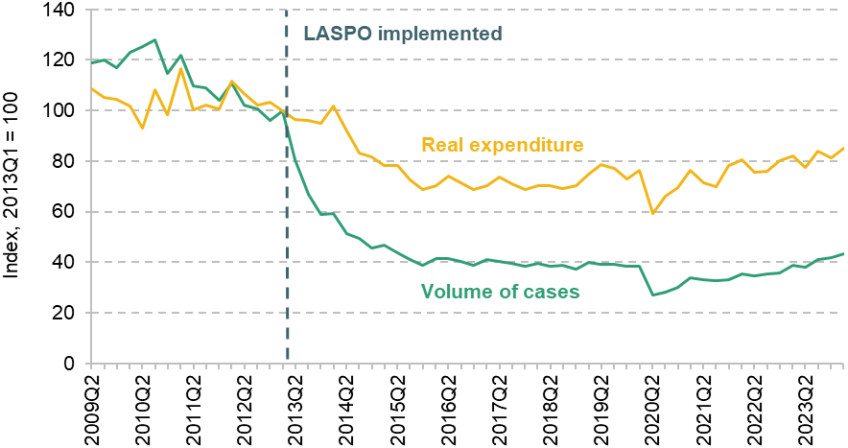
Figure 1 shows national-level trends in civil legal aid cases. There was a substantial decline in both the volume of civil legal aid cases and the level of associated public expenditure following the introduction of LASPO in 2013. LASPO’s changes to scope and fee structures corresponded to a 30% reduction in real-terms civil legal aid expenditure between 2013 and 2016, with most of the decline occurring after 2014. The fall in case volumes is even more striking: the total number of completed civil legal aid cases dropped by 59% over the same period. Since 2021, there has been a small uptick in completed cases, consistent with some recovery in legal aid activity after the COVID-19 pandemic. However, completed case volumes reflect both demand and the capacity of the legal aid system to provide services.
Figure 1. Civil legal aid cases in England and Wales: volume and real expenditure (indexed to 100 in 2013Q1)
Note: Expenditure values are expressed in real terms and adjusted for inflation using the Consumer Prices Index including owner-occupiers’ housing costs (CPIH) from the Office for National Statistics.
Source: Authors’ construction based on Ministry of Justice (2024b).
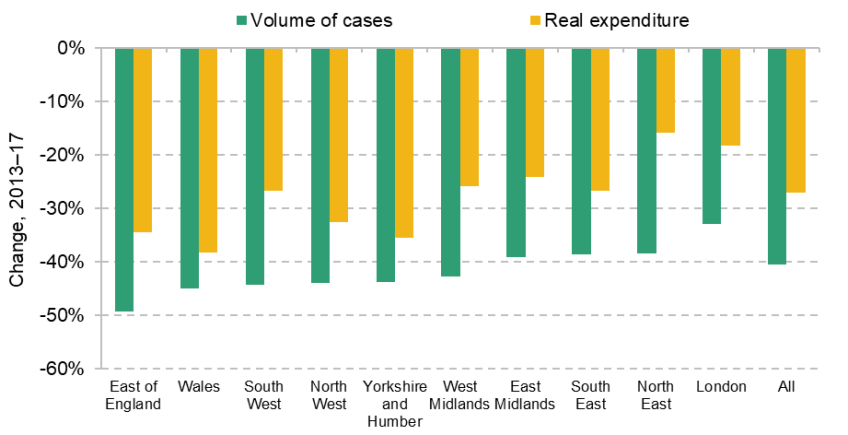
The drop-off in case volume and expenditure can be observed in all regions of England and Wales. Figure 2 shows reductions in civil legal aid cases by region between 2013 and 2017. The largest reductions in case volume and real expenditure took place in the East of England and in Wales, while London, the North East and the South East of England experienced the smallest declines in volume.
Figure 2. Percentage change in civil legal aid cases (volume and expenditure) in England and Wales, by region, between 2013 and 2017
Note: Expenditure values are expressed in real terms and adjusted for inflation using the Consumer Prices Index including owner-occupiers’ housing costs (CPIH) from the Office for National Statistics.
Source: Authors’ construction based on Ministry of Justice (2024b) and Office for National Statistics (2025).
Although all regions saw a decrease in volumes of cases, it could be that different types of areas were differentially affected by the reforms. Figure 3 examines the link between local area deprivation and changes in the volume of cases over time. This analysis focuses on more granular geographical provision, using local authority measures.
Figure 3. Civil legal aid case volumes pre- and post-LASPO, and percentage change post-LASPO, by local authority deprivation decile
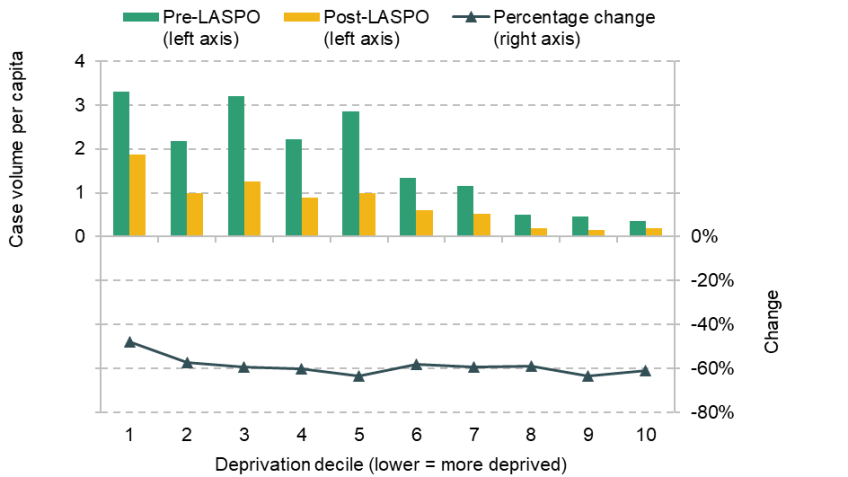
Note: Pre- and post-LASPO periods are 2010–12 and 2013–15, respectively. The percentage change is between these two periods. Deprivation decile is according to the Index of Multiple Deprivation.
Source: Authors’ construction based on Ministry of Housing, Communities and Local Government (2019) and Ministry of Justice (2024b).
Figure 3 presents pre- and post-LASPO civil legal aid case volumes per capita, alongside the percentage change, by deprivation level. It uses the Index of Multiple Deprivation (IMD) to measure deprivation, and lower deciles indicate higher levels of deprivation. Prior to LASPO, case volumes were substantially higher in more deprived areas, with a clear gradient across the distribution: volumes decline steadily as areas become less deprived. This pattern remains evident after LASPO, indicating that civil legal aid activity continued to be disproportionately concentrated in more deprived areas. However, levels are markedly lower across all deciles following the reform. The percentage change in volumes shows large reductions across the entire distribution, typically in the range 40–65%. There is little evidence of a systematic relationship between deprivation and the size of these declines in percentage terms. However, because of the higher number of cases per capita in more deprived areas and similar changes in percentage terms, the absolute number of civil legal aid cases per capita has declined significantly more in the more deprived half of local authorities than in the less deprived half.
Taken together, the figures indicate that civil legal aid activity contracted substantially across England and Wales following LASPO. While the overall level of provision fell sharply, the relative distribution of civil legal aid cases by deprivation remained largely unchanged.
3. The provision of civil legal aid and the rise of ‘civil legal aid deserts’
We now consider in more detail the provision of civil legal aid. Here we measure the supply of civil legal aid using the total number of providers, which serves as a proxy for local civil legal aid activity and effective market capacity.7 Legal aid providers are not part of the public sector; they are private or non-profit organisations that can choose whether to undertake this work. As a result, reductions in provider numbers may reflect a genuine contraction in availability. However, this measure is imperfect. Although it avoids counting wholly inactive contract holders in a given area and quarter, it does not capture variation in caseload specific to civil legal aid as a share of providers’ total activity, staffing levels, hours spent on legal aid work, whether providers are accepting new clients, or the capacity of providers to take on additional cases. Provider counts should therefore be interpreted as a proxy for local legal aid activity, rather than a complete measure of effective supply.
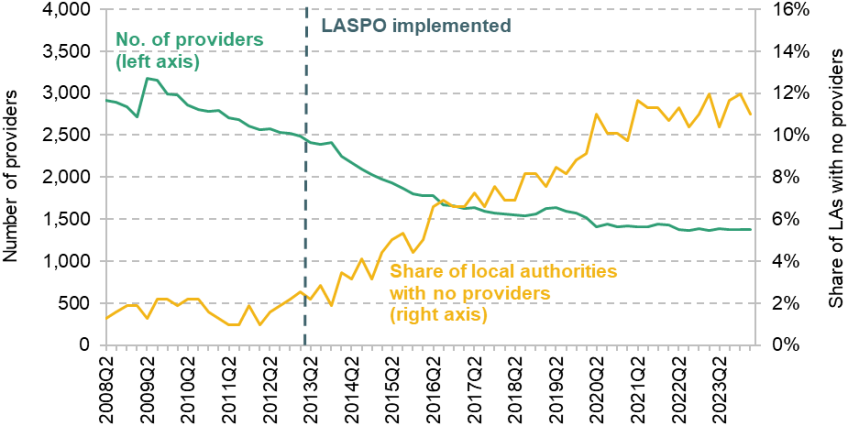
The overall number of firms providing civil legal aid has declined steadily since 2010 – with the start of the decline predating the introduction and implementation of LASPO. The total number of unique civil legal aid providers fell from approximately 3,200 to 1,600 between 2009Q3 and 2019Q3 (Figure 4). LASPO, which came into effect in April 2013, does not appear to have caused a sharp break in the pre-existing downward trend.
Figure 4. Civil legal aid providers and share of local authorities with no civil legal aid provider
Source: Authors’ construction based on Ministry of Justice (2024b) and Office for National Statistics (2025).
Figure 4 also shows one implication of the decline in total provider numbers: more and more local authorities have no providers. At the end of 2010, only 1.6% of local authorities (5 in total) had no civil legal aid provider at all; this had risen to 8.8% (28) by the end of 2019 and 11.9% (38) by the end of 2023. Figure 5 maps these ‘civil legal aid deserts’ – local authorities that do not have any civil legal aid providers in the quarter in question – to understand how they are distributed geographically.
Figure 5. Local authorities in England and Wales with no civil legal aid provider (in grey)
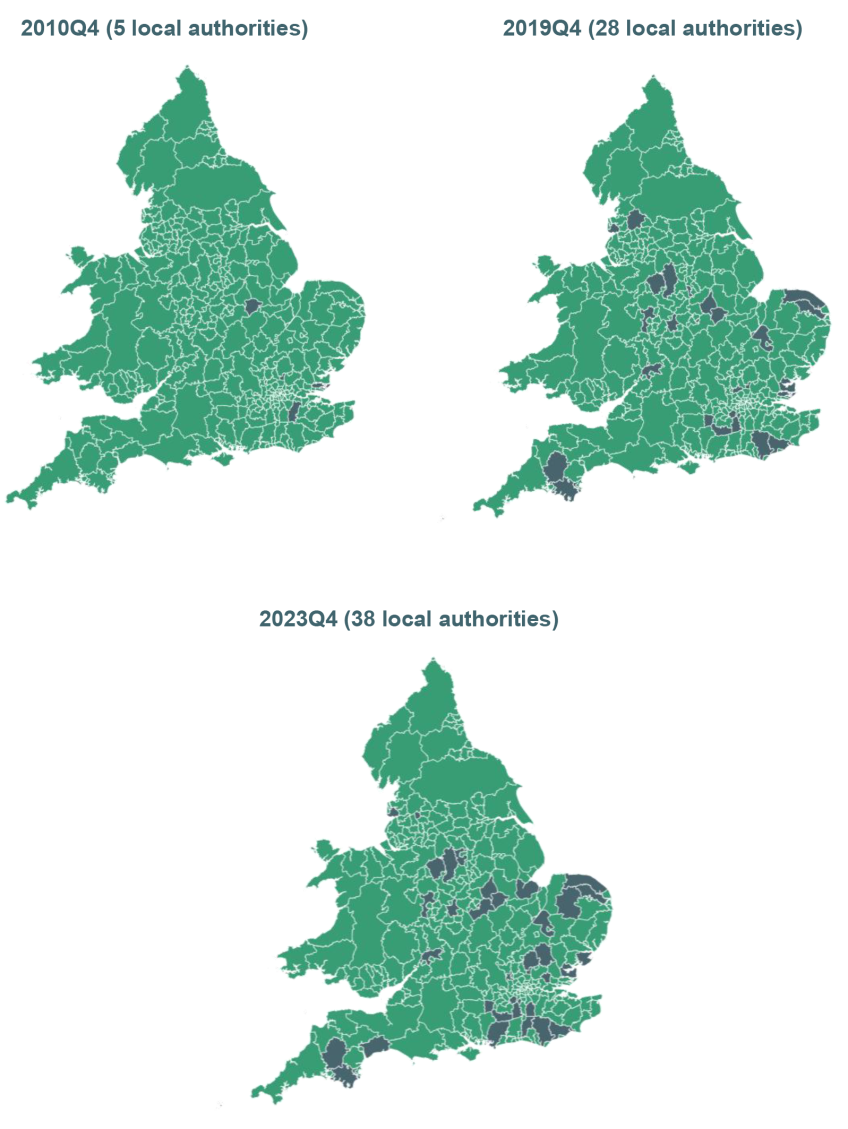
Note: Isles of Scilly is a local authority with no civil legal aid providers throughout the analysis period. For exposition purposes, it is not included in the maps.
Source: Authors’ construction based on Ministry of Justice (2024b) and Office for National Statistics (2025).
This approach is related to recent work by Wilding and Emberson (2026), which maps social welfare legal aid need and provision across England and Wales and highlights the importance of considering deprivation and accessibility together. Their analysis shows that legal aid shortages may not be fully captured by the absence of provider offices alone: shortages may also arise where providers are present but have limited activity or capacity. Our measure of ‘civil legal aid deserts’ should therefore be interpreted as a conservative indicator of local provider absence, rather than a complete measure of access to legal aid. The classification of an area as a ‘civil legal aid desert’ identifies local authorities with no observed civil legal aid provider activity. It should not be interpreted as implying that areas with at least one active provider have sufficient provision. Providers in ‘non-desert’ areas may still have limited capacity or may be unable to meet demand across all areas of law.
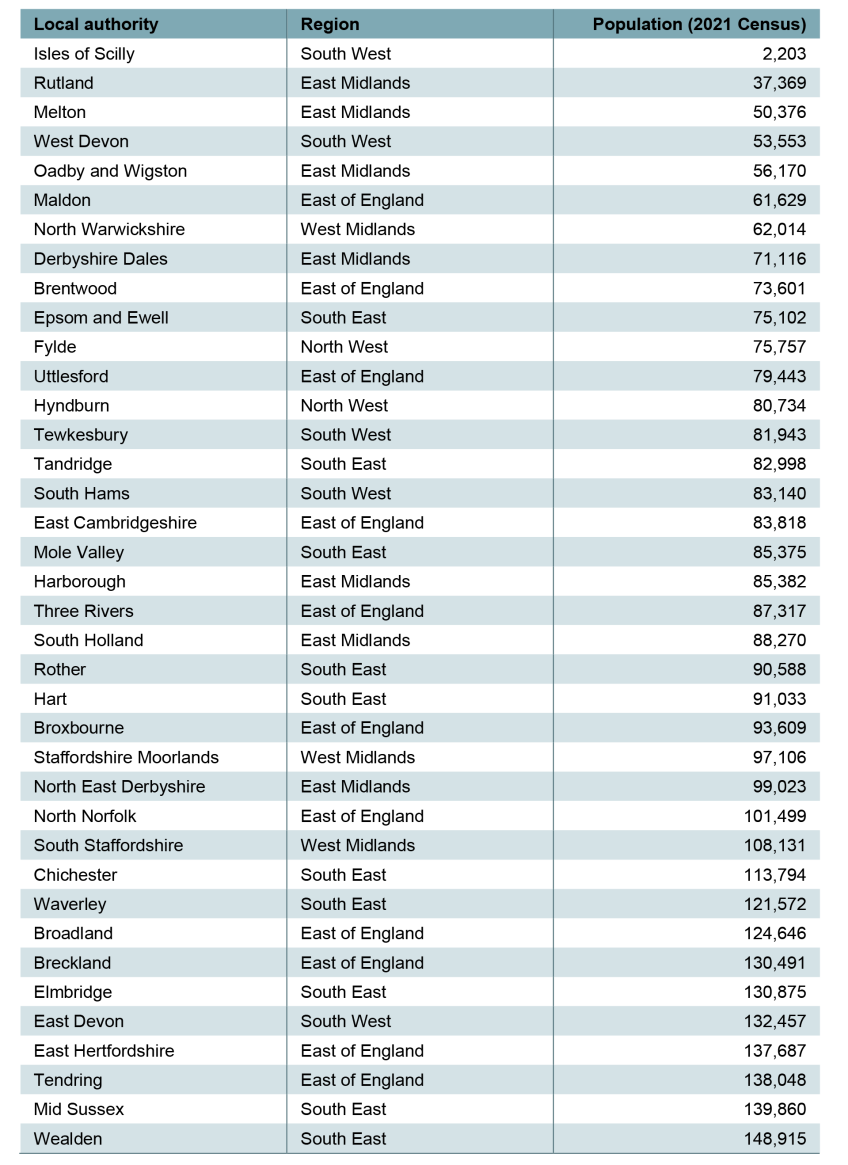
Table 1 provides a list of the 38 local authorities defined as ‘civil legal aid deserts’ by the end of 2023.
Table 1. Local authorities in England and Wales without a civil legal aid provider in 2023Q4
Source: Authors’ construction based on Ministry of Justice (2024b) and Office for National Statistics (2025).
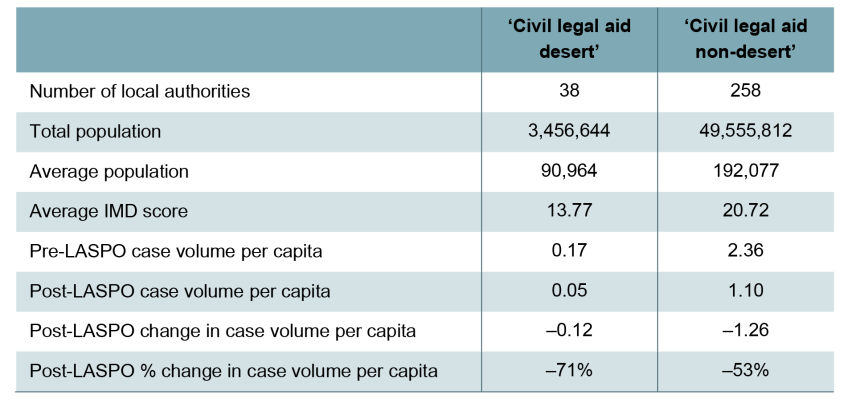
As Figure 5 and Table 1 show, these ‘deserts’ are rural or semi-rural yet geographically diverse and spread across multiple regions. To better understand these areas, Table 2 compares local authorities classified as ‘civil legal aid deserts’ by the end of 2023 with those that are not, showing differences in population, deprivation, and legal aid provision before and after LASPO. ‘Civil legal aid deserts’ have smaller populations, on average. They are generally less deprived, as indicated by a lower average Index of Multiple Deprivation (IMD) score (13.77 versus 20.72). Overall, by the end of 2023, 3.5 million people in England and Wales lived in a local authority without a legal aid provider.
Table 2. Local authority characteristics, by ‘desert’ status in 2023Q4
Note: The Index of Multiple Deprivation (IMD) is an area-level composite measure of deprivation. Higher scores indicate greater deprivation.
Source: Authors’ construction based on Ministry of Justice (2024b) and Office for National Statistics (2025).
Unsurprisingly, local authorities with no civil legal aid providers have very low levels of civil legal aid provision – with 0.05 cases per capita, compared with 1.10 in local authorities with at least one civil legal aid provider. This does not automatically imply that these areas are under-served. They also had much lower civil legal aid case volumes even before LASPO (0.17 versus 2.36 per capita), which may reflect historically lower demand. This interpretation is supported by the deprivation data: these local authorities are, on average, less deprived, suggesting that a smaller share of their population is likely to be financially eligible for civil legal aid. Lower eligibility may therefore translate into lower demand, meaning that reduced provision does not necessarily indicate unmet need. This may mitigate the average impact of provider absence in these areas. However, it does not remove the possibility that eligible individuals living in local authorities without a provider face greater difficulty accessing legal aid.
External indicators suggest that the fall in civil legal aid case volumes should not be interpreted as evidence that legal problems or advice needs have fallen by a similar amount. For example, Citizens Advice trend data show that advice issues linked to debt, housing, energy and other cost-of-living pressures have remained substantial over recent years, with some indicators reaching historically high levels (Citizens Advice, undated and 2023). These indicators are not directly comparable to legal aid case completions, and they do not measure unmet need for civil legal aid among eligible individuals. However, they provide useful context: reductions in legally aided case volumes took place against a backdrop in which many of the underlying social and legal problems associated with civil legal aid remained significant.
While provider presence offers a useful summary of local supply, it does not fully capture how easily individuals can access services in practice. Even in areas with no local provider, individuals may be able to travel to neighbouring authorities. To better understand how access has evolved, Figure 6 examines the distribution of distances to the nearest civil legal aid provider across local authorities over time. It shows that distances have increased steadily. Median (50th percentile) distances rise gradually, indicating a broad-based increase. However, the upper tail increases more sharply: the 90th percentile rises substantially over the period. This suggests that increases in distance are concentrated in a subset of local authorities, rather than being uniform across areas.
Figure 6. Distribution of distances to nearest civil legal aid provider
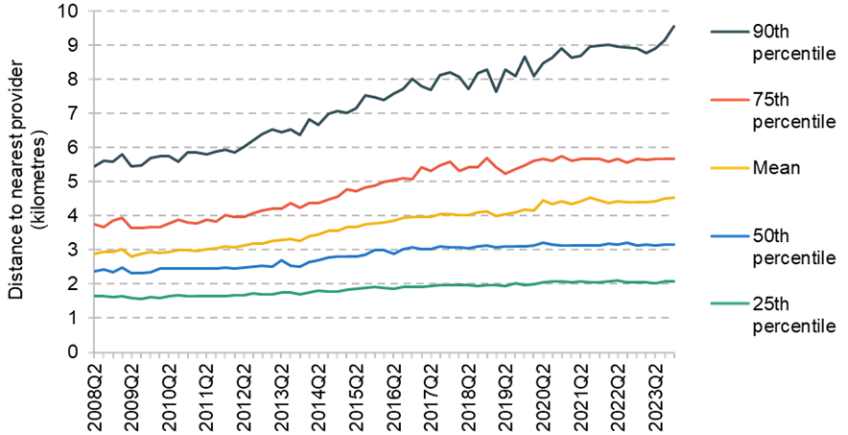
Note: For a given local authority, distance to the nearest provider is calculated from its population-weighted centroid (from its corresponding Lower Super Output Areas) to the coordinates of the nearest civil legal provider, and measured as Euclidean distance.
Source: Authors’ construction based on Ministry of Justice (2024b) and Office for National Statistics (2025).
Figure 7 examines how these patterns relate to the emergence of ‘civil legal aid deserts’, distinguishing between areas with and without a local provider. Distances are substantially higher, and have increased further, in local authorities without a provider. By contrast, distances in areas with at least one provider remain relatively low and stable.
Figure 7. Average distance to nearest civil legal aid provider

Note: For a given local authority, distance to the nearest provider is calculated from its population-weighted centroid (from its corresponding Lower Super Output Areas) to the coordinates of the nearest civil legal provider, and measured as Euclidean distance.
Source: Authors’ construction based on Ministry of Justice (2024b) and Office for National Statistics (2025).
Taken together, this suggests that ‘civil legal aid deserts’ are characterised by persistently low provision and worsening geographic access. While some areas may still be served by nearby providers, individuals (particularly in areas without local provision) are required to travel further on average than in the past to access civil legal aid services.
Capacity constraints may be particularly relevant in areas with high levels of legal need. In dense and deprived urban areas, the presence of local providers does not necessarily mean that all eligible individuals can access advice. Providers may have to prioritise the most urgent issues – for example, cases involving immediate risk of homelessness or destitution – while earlier-stage problems such as rent arrears or debt may receive less support.
4. Conclusion
Volumes of civil legal aid cases, associated government spending and the number of civil legal aid providers have declined substantially nationally. These declines occurred after the introduction and implementation of LASPO, reforms that were explicitly intended in part to reduce legal aid expenditure, although this report does not separately identify the causal effect of LASPO from other contemporaneous changes. A rising number of local authorities – now more than one in eight – have no civil legal aid provider whatsoever. These ‘civil legal aid deserts’ have smaller populations on average and tend to be less deprived local authorities with historically low levels of civil legal aid case volumes. While lower levels of provision in these areas may partly reflect lower underlying eligibility and demand, the absence of local providers may still have important implications for access.
In a context where legal services are increasingly delivered remotely, the importance of local provision may appear diminished. However, there are several reasons why the absence of nearby providers may still matter.
- Physical proximity can reduce barriers to access, particularly for vulnerable individuals (i.e. those who we would expect to be among the heaviest users of legal aid) who may face challenges related to digital access, language, or confidence in navigating legal processes. These concerns may be especially relevant in rural areas with limited transport links.
- Some areas of law – such as housing or welfare – may benefit from providers with detailed knowledge of and interactions with local institutions, practices and communities. Local providers might build up specialist knowledge and, once these providers exit, that expertise might be hard to replace.
- Local providers may also play an important role within wider networks of support, working alongside charities, advice services and local authorities. The loss of these providers may therefore weaken broader systems of assistance.
- For some clients and problem types, face-to-face advice from qualified professionals may be particularly valuable in helping individuals resolve problems before they escalate. Given the role of legal aid in supporting individuals facing issues related to housing, debt, welfare and family law, the emergence of areas with very limited provision may still create barriers for those who are eligible, even if overall demand is lower.
The importance of local and face-to-face provision is likely to vary by client group, type of legal problem and the availability of remote alternatives. Telephone or online advice may reduce distance-related barriers for some individuals, while others may face difficulties accessing or navigating advice without local or in-person support.
The role of local provision also needs to be understood in the context of policy changes intended to increase the use of remote advice. Following LASPO, some areas of civil legal aid advice were routed through the Civil Legal Advice telephone gateway, with face-to-face advice available only in certain circumstances. The mandatory element of the gateway was later removed for education, discrimination and debt cases, but telephone and online advice remain part of the legal aid access landscape (Legal Aid Agency, 2020; Civil Legal Aid (Procedure) (Amendment) Regulations 2020).
The data used in this report do not distinguish between face-to-face, telephone and online advice, so we cannot assess how provision or accessibility varies by delivery channel. Even provision that is nominally face-to-face may involve a mix of in-person, telephone and online contact. For this reason, we refer to Civil Legal Advice as part of the policy context, but do not use headline Civil Legal Advice figures as quantitative evidence on local capacity, demand or unmet need.
Taken together, these findings suggest that the period following LASPO saw a reduction in the overall scale of civil legal aid provision, alongside changes in its geographic distribution. This is likely to have had consequences for access to justice, although the scale and nature of those consequences will depend on underlying demand, provider capacity, the availability and effectiveness of remote advice, and the needs of different client groups. Understanding how these changes affect access to justice remains an important area for future research, particularly in assessing whether reduced provision translates into poorer outcomes for individuals and communities.
References
Bellamy, C., 2021. Independent Review of Criminal Legal Aid. Ministry of Justice, https://assets.publishing.service.gov.uk/government/uploads/system/uploads/attachment_data/file/1041117/clar-independent-review-report-2021.pdf.
Bharti, N. K. and Lehne, J., 2024. Justice for all? The impact of legal aid in India. Working Paper, https://www.isid.ac.in/~acegd/acegd2025/papers/NitinKumarBharti.pdf.
Cassidy, M. T. and Currie, J., 2023. The effects of legal representation on tenant outcomes in housing court: evidence from New York City’s Universal Access program. Journal of Public Economics, 222, 104844, https://doi.org/10.1016/j.jpubeco.2023.104844.
Citizens Advice, undated. Advice trends. https://www.citizensadvice.org.uk/about-us/browse/advice-trends/.
Citizens Advice, 2023. Cost-of-living data trends. https://www.citizensadvice.org.uk/policy/publications/cost-of-living-trends/.
Civil Legal Aid (Procedure) (Amendment) Regulations 2020, SI 2020/439. Explanatory memorandum. https://www.legislation.gov.uk/uksi/2020/439/pdfs/uksiem_20200439_en.pdf.
Cooper, R., Doyle, J. J. and Hojman, A., 2025. Effects of enhanced legal aid in child welfare: evidence from a randomized trial of Mi Abogado. American Economic Review, 115(7), 2306–42, https://doi.org/10.1257/aer.20230947.
Ellen, I. G., O’Regan, K., House, S. and Brenner, R., 2021. Do lawyers matter? Early evidence on eviction patterns after the rollout of Universal Access to Counsel in New York City. Housing Policy Debate, 31(3–5), 540–61, https://doi.org/10.1080/10511482.2020.1825009.
House of Commons Justice Committee, 2015. Impact of changes to civil legal aid under Part 1 of the Legal Aid, Sentencing and Punishment of Offenders Act 2012. Eighth Report of Session 2014–15, https://publications.parliament.uk/pa/cm201415/cmselect/cmjust/311/311.pdf.
House of Commons Justice Committee, 2021. The future of legal aid. Third Report of Session 2021–22, https://committees.parliament.uk/publications/6979/documents/72829/default/.
Legal Aid Agency, 2020. Civil news: mandatory telephone gateway phased out. https://www.gov.uk/government/news/civil-news-mandatory-telephone-gateway-phased-out.
Legal Aid Agency, 2025a. Guidance on claiming Housing and Debt and Asylum and Immigration Fee Uplifts for matters started on or after 22nd December 2025. https://assets.publishing.service.gov.uk/media/696a1b7d0c654a0ec44022e5/Fees_Uplift_Guidance.pdf.
Legal Aid Agency, 2025b. Legal Aid Agency Annual Report and Accounts 2024–25. https://www.gov.uk/government/publications/legal-aid-agency-annual-report-and-accounts-2024-to-2025.
Legal Aid Agency, 2026a. Civil legal aid: means testing. https://www.gov.uk/guidance/civil-legal-aid-means-testing.
Legal Aid Agency, 2026b. Keycard 62. https://assets.publishing.service.gov.uk/media/69d611b485ac94fabd46253f/LAA_civil_legal_aid_eligibility_keycard_62.pdf.
McGuinness, T., 2020. Legal aid: the review of LASPO Part 1. House of Commons Library Briefing Paper, https://researchbriefings.files.parliament.uk/documents/CBP-8910/CBP-8910.pdf.
Ministry of Housing, Communities and Local Government, 2019. English Indices of Deprivation 2019. https://www.gov.uk/government/statistics/english-indices-of-deprivation-2019.
Ministry of Justice, 2010. Proposals for the reform of legal aid in England and Wales. Consultation Paper CP12/10, https://assets.publishing.service.gov.uk/media/5a7c811ae5274a559005a531/7967.pdf.
Ministry of Justice, 2019. Post-implementation review of Part 1 of the Legal Aid, Sentencing and Punishment of Offenders Act 2012 (LASPO). https://assets.publishing.service.gov.uk/media/5c5b3b2b40f0b676c362b4e0/post-implementation-review-of-part-1-of-laspo.pdf.
Ministry of Justice, 2024a. Survey of civil legal aid providers in England and Wales. Report informing the Review of Civil Legal Aid, prepared by PA Consulting, https://assets.publishing.service.gov.uk/media/65aa4068ed27ca000d27b28a/civil-legal-aid-providers-survey.pdf.
Ministry of Justice, 2024b. Civil legal aid statistics England and Wales completions by provider and area data to March 2024. Available at https://www.gov.uk/government/statistics/legal-aid-statistics-january-to-march-2024-data-files.
Ministry of Justice, 2025. Review of Civil Legal Aid. https://www.gov.uk/guidance/civil-legal-aid-review.
National Audit Office, 2024. Government’s management of legal aid: Ministry of Justice, Legal Aid Agency. Value for money report, https://www.nao.org.uk/reports/governments-management-of-legal-aid/.
Office for National Statistics, 2025. Lower layer Super Output Areas (December 2021) EW population-weighted centroids. https://geoportal.statistics.gov.uk/datasets/lower-layer-super-output-areas-december-2021-ew-population-weighted-centroids-3/about.
Onafuwa, O., 2024. LASPO 2012: ten years and beyond – a socio-legal study of the impact of legal aid cuts on service providers in England and Wales. Legal Ethics, 27(1), 45–62, https://doi.org/10.1080/1460728x.2024.2399921.
Open Innovation Team, 2024. Review of civil legal aid in England and Wales: comparative analysis of legal aid systems. https://assets.publishing.service.gov.uk/media/66461e94993111924d9d36ab/240516_-_RoCLA_Comparative_Analysis_of_Legal_Aid_Systems.pdf.
Organ, J. and Sigafoos, J., 2018. The impact of LASPO on routes to justice. Equality and Human Rights Commission, Research Report 118, https://www.equalityhumanrights.com/sites/default/files/the-impact-of-laspo-on-routes-to-justice-september-2018.pdf.
Parliament of the UK, 1999a. Access to Justice Act 1999. https://www.legislation.gov.uk/ukpga/1999/22.
Parliament of the UK, 1999b. Access to Justice Act 1999: explanatory notes. https://www.legislation.gov.uk/ukpga/1999/22/notes.
Uraz, J-N., 2025. The impacts of reduced access to legal assistance: evidence from England and Wales. Working Paper, https://ilag2025.jura.uni-koeln.de/sites/ilag2025/URAZ_Juliet_Nil_June_2025.pdf.
Uraz, J-N., 2026. Legal aid in England and Wales: a historical and budgetary perspective. Working Paper, https://papers.ssrn.com/sol3/papers.cfm?abstract_id=6516838.
Wilding, J. and Emberson, C., 2026. A geography of access to justice: mapping social welfare legal aid need and provision in England and Wales. Journal of Law and Society, 53(2), 187–210, https://doi.org/10.1111/jols.70063.
Acknowledgements
The authors gratefully acknowledge the support of the ESRC Centre for the Microeconomic Analysis of Public Policy (ES/Z504634/1) and of the Nuffield Foundation (SFS/FR-000024397). They thank Imran Rasul, Max Warner and Ben Zaranko for their comments. This project has been funded by the Nuffield Foundation, but the views expressed are those of the authors and not necessarily the Foundation. Any errors are the authors’ own.
The Nuffield Foundation is an independent charitable trust with a mission to advance social well-being. It funds and undertakes rigorous research, encourages innovation and supports the use of sound evidence to inform social and economic policy, and improve people’s lives. The Nuffield Foundation is the founder and co-funder of the Nuffield Council on Bioethics, the Ada Lovelace Institute and the Nuffield Family Justice Observatory. This project has been funded by the Nuffield Foundation, but the views expressed are those of the authors and not necessarily the Foundation. Find out more at: nuffieldfoundation.org. Bluesky: @nuffieldfoundation.org LinkedIn: Nuffield Foundation
Endnotes
Authors

Tom Burrows

Magdalena Domínguez
Magdalena is a Senior Research Economist at the IFS. Her research focuses on issues related to the economics of crime, networks & place-based policies
More from IFS
Understand this issue


Policy analysis


Academic research


