Last month, the government published the provisional Local Government Finance Settlement, setting out funding allocations for English councils for the three years from 2026–27 to 2028–29. These allocations reflect major reforms to how local government is funded, which are set to be phased in over this period.
As we discussed in our immediate response to the settlement, councils’ core funding (or ‘core spending power’) is set to increase at a fair clip over the next three years, provided they make full use of their council tax raising powers: if they do, by 2028–29, core funding will be around 15.6% higher in cash terms and 8.8% higher in real terms than in 2025–26. There will be a significant redistribution of funding towards more urban and more deprived councils so that by 2028–29, core funding per person will be around 46% higher in the most deprived than in the least deprived tenth of areas, compared with 26% higher in 2025–26.
In new analysis, as we await the final settlement (expected in the next week or so), we now look in more detail at three issues:
- the extent to which funding increases depend on council tax increases;
- the extent to which funding reforms meet the government’s objective of better aligning funding with need;
- the way the government is calculating how much business rates growth councils are currently retaining, which affects the funding floors it is setting for them.
Reliance on large council tax increases
The stated increase in overall council funding assumes that councils increase their council tax bills by the maximum allowed without calling and winning a local referendum. For the vast majority, this assumes that bills increase by 5% each year (3% for shire districts). These would be substantial increases in real terms, with consumer prices set to increase by only around 2% on average each year. The average council tax bill for a band D property could rise from £2,280 this year to £2,630 by 2028–29, an increase of 8.5% in real terms.1
For six councils (City of London, Hammersmith & Fulham, Kensington & Chelsea, Wandsworth, Westminster and Windsor & Maidenhead), the usual limits to council tax increases will not apply in 2027–28 or 2028–29 (after London’s May 2026 local elections). The figures for overall funding presented by the government assume some very large increases in council tax bills indeed for these councils. For example, the council tax bill set by Wandsworth council for a band D property is assumed to rise from £507 this year to around £900 by 2028–29, an increase of two-thirds in real terms.2 The actual bills set in these areas will continue to be set by local policymakers.
If instead of the above-inflation increases assumed by the government, all councils were to increase council tax bills in line with forecast CPI inflation each year, then overall council funding would increase by 3.8% in real terms over the next three years (instead of by 8.8%). Without above-inflation bill rises, 44% of councils would see a real-terms increase in funding over these three years, compared with 57% with the government’s assumed rises. As shown in Figure 1, the difference would be especially stark for those councils that will not be subject to the usual referendum limits from 2027–28. Five of those six areas (excluding City of London) can expect to see average real-terms cuts in overall funding of 9% over the next three years. As shown by the blue diamonds, if they only put bills up in line with inflation, they could each see their overall funding fall by more than a fifth in real terms.
Figure 1. Change in real-terms funding between 2025–26 and 2028–29 for individual councils under different assumptions for changes in council tax bills
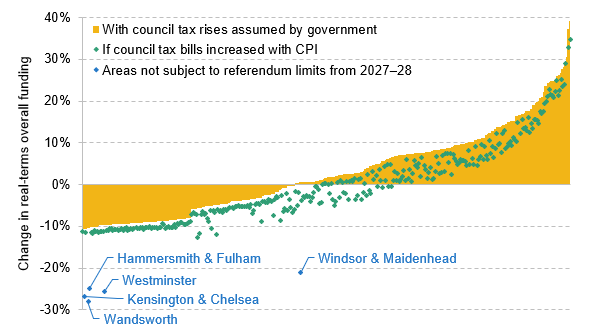
Note: Each vertical bar and each marker corresponds to one council. Real-terms changes reflect forecast GDP deflators. Assumes taxbase growth as per the government’s core spending power calculations. Excludes City of London, Isles of Scilly, Greater London Authority, fire authorities and combined authorities.
Source: Authors’ analysis using Core Spending Power table: provisional local government finance settlement 2026 to 2029, Council tax levels set by local authorities in England 2025 to 2026 and Economic and fiscal outlook – November 2025.
Figure 2 shows the changes in overall core funding for councils by decile of area deprivation since 2024–25 – i.e. since the last settlement under the previous government – both with the council tax rises assumed by government in future years and if bills were to increase in line with CPI inflation after 2025. Over these four years, core funding for the most deprived tenth of areas is set to increase by 23.3% on average, compared with 4.1% amongst the least deprived tenth of areas, which will see almost no real-terms growth in core funding over the next three years (0.8%). Without above-inflation increases in council tax bills after 2025–26, councils in the least deprived tenth of areas could have around 2.7% less funding in 2028–29 than they had in 2024–25.
Figure 2. Changes in real-terms overall funding by deprivation decile
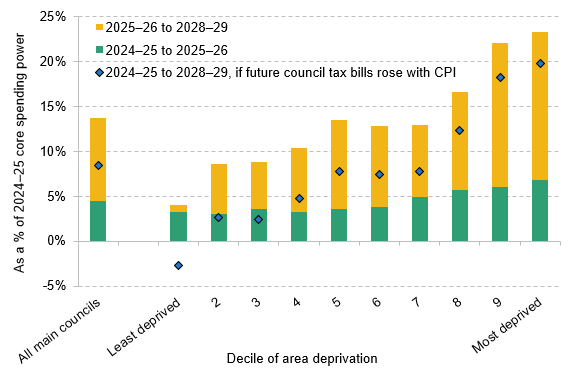
Note: Real-terms changes reflect forecast GDP deflators. Deprivation deciles are based on Index of Multiple Deprivation (IMD) 2025 Average Score at the upper-tier authority level. Excludes City of London, Isles of Scilly, Greater London Authority, fire authorities and combined authorities.
Source: See Figure 1.
Importantly, this reliance on council tax for additional revenue will not create the same distributional issues as it once might. As a result of the government’s reforms, grant funding will be allocated between councils to offset differences in how much council tax each area could raise for itself. More specifically, by 2028–29, most grant funding will be allocated to councils to achieve ‘full equalisation’ – i.e. to ensure that if all councils were to set their council tax level to the national average, councils would receive the same share of overall funding as the share that the government assesses they ‘need’. These assessments of needs are meant to capture the relative spending required by each council in order for them all to deliver equivalent services to their residents, given differences in the costs and demands they face.
Will the government achieve 'fair funding'?
A key objective of this new system is to better align funding with spending needs. How successful will it be?
As we have previously explained, councils’ relative spending needs cannot be observed directly and any attempt to assess them will inevitably reflect subjective judgements on, for example, the impact of remoteness on the relative costs of delivering services in different parts of the country and the importance of deprivation as a driver of demand for services. This means it is not possible to say whether funding under the new system will truly align with underlying needs.
But we can examine the extent to which funding will align with the government’s own assessments of each area’s needs which (following some updates) we have assessed to be based on reasonable methodological choices. Comparing the share of overall funding each area is set to receive with these assessments allows us to judge whether, by its own measure, the government will be achieving ‘fair funding’ for different councils in England by 2028–29.
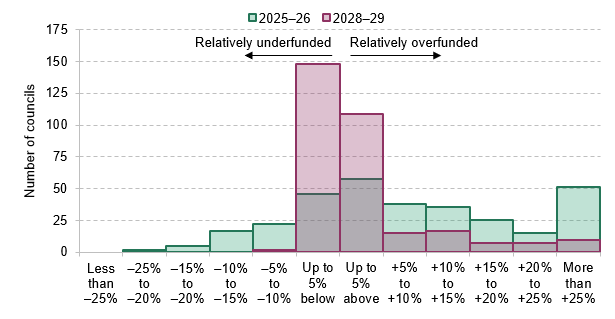
First, as shown in Figure 3, many councils were relatively overfunded in 2025–26 – they received a greater share of overall funding than the government now assesses they would need – and only 29% of councils were receiving a share of funding within 5% of their share of assessed needs. This partly reflects that councils have been able to retain above-baseline growth in business rates revenues since 2013–14 – a feature of the system that will be fully reset from 2026–27 alongside the government’s funding reforms. By 2028–29, many more councils – around half – can expect to receive a share of overall funding that is within 5% of the funding they would receive if all funding was distributed in line with needs.
Figure 3. Distance between share of actual funding and share of assessed needs, 2025–26 and 2028–29
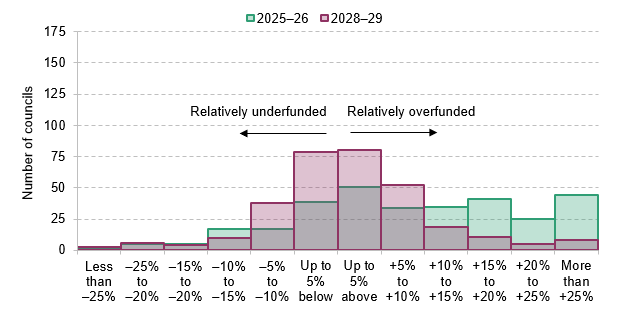
Note: Measure of funding is actual core funding reflecting assumed council tax bill increases but excluding consolidated grants that are part of core spending power which are allocated based on other formulae. Excludes any future retained above-baseline business rates growth. Shares of this measure of funding are compared with shares of assessed weighted relative needs in 2028–29. Both funding and needs exclude City of London, Isles of Scilly, Greater London Authority, fire authorities and combined authorities.
Source: Authors’ analysis using Fair funding share calculator, Core Spending Power table: provisional local government finance settlement 2026 to 2029, Council tax levels set by local authorities in England 2025 to 2026 and Economic and fiscal outlook – November 2025.
To a large extent, remaining differences between overall funding and assessed needs reflect differences in the council tax levels set in different parts of the country. Under the reformed system, a ‘resources adjustment’ explicitly accounts for the notional council tax revenues each area could raise if it was to set its council tax to the national average. This avoids rewarding areas that set low council tax bills with more grant funding and avoids penalising areas that set higher bills with less grant funding. A better measure of whether funding is ‘fair’ is whether funding would align to needs shares if all areas set their council tax bill to the average.
As shown in Figure 4, on this measure, only a third of councils would have had funding within 5% of their assessed needs in 2025–26, and 24 councils would have been relatively underfunded by at least 10%. By 2028–29, it will be much less common for councils to be relatively underfunded: the most relatively underfunded council will receive 5.5% less funding than its share of needs, with four-fifths of councils set to receive funding within 5% of their needs share.
Figure 4. Distance between share of funding if all set council tax to the average and share of assessed needs, 2025–26 and 2028–29
Note: Measure of funding is core spending power excluding consolidated grants but adjusting council tax revenues based on {the difference between actual council tax level set (and assumed level set in 2028–29) and notional council tax level} x {tier split} – as a proxy for revenues if all areas set their council tax level to the average. Excludes any future retained above-baseline business rates growth. Excludes City of London, Isles of Scilly, Greater London Authority, fire authorities and combined authorities.
Source: See Figure 3.
However, it will still be common for councils to be relatively overfunded, with 41 still set to be receiving at least 10% more funding than the share that the government assesses they will need in three years’ time, when the government’s reforms are meant to have been fully rolled out.
There are two main reasons for these remaining gaps.
First, the government has decided to maintain allocations of the so-called ‘recovery grant’ for the next three years instead of rolling this funding in and redistributing it through the new funding system. This grant was initially awarded to around half of councils in 2025–26 as a one-off, as a way for the government to redistribute funding in the short term to the more deprived areas that had seen the largest cuts in funding during the 2010s. It will still be worth £600 million to these areas in 2028–29.
Second, the government has also decided to provide ‘transitional protection’ to councils facing the largest cuts in funding as a result of the reforms. This takes the form of funding floors, with different floors applying to different councils: depending on which floor they are on, councils are guaranteed that their overall cash-terms funding will be at least 95% or 100% of their 2025–26 funding level. When its funding reforms are fully rolled out in 2028–29, the government expects to be spending £560 million on these cash-terms floors, plus a further £100 million on a more generous real-terms funding floor for councils in receipt of the recovery grant.
This funding – together worth £1.3 billion in 2028–29 – is not being allocated in a way that is aligned with the government’s assessments of councils’ needs. Without these features, we estimate that 98% of councils would receive funding within 5% of their needs share in 2028–29, were they to set their council tax bills at the national average level.
Transitional protections may be justified as preventing some councils seeing very large funding cuts, which may be difficult to deliver quickly without unnecessarily severe impacts on local services and residents. The government’s approach to the recovery grant is more difficult to justify given that initial allocations of the grant were based on factors – deprivation and council tax bases – which are anyway set to be accounted for under the government’s reformed system, and in a more up-to-date and sophisticated way. Maintaining 2025–26 allocations of the recovery grant does not look like a principled decision but a way for the government to achieve particular distributional aims through an ad hoc bolt-on to the new system. If it thinks the needs assessments it has produced do not properly reflect the needs of more deprived places, it should say so – and update them accordingly.
In 2028–29, nearly four in ten councils are set to be receiving some transitional protection, and for 42 councils this funding will be worth more than 10% of their overall funding in that year. This raises major questions for how the government will update the funding system after 2028–29. Will these councils face a cliff-edge in funding at that point as the government moves more quickly to ‘fair funding’? Will the slow transition continue? Or will the protection they still benefit from become a permanent part of their allocations?
Are the jumping-off points for transitional protections wrong?
Many of the councils set to receive transitional protections are those that have gained the most from business rates growth since the business rates retention scheme was introduced in 2013. The gains that have been accrued over the past 13 years are now due to be redistributed. The transitional protection scheme needs an estimate of the gains councils are currently enjoying, so that the funding floors can account for the loss of this income.
The approach the government is using to estimate the distribution of these business rates revenues in 2025–26 is likely to be systematically overestimating revenues for some councils and underestimating them for others – leading to the funding floors being set too high and too low, respectively. A particular issue relates to councils that form ‘business rates pools’ – a way to share risk and reward between councils but also to avoid ‘levies’ the government charges on the business rates growth of councils with big tax bases (as the levy is calculated at the pool level rather than individual council level). The government has assumed that all of the gains from pooling go to councils that would otherwise have had to pay a levy on their business rates growth. But in reality these pooling benefits are shared between councils in a pool – the councils that would otherwise pay a levy share some of the benefits with other councils to encourage them to join the pool!
The government’s assumption has resulted in higher estimates of current funding for councils that would have paid big levies had they not been part of a pool. For example, the government has assumed for the purposes of the funding floors that business rates provided £26.4 million in funding for North West Leicestershire in 2025–26, whereas the council’s own estimate at the start of the year (based on actual pooling arrangements in Leicestershire) was £8.7 million. As a result, North West Leicestershire’s funding floor has been set at an artificially high level – so much so that that council is still set to receive twice as much funding in 2028–29 as the government assesses it will need. In contrast, Leicestershire county council’s assumed business rates revenues (£93.2 million) are lower than its own budget estimates (£99.9 million) – because the government has assumed it does not currently benefit from pooling, when in reality the county council is allocated one-third of the gains of this pool. Its funding floor is thus set too low (although, in this case, its funding is set to be high enough above the floor that this does not matter).
This pattern will be repeated – albeit in a less extreme way – in other parts of England where councils are part of business rate pools. Designing and implementing an alternative approach to allocating assumed pooling gains is challenging. The details of pooling arrangements differ across the country, information on them is not collated centrally, and allocations are sometimes not finalised for several years as councils try to negotiate a better share for themselves. But by reviewing pooling agreements, the government should be able to develop and model an ‘exemplar scheme’. While this would not exactly match the actual arrangements in each area, this would be better than its current approach. As we await the final local government settlement, a key question is whether the government will be able to do that for next year – or whether it will postpone such an improvement to the next multi-year local government finance settlement. The answer will mean differences in funding of millions of pounds a year for some councils such as North West Leicestershire.
Endnotes
Authors

Kate Ogden
Kate joined the IFS in 2020 and works on local government finance and higher education.

David Phillips
David is Head of Devolved and Local Government Finance. He also works on tax in developing countries as part of our TaxDev centre.
More from IFS
Understand this issue


Policy analysis


Academic research