
Correction: An earlier version of this comment incorrectly stated that core funding for the most deprived tenth of areas would increase by 22.6% in real terms. This is the cash-terms figure.
The government has today published the provisional Local Government Finance Settlement, setting out funding allocations for English councils for the next three years from 2026–27 to 2028–29. This is a particularly important settlement for councils, as the government is implementing major reforms to how local government is funded, with changes set to be phased in over these three years. The government consulted on initial reform proposals over the summer, and provided information on updated plans in a policy statement in November, so the overall shape of the planned reforms has been known. However, today’s settlement provides the first official figures for how funding for specific councils will evolve over this period.
Overall funding for local government
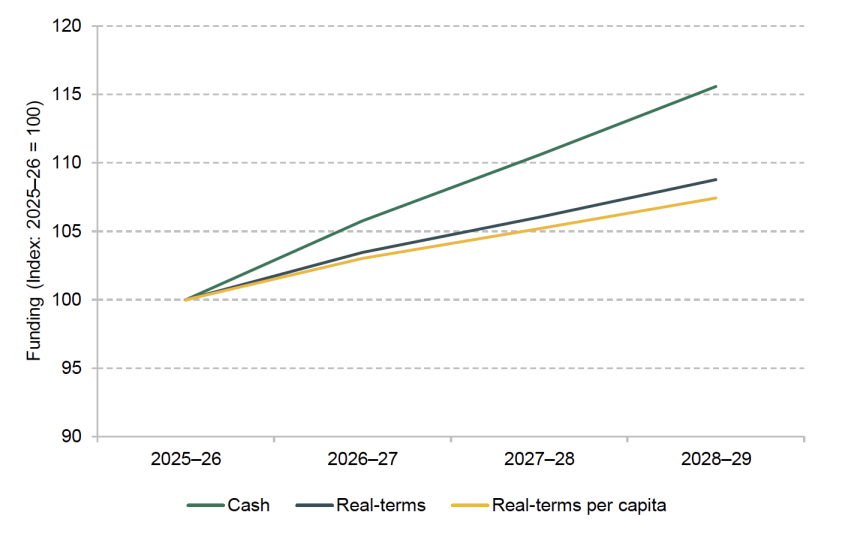
The settlement confirmed that councils’ core funding (or ‘core spending power’) will increase substantially over the next three years. In 2026–27, core funding for main councils will increase by £3.9 billion, or 5.8%, if all councils (bar six exceptions discussed below) put council tax up by the maximum typically allowed without a referendum of local residents. This is equivalent to 3.5% in real terms, after accounting for forecast economy-wide inflation. As shown in Figure 1, overall funding will increase further in the next two years, albeit at a slightly slower pace. By 2028–29, overall council core funding will be around 15.6% higher in cash terms, and 8.8% higher in real terms, than in 2025–26. After accounting for projected population growth, this translates into a 7.4% real-terms increase in funding per resident, on average.
This is substantially faster than overall day-to-day spending on public services, which is set to increase by just 2.9% in real terms between this year and 2028–29. It is even faster than the increase for the Department of Health and Social Care, which is set to see a 7.0% real-terms boost over the same period.
Figure 1. Change in overall council core funding, real-terms and real-terms per resident
Note: Includes funding for main councils only (i.e. excluding fire and combined authorities). Excludes City of London, for which core funding figures are not available after 2026–27. Funding adjusted for inflation using GDP deflators from OBR Economic and Fiscal Outlook, November 2025. Per-person figures reflect the latest ONS mid-2024 resident population estimates, and 2022-based projections.
If all councils (bar six exceptions discussed below) put bills up by the maximum typically allowed, revenues from council tax would increase by around £2.4 billion in 2026–27 and by £7.8 billion (15% in real terms) by 2028–29. By that final year, assumed increases in council tax revenues – which reflect both increases in tax rates, and growth in the underlying council tax base due to new housing development – are set to account for around three-quarters of the overall increase in councils’ core funding. Importantly, while the revenues raised from a given increase in council tax bills will differ between areas, this reliance on council tax for additional revenue will not create the same distributional issues as it once might. This is because the government will assess councils’ tax bases – and hence how much they could raise from council tax – and will allocate grant funding between councils to offset these differences.
Major reforms to how funding is allocated
The government is putting in place a new system for allocating funding between councils, and phasing in the resulting large changes to allocations of government grant funding and business rates revenues to individual councils. The major elements of the reforms are:
- Assessing each council’s relative spending needs using a new set of formulas designed to reflect differences in the demand for and cost of delivering local services.
- Assessing how much councils can raise themselves via council tax, based on modelled revenues if their tax rate was equal to the average tax rate across all councils.
- Allocating most grant funding from government to areas to achieve ‘full equalisation’ of revenue-raising capacity and spending needs, i.e. to ensure that councils would receive the share of overall funding that they are assessed to need, if they were to set their council tax level to the national average.
- Fully redistributing growth in business rates around England. Accrued above-baseline growth in business rates revenues, which councils have been able to retain since 2013–14, will be redistributed based on updated assessments of needs. Following this redistribution of past growth, councils will be able to benefit from future growth in business rates revenues from 2026–27 onwards, until the system is reset again.
- Phasing in these various changes over a period of three years from 2026–27 to ease the transition, and putting in place funding floors to limit losses for those receiving less funding under the new system than currently.
Many of the details of the reforms – such as how to assess councils’ need to spend, and how far to account for council tax revenue-raising capacity – embody subjective, political judgements about how councils should be funded. Different councils and stakeholders will differ in their views about how fair the government’s assessments are – and what changes, if any, should be made to make them fairer. And as discussed in our response to November’s Policy Statement, some specific decisions are a little questionable. However, the reforms as a whole are welcome, as they will give England a rational system for allocating funding between councils, arguably for the first time in two decades.
In addition, the government has said that it will consider requests by councils to increase council tax by more than the usual referendum limits if they are losing funding and if their tax rates are currently below the national average. Six councils (City of London, Hammersmith and Fulham, Kensington and Chelsea, Wandsworth, Westminster, and Windsor and Maidenhead) facing reductions in funding and with among the lowest council tax rates in the country have been granted pre-authorisation to exceed the usual limits for two years. The funding figures published today assume some very large increases in council tax bills indeed for these councils – around 75% in the case of Wandsworth and Westminster.
Variation in changes across councils
Today’s settlement gives the first official projections of how funding for individual councils will evolve as a result of the final package of reforms.
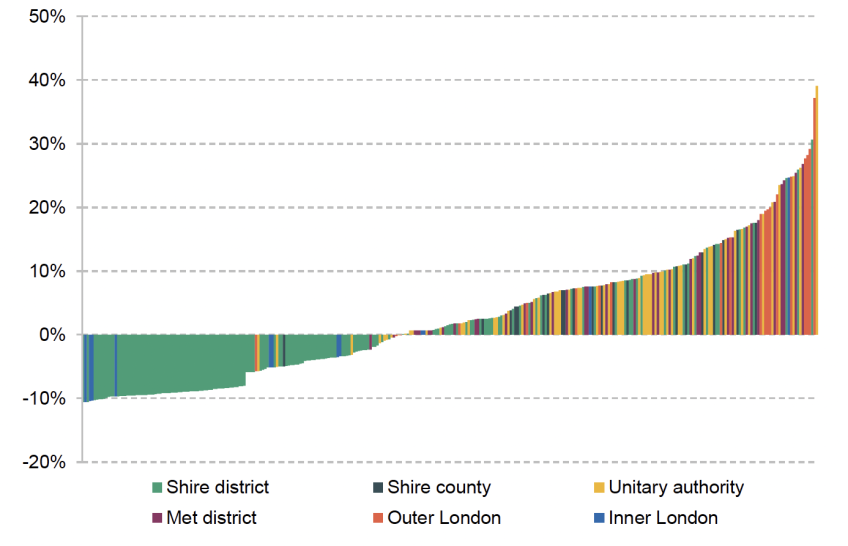
Figure 2 shows the projected real-terms changes in funding for different councils between this year and 2028–29, ranked from biggest reduction to biggest increase.
The graph shows that almost half of councils (43%) will see their funding fall in real terms over the next three years. This includes the majority of shire districts (70%) and inner London boroughs (67%), but far smaller shares of outer London boroughs (15%), unitary authorities (13%), metropolitan districts (6%) and shire counties (5% – or 1 out of 21). These patterns reflect changes to where needs are assessed to lie – including a shift from the types of services provided by district councils (such as refuse collection, planning services and leisure services) to those provided by counties and single-tier councils (such as social care and home-to-school transport).
At the other end of the spectrum, 1 in 10 councils will see their funding increase in real terms by a sixth (16.7%) or more over the next three years. There is a concentration of such big winners in outer London, where half (10 out of 20) councils are set to gain at least this much. Five outer London boroughs (Barking and Dagenham, Enfield, Hillingdon, Hounslow and Newham) are set to see increases of a quarter or more.
Figure 2. Percentage real-terms changes in funding between 2025–26 and 2028–29 for individual authorities
Note: See note to Figure 1. Excludes City of London, standalone fire authorities and combined authorities.
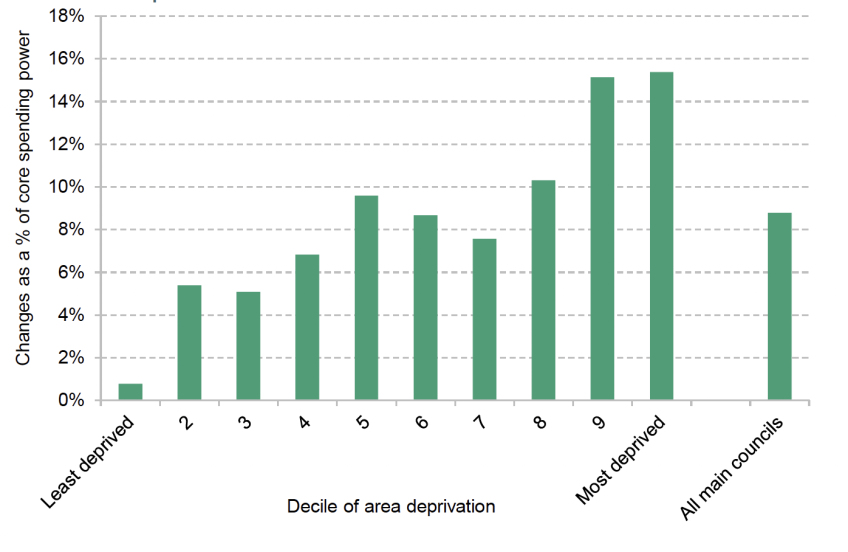
Figure 3 shows the changes in overall core funding for councils by decile of area deprivation. On average, councils in the least deprived tenth of areas will see almost no real-terms growth in core funding over the next three years (0.8%). In stark contrast, core funding for the most deprived tenth will increase by 15.4% on average. By 2028–29, core funding per person will be around 46% higher in the most deprived than in the least deprived tenth of areas, compared with 26% higher in 2025–26 and 22% in 2024–25.
Figure 3. Percentage real-terms changes in core funding between 2025–26 and 2028–29 by decile of area deprivation
Note: Deprivation deciles are based on IMD 2025 Average Score at the upper-tier authority level.
More than a third of councils are still set to be receiving some funding through ‘transitional protections’ in 2028–29, when the reforms to the funding system will have been fully rolled out. For 41 councils, at least a tenth of their core funding in 2028–29 will be from transitional protections, and this is more than a third for three district councils (North West Leicestershire, Harborough and North Warwickshire). This raises major questions for how the government will update the system after 2028–29. We will look into this issue – and delve deeper into analysing the funding reforms – in the new year.
Authors

Kate Ogden
Kate joined the IFS in 2020 and works on local government finance and higher education.

David Phillips
David is Head of Devolved and Local Government Finance. He also works on tax in developing countries as part of our TaxDev centre.
More from IFS
Understand this issue


Policy analysis


Academic research


