The UK government has highlighted a boost to Welsh Government funding as a result of the UK Budget last month, but the Welsh Government says its funding is being cut in real-terms next year. At the same time the draft Welsh Budget published earlier this month suggests that spending is set to increase next year. These claims and counterclaims make it hard for the public to understand what is really happening to Welsh Government funding and spending. So what is the truth? In this comment we explain how these seemingly contradictory statements can be true – but as answers to somewhat different questions.
The impact of the UK 2026 Budget on Welsh Government funding
The UK government is correct that announcements in its October Budget did increase funding for the Welsh Government. Funding for day-to-day (resource) spending was boosted by £196 million in 2026–27, and an average of £158 million in the following two years. Most of the increase this year relates to funding received as a consequence of £100 payments to households living in properties in council tax bands A to D in England – which the Welsh Government has said it will replicate in Wales. In future years, the top-up reflects a wider range of announcements, including enhanced business rates reliefs and funding for devolution and growth in England.
These increases in resource funding have been partly offset by cuts in capital funding – an average cut of £15 million a year – as part of UK government plans to divert part of existing capital funding allocations to defence spending.
The overall outlook for Welsh Government funding
While the UK Budget announced top-ups to previous Welsh Government funding totals, the Welsh Government is also correct that funding for day-to-day spending is set to fall in real terms in 2027–28 compared to this year – as was the case prior to the UK Budget.
Alongside the Welsh Budget the Finance Minister said that funding for day-to-day spending is set to fall 0.5% in real terms next year compared to this, using the latest OBR forecasts for inflation as measured by the GDP deflator (2.1%). This likely overstates the fall in funding somewhat as the funding figures used by the Finance Minister for this year include regular in-year transfers from the UK government – including the Immigration Health Surcharge –, but exclude them for next year, for which the amount that will be received is not yet known. But it is still true that overall funding for day-to-day spending will fall a little bit in real terms (by perhaps 0.3%) given current plans and forecasts. And this is due to a reduction in the block grant from the UK government, which is only partly offset by a growing (net) contribution from devolved tax revenues (mainly the Welsh rates of income tax and business rates).
The small real-terms fall may also understate the true pressures on the Welsh Budget next year due to the inflation measure used to calculate real-terms changes in funding. The GDP deflator is a measure of domestically generated inflation and is the most commonly used measure for assessing real-terms changes in the value of government revenues and spending (as well as real economic growth). But it excludes ‘imported’ inflation – including much of the increase in the cost of energy – and is expected to remain much more subdued than the more commonly cited consumer price index (CPI) inflation measure. It may therefore understate some of the inflation pressures facing the public sector – including energy costs but also pay awards, which are often negotiated with reference to CPI inflation.
Resource funding is then set to grow again in real terms in 2028–29 – by 1.8%, bearing in mind this figure is also based on the GDP deflator. This figure is also subject to greater uncertainty than the figure for next year: the UK government’s 2027 Spending Review will set revised spending plans for 2028–29, with knock-on effects for Welsh Government funding.
On the capital front, funding is currently set to fall by 3.8% in both 2027–28 and 2028–29, and by 0.7% in 2029–30 – again using the GDP deflator measure of inflation, and bearing in mind the greater uncertainty for later years. This is slightly faster than previously expected given the aforementioned £15 million cuts to fund higher defence spending.
The falls in resource funding next year, and capital funding over the next three years, follow a period during which Welsh Government funding was increased at a rate substantially faster than economic growth. On the consistent basis that we used in our election analysis, Figure 1 shows that day-to-day funding grew at an average rate of 2.7% a year in real terms in the three years to 2026–27, and capital funding grew over the same period by 6.2% a year in real terms. In both cases, funding will be around 10% higher in real terms by the end of the projections (2028–29 for resource, 2029–30 for capital) than in 2023–24. Funding increases – particularly for capital investment – have been front-loaded, and are now set to slow or partially reverse.
Figure 1. Welsh Government total resource and capital funding, 2024–25 to 2028–29 (2029–30 for capital)
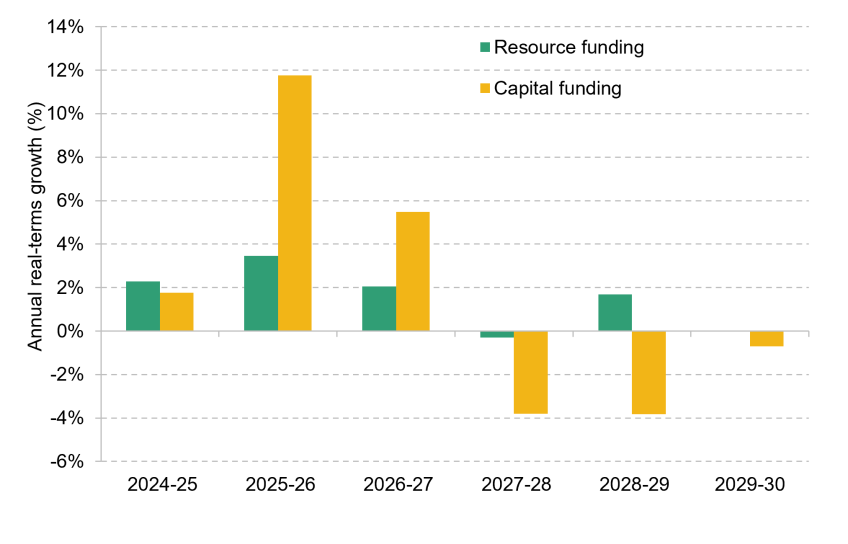
Note: These figures exclude a technical adjustment for employer contributions in 2027–28. See the appendix of our election analysis report, Recent changes and the future outlook for Welsh Government funding, for details of adjustments we have made to this series.
Source: Authors’ calculations using Welsh Government draft Budget 2027–28, 2nd Supplementary Budget 2026–27; correspondences with the Welsh Government; and HM Treasury, Block Grant Transparency: October 2025.
Welsh Government spending allocations
While funding is set to fall in 2027–28, Welsh Budget documentation shows day-to-day (resource) spending on the Welsh Government’s various portfolios growing by an average of 1.2% in real-terms compared to this year. And capital spending set to grow by a substantial 7%. How can that be?
It’s not borrowing. The Welsh Government cannot borrow and what limited borrowing it can do is already incorporated in the funding figures (i.e. cuts) discussed earlier.
Instead it reflects two main factors: unallocated funding, and baseline adjustments.
The Budget document compares spending plans for 2027–28 to a set of ‘baseline’ spending plans for 2026–27. At the time of putting the 2027–28 Welsh Budget together, around £405 million of funding had yet to be allocated to spending portfolios in the current year – a mix of money the Welsh Government held back earlier in the year and top-ups to funding confirmed in the UK Budget. In addition, when calculating the ‘baseline’ spending plans for 2026–27, the Welsh Government chose to exclude around £132 million of funding for day-to-day spending that has already been allocated – depressing the spending figures for the current year. There are good reasons to exclude some of this funding from year-on-year comparisons, but not necessarily all of it.
When you take into account the £405 million unallocated and £132 million of subtracted funding this year, that explains why spending can increase next year compared to the ‘baseline’ plans for 2026–27.
In reality, much of the funding unallocated this year will be used this year – to top-up NHS spending over the winter, to fund council tax rebates and so on. And so final spending in 2026–27 will be higher than the ‘baseline’ figures that 2027–28 plans are being compared to in the Welsh Budget. If most of this year’s funding is indeed used this year, the funding cut cited by the Finance Minister will translate into a spending cut too.
That means that the 2.1% year-on-year increase cited for health and social care next year may turn out to be smaller once further top-ups this year are accounted for. Finding funding for a further increase in health and social care spending and other Welsh Government priorities – such as an expansion of childcare – next year as well will then inevitably necessitate further year-on-year cuts to other areas of the Welsh Budget.
A misleading picture for capital spending
The presentation of capital spending plans is even more extreme. The Welsh Government has decided to not only exclude all in-year top-ups to capital spending made this year, but to exclude a further £152 million of capital spending from its ‘baseline’ spending figures for 2026–27. Some of this appears sensible – such as excluding planned spending on border control facilities at Welsh ports that were to be funded by the UK government and are in fact no longer needed. But much of the spending subtracted, especially in the “Enterprise, Connectivity and Energy” portfolio, is excluded this year despite it appearing to be recurrent spending that makes an appearance again next year. Why this baseline adjustment has taken place is not explained, and is hard to rationalise. Excluding this spending this year but including it again next year gives a misleading picture of how much capital spending in this important area is changing. Rather than increasing in real-terms, capital spending on “Enterprise, Connectivity and Energy” is in fact decreasing in real-terms. Budget documentation obfuscates this key information.
The Welsh Government has also chosen to ‘over allocate’ capital funding next year – the total spending allocated exceeds the funding available. This is because of a history of capital under-spends: the idea is that by over-allocating funding, it will reduce the extent of any subsequent underspends relative to actual funding. But it further distorts the year-on-year change (given that capital funding has not been over-allocated this year).
Once we account for the excluded capital spending this year and the over-allocation next year, that reconciles figures: capital funding is set to fall and so is total capital spending, despite what Budget documentation seems to suggest.
However, not all areas of capital investment are set to fall. Investment in social housing is set to increase by a quarter in real terms. Spending on housing decarbonisation will also increase by around 40% in real terms. In part these increases will be funded through cutting investment in building safety and housing adaptations to support independent living by older and disabled adults, and support for the private housing market.
A difficult puzzle to piece together
So there you have it:
- The UK Budget did increase Welsh Government funding
- Welsh Government funding is still set to fall in real-terms next year
- And it looks like spending is set to increase because not all funding this year has been allocated, and the Welsh Government has made (somewhat dubious) decisions to exclude some spending this year from its year-on-year comparisons.
Getting to the bottom of this has required piecing together information from different spreadsheets from the 2027–28 Budget, the 2026–27 second supplementary Budget, OBR devolved tax forecasts and so on. Even after that we needed to speak to officials as we could not quite reconcile things from published information.
Frankly this is too hard. If claims are going to be made about funding by Ministers in speeches, the relevant information should be published in one place. And if funding and spending figures are seemingly contradictory, reconciliations and explanations should be published.
The Welsh Budget has always been lacking somewhat in this regard, but the amount of unallocated funding and scale of baseline adjustments this year have made it particularly difficult to understand. With a larger Senedd aimed at providing greater scrutiny of the Welsh Government, it needs to be provided with the clear information needed to perform that function. Transparency rating: improvement required.
Authors

David Phillips
David is Head of Devolved and Local Government Finance. He also works on tax in developing countries as part of our TaxDev centre.

João Sousa
João is a Senior Research Economist, with a focus on public finances and devolved government finances.
More from IFS
Understand this issue


Policy analysis


Academic research