The Barnett formula was introduced in the late 1970s with the aim of simplifying funding arrangements for Scotland and Wales (and Northern Ireland), and reducing the role of discretionary decisions by UK government ministers.
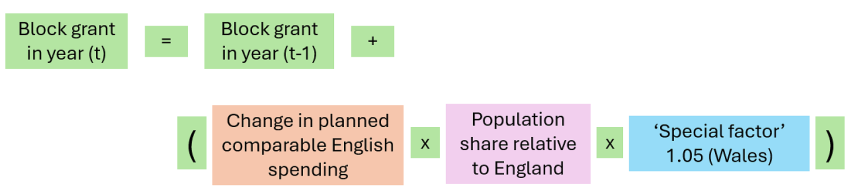
The formula determines how the main ‘block grant’ funding provided by the UK government to the devolved governments is updated each year. It operates slightly differently in Scotland and Wales, reflecting reforms made to the formula for Wales designed to account for differences in needs for spending between Wales and England. Figure 1 summarises the operation of the formula in both nations.
Figure 1. The operation of the Barnett formula
The standard Barnett formula
Under the formula as originally introduced, and as it still applies in Scotland, the block grant in any given year (t) is set equal to the block grant in the prior year (t-1) plus a population-based share of any changes in planned spending in England by the UK government in the same year (t) on ‘comparable services’, i.e. services that are devolved to the devolved government in question. Where a service is devolved to Scotland but not Wales, a small tweak is made: changes in the block grant are based on population-based shares of changes in planned spending by the UK government in England and Wales. The effect of this is to give the devolved government the same cash-per-person change in funding as is planned for England (or England and Wales) for comparable services, before accounting for population growth.
The changes in planned comparable spending that enter the formula are calculated in two main different ways.
At major Spending Reviews, the UK Treasury decides how much to allocate to different UK government departments, but it does not know precisely how they will spend that money. Many UK government departments are responsible for some services in England (or England and Wales) which are devolved elsewhere and for other services that are UK-wide. To ensure the appropriate change in funding is provided for devolved responsibilities, the UK Treasury estimates the share of each department’s spending that is spent on services that for each devolved nation are devolved. These averages are termed ‘comparability factors’ and are set out in the UK government’s Statement of Funding Policy. For example, because the vast majority of the services of the UK government’s Department of Health and Social Care (DHSC) are devolved to both Scotland and Wales, its comparability factor has been calculated as 99.5%. In contrast, because most of the responsibilities of the Department for Business and Trade (DBT) are UK-wide, its comparability factors are just 4.7% and 2.6%, respectively, for Scotland and Wales. The change in a department’s planned budget is multiplied by these comparability factors before entering the Barnett formula. The Barnett formula therefore accounts for 99.5% of planned changes in DHSC spending but only 4.7% and 2.6% of planned changes in DBT spending for Scotland and Wales, respectively.
On the other hand, at Budgets and fiscal statements (rather than at Spending Reviews), when spending plans are being updated as part of the UK parliamentary estimates process, and when the UK government knows more precisely what money is due to be spent on, the Treasury decides whether each spending line is ‘comparable’ or not. Those that are deemed a change in comparable spending enter the Barnett formula in full, while those that are deemed UK-wide do not enter the Barnett formula.
There can be disagreements between the UK and devolved governments about which spending should be classed as ‘comparable’ to devolved responsibilities and hence subject to the Barnett formula (either directly at Budgets and parliamentary updates, or in the calculation of comparability factors at Spending Reviews). Examples of disagreements include certain costs associated with the 2012 London Olympics, Kew Gardens and the HS2 railway.
The effects of the standard formula
This design means that there is no link between the levels of funding provided under the Barnett formula and the levels of need of the devolved governments (either in absolute terms or relative to England). Instead, the levels of funding per person will depend on historical funding levels per person, the absolute changes in planned comparable spending in England, and the changes in population in the devolved nations compared with England. In particular:
- Historical relative funding levels are ‘baked in’ as the Barnett formula only applies to changes in comparable spending and funding, not existing baseline funding levels. As of 2019–20, it was estimated that block grant funding per person in Scotland and Wales was, respectively, 129% and 123% of comparable spending in England.
- When planned comparable spending in England is increasing quickly, the absolute funding levels for the devolved governments also increase by more, but their relative funding levels tend to fall compared with England. This is because the population-based increase in funding provided by the Barnett formula is a smaller percentage increase in the devolved nations than in England given their higher baseline funding levels. Over time, these smaller percentage increases lead to a degree of convergence in funding levels per person in the devolved nations to levels in England – a process known as the ‘Barnett squeeze’. For example, if spending was initially £100 per person in England and £129 per person in Scotland, a £100 per person increase in England and in turn a £100 per person increase for Scotland via the Barnett formula would mean spending would increase to £200 and £229 per person respectively. That represents the same cash difference (£29 per person), but a halving of the percentage difference (from 29% to 14.5%). The faster the increases in comparable spending in England, the more rapid is this relative convergence.
- When spending is being reduced in England though, the same pounds-per-person reduction in funding for Scotland is a smaller percentage cut, meaning a divergence in relative funding. For example, if spending in England were cut by £50 per person to £50 per person, funding for Scotland would also be reduced by £50 per person to £79 per person by the Barnett formula. Spending per person would remain £29 higher in Scotland as initially, but this would now represent a 58% (not 29%) premium compared with England. Cuts to spending during the early 2010s therefore led to some divergence in funding and, as a result, funding levels relative to England were higher in 2019–20 than 10 years earlier (see here).
- Another factor that has tended to lead to divergence (rather than convergence) is differences in the relative population growth rates in the devolved nations compared with England. While the population shares used in the Barnett formula itself are updated to account for changes in populations, the fact that the formula applies only to the change in funding (and not existing baseline funding levels) means that changes in population are only very partially accounted for. When population is growing less quickly in the devolved nations than in England, as has typically been the case in recent years, funding has to be spread over fewer additional people in the devolved nations than in England. The bigger the shortfall in population growth compared with England, the bigger this effect, offsetting any Barnett squeeze when comparable spending in England is growing (or adding to any divergence when comparable spending in England is falling).
The Welsh needs-based factor
In large part to prevent (or at least slow) the Barnett squeeze which would otherwise take place when spending in England is increasing, the design of the Barnett formula has been amended for Wales to provide the Welsh Government with a larger-than-population-based share of changes in planned comparable spending in England. This reflects the fact that an older, poorer, sicker and more rural population means Wales is estimated to have higher spending needs than England – convergence in funding to English levels via the Barnett squeeze could therefore leave Wales underfunded relative to those assessed needs.
Since 2018–19, changes to the Welsh Government’s block grant have been calculated as 105% of the change in planned spending per person on comparable services in England. If the level of block grant were to fall from its starting level (as of 2019) of 123% to the equivalent of 115% (or less) of planned spending per person on comparable services in England, this ‘needs-based factor’ applying to changes in funding would increase to 115%. This 115% ‘funding floor’ is based on an estimate of spending needs per person in Wales as a share of spending needs per person in England as of the late 2000s (estimated in Holtham (2010)).
No needs-based factor has been introduced for Scotland, likely reflecting the fact that it currently receives more funding per person than Wales despite assessments suggesting it has lower needs: there is therefore less concern of its relative funding falling below its level of relative needs under the standard Barnett formula.
Authors

David Phillips
David is Head of Devolved and Local Government Finance. He also works on tax in developing countries as part of our TaxDev centre.
More from IFS
Understand this issue


Policy analysis


Academic research