
The government has today announced a 6% cap on the maximum interest rate which will be applied to student loans from 1 September 2026. This will affect some borrowers with Plan 2 student loans, which were issued to English undergraduates between 2012 and 2023, and those with Plan 3 (postgraduate) loans.
Importantly, the interest rate on student loans usually changes on 1 September each year, based on Retail Price Inflation (RPI) measured in the previous March. This means the interest rate on student loans from September 2026 to August 2027 will depend on inflation measured in March 2026.
The actual March inflation figure will not be confirmed for a few more weeks. RPI came in at 3.6% in February 2026 and recent events in the Middle East are likely to have increased inflation since then. To give a sense of scale, at its latest meeting in mid-March, the Bank of England expected CPI inflation in March to be almost 0.5 percentage points higher than it had forecast in early February.
If the March RPI figure comes in at above 3% – as seems likely – then the newly-announced 6% cap will reduce the interest rate applying to some (but not all) student loans.
Interest is applied to Plan 2 loans at a rate between RPI and RPI + 3%, depending on how much a borrower earns, with only those earning at least £52,885 currently subject to the maximum interest rate. The cap will reduce interest rates for higher-earning graduates with Plan 2 loans who would otherwise have seen an interest rate above 6%, but will do nothing for lower-earning graduates. For example, if March RPI comes in at 4%, the interest rate on Plan 2 loans from September will vary between 4% and 6% – compared with between 4% and 7% without the cap – as shown on Figure 1. This would benefit graduates earning more than £45,000. The cap will reduce the interest rate applied to all postgraduate loans, as these typically face an interest rate of RPI + 3%.
This cap will not make any immediate difference to graduates’ monthly repayments. That is because the amount borrowers repay each month depends only on how much they earn, rather than on their loan balance. The Department for Education estimates that around two-thirds of the final cohort to be issued Plan 2 loans will not repay their loans in full and will instead have some balance written off after 30 years. For these borrowers, a lower interest rate will reduce the amount of their loans eventually written off, rather than reducing the amount they can expect to repay. For the third of borrowers who can expect to eventually repay their loans with interest, a lower interest rate would see them fully repaying their loans – and stopping making repayments – sooner and repaying less overall. If March RPI comes in at 4%, then this one-year interest rate cap might reduce expected lifetime repayments from a high earner with a typical Plan 2 loan by something in the region of £500 in today’s prices.
Figure 1. Interest rate applying to Plan 2 student loans in academic year 2026/27 if March RPI were 4%, with and without announced 6% cap
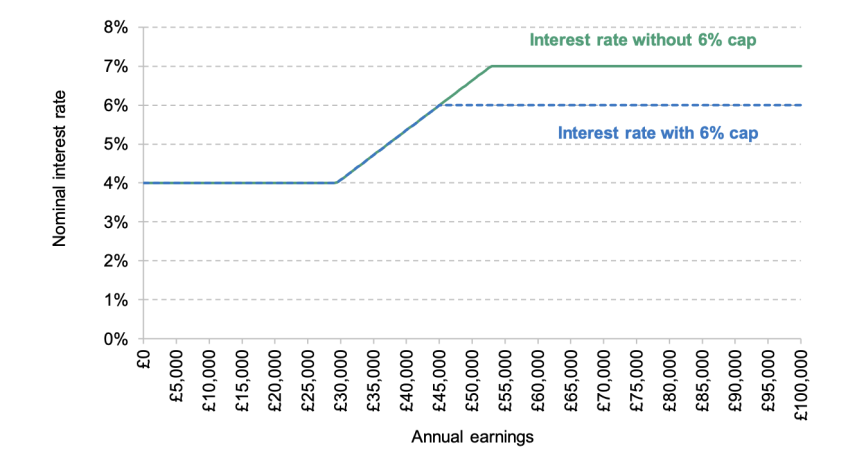
Note: Illustrative figure showing interest rate applying to Plan 2 student loans if the relevant measure of RPI was 4.0%. Reflects lower and upper interest rate thresholds of £29,385 and £52,885 which apply from April 2026.
Authors

Kate Ogden
Kate joined the IFS in 2020 and works on local government finance and higher education.
More from IFS
Understand this issue


Policy analysis


Academic research


