
From the mid 1990s to the mid 2000s, the UK experienced a dramatic surge in house prices, with the average house price rising from around four times annual earnings in 1995 to eight times by 2010 (Figure 1). This increase was highly uneven across different parts of the UK. While house price to earnings ratios were quite similar in London and North East England in the mid 1990s, by 2010 house prices had risen to ten times annual earnings in London as compared with ‘just’ six times in the North East.
Figure 1. House price to annual household earnings ratios in London, the North East of England and the UK
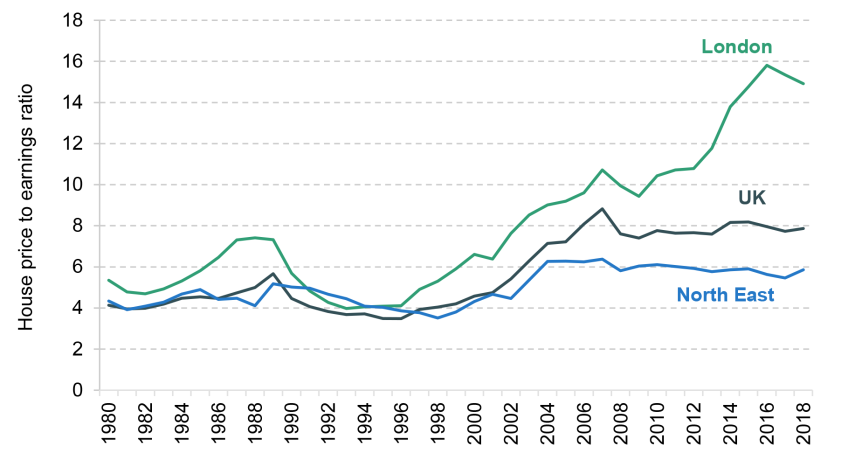
Note: The figure shows the region’s mean house price from the Nationwide House Price Index divided by mean annual household earnings in that region. Average earnings by region are taken from the Family Expenditure Survey and its successors (1980–2002), the British Household Panel Survey 2002–08 and the UK Household Longitudinal Study, 2009–18.
This property boom meant enormous wealth gains for some households but not others. This in turn led to a big increase in wealth inequality between homeowners and renters, as well as between homeowners in different parts of the UK. In new research, we ask how these inequalities passed through into the next generation – what happened to the children of the boom? Studying this episode is useful as it helps us to understand the causal impacts of parents’ housing wealth on children’s opportunities in life. While many studies have shown that children of richer parents tend to do better in the labour market, it is still hard to say how much of this is due to wealth itself rather than other factors (such as the intergenerational transmission of skills). This matters for understanding how policies that affect housing wealth gains in the current generation might impact social mobility in the future.
Our approach uses data from the ONS Longitudinal Study which links census records for a 1% sample of the population of England and Wales. This allows us to follow individuals from their childhood in their parents’ homes into adulthood, allowing us to see whether they own and where they live as adults. The census does not contain direct measures of housing wealth, but does tell us where individuals live, whether their home is owned or rented and what type of home they have. Combining this information with data on local house prices for different house types from the Land Registry allows us to estimate what their homes were worth at different points in their lives.
A straightforward – but naive – way to study the effects of housing wealth would be to compare the children of homeowners in areas where house prices rose quickly with those in areas where prices rose more slowly. The problem with this approach is that places with fast-rising house prices often differ in other ways too – for example, they may have stronger local job markets or better schools. These other factors could affect children’s later outcomes as well, making it hard to tell whether it is truly differences in their parents’ housing wealth that are the cause of differences in later outcomes.
To get around this problem, we look at differences in the outcomes of the children of homeowners and renters, and how the gap between these two groups changes across areas and over time periods with high and low house price growth. The key idea is that improvements in a local area – such as better jobs or schools – should benefit the children of renters and homeowners in similar ways. By contrast, increases in local house prices should only benefit homeowners. If we see the gap in outcomes between the children of homeowners and renters getting wider in areas with faster house price growth during the property boom, this would therefore be indicative of a strong effect of parents’ housing wealth.
Figure 2 shows this approach graphically. Panel a shows how homeownership rates vary for the children of homeowners and renters across areas with high and low house price growth. Homeownership rates are measured when the children are aged 28–37. The graph shows this for two cohorts of children born at different times. For a pre-boom cohort of children born 1954–63, it shows their homeownership rates in the 1991 census (the dashed lines). For the post-boom cohort of children born 1974–83, it shows these rates in 2011 (the solid lines). Among both cohorts, the children of parents who owned their homes when children were growing up are more likely to become homeowners at ages 28–37 than the children of renters. However, the gap between these two groups is roughly the same regardless of the amount of house price growth in each area and regardless of whether we are looking at children before or after the house price boom. From this, we conclude that higher wealth gains among parents during the property boom did not causally lead to higher rates of homeownership for their children at these ages.
Figure 2. Relationship between parents’ local house price growth and children’s outcomes in pre- and post-boom generations
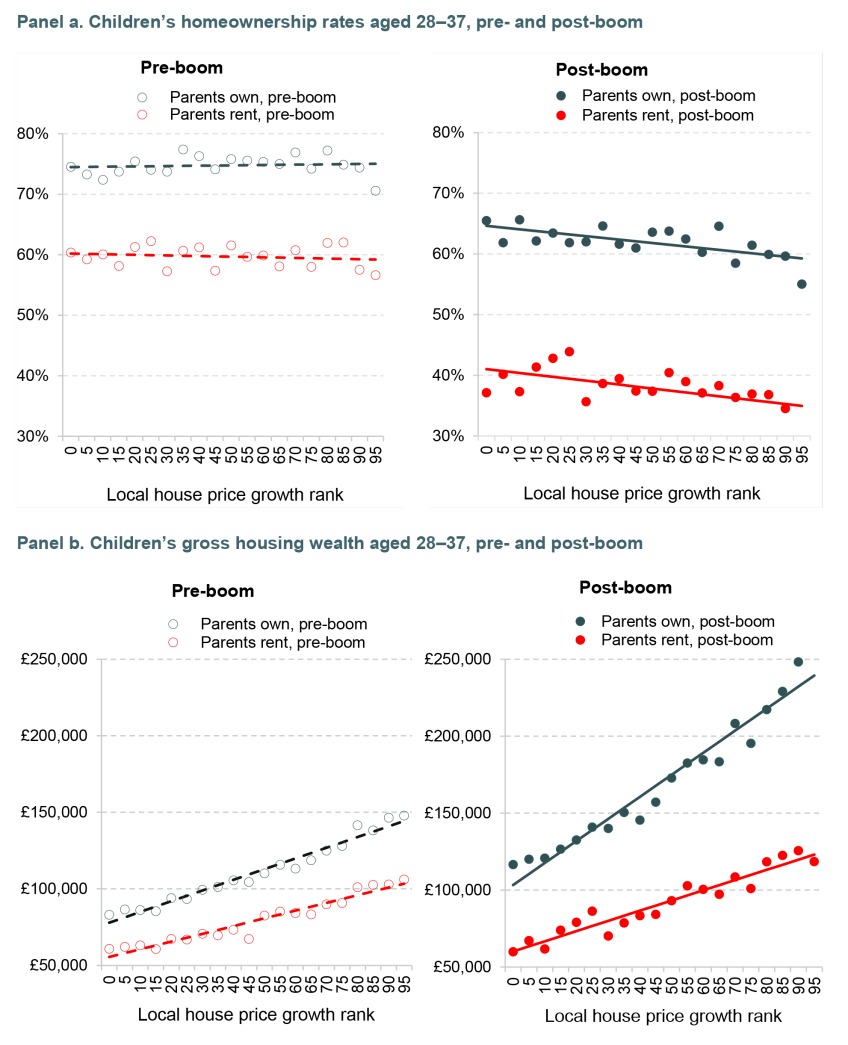
Note: Pre-boom cohort refers to those born 1954–63 and post-boom cohort is those born 1974–83. Ownership rates and housing wealth when individuals in each cohort are aged 28–37. The horizontal axis shows ventiles of local authorities for the distribution of house price growth between 1991 and 2011. Data are taken from the ONS Longitudinal Study and Land Registry. For more details, see Levell and Sturrock (2025).
However, when we look at gross housing wealth (a measure that includes not only whether children own or rent but also an estimate of the value of homes owned), we see stronger evidence of an effect of parents’ exposure to the house price boom. Panel b of Figure 2 shows that the gap between the children of owners and the children of renters clearly rises across areas with high house price growth relative to low house price growth, in a way that was not the case for the pre-boom cohort of children. In other words, children of parents who saw higher wealth gains were not more likely to own, but those that did own owned more valuable homes. These patterns persist even after controlling for a rich set of parents’ characteristics, including their education and occupation. We estimate that each £100,000 gain in real-terms housing wealth for parents over 1991–11 led to their children having on average £15,000 more housing wealth when aged 28–37.
An important explanation for this finding is that the children of parents more exposed to the house price boom were more likely to own in London – the most expensive property market in the country. This is partly explained by an increased tendency of people whose parents did relatively well out of the house price boom, but who grew up outside of London, to move to the capital.
This raises another question – did the children of parents more exposed to the property boom get an advantage from being able to access high-wage jobs in more prosperous parts of the country (including London)? While we cannot look at earnings directly (since they are not asked about in the census), we can look at the average earnings in the types of jobs these children moved into (based on hours of work, occupation, region and whether or not the jobholder has a degree). Here we find that the children of parents who did better from the house price boom were less likely to enter middle-paying occupations outside London, and more likely to enter more highly paid occupations in London, than other children. We find that the male children of parents who did better from the property boom were relatively more likely to enter occupations at the top of the earnings distribution (and less likely to be in the middle) than other male children, while for women we find no significant effect. Each £100,000 increase in parents’ housing wealth increased the probability of earning above a level that defines the top 20% of earnings by 1.5 percentage points. Thus, wealth from parents may help male children in particular access better labour market opportunities.
Why does all this matter? Our results show that housing wealth, independent of other factors such as parents’ skills, substantially affects inequality in the subsequent generation. While each percentile increase in parents’ gross housing wealth led to a 0.28 percentile increase in their children’s gross housing wealth for this cohort, our estimates imply that without the housing boom this figure would have been only half the size (0.14). This is important because it means that policies that change the taxation of capital gains on housing wealth, transfers from parents to children and/or inheritances, as well as policies that relax housing supply constraints in booming housing markets, would be likely to affect wealth inequality in the next generation as well as the current one.
Authors

Peter Levell
Peter joined in 2009. He has published several papers on the microeconomics of household spending and labour supply decisions over the life-cycle.
More from IFS
Understand this issue


Policy analysis


Academic research


