Related documents
Download introductory slides
PDF | 150.86 KB
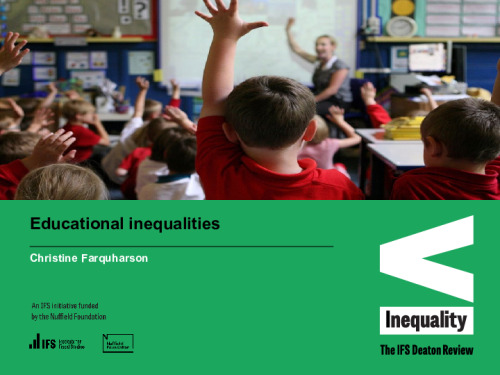
Download educational inequalities slides
PDF | 1.11 MB
Download inequality and good jobs slides
PDF | 369.17 KB
Download wealth inequality slides
PDF | 311.34 KB
Download geographical inequalities slides
PDF | 637.62 KB
Inequalities in the UK - in education, health, income, wealth and political power, as well as across places, ethnicities and genders - matter to many people and are the subject of significant public debate. Understanding the drivers of these inequalities is essential to designing appropriate policy responses.
Over the past six years, the IFS-Deaton Review of Inequalities, funded by the Nuffield Foundation, has produced a comprehensive body of evidence on the causes and consequences of these inequalities.
To mark the conclusion of the review, this workshop brought together researchers, policymakers and practitioners to explore what the evidence means in practice, coinciding with the publication of a new book drawing together the review's findings and the launch of an accompanying report on the lessons for UK policymakers.
The event opened with an overview of the review and its implications for policy, before turning to four themed sessions:
Educational inequalities
What drives gaps in educational attainment, and to what extent does the school system narrow them? We will discuss different approaches that the government can take, particularly focusing on improving attainment of poorer pupils.
Good jobs
There is increasing interest in valuable attributes of jobs that are not just the wage or salary, such as career progression, non-wage benefits, autonomy, and flexibility. This session will examine reasons for a lack of good jobs, how current policy affects them, and what could work in the future.
Wealth inequalities
This session will examine patterns of wealth inequality, how it has changed, and where the taxation of wealth fits in with concerns in some quarters about these inequalities.
Geographical inequalities
Differences in productivity and opportunity across different parts of the UK are wide. This session will consider different elements of geographical inequality, about which there is significant public concern, and why policy to address this can be particularly challenging.
Speakers

Stuart Adam
Stuart is a Senior Economist working in the Tax sector, and focuses on analysing the design of the tax and benefit system.

Jonathan Cribb
Jonathan joined IFS in 2011. His research areas includes: pensions, ageing and demographic change, public sector pay, housing, and inequalities.

Christine Farquharson
Christine's research examines inequalities in children's education and health, especially in the early education and childcare sector.

Tom Waters
Tom is an Associate Director at the IFS and Head of the Income, Work and Welfare sector.

Xiaowei Xu
Xiaowei joined the IFS in 2018 and works in the Income, Work and Welfare sector.
Chair

James Banks
James is an CPP Institute Co-director and Professor of Economics at the University of Manchester.

Richard Blundell
Richard is an CPP Institute Co-director and the Ricardo Professor of Political Economy at University College London.


Helen Miller
Helen joined the IFS in 2007. She has almost two decades of experience analysing UK fiscal policy and providing trusted advice to policymakers.

Imran Rasul
Imran is Director of the CPP Institute and Professor of Economics at University College London
More from IFS
Understand this issue


Policy analysis


Academic research


