
David Phillips, head of devolved and local government finance at IFS, said:
‘The Scottish Conservatives’ two flagship tax proposals are significant cuts to income tax and business rates. Together, the party estimates that these would cost £3.7 billion a year by the end of the parliament in 2031–32. Over £2 billion a year of additional spending on a range of priority areas takes the total cost of ‘new measures’ to around £6 billion a year by 2031–32.
It is welcome that these costs are set out clearly in a costings document. But these are big tax cuts and spending increases – equivalent to almost 10% of current forecasts for Scottish Government day-to-day spending in 2031. While specific cuts to disability benefits have been identified to pay for around a third of the £6 billion package, history suggests there is a significant risk that the amount saved from these cuts would be lower than the £2.1 billion a year pencilled in by 2031–32. The almost £4 billion a year expected from various measures to reduce back-office, administration and civil service costs is very large relative to existing budgets – and relative to what Reform UK said it would aim to save from such measures. Given the scale and nature of these measures, the money that will be saved is not only less certain than the cost of the tax and spending increases it is meant to help fund. There is also no evidence that there is scope for ‘efficiencies’ of such a big scale that would avoid adverse effects on front-line services. History is replete with missed targets for savings, necessitating top-ups to budgets (and increases to taxes) or cuts to front-line services instead.
Taking the entire package of measures together, this may be a costed plan on paper but whether it would survive contact with reality is far from clear. Scotland can have lower taxes and higher spending on some services – but giveaways on the scale proposed by the Scottish Conservatives cannot credibly be funded largely through back-office and administrative savings. In addition to the cuts to benefits set out in the manifesto, there would likely need to be substantial cutbacks to either the range or quality of some services used by households and businesses too.’
Taxation
The Scottish Conservatives propose changes to both rates and thresholds of Scottish income tax:
- A new 0% band would be introduced above the UK government’s personal allowance and increased each year so that the amount of income individuals can earn tax-free rose in line with inflation (despite the UK government freezing the personal allowance).
- The higher-rate threshold would be increased by more than inflation so that it reached £50,270 (in line with the current threshold in the rest of the UK) by the end of the parliament.
- The basic and intermediate rates (currently payable on income between £16,537 and £43,662 per year) would be reduced from 20% and 21% respectively to 19% (matching the current starter rate) by the end of the parliament.
These changes would reduce income tax liabilities for all income tax payers in Scotland – strengthening work incentives in the process. The tax cuts would increase in size over the course of the parliament, as inflation uprating would gradually widen the gap between the currently planned thresholds and those proposed by the Scottish Conservatives.
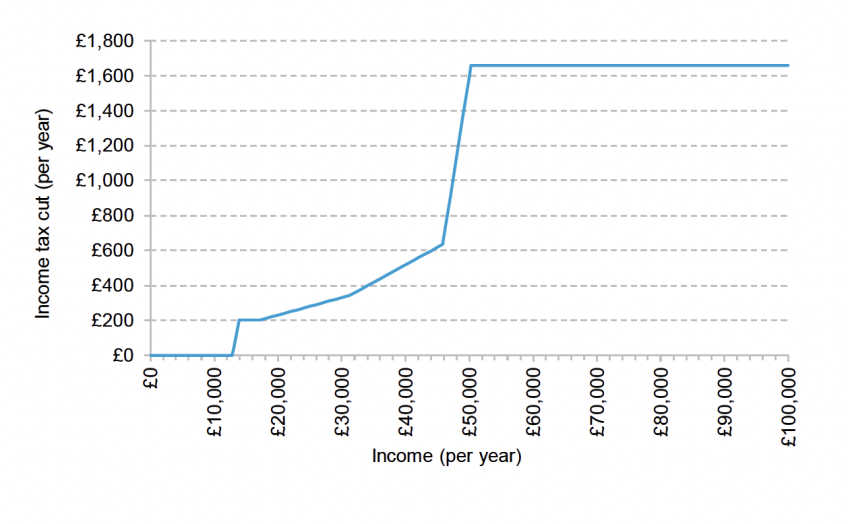
By 2031−32, the annual income tax cut would be about £200 for someone with an income of £15,000, £420 for someone with an income of £35,000, and £1,660 for anyone above the £50,270 higher-rate threshold (see Figure 1 below). The Scottish Conservatives also propose to eliminate the first £500 a year of income tax paid on pension income. The manifesto estimates that all this would cost almost £3 billion a year by 2031–32.
Whatever one’s views on the merits of a large income tax cut, moving to a single marginal tax rate from the point income tax starts to be payable up to the higher-rate threshold, rather than having separate starter (19%), basic (20%) and intermediate (21%) rates, would be a welcome simplification.
On business rates, the Scottish Conservatives propose giving each business a property allowance of £20,000 that would be tax-free, as part of cuts to business rates costing £0.7 billion a year by 2031–32. A business occupying a property with an annual rental value of £20,000 would therefore pay no business rates, initially saving it £9,620 a year (though over time we would expect rents to rise in response, transferring much of the benefit from tenants to landlords). Once the rateable value of the property (or properties) that a business occupies exceeds £20,000, business rates would be due on the rateable value in excess of £20,000. Existing jumps in business rates bills that apply once the rateable value of specific properties crosses particular thresholds (currently £51,000 and £100,000) would be replaced with a marginal tax rate structure more akin to income tax.
Putting aside the overall cut to business rates bills this entails – and the corresponding cost to the Scottish Government – removing cliff-edges and high marginal rates in this way would be a sensible rationalisation of the structure of business rates.
The Scottish Conservatives’ manifesto also proposes a number of other changes to business rates. The proposal to extend the grace period before improvements to properties affect bills, from one year to three, would be welcome, alleviating the disincentive for property improvements that is one of the key problems with business rates. The case for permanently lower business rates for small and medium-sized retail, hospitality and leisure businesses than for other businesses (and 100% relief for smaller pubs) is less clear, though at least it would give more certainty than the succession of temporary reliefs seen so far. But proposals to permanently cap the increase in bills that businesses can face when properties are revalued, not just have a transitional relief to phase in changes gradually (as at present), risk undermining the basic principle of revaluation – that bills should (eventually) reflect current not past property values.
Benefits and childcare
Turning to the spending side of the budget, the Scottish Conservatives propose significant cuts to spending on disability benefits. In particular, eligibility for adult disability payments (ADP) for those reporting mental health problems would be made significantly more stringent. Only those with a medically diagnosed mental health condition would be eligible, and verified evidence that this condition entailed unavoidable and necessary costs would need to be submitted alongside benefit applications and reassessments.
The Scottish Conservatives estimate that this would reduce expenditure by around £1.8 billion in 2030–31 – around 34% of currently forecast spending on ADP in that year. Given that, as of January 2026, mental or behavioural disorders account for 40% of ADP primary conditions, this implies a large majority of recipients with mental health conditions losing their ADP entitlement. On top of this, review processes would be made more stringent for all claimants, which the Scottish Conservatives estimate would save another £153 million (3% of ADP spending) by 2030–31.
These are concrete plans, rather than the vague statements of intent that parties have sometimes made when pledging to cut benefit spending. Whether they can save as much as the Scottish Conservatives hope is far less clear, though. The costings assume not only that a large majority of claimants would not currently meet the eligibility criteria, but also that relatively few would successfully change their behaviour in order to qualify – by seeking medical diagnoses for currently undiagnosed conditions, for example. In contrast, in its costing of the UK government’s aborted reforms to personal independence payments (PIP), the Office for Budget Responsibility assumed that behavioural responses to the reforms would halve the savings. The scale of such responses is always uncertain. But our judgement is that responses would probably be greater than implicitly assumed by the Scottish Conservatives, meaning a significant risk that savings would be lower than they are banking on.
Savings of £65 million a year from restricting the Scottish child payment to two children per family are more certain. By reducing the value of the payment for large families, it would strengthen financial work incentives and mean a smaller cliff-edge in support when eligibility is lost. But, alongside plans to stop mitigating the UK government’s benefits cap (which the current Scottish Government does using discretionary housing payments), it would also increase child poverty among larger families, which currently have substantially higher poverty rates than one- and two-child families.
One of the key spending giveaways also relates to children: an expansion of free childcare. Existing entitlements offer 1,140 hours of funded Early Learning and Childcare (equivalent to 30 hours a week for 38 weeks of the year) to all 3- and 4-year-olds, as well as disadvantaged 2-year-olds. The Scottish Conservatives propose to offer a similar entitlement to children in working families from 9 months onwards, mirroring recent reforms to the English system.
Targeting support at children in working families can help some parents to move (back) into paid work. But by far the most numerous beneficiaries would be families who would have worked anyway, and would have paid for childcare themselves – meaning that most spending on this policy would support families with the cost of living, rather than generating growth or changing child outcomes.
Cuts to back-office functions
The Scottish Conservatives propose large savings in back-office and administration costs. This is a perennial source of funding at election time but the amounts involved in this manifesto are very large indeed: almost £4 billion a year by 2031–32, equivalent to over 7% of projected Scottish spending on public services in that year, a large majority of which will be for front-line services.
The existing Scottish Spending Review already assumes big savings in both NHS board budgets and cross-government administration costs in order to protect front-line services. It also plans real-terms cuts to funding for both councils and the policing and justice system. To pay for the tax cuts and new spending proposed by the Scottish Conservatives, the £4 billion of savings they say they would find would have to come on top of these pre-existing savings plans. That is true even though, as the Scottish Conservatives have said, the current government has not set out in full how it will deliver the savings its Spending Review was predicated on.
In our view, it is therefore not credible that additional savings of the scale proposed by the Scottish Conservatives could be made without cuts to the range and quality of services provided to the residents of Scotland. These are not spelled out.
Additional tax proposals:
- On land and buildings transaction tax (LBTT), the Scottish Conservatives propose keeping the tax for purchases of second homes and rental properties but abolishing it for purchases of a main home – although only if and when the UK government does so (as the Conservative Party in Westminster proposes it should). About one in three housing purchases fall below the £145,000 LBTT threshold and already face no tax if the property in question is the buyer’s main home; this proposal, if enacted, would eliminate the tax for higher-value purchases as well. The value of the tax cut would increase with property value: £1,100 (0.6% of value) for a property bought for £200,000, rising to £33,350 (5.6% of value) for a property bought for £600,000 (and rising further for higher-value properties).
- More definitively, the manifesto proposes to reduce the additional dwelling supplement in LBTT paid on purchases of rental properties and second homes (on top of standard LBTT rates) from 8% to 4%. This is a welcome step that would reduce the extent to which the tax system penalises the rental sector (tenants as well as landlords) relative to owner-occupation. It would reduce the LBTT due on a property bought to rent out or as a second home for £200,000 by £8,000 (4% of value).
- The manifesto also proposes annual ‘tax rebates’ for households funded by unspent funding. It is true that the Scottish Government has typically underspent its final budget for each year, with unspent money carried forward using the Scotland Reserve. However, that money is then subsequently reallocated the following year, rather than building up permanently (which is not possible given strict limits on how much can be held in the Scotland Reserve). Using this money instead for tax rebates would therefore just mean running down the Scotland Reserve – reducing the resilience of the Scottish Government’s finances.
Additional public services proposals:
- For healthcare, the Scottish Conservatives have committed to increasing funding by £350 million on top of existing plans in 2028–29, to improve GP services and increase NHS capacity. This figure rises to an assumed £1 billion by 2031–32, although it is important to note that without existing spending plans for that year, we cannot tell whether all of this funding would be ‘additional’. The manifesto says that this investment would support guaranteed GP appointments within 48 hours, higher hospital capacity and reduced waiting lists, the end of ‘corridor care’, and new walk-in mental health hubs. Additional funding should help deliver improvements, but the challenge in meeting all the manifesto’s objectives for the health system should not be underestimated.
- On schools, the Scottish Conservatives say they would reform the curriculum to focus more on knowledge-based learning, with performance measured via increased inspections, examinations and participation in internationally comparable testing programmes. These could have benefits in improving standards and, alongside a focus on discipline, are similar to proposals set out in Reform UK’s Scottish manifesto. The party also proposes a review of Scotland’s presumption that pupils with Additional Support Needs should be educated in mainstream schools where possible – meaning that the Scottish system could move away from mainstreaming just as England moves strongly towards it.
- The Scottish Conservatives have proposed significant new spending on adult education and training – £260 million a year by 2031–32. They would expand the number of apprenticeships on offer and introduce a new ‘Jobs for Life’ programme combining careers advice with training for long-term benefit recipients, people who are out of work, and those working in industries at high risk of economic disruption. Getting the balance right between learners, employers and government – and ensuring that all three groups have skin in the game – will be important to ensure that these programmes support training that is both additional to existing provision, and valuable to workers and firms.
Figure 1. Income tax cut in 2031–32 under Scottish Conservative proposals, relative to current Scottish Government plans
Authors

Stuart Adam
Stuart is a Senior Economist working in the Tax sector, and focuses on analysing the design of the tax and benefit system.

Christine Farquharson
Christine's research examines inequalities in children's education and health, especially in the early education and childcare sector.

Jed Michael
Jed joined the IFS in 2025 and works in the Income, Work and Welfare (IWW) sector.

Helen Miller
Helen joined the IFS in 2007. She has almost two decades of experience analysing UK fiscal policy and providing trusted advice to policymakers.

Natan Ornadel
Natan works in the Education and Skills sector. His current research covers early years and higher education.

David Phillips
David is Head of Devolved and Local Government Finance. He also works on tax in developing countries as part of our TaxDev centre.

Sam Ray-Chaudhuri
Sam joined the IFS in 2022 and works as a research economist in the Income, Work and Welfare sector.
More from IFS
Understand this issue


Policy analysis


Academic research


