
Downloads
Download the report as a PDF
PDF | 542.26 KB
Executive summary
In the last decade, there have been significant cuts to spending on adult education and large falls in the numbers of adult learners, particularly amongst those taking low-level qualifications. The government is planning to partially reverse these cuts as part of wider plans to improve technical education and level up poorer areas of the country. As part of these plans, the government has also pledged to introduce a Lifelong Loan Entitlement to provide all adults with an entitlement to higher education style loan funding for four years of post-18 education, which can be used flexibly across time and different types of courses. This briefing note seeks to provide context to these reforms and what we know already about their potential impact.
Key findings
- There have been large falls in the numbers of adult learners and spending on adult education over the last decade. Total spending on adult education and apprenticeships fell by 38% between 2010–11 and 2020–21, with a 50% fall in spending on classroom-based adult education. The numbers of adult learners also fell significantly, particularly those taking low-level qualifications, with a 50% fall in numbers taking qualifications at Level 2 and below, and a 33% fall in the number of adults taking Level 3 qualifications.
- Partial reverse of past cuts. The cuts to adult education will be partially reversed by an additional £900 million in extra spending in 2024–25, which includes money for a restoration of public funding for adults’ first full Level 3 qualifications. However, total spending on adult education and apprenticeships will still be 25% lower in 2024–25 compared with 2010–11.
- Full-time participation at degree level has expanded. The number of full-time undergraduates has increased by nearly 25% since 2010. This has been facilitated by the student loan system covering tuition and maintenance costs. The number of full-time postgraduates grew by 60% after postgraduate loans were introduced in 2016.
- Other forms of higher education have seen falling numbers. The number of (mostly mature) students on part-time undergraduate degrees has plummeted by almost 50% since 2010 and there was a 28% decline in the number of students taking sub-degree courses at Level 4 or 5 between 2015 and 2018. These are both groups that receive comparatively lower levels of support in the student loan system.
- Apprenticeships more focused at advanced and higher levels. After 2010, the number of adult (19+) apprenticeship starts initially increased to about 350,000–400,000 per year. However, apprenticeship starts have dropped off to about 250,000 per year since the introduction of the Apprenticeship Levy in April 2017. At the same time, there has been a shift in the type of apprenticeships taken by adults. In 2020, fewer than 50,000 adults began the lowest level of apprenticeships (intermediate apprenticeships) compared to 200,000 a decade earlier. The number of higher apprenticeships has rocketed from a few hundred starts in 2010 to almost 100,000 starts in 2020.
- ‘New’ Lifelong Loan Entitlement. The government has pledged to create a new Lifelong Loan Entitlement to provide all adults with loans to cover four years of post-18 education. For nearly all post-18 education routes, the loan entitlement is already at this or a more generous level; the ‘new’ entitlement is thus mostly an attempt to make the existing system more transparent. The reform will encompass some substantive changes that are sensible: it will extend full living cost support to Higher Technical Qualifications that would not otherwise qualify, and will likely relax loan eligibility rules for those studying for a qualification at the same or a lower level than one they already hold. However, restricting funding to four years of post-18 study will reduce entitlements for students on some post-18 routes unless exemptions are introduced, particularly for longer courses or those with a foundation year.
- Greater support needed for those leaving school with few qualifications. Considered together, the plans will likely provide extra help to those who left schools with good GCSEs or equivalent qualifications. The main plans for helping adults with few qualifications are through skills bootcamps and the new ‘Multiply’ programme, which are relatively untested and are unlikely to lead to formal qualifications. Providing effective support and training for this group is a significant challenge, but it will also be key to levelling up poorer areas of the country.
1. Introduction
In recent years, the government has announced several major reforms to technical and adult education, which represent fundamental changes to the adult education landscape. The government’s broad objective is to deliver what it has dubbed the ‘Lifetime Skills Guarantee’ – a commitment to provide every adult with the opportunity to access the training and education they need throughout their life. The set of reforms implemented in delivering this commitment will not only affect the adult education sector but the economy as a whole, as well as the government’s ability to fulfil its levelling-up ambitions.
As part of the government’s plans for adult education in England, a £2.5 billion National Skills Fund has been launched, which among other things will be used to restore funding for Level 3 qualifications and for new skills bootcamps. There have also been reforms to the nature of technical qualifications, with a move to kite-marked technical qualifications as well as the introduction of T Levels in 2020. The government has also sought to increase the role of apprenticeships in the education and training system. The centre piece of the government’s plans though is the overhaul of the post-18 education loans system with the introduction of the new Lifelong Loan Entitlement (LLE) pencilled in for 2025.
Taken together, these policies have the potential to affect all adult learners, from those taking basic skills qualifications at local community colleges through to adults studying advanced technical qualifications and degrees at universities. It is too early to evaluate whether these reforms will deliver the government’s promised Lifetime Skills Guarantee – some of these changes have only just come into effect while key policy details remain to be deliberated for others.
Instead, the purpose of this briefing note is to put the government’s adult education policy in context. In Sections 2 and 3, we put these reforms into historical context by documenting what has happened to participation and spending in adult education in the past decade in England. As part of this, we highlight the key funding reforms implemented by previous governments, which continue to affect adult education today. In Section 4, we outline the full set of government reforms to adult education in England and argue that they should be viewed holistically rather than as separate reforms. We also analyse the likely impact of the government’s programme of reform on adult education now and in the future.
2. Adult education’s decade of (mostly) contraction
Over the last decade, there has been a significant decline in the total number of adult learners taking most forms of education and training. This has been mostly driven by a sharp fall in the number of adults taking low-level qualifications each year. Such falls in the numbers of adult learners have been a key factor driving reductions in spending over time. In this section, we set out these trends, and note the key funding reforms that underlie changes in participation.
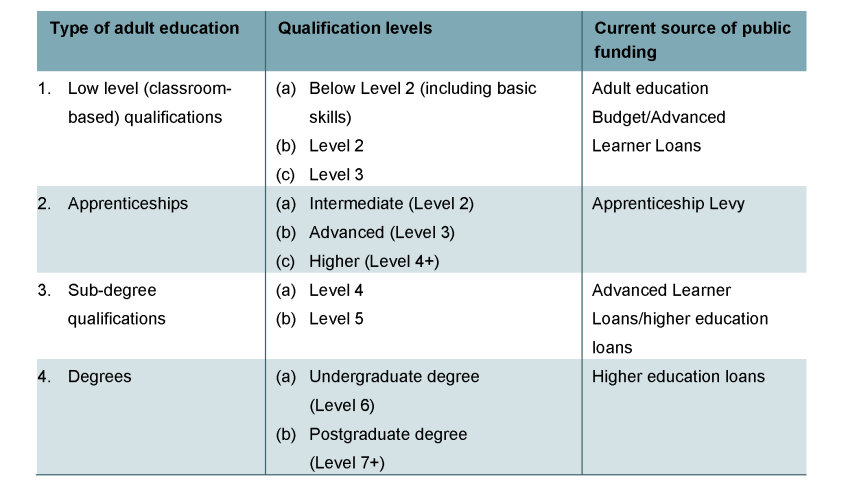
Before we present these trends, it is first necessary to categorise the different forms of adult education. In England, there are countless education and training options available to adult learners from basic skill qualifications through to higher education. For the purposes of this briefing note, we define four distinct categories of adult education: (1) low-level qualifications; (2) apprenticeships; (3) sub-degree qualifications; and (4) degrees. Table 2.1 provides more detail on each of these categories.1 Unless otherwise stated, we define adults as anyone aged over 18, which includes young people taking their first full undergraduate course.
In the remainder of this section, we show how the total numbers of learners in each of these categories has changed in the previous decade, and also how the composition of learners within these categories has changed.
Table 2.1. The four different forms of adult education and training
2.2 The decline in adult learners since 2010
In England, the majority of adult learners study low-level qualifications. At the beginning of the decade, there was a large gap between the numbers of low-level adult learners and adults starting higher levels of qualifications each year. However, over the last decade, there has been a large decline in the number of adults taking these low-level qualifications, from around 2.8 million in 2010 to around 1.5 million in 2020 – a decline of roughly 47%. Despite a large policy focus, the number of adult apprentices also decreased by around 21%. However, there was an almost 10% increase in the number of adult learners beginning degrees each year. Overall, this means that there were 30% fewer adults starting qualifications in 2020 than in 2010, largely driven by the fall in the number of adult learners taking low-level qualifications.
In addition to a change in the total number of qualifications taken, there has also been a large shift in the type of qualifications taken by adult learners within each category. This is depicted by Figure 2.1, which shows the percentage change in the number of adult learners starting different qualfications between 2010–11 and 2020–21.
Figure 2.1. The total number of adult learners in England between 2010-11 and 2020-21

Note: We calculate the total number of adults learners starting qualifications each year using various published statistics. In calculating the number of adults studying low-level qualifications, we substract the number of intermediate and advanced apprentices (i.e. Level 2 and Level 3 apprenticeships) from Department for Education statistics on the total number of learners at Level 3 and below. We calculate the number of sub-degree learners by adding the total number of Level 4 and Level 5 entrants each year and subtracting the number of higher apprentices. However, data on Level 4 and Level 5 learners are currently only available between the academic years 2015–16 and 2018–19. In calculating the total number of degree students, we add the number of part-time and full-time undergraduate and postgraduate students.
Source: To calculate the total number of low-level learners, we use Table 4 from ‘Further education and skills: July 2020 main tables’ (https://www.gov.uk/government/statistics/further-education-and-skills-july-2020) and ‘“Annual headline – summary” in England between 2016/17 and 2020/21’ (https://explore-education-statistics.service.gov.uk/data-tables/fast-track/bbcaf878-50f3-4755-a987-36b0e9a752cd). To calculate the total number of apprenticeships, we use Table 2.1 from ‘Further education and skills: July 2020 main tables’ (https://www.gov.uk/government/statistics/further-education-and-skills-july-2020) and ‘“Latest headlines – age and level” for 19+, 19–24, 25+, Advanced Apprenticeship, Higher Apprenticeship and 2 other filters in England between 2018/19 and 2021/22’ (https://explore-education-statistics.service.gov.uk/data-tables/fast-track/8e8af231-6052-4145-9226-03887f303e2e). The number of Level 4 and Level 5 learners is from ‘Higher level learners by type of higher level learning – 2015/16 to 2018/19 academic years’ (https://explore-education-statistics.service.gov.uk/find-statistics/higher-level-learners-in-england#dataDownloads-1). To calculate the total number of degree students, we use ‘First year students by level of study and mode of study and academic year’ (https://www.hesa.ac.uk/data-and-analysis/students/chart-2).
Figure 2.2. The change in the number of adult learners taking different courses between 2010-11 and 2020-21
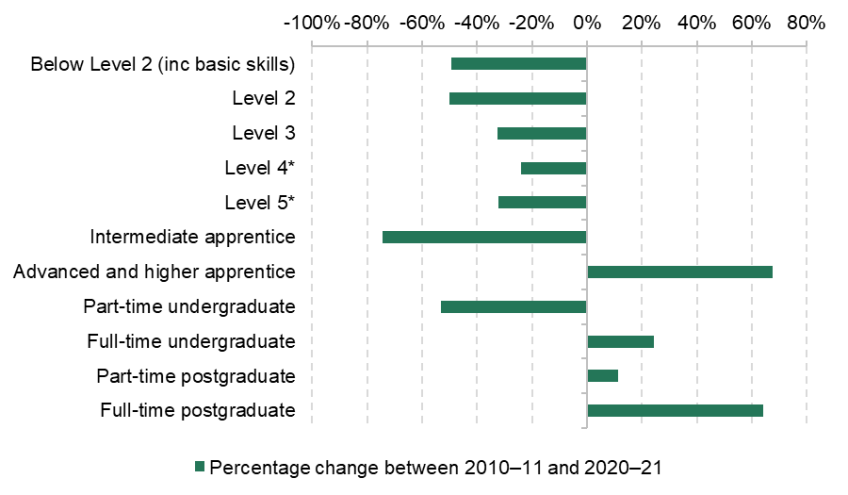
Note: In this figure, we take the total number of adult learners in each of the qualification categories and then calculate the percentage change between numbers in 2010–11 and 2020–21.
(*) It should also be noted that the change in Level 4 and Level 5 learner numbers was calculated between 2015–16 and 2018–19 because we only have data across this time period.
Source: See Figure 2.1.
There has been a decline in the number of adults starting each type of low-level qualification. The number of learners taking the most basic qualifications (below Level 2 and Level 2) fell by around 50% between 2010 and 2020. There was also a 74% decline in the number of adults starting the most basic apprenticeships (intermediate apprenticeships). In contrast, there has been a large increase in the number of adults starting full-time degrees as well as those taking advanced or higher apprenticeships.
In the following subsections, we explore these trends in more detail by looking at each of the four different categories in turn. We look at the trends in the number of adults starting different qualifications within each of these levels and note some of the funding changes that have affected each learning category during the last decade.
2.3 Low-level qualifications
There is a range of different low-level qualifications available to adults in England. The lowest-level qualifications (below Level 2) tend to be basic skills qualifications, including in English and mathematics. These qualifications can provide learners with second chances to gain essential skills. Within our category of low-level qualifications, we also include Level 3 courses, which are actually fairly advanced qualifications that are equivalent to A Levels.
Since 2010, the number of adult learners taking each type of low-level qualification has decreased. This is illustrated by Figure 2.3, which shows the number of adults taking different forms of low-level qualifications in each academic year between 2010 and 2020. The total number of adults taking low-level qualifications was roughly 2.8 million in 2010. By 2020, the total number of adults taking these qualifications was below 1.5 million, a decline of 47%.
Figure 2.3. The number of adult learners studying classroom-based low-level qualifications

Source: Learner numbers for 2010–11 to 2018–19 are calculated using Table 4 from ‘Further education and skills: July 2020 main tables’ (https://www.gov.uk/government/statistics/further-education-and-skills-july-2020). Learner numbers post-2018–19 are from ‘“Annual headline – summary” in England between 2016/17 and 2020/2’ (https://explore-education-statistics.service.gov.uk/data-tables/fast-track/bbcaf878-50f3-4755-a987-36b0e9a752cd).
While the numbers taking each type of qualification have declined, there has been an especially sharp decrease in the absolute number of learners taking qualifications below Level 2. This follows on from large falls during the late 2000s, when funding for low-level qualifications was restricted in response to the 2006 Leitch Review. The numbers taking these courses peaked in 2012 at roughly 1.8 million learners, but by 2020 had fallen further to less than 700,000.2
The numbers taking Level 2 qualifications also fell by more than 50% from about 1.1 million in 2010 to a low of 520,000 in 2019. However, most of the fall occurred between 2011 and 2015. This coincides with restrictions in funding for Level 2 qualifications. As detailed in the Augar Review of Post-18 Education (Department for Education, 2019), from 2012–13, adults aged 24 or over had to pay half the costs of their first full Level 2 qualifications (with an exception for mathematics and English qualifications) and workplace support for this group was fully removed in 2016.
There has also been a decline in the numbers taking classroom-based Level 3 qualifications, which decreased by 33% over the decade. As can be seen, most of this fall occurred between 2012 and 2014. This is almost certainly linked to the fact that public funding for Level 3 qualifications was restricted from 2013–14 onwards. From 2013–14, most adults aged 24 or over had to take out an Advanced Learner Loan to fund Level 3 qualifications. Alongside specific cuts to eligibility, funding rates in the Adult Education Budget were frozen in cash terms from 2013 onwards. This is likely to have reduced the willingness and ability of providers to offer high-quality courses over time.
2.4 Apprenticeships
Apprenticeships have been a key part of the adult education and training landscape for the past decade. They provide individuals with the opportunity to undertake a combination of work experience and training. Modern apprenticeships began in 1993 but up until 2004 they were restricted to adults under the age of 25 (Mirza-Davies, 2015). Since then, they have become an increasingly popular route into employment for adults. Indeed, an explicit goal of previous governments has been to increase the number of apprentices.
The total number of adult apprentices (aged 19 and above) has fluctuated over the last decade. This is illustrated in Figure 2.4, which shows the total number of adult apprenticeship starts between 2010 and 2020. There was a large increase in 2011, which coincided with many individuals being moved over from ‘Train to Gain’ on to apprenticeships. The number of adult apprenticeship starts then totalled about 370,000–400,000 per year up to 2016 (with the exception of a brief dip in 2013). This allowed the coalition government to meet a commitment to 2 million apprenticeship starts between 2010 and 2015 (after adding apprentices aged under 19).
From 2017–18, there has been a decline in the number of apprenticeship starts with the total number between 150,000 and 300,000 per year. As a result, there was little chance of meeting a government target of 3 million new apprenticeship starts between 2015 and 2020.
This drop in apprenticeship starts coincides with, and is almost certainly linked to, the introduction of the new Apprenticeship Levy in April 2017 and other changes to the apprenticeship system. We discuss this in more detail in Section 3.
Figure 2.4. The total number of adult (19+) apprenticeship starts

Source: Apprentice starts for 2010–11 to 2018–19 are from Table 2.1 from ‘Further education and skills: July 2020 main tables’ (https://www.gov.uk/government/statistics/further-education-and-skills-july-2020). Apprentice starts post-2018–19 are from ‘“Latest headlines – age and level” for 19+, 19–24, 25+, Advanced Apprenticeship, Higher Apprenticeship and 2 other filters in England between 2018/19 and 2021/22’ (https://explore-education-statistics.service.gov.uk/data-tables/fast-track/8e8af231-6052-4145-9226-03887f303e2e).
In Figure 2.5, we provide a breakdown of the number of apprenticeship starts by the age of the apprentices. Over the last decade, the total number of apprentices in each age group has fallen, but the sharpest decline has been amongst the youngest age group. The number of under 19s starting apprenticeships has declined by 50% between 2010 and 2020, compared to a 34% fall for the 19–24 age group and an 11% fall for the 25+ age group.
It is worth noting that whilst there is a large policy focus on apprenticeships as a valuable education route for young people, it remains a minority choice. Only about 5%–6% of young people aged 16–18 were on an apprenticeship route just before the pandemic, with the share mostly unchanged over the preceding decade.3
Figure 2.5. The number of apprenticeship starts by age group

Source: Apprentice starts for 2010–11 to 2018–19 are from Table 2.1 from ‘Further education and skills: July 2020 main tables’ (https://www.gov.uk/government/statistics/further-education-and-skills-july-2020). Apprentice starts post-2018–19 are from ‘“Latest headlines – age and level” for 19+, 19–24, 25+, Advanced Apprenticeship, Higher Apprenticeship and 2 other filters in England between 2018/19 and 2021/22’ (https://explore-education-statistics.service.gov.uk/data-tables/fast-track/8e8af231-6052-4145-9226-03887f303e2e).
There has also been a change in the composition of adult apprenticeships, which we show in Figure 2.6. In 2010, intermediate level apprentices – the lowest level of apprenticeships – were the most common form. After 2016–17, there was a large fall in the number of intermediate apprenticeships, but a rise in the number of higher-level apprenticeships. Therefore, although the total number of apprenticeships has declined, there has been a shift towards higher-level apprenticeships.
Figure 2.6. The number of adult (19+) apprenticeship starts by level

Source: Apprentice starts for 2010–11 to 2018–19 are from Table 2.1 from ‘Further education and skills: July 2020 main tables’ (https://www.gov.uk/government/statistics/further-education-and-skills-july-2020). Apprentice starts post-2018–19 are from ‘“Latest headlines – age and level” for 19+, 19–24, 25+, Advanced Apprenticeship, Higher Apprenticeship and 2 other filters in England between 2018/19 and 2021/22’ (https://explore-education-statistics.service.gov.uk/data-tables/fast-track/8e8af231-6052-4145-9226-03887f303e2e).
The overall impact of this change in apprenticeship composition is unclear. The increase in the numbers of adults taking good-quality higher-level apprenticeships is likely to be a positive trend. However, the reducing opportunities for low-skilled individuals taking intermediate apprenticeships may limit their development. Therefore, the net effect of this change depends on what adults who would have taken intermediate apprenticeships are now doing instead – something that is very hard to observe in practice.
2.5 Sub-degree qualifications
Another set of options available to adult learners is sub-degree qualifications, which correspond to Level 4 and Level 5 qualifications. This is an extremely heterogeneous set of qualifications ranging from Creative Arts foundation degrees to Higher National Diploma in Engineering. The central objective of these qualifications is to offer learners high-level training in specific vocations. Level 4 qualifications typically consist of one year of post-secondary education, while Level 5 qualifications usually last for two years.
In Figure 2.7, we present the number of people starting Level 4 and Level 5 qualifications between 2015–16 and 2018–19. Unfortunately, data are currently only available for these years and not the entire decade.
Figure 2.7. The number of Level 4 and Level 5 entrants (excluding higher apprenticeships)

Source: ‘Higher level learners by type of higher level learning – 2015/16 to 2018/19 academic years’ (https://explore-education-statistics.service.gov.uk/find-statistics/higher-level-learners-in-england#dataDownloads-1).
Between 2015 and 2018, there was a year-on-year decline in the number of learners at both Level 4 and Level 5. The number of Level 4 entrants in 2018 was almost 24% lower than in 2015, and the number of Level 5 entrants was 32% lower. Unless these learners are substituting to other forms of education and training, this trend is likely to be negative. As Espinoza et al. (2020) show, for both men and women, these qualifications lead to better average earnings outcomes than finishing education at Level 3.
2.6 Degree learners
The final set of qualifications that we consider is degree-level qualifications. Usually we would consider degrees as distinct from the other forms of post-18 education. However, as we discuss later, the introduction of the LLE will unify funding for vocational qualifications and degrees, so it makes sense to consider them here.
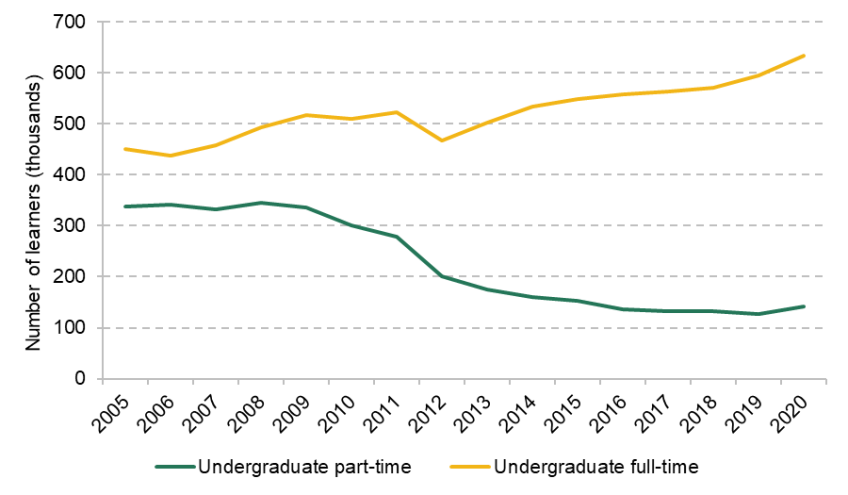
In Figure 2.8, we show the number of undergraduate entrants by mode of study since 2005. Apart from a small blip around the 2012 higher education funding reforms, there has been a gradual increase in the number full-time undergraduate learners over time, rising from 450,000 in 2005 to 510,000 in 2010 and up to 630,000 by 2020. This amounts to a rise of nearly 25% over the last decade.
Figure 2.8. The number of undergraduate entrants by mode of study
Source: ‘First year students by level of study and mode of study and academic year’, https://www.hesa.ac.uk/data-and-analysis/students/chart-2.
At the same time, the number of part-time undergraduates has more than halved, from 300,000 in 2010 to about 140,000 in 2020. This is almost certainly connected to the 2012 funding reforms, which we discuss in more detail in Section 3.
The number of full-time postgraduates has also risen sharply in recent years, while the number of part-time postgraduate students has mainly remained stable throughout the period. This is illustrated by Figure 2.9, which shows the number of postgraduate entrants by mode of study since 2005. There has been an especially large rise in the number of adults studying full-time postgraduate courses since 2016, when students became eligible for loans to cover the costs of these courses.
Figure 2.9. The number of postgraduate entrants by mode of study

Source: ‘First year students by level of study and mode of study and academic year’, https://www.hesa.ac.uk/data-and-analysis/students/chart-2.
Summary
Over the last decade, there have been stark changes in the number of adult learners and the types of qualifications they are studying. The total number of adult learners starting qualifications each year has declined, and in 2020 there were roughly 30% fewer adults starting qualifications than a decade earlier. This decline has been driven by large falls in the number of adults taking low-level qualifications – the number of adults starting classroom-based courses at below Level 2 and at Level 2 fell by roughly 50% over the decade. There was also a 74% fall in the number of adults starting the most basic form of apprenticeships. While the number of low-level qualifications being taken has fallen sharply, the number of degree learners and higher-level apprentices has increased. The number of individuals beginning full-time undergraduate degrees was 24% higher in 2020 than a decade earlier, while the number of full-time postgraduate learners rose by 64%. In summary, there has been an incredible amount of change in adult participation in education over the last decade; a lot of this has been driven by funding and spending changes, which we explore in the next section.
3. Large declines in public spending and changes to student loans
A crucial piece of context for understanding trends in adult education is how funding and spending have been changing over time. This is clearly inextricably linked to learner numbers over time. In this section, we discuss broad changes in adult education funding in recent years. The funding of adult education is complex and we do not go into all of the technicalities in this section. In brief, low-level qualifications are mainly supported by public spending, apprenticeships are funded via the Apprenticeship Levy scheme, and there is a loan system available for advanced vocational learners and degree students. We consider each of these forms of funding in turn.
3.1 Trends in public spending
There has been a long-term decline in total public spending on adult education in England, which is likely to have driven and been shaped by the participation trends we documented in the previous section. This is illustrated by Figure 3.1, which shows the total level of adult education spending between 2002–03 and 2020–21, broken down by classroom-based adult education and spending on apprenticeships or work-based learning. Because of the nature of the data, apprenticeships spending is shown for all ages. Funding for higher education is excluded from these figures.
As can be seen, total funding for adult education and apprenticeships was around £5–6 billion between 2002–03 and 2010–11. Funding for classroom-based adult education then dropped, which partly reflects restrictions in funding for lower-level courses introduced following the Leitch Review in 2006. However, this was made up for by increases in funding for work-based learning, particularly the creation of the ‘Train to Gain’ programme in the late 2000s.
From 2010–11, total spending continued to fall. Classroom-based adult education spending fell from just over £2.9 billion in 2010–11 to just below £1.5 billion in 2020–21 (all in 2022–23 prices), a real-terms decrease of about 50% over the decade. This partly reflects cash-terms freezes in funding rates for most of the decade, which have been eroded in real terms by inflation, but also cuts in eligibility for public funding for qualifications at Level 3 and below.
Figure 3.1. Total spending on adult education and apprenticeships (actual, and projected for 2024–25)

Note: ‘Work-based learning’ includes ‘Train to Gain’. Apprenticeships include 16–18 and 19+ apprenticeships. * Projection.
Source: Education and Skills Funding Agency annual report and accounts 2020–21 (https://www.gov.uk/government/publications/education-and-skills-funding-agency-esfa-annual-report-and-accounts-2020-to-2021); Education and Skills Funding Agency annual report and accounts 2019–20 (https://www.gov.uk/government/publications/education-and-skills-funding-agency-esfa-annual-report-and-accounts-2019-to-2020); Education and Skills Funding Agency annual report and accounts 2017–18 (https://www.gov.uk/government/publications/education-and-skills-funding-agency-annual-report-and-accounts-2017-to-2018); Skills Funding Agency annual reports and accounts 2010–11 to 2016–17 (https://www.gov.uk/government/collections/sfa-annual-reports-and-accounts); Department for Innovation, Universities and Skills departmental report 2009 (https://assets.publishing.service.gov.uk/government/uploads/system/uploads/attachment_data/file/238617/7596.pdf); Department for Education, ‘Adult education budget: S31 grant determination letters 2020 to 2021’ (https://www.gov.uk/government/publications/adult-education-budget-s31-grant-determination-letters-2020-to-2021); Department for Education, ‘Adult education budget: S31 grant determination letters 2019 to 2020’ (https://www.gov.uk/government/publications/adult-education-budget-s31-grant-determination-letters); Spending Review (HM Treasury, 2021); HM Treasury, GDP deflators, March 2022 (https://www.gov.uk/government/statistics/gdp-deflators-at-market-prices-and-money-gdp-march-2022-quarterly-national-accounts).
Total spending on work-based learning and apprenticeships fell by about £500 million between 2010–11 and 2014–15 as the ‘Train to Gain’ programme was unwound and participants moved over to apprenticeships. Since then, spending on apprenticeships (across all ages) has remained close to about £2 billion per year in today’s prices. Despite the introduction of the Apprenticeship Levy on firms in April 2017 and the associated change in the funding regime, total spending on apprenticeships has still remained close to £2 billion per year. There was a drop of £150 million, or 8%, in 2020–21, but this likely reflects the temporary effects of the pandemic on demand and supply.
Combining these trends, total spending on adult education and apprenticeships fell from £5.4 billion in 2010–11 to about £3.4 billion in 2020–11, a drop of about 38% in real terms. However, there has been a big shift in composition with about 55%–60% of spending on apprenticeships, compared to about 45% in 2010–11 (or up from 28% if we exclude ‘Train to Gain’ in 2010–11).
Looking to the future, the government has committed to increases in spending on adult education in the 2021 Spending Review. This includes:
- An extra £550 million in cash terms for adult education in 2024–25 compared with 2019–20 (this comes from the commitment to a National Skills Fund of £2.5 billion over this parliament). This will be used to partially restore public funding for adults taking their first full Level 3 qualifications, new skills bootcamps and other reforms to adult education funding.
- £170 million in increased apprenticeship funding by 2024–25. This will be mainly used to provide a more flexible funding model, particularly for small and medium-sized enterprises.
- £560 million for a new programme called ‘Multiply’ to improve numeracy skills across the UK. This is to be spread over three years and so will amount to about £190 million per year on average.
Together, this amounts to about £900 million in extra day-to-day spending on adult education and apprenticeships in 2024–25 compared with 2019–20 (cash terms). This will deliver a 12% real-terms increase in total spending on adult education and apprenticeships between 2019–20 and 2024–25, taking total spending back to around 2014–15 levels, but still over 25% lower than its recent high point in 2010–11.
The planned real-terms increase in classroom-based education (about 33%) is larger than the planned change in apprenticeship spending (a small drop of 4%). This reflects the fact that the planned increases in spending are largely focused on adult education, with the planned increased in apprenticeship funding not quite enough to keep pace with a relatively high level of inflation.
3.2 Additional public spending on low-level education and training
As detailed above, there will be additional public money spent on post-18 education over the course of this parliament through the £2.5 billion National Skills Fund. This will primarily be spent on increased eligibility for low-level qualifications.
Changes to Level 2 and Level 3 entitlements
From about 2013, most adults aged 24 or over were no longer eligible for public funding for their first full Level 2 and Level 3 qualifications. Instead, only co-funding of 50% was available for most adults taking Level 2 qualifications through the Adult Education Budget and through Advanced Learner Loans for Level 3 qualifications. Only adults who were unemployed were eligible for full public funding.
The Augar Review (Department for Education, 2019) recommended restoring full public funding for adults to take their first full Level 2 and Level 3 qualifications. This was on the basis of research suggesting that Level 2 qualifications increase earnings by 11% and Level 3 qualifications by a further 9%, on average.4 However, producing true causal estimates of the impact of adult skills qualifications can be fraught with difficulties, as it can be hard to find a convincing counterfactual. A recent paper for Norway seeks to address this by using detailed census or register data and it confirms high returns to adult skill qualifications in this context, particularly for women.5
From April 2021, the government restored full public funding for some Level 3 qualifications for adults aged 24 or over. In particular, full public funding has been restored for Level 3 qualifications deemed to be in-demand or which offer high returns. In principle, this is a relatively complex and potentially partial approach. In practice, the offer already covers quite a wide range of subject areas.6
There have not yet been any commitments to restore public funding Level 2 qualifications, except in English and mathematics. This is potentially a concern as Level 2 qualifications can often be a stepping stone to Level 3 qualifications.
Skills bootcamps
As part of the National Skills Fund, the government has allocated funding to a new type of training programme called skills bootcamps. These are free, short courses up to 16 weeks that are designed to provide learners with in-demand skills to enable career progression within their current sector or to change sectors.7 The government allocated an initial £43 million to skills bootcamps in 2021–22 and will invest a further £550 million over the next three years to respond to priority skill needs.8 The first skills bootcamps have been rolled out across the country with training in areas such as Digital, Engineering and HGV driving.9
Because skills bootcamps have only just been introduced, it is clearly far too early to evaluate whether they have been successful. However, the principle of providing adults with the opportunity to acquire in-demand skills is a good one. Recent analysis by the Office for National Statistics10 found that ‘more than half of businesses who reported worker shortage stated they were unable to meet demands’. A key barrier to workers filling gaps in the labour market is a lack of skills, and thus there could be a role for a training programme such as the skills bootcamps to address this issue.
There are a number of factors that will determine the extent to which skills bootcamps are successful. First, it is crucial that learners receive high-quality training; maintaining the quality of skill bootcamps as they are expanded across the country will be challenging. There is also the concern that skills bootcamps may simply crowd out existing private provision of skills courses in local areas. It is also essential that potential employers recognise the skills that individuals gain through skills bootcamps even if they do not gain a qualification for their attendance.
3.3 Apprenticeships
The government has frequently set out high ambitions for apprenticeships. Such ambitions are based on strong empirical evidence too. Cavaglia, McNally and Ventura (2020) find that apprenticeships raise earnings by 30% and 46% for men educated up to Levels 2 and 3, respectively. For women, they find that apprenticeships raise earnings by 10% and 20% for the respective groups. They also find that there is a great deal of heterogeneity by sector with high returns to apprenticeships in the areas of construction, engineering and manufacturing – areas mostly dominated by men – and lower returns to subject areas such as childcare – mostly taken by women. These return estimates are, however, measured at a young age. Hanushek et al. (2017) suggest that the employment advantage that young workers with apprenticeships have over those with general education in early years can be reversed later in the life cycle (from about 50).
The main recent change to the apprenticeship system was the introduction of the Apprenticeship Levy in 2017. This also coincided with a number of other gradual changes, such as the shift from Apprenticeship Frameworks to Apprenticeship Standards in an effort to improve quality.
Under the levy, large employers with a total paybill in excess of £3 million pay 0.5% of their paybill as an apprenticeship levy. This is transferred into a digital account and topped up by 10% of extra public funding, which can be used to pay for the costs of apprenticeship training.11 There is also a generous system of public funding for non-levy-paying firms, who only have to pay 5% of the costs of apprenticeship training. As a result, the costs of apprenticeship training up to the value of maximum funding bands is mostly fully funded for all firms.
Despite this high level of public funding, we saw earlier that there have been declines in apprenticeship starts since 2017. However, Patrignani et al. (2021) argue that levy-paying firms increased their demand for apprenticeships, particularly higher and advanced apprenticeships. They instead argue that the most of the decline can be explained by a misallocation of funds, with a lack of funds for non-levy-paying firms, as well as other difficulties in using the digital accounts.
In response, the government has provided more flexibility, allowing levy-paying firms to transfer more of the unused funds in their digital accounts to non-levy-paying firms. They have also increased financial incentives to take on apprentices, with a £3,000 hiring incentive payment in place up until January 2022. Despite these efforts, apprenticeships starts remain relatively low.
The other major reform has been the shift from Apprenticeship Frameworks to Apprenticeship Standards, which are thought to be higher quality and better linked to employer needs. This shift may further explain some of the decline in apprenticeship starts, including the new 12-month minimum duration.12 A shift towards higher-quality apprenticeships may, however, be a good compositional shift in the long run. Indeed, we have already seen a shift towards higher-level apprenticeships in recent years. The main difficulty is the shrinking number of opportunities at Level 2. This continues a theme from the previous section, with a focus on expanding opportunities at Level 3 and above, but little focus on opportunities for those who have not already achieved Level 2.
3.4 Post-18 funding
The post-18 funding system in England has changed fundamentally over the last 15 years, and is set to change again in the next few years as the higher education student loans system is reformed and the LLE is introduced.13 In this subsection, we highlight a few key changes that have likely been significant drivers of the changes in learner numbers discussed above. These are: the introduction of equivalent or lower qualification (ELQ) rules for teaching grants in 2008–09, the large reform to higher education funding in 2012–13; the removal of student number controls between 2014–15 and 2015–16; and the introduction of Master’s degree loans in 2016–17.14
The introduction of ELQ rules for teaching grants in 2008–09 meant that both part-time and full-time students studying for qualifications at the same or a lower level than a qualification they already held no longer attracted teaching grants to universities, which were still substantial for all subjects at the time. Providers reacted by closing courses, raising fees, or charging affected students an ‘ELQ supplement’.15 Part-time provision was much more affected than full-time provision, as a much higher share of part-time students already held a higher education qualification (Callender and Thompson, 2018).
The most important changes came with the large reform to higher education funding in 2012–13. Then, maximum tuition fees for new full-time undergraduates were nearly tripled, government teaching grants were cut (but not by as much as the increase in maximum tuition fees), and a new student loans system was introduced with less favourable conditions for most students. Most obviously, this made higher education more expensive for full-time undergraduates, which explains the dip in the number of full-time undergraduates in that year and the increase in participation in the previous year as gap years became costlier.
But there were also more subtle effects. For example, as most students could never expect to pay off their full student loans, studying for shorter Level 4/5 courses became less attractive, because the additional years of study required for a Level 6 course only increased the expected write-off at the end of the loan term but were effectively free of charge from the student’s point of view. For universities, the high fees they were able to charge for full-time undergraduate degrees also made these courses more attractive.
For part-time students, fees were capped for the first time, tuition fee loans were introduced, and means-tested tuition fee and course grants were abolished. This shifted part-time provision from a system characterised by relatively small out-of-pocket payments to one more akin to the full-time system, where relatively high tuition fees could in principle be financed by government student loans.
In combination, these changes seem to have made the system less attractive for part-time students, explaining the steep fall in part-time starters in 2012–13. Many part-time students will not in fact have been eligible for government loans, either as a consequence of ELQ rules or because they studied at less than the minimum intensity of 25% of full time. Those who were might well have anticipated paying back their loans in full (given that amounts borrowed will usually have been smaller than for full-time students).
The next major policy change driving learner numbers was the removal of student number controls between 2014–15 and 2015–16. This change gave providers free reign to expand full-time undergraduate provision as they saw fit. Given the financial attractiveness of full-time undergraduate courses for providers, many will have admitted more students to full-time degree courses. This will have further depressed Level 4/5 and part-time learner numbers.
Finally, the introduction of Master’s degree loans in 2016–17 meant that postgraduates could borrow up to £10,000 to be used to cover part of the cost of postgraduate study. In the year of its introduction, enrolments of English-domiciled loan-eligible students increased by more than a third, whereas enrolments of other students remained flat. Interviews with both students and institutions are consistent with the rise in enrolments being directly driven by the availability of loans (Adams et al., 2019).
3.5 Summary
Over the last decade, there has been a significant decline in spending on adult education. Total spending on adult education and apprenticeships fell by 38% between 2010–11 and 2020–21. Most of this drop can be explained by a 50% fall in classroom-based adult education, which reflects reductions in eligibility for low-level qualifications and a long-term cash-terms freeze in funding rates. These cuts will be partially reversed by an £900 million in extra spending in 2024–25 compared with 2019–20, which includes funding for a restoration of public funding for first full Level 3 qualifications. However, total spending on adult education and apprenticeships will still be 25% lower in 2024–25 compared with 2010–11.
There has also been a big shift in the composition of spending with about 55%–60% of total spending now taken up by apprenticeships, compared with about 45% (or up from 28% if we exclude ‘Train to Gain’) in 2010–11. However, apprenticeship starts have dropped off since the introduction of the Apprenticeship Levy in April 2017. There has also been a shift towards more higher- and advanced-level apprenticeships.
There have also been significant changes to higher education funding. The introduction of ELQ rules is likely to have played a significant part in the reduction in part-time student numbers, whilst the 2012 reforms are likely to have increased incentives to take degree-level courses instead of Level 4 and 5 courses. The introduction of postgraduate loans is very likely to have boosted the numbers on Master’s courses.
4. Planned future reforms
In the past few years, the government has announced or mooted an array of different reforms to adult and post-18 education. Even for those familiar with adult education policy, it can be difficult to keep abreast of all of these changes. However, we can group all of these reforms into three broad categories, as shown in Table 4.1.
Table 4.1. Adult education policy reforms

In the previous section, we discussed additional public spending plans. In what follows, we describe what we already know about planned reforms to technical qualifications and the LLE, including their potential impact given the evidence base. The most significant reform is likely to be the new LLE, which will provide an entitlement to higher education style loans for four years of post-18 education at Level 4 and above. There will also be clear interaction between these reforms, with the LLE a deliberate attempt to stimulate more demand for Level 4 and 5 qualifications. Unfortunately, there also remain a number of unanswered questions and missing details, particularly with regards to rules regarding ELQs and part-time courses.
4.1 Reform of technical qualifications
The government is reforming the qualifications that are offered. The goal is to make adult education more responsive to the skills required by employers and local labour markets.
Local Skills Improvement Plans
A key pillar of the government’s attempts to make adult education more responsive to employer and local needs is the creation of Local Skills Improvement Plans (LSIPs). First announced in the Skills for Jobs White Paper (Department for Education, 2021), LSIPs involve employer representative bodies (ERBs), further education providers and other stakeholders coming together to create a skills plan for their region. In this way, employers around the country should be able to influence the provision of training in their local area so that it is better tailored to their skill needs.
The programme has so far been trialled in eight areas, with each area recently publishing its LSIP, and the government is currently seeking to expand the programme across the country. In total, £20.9 million has been allocated to create local skills plans in 38 areas over the next three years, and the aim is to ensure that eventually every local region is covered by an LSIP.16 Although it is too early to evaluate the impact of LSIPs, it seems sensible to create a formal channel through which employers can engage with local training providers and influence the type of training being offered.
The impact of LSIPs will crucially depend on the capacity of further education providers to respond to these plans. It may well prove challenging to provide courses that meet all of the skill requirements demanded by local employers. Another concern with LSIPs is that they may lead to a patchwork of different qualifications and training programmes across the country. In some respects, this is the objective of the policy, but a potential unintended consequence is that this adds more complexity to the further education system. In addition, individuals may gain skills and qualifications that are too specific and not portable to other labour markets.
Introduction of T Levels
A key reform of technical education is the introduction of T Levels. These are new qualifications designed to be the technical alternative to A Levels. These have also been designed with large amounts of feedback and consultation with employers. They are intended to be taken by both adults and young people.
The first three T Levels – in ‘design, surveying and planning for construction’, ‘digital production, design and development’ and ‘education and childcare’ – were launched in September 2020, with a further seven launched in September 2021.17 The remaining subjects will then be launched in September 2022 and 2023.
There are many challenges stemming from the introduction of T Levels. The primary challenge will be convincing employers that T Levels are a high-quality equivalent for A Levels and a permanent feature of the education system, particularly given the frequent changes to vocational qualifications over the last 20 years and longer. The second key challenge is delivering industry placements, which are a key component of T Levels (and must last a minimum of 315 hours). Such opportunities dried up during the pandemic and may be limited by what is available in firms and employers in the local area.
Third, there is uncertainty about what happens to the current set of Level 3 qualifications. Last year, the government stated that it intends to remove funding for other technical qualifications that overlap with T Levels, such as BTECs, between 2023 and 2025.18 This has since been pushed back to a transition starting in 2024 and the government has recently set out proposals for which qualifications would no longer be funded.19 However, even this is a rapid transition given that T Levels are still very new qualifications and about 18% of all 16 and 17 year olds currently take Applied General qualifications (mainly BTECs).20 Some pupils also use BTECs as a way of progressing to higher education.
Level 4 and 5 qualifications
A further key government aim is increasing the number of students taking Level 4 and 5 courses. Numbers on these sub-degree qualifications have been declining in recent years and are low by international standards. However, there is strong evidence showing high returns to these qualifications, compared with stopping at Level 3 (Espinoza et al., 2020).
The main way in which the government hopes to stimulate demand for Level 4 and 5 courses is through the creation of the LLE and the extension of the student loans system to the further education sector (discussed below).
The other way is through the creation of new Higher Technical Qualifications. These are new or existing qualifications at Levels 4 and 5 that have been approved as meeting relevant occupational standards, and will be eligible for the LLE. They are intended to be a stepping stone from T Levels and will be gradually rolled out from September 2022.
4.2 Lifelong Loan Entitlement
The LLE is the government’s name for a wide-ranging package of reforms to the funding of post-18 education. A key idea is that under the reformed system, everyone will have access to a ‘lifetime entitlement’ sufficient to fund four full years of post-18 study. However, as we explain below, this in itself is not a new entitlement at all, as learners on nearly all routes at Levels 4–6 are already entitled to at least four years’ worth of student loans to cover their fees.
The three substantive reforms the government is proposing are:
- the creation of a unified student finance system for higher education and further education at Levels 4–6;
- bringing in student loans for separate modules (i.e. for parts of courses); and
- a reform of the rules governing student loan eligibility for learners who already hold a qualification at the same or a higher level (ELQ rules).
The LLE was the subject of a recent government consultation. The consultation document (Department for Education, 2022) added some much-needed detail to the reform proposals, which were first set out in the government’s January 2021 White Paper on adult education (Department for Education, 2021). Here, we briefly discuss the outlook based on the consultation document; an in-depth analysis of the original proposals can be found in our briefing note on the White Paper (Sibieta et al., 2021).
A unified student finance system
The first plank of the government’s proposals is the unification of the higher education and further education funding systems. Table 4.2 illustrates levels of current and future loan eligibility for different types of courses.
At present, students on higher education courses at Levels 4–6 are eligible for student loans to finance both tuition fees and living costs (‘maintenance’). In contrast, the much smaller group of further education students at that level are only eligible for loans to finance their tuition fees (so-called ‘Advanced Learner Loans’). For their living costs, these students only receive limited support through a bursary fund administered by their provider on a case-by-case basis.
Table 4.2. Current and future loan eligibility for different types of courses

Note: Based on Department for Education (2021).
As recommended by the Augar Review (Department for Education, 2019), the government is proposing to bring these systems together under the banner of the LLE. The primary substantive change will be an extension of the higher education fee cap and the higher education maintenance system to qualifying further education courses. In addition, there will likely be more stringent criteria governing whether courses qualify for government funding and new restrictions on the amount of support available to each student. There may also be changes to the rules governing maintenance support.
As we discussed previously (Sibieta et al., 2021), effectively extending the higher education funding system to qualifying further education courses is a sensible move. It will redress the arbitrary inequality between Levels 4–6 students on further and higher education courses and remove the incentive for students to enrol on higher education courses merely because they offer better support for living costs (as well as the incentive for providers to offer higher education courses in order to be able to charge higher fees). In contrast, the changes to funding eligibility entailed by the four-year loan entitlement risk achieving precisely the opposite of the government’s stated aim by making it harder for people to retrain later in life.
It is still substantially unclear which courses will attract funding under the new LLE system (see Table 4.2). Only the new Higher Technical Qualifications – particularly regulated vocational qualifications at Levels 4–6 – will definitely qualify for the LLE (shown in the top row of Table 4.2). Standard higher education courses (up to four years of study) also seem very likely to qualify, but the consultation document leaves open the possibility that there might be additional eligibility criteria over and above the current eligibility criteria for higher education funding (second row).
For courses that are neither Higher Technical Qualifications nor standard higher education courses up to four years in duration, the future funding situation is very uncertain. One difficult case is undergraduate courses that are longer than four years in duration, which is typical for medicine, dentistry and architecture courses (third row). The LLE is only meant to cover four years of post-18 study, so these courses would exceed the four-year entitlement if no exemptions were put in place. The consultation document also leaves open whether LLE funding will be available for foundation years, teacher training (PGCE) courses, or integrated Master’s degrees, as is currently the case for undergraduate higher education funding (fourth row). New restrictions at the course level are especially likely for further education courses that do not qualify as Higher Technical Qualifications (bottom row); the consultation document suggests that most of these courses will no longer attract government funding, but it is still possible that some might.
On the student side, a strict four-year loan allowance will be substantially more restrictive than the current system in a variety of circumstances. Without an exemption, those who have previously studied part-time or for a further education qualification will effectively be barred from enrolling in a four-year undergraduate degree (currently neither kind of previous study is relevant). Options will similarly become more limited for those who previously studied for a higher education qualification at Level 4 or 5, or changed their higher education course within a year of enrolling. Those who have completed four years of post-18 study and thus exhausted their allowance will no longer be eligible for any funding at Levels 4–6 under the LLE, when they would still be eligible for Advanced Learner Loans for further education qualifications under the current system.
So, far from being a new entitlement, the four-year loan entitlement actually could make the system more restrictive. As it stands, it is therefore hard to see how the LLE will drive ‘an increase in the number of people engaging in learning at Levels 4 to 6 across their lifetime’. This conclusion is only somewhat tempered by the other two planks of the reform package – funding for separate modules and a relaxation of ELQ rules – which are discussed below.
Lastly, the government seems to be open to making substantial changes to students’ living costs support as part of the LLE reforms. The stated motivation is that family/parental income seems less appropriate as a basis for means-testing maintenance support for older learners. But the range of options under consideration appears much broader than this would warrant, including different maintenance entitlements by course type. The latter proposal is particularly surprising, as removing differences in maintenance support between further and higher education courses would seem to be the primary motivation for creating a unified student finance system in the first place.
Funding for separate modules
The second plank of the government’s proposals is the commitment to offering funding for separate modules (i.e. for parts of courses that do not in themselves lead to a qualification). The consultation document offers a bit more clarity on how this will work. The LLE will be represented as a monetary amount (currently £37,000) in an individual’s ‘Lifetime Learning Account’; maintenance support will be separate from that monetary entitlement. Maximum tuition fees for modules will be set in proportion to study time: for instance, a module worth 20% of a year studied full-time could be charged a maximum tuition fee of £1,850 at the current rate. The minimum funding amount for which prospective students will be able to apply will be 25% of one year studied full-time (i.e. currently £2,312.50), but it will be possible to bundle smaller modules together for a funding application.
Nevertheless, a lot is still unclear about how the system will operate. On the policy side, we still do not know how Lifetime Learning Accounts will work for those who have already taken up government funding for their post-18 study, or what – if anything – will happen to account balances when maximum tuition fees change. More importantly, it is very hard to predict how many providers will be willing to offer these modules, and to what extent they will in fact be transferable between institutions. It will depend on these factors whether the new modular funding system will transform how higher education is delivered in England or whether (as seems more likely) student loans for separate modules will only ever be a niche phenomenon.
A limited role for modular funding may not be such a bad thing, as the arguments for and against are in fact quite finely balanced (see Sibieta et al., 2021, for a detailed discussion). The government has very clearly outlined the benefits of a more modular system: it would enable learners to structure their courses in a way that works for them, making it much easier to fit further study around other commitments. However, there are also important downsides, which the government’s consultation document does not address. Most importantly, many students are likely to take much longer to complete their degrees if offered the chance, as is common in many other European countries where courses are organised in a more modular fashion. This is unlikely to be a desirable outcome. The more time elapses between separate modules, the less likely students will be to develop a comprehensive understanding of the material, and the more likely they will be to leave their courses without achieving a qualification. From a public finance perspective, longer degree completion times could to lead to substantially lower lifetime tax contributions, as graduates will spend a lower share of their working lives in highly skilled jobs.
Equivalent or lower qualification rules
The third plank of the reform package will likely be a relaxation of ELQ rules. At the moment, students are in principle only eligible for government funding for courses at a higher level than the highest qualification that they currently hold – regardless of whether that qualification was itself funded through the government student finance system. There is already a complex patchwork of exemptions in place that partially or entirely relaxes these rules for particular subjects of study (some only if studied part-time). The Augar Review recommended that these rules be scrapped entirely.
Unfortunately, the topic of ELQ rules is only addressed obliquely in the consultation document. As a result, there is still little clarity on how these rules will be reformed. Yet the government’s starting point appears to be no restrictions.21 This likely means that a major relaxation is on the cards.
However, the consultation document does mention some possible restrictions, which are meant to ensure that the system funds human capital accumulation (‘high-value learning that meets the needs of employers and the economy’) rather than courses taken for their consumption value or outright fraud. Mooted new restrictions include restrictions on accessing the LLE based on learners’ age; restrictions on using the LLE for individual modules that do not lead to a full qualification; and a time lapse between finishing a Level 6 course and borrowing for another year of Level 6 study. Apart from the final suggestion, these restrictions could be reasonably well targeted for this purpose.
5. Conclusion
Over the past decade, there have been some very significant cuts to adult education spending and the numbers of adult learners, particularly the numbers taking low-level qualifications. This has only partly been compensated by an increasing focus on apprenticeships. At the same time, there have been large increases in the number of students in higher education, including full-time undergraduates and postgraduates. This was partly facilitated by increases in tuition fees, and student loans to cover fees and living costs.
The government is planning to partially reverse these past cuts, with a restoration of public funding for Level 3 qualifications. The government is also planning to remove arbitrary distinctions in the student loans system and to extend the system to students taking Level 4 and 5 qualifications in the further education sector. There have also been increases in the numbers taking higher and advanced apprenticeships. Such shifts seem sensible and positive for the long run, given the relatively high returns to such qualifications. However, there is a gap opening up for adults without Level 2 or GCSE-equivalent qualifications. Apprenticeship opportunities at this level have been drying up, there is no commitment to restore full public funding Level 2 qualifications and skills bootcamps might not lead to a formal qualification for the long run.
As part of a Lifetime Skills Guarantee, the government has pledged to create a Lifelong Loan Entitlement to provide all adults with loans to cover four years of post-18 education. Individuals will be able to use this flexibly over different types of provision and part-time modules. There is value in a simple and clear entitlement, and some of the underlying changes are very sensible, such as extending full student loans to those on qualifying further education courses and relaxing ELQ rules. However, there is a risk that creating a simple entitlement will reduce entitlements for those on more complex post-18 routes unless exemptions are introduced, particularly for longer courses or those with a foundation year. To some extent, the complicated nature of the current system is a direct reflection of a complicated set of courses.
In conclusion, increasing levels of provision and funding for qualifications at higher levels are welcome changes, as is the increasing number of apprenticeships at higher and advanced levels. This follows on from a decade of increased participation in higher education. Such changes will likely help those who left schools with good GCSEs or equivalent qualifications. The main plans for helping adults with few qualifications is through skills bootcamps and the new ‘Multiply’ programme, which are relatively untested and are unlikely to lead to formal qualifications. Providing effective support and training for this group is a significant challenge, but it will also be key to levelling up poorer areas of the country.
Acknowledgements
The authors gratefully acknowledge funding from the Nuffield Foundation (grant number EDO/FR-000022637). The authors also thank the Economic and Social Research Council (ESRC) for support through the ESRC Centre for the Microeconomic Analysis of Public Policy (ES/T014334/1).
References
Adams, L., Huntley Hewitt, J., Morris, S., Whittaker, S. and Robertson, K. (2019), ‘Master’s Loan Evaluation’, Department for Education Research Report DFE-RR914, https://assets.publishing.service.gov.uk/government/uploads/system/uploads/attachment_data/ file/909900/Master_s_loan_report.pdf
Bennett, P., Blundell, R. W. and Salvanes, K. G. (2021), ‘A Second Chance? The Labor Market Outcomes of Reforming Access to Adult Education’, CESifo Working Paper No. 9306, https://www.cesifo.org/DocDL/cesifo1_wp9306.pdf.
Bibby, D., Buscha, F., Cerqua, A., Thomson, D. and Urwin, P. (2014), ‘Estimation of the labour market returns to qualifications gained in English Further Education’, Department for Business, Innovation and Skills (BIS) Research Paper No. 195, https://assets.publishing.service.gov.uk/ government/uploads/system/uploads/attachment_data/file/383646/Estimation_of_the_labour_market_returns_to_qualifications_gained_in_English_Further_Education_-_Final_-_November_2014.pdf.
Callender, C. and Thompson, J. (2018), ‘The lost part-timers: the decline of part-time undergraduate higher education in England’, London: The Sutton Trust. Available at https://www.suttontrust.com/wp-content/uploads/2019/12/The-Lost-Part-Timers-Final.pdf.
Cavaglia, C., McNally, S. and Ventura, G. (2020), ‘Do apprenticeships pay? Evidence for England’, Oxford Bulletin of Economics and Statistics, 82, 1094–134.
Department for Education (2019), ‘Independent panel report to the Review of Post-18 Education and Funding’, https://assets.publishing.service.gov.uk/government/uploads/system/uploads/ attachment_data/file/805127/Review_of_post_18_education_and_funding.pdf.
Department for Education (2021), ‘Skills for Jobs: Lifelong Learning for Opportunity and Growth’, https://assets.publishing.service.gov.uk/government/uploads/system/uploads/attachment_data/ file/957856/Skills_for_jobs_lifelong_learning_for_opportunity_and_growth__web_version_.pdf.
Department for Education (2022), ‘Lifelong Loan Entitlement: Government Consultation’, https://assets.publishing.service.gov.uk/government/uploads/system/uploads/attachment_data/ file/1056948/CP_618_Lifelong_Loan_Entitlement_Consultation_print_version.pdf.
Espinoza, H., Speckesser, S., Tahir, I., Britton, J., McNally, S. and Vignoles, A. (2020), ‘Post-18 education: who is taking different routes and how much do they earn’, Centre for Vocational Education Research (CVER) Briefing Note 013, https://cver.lse.ac.uk/textonly/cver/pubs/cverbrf013.pdf.
Hanushek, E. A., Schwerdt, G., Woessmann, L. and Zhang, L. (2017), ‘General education, vocational education, and labor-market outcomes over the lifecycle’, Journal of Human Resources, 52, 48–87.
Hupkau, C. and Ventura, G. (2017), ‘Further Education in England: Learners and Institutions’, Centre for Vocational Education Research (CVER) Briefing Note 01, https://cver.lse.ac.uk/textonly/cver/pubs/cverbrf001.pdf.
Lingwood, R. (2015), ‘Recovering from ELQ: A Cambridge view’, in N. Hillman (ed.), It’s the finance, stupid! The decline of part-time higher education and what to do about it, Oxford: Higher Education Policy Institute, p. 77. Available at https://londoneconomics.co.uk/wp-content/ uploads/2015/10/HEPI-report.pdf.
Mirza-Davies, J. (2015), ‘Apprenticeships Policy, England prior to 2010’, House of Commons Library, Briefing Paper 7266, https://researchbriefings.files.parliament.uk/documents/CBP-7266/CBP-7266.pdf.
Patrignani, P., Conlon, G., Dickerson, A. and McIntosh, S. (2021), ‘The impact of the Apprenticeship Levy on Apprenticeships and other training outcomes’, Centre for Vocational Education Research (CVER) Discussion Paper 034, https://cver.lse.ac.uk/textonly/cver/pubs/cverdp034.pdf.
Pollard, E., Huxley, C., Martin, A., Takala, H. and Byford, M. (2019), ‘Impact of the student finance system on participation, experience and outcomes of disadvantaged young people: Literature review’, Department for Education Report DFE-RR931, https://assets.publishing.service.gov.uk/ government/uploads/system/uploads/attachment_data/file/909623/Impact_of_the_student_finance_system_on_disadvantaged_young_people.pdf.
Sibieta, L., Tahir, I. and Waltmann, B. (2021), ‘Big changes ahead for adult education funding? Definitely maybe’, Institute for Fiscal Studies Briefing Note BN325, https://ifs.org.uk/publications/15405.
Waltmann, B. (2022), ‘Student loans reform is a leap into the unknown’, Institute for Fiscal Studies Briefing Note BN341, https://ifs.org.uk/publications/16021.
Endnotes
Authors

Luke Sibieta
Luke is a Research Fellow at the IFS and his general research interests include education policy, political economy and poverty and inequality.

Imran Tahir
Imran joined the IFS in 2019 and works in the Education and Skills sector.

Ben Waltmann
Ben's main research areas are tax and social protection in developing countries, higher education, and dynamic discrete choice models.
More from IFS
Understand this issue


Policy analysis


Academic research


