
Governments often opt to focus benefit cuts on new claimants, providing protections for those already receiving benefits. The latest government is no exception. Its planned benefit reform will cut the health element of universal credit in half for new claimants, but existing claimants will see no change to their universal credit award in real terms.
A cut in a household’s benefit will generally result in a decline in its income. Separate to the long-run effect of the cut itself, the transition to a lower payment can present additional challenges for households.
Adjusting quickly to a cut in your income can be hard – particularly for those on low incomes – and there is therefore a strong case for providing some additional support to help claimants who are due to face a significant loss. Some claimants may also have taken irreversible actions on the basis of the system prior to a cut, which the government does not wish to penalise retrospectively. However, poorly designed transitional protections can lead to significant unfairness and perverse incentives.
This comment discusses the trade-offs government faces when designing transitional protections.
Recent reforms
The government’s recent ‘Universal Credit Bill’ contains a big cut for new claimants to the universal credit health element (UCHE). New UCHE claimants will be around £2,500 per year worse off by 2029–30 due to the reforms.1 In contrast, the bill contains protections for existing UCHE claimants that mean they will be no worse off in real terms.2 The protections are permanent, so UCHE claimants who have already begun their claim or begin their claim before 6 April 2026 will receive more than claimants who begin their claim from 6 April 2026, and this difference will last until their claim ends.3
Many other recent reforms have been rolled out with protections for existing claimants. Table 1 shows how various working-age social security policy changes were rolled out since 2010. It demonstrates that governments often include transitional arrangements for benefit reforms, but that these take different forms. Permanently protecting existing claimants from losses is only one option. Other options include providing existing claimants notice before any change to their benefits and/or imposing the cut on existing claimants gradually.4
Table 1. Roll-out of various working-age social security policies with transitional arrangements
Change | Date | Transitional arrangements | Link to IFS output |
Reduction to local housing allowance (LHA) rates | April 2011 | Existing claimants were protected from the cut until their housing contract ended or nine months after the anniversary of their claim, whichever came first.a | |
Removal of housing benefit excess payment | April 2011 | Existing claimants were protected from the cut until the anniversary of their claim. | |
Introduction of high-income child benefit charge | January 2013 | No transitional arrangements. |
|
Introduction of the under-occupancy charge (so-called ‘bedroom tax’) | April 2013 | No transitional arrangements. |
|
Benefit cap | From April 2013 | No transitional arrangements. | |
Universal credit (UC) transition | In stages since April 2013 | Those who are migrated from a legacy benefit to UC and would be left worse off as a result receive a top-up payment maintaining their income in nominal terms. However, the value of this was eroded by inflation, tapering away the transitional support over time. | Reforms, roll-outs and freezes in the tax and benefit system |
Removal of family premium | April 2017 | Family premium was abolished for families in which the eldest child was born after 5 April 2017. Families with older children continue to receive the payment. | Reforms, roll-outs and freezes in the tax and benefit system |
Tax credits and UC child element no longer paid for third and subsequent children | April 2017 | UC claimants continue to receive child‑element payments for children born before 6 April 2017. Only third or subsequent children born after this date are affected by the reform. | |
Removal of premium for limited capability to work (LCW) groupb | April 2017 | Existing LCW claimants were exempted from the reform for as long as their claim lasted. There were also protections for existing claimants moving from a more severely disabled category to LCW. | |
Universal credit health element (UCHE) cut | April 2026 | The government will preserve the combined real value of UCHE and the UC standard allowance for the duration of existing claimants’ claims. |
aThe impact of recent reforms to Local Housing Allowances.
b Or equivalent legacy benefit claimants.
In addition to transitional arrangements, and as with the cut to the UCHE, most reforms to the benefit system are announced substantially in advance. This can help current and future claimants to prepare themselves for the change before it occurs.
The case for transitional arrangements
There are two main justifications for offering transitional protections to incumbent claimants: to give claimants time to adapt; and to protect households who made decisions based on previous policy.
First, giving claimants some notice of a change to their future payments can enable them to adapt to changes and plan with confidence for the future. People have often already committed to substantial spending in advance, making it difficult to reduce their spending quickly after their income drops. For example, it can be difficult to cut your spending suddenly if you have leased a car or have a rental contract for housing. It also might take time for people to be able to change their employment, draw on savings or access other support.
Government can design transitional arrangements to allow claimants time to adjust their spending. In 2011, when the government reduced the level of support available for low-income renters, it implemented the cut for claimants only when their current rental contract ended or from nine months after the anniversary of their claim. This allowed claimants time to find a new place to live – or to negotiate lower rent with their landlord – if they needed to in response to the cut in support.
Second, people may have taken some irreversible decisions in the past on the assumption of future support. Most notably, people may have chosen to have a child on the basis of state support that was offered at that time. Reducing that support could push families into hardship – and they cannot reverse their decision to have a child. This may have motivated the form of implementation of the two-child limit, which limited additional means-tested benefits to a family’s first two children.5 When the limit was introduced, it did not apply to children in families who already had three or more children.6
How long an existing claimant should be covered by transitional protections, then, depends in part on how quickly they can adjust their spending and how long-lasting any choices they made under the old regime are likely to be. Different governments will take different views on the importance of these issues.
Problems with transitional protections
There are four major downsides to offering transitional arrangements, especially for a long time.
First, it generates largely arbitrary inequities in treatment on the basis of when someone began their claim. In the case of the reduction in UCHE, someone who receives entitlement the day after the cut-off will receive nearly half the payment of someone processed a day earlier. Some people who have more severe assessed health needs according to the benefit’s own eligibility criteria will inevitably end up receiving less support than others who are less needy but began to claim earlier.
Second, transitional arrangements typically distort claimants’ incentives. If the protection expires when a claimant’s status changes, they will be encouraged to maintain that status for as long as possible. For example, current claimants to UCHE face a disincentive to take actions that would end their UC entitlement, which may sometimes include moving into employment or higher paid work, because if after more than six months they begin a new UCHE claim, they will receive a much lower total payment.7 The Office for Budget Responsibility (OBR) estimates that 30,000 more people will stay on UCHE as a direct result of the protection from the cut for existing claimants, at a cost of £0.1 billion. Where the cut-off is not retrospective, there is also a short-term incentive to qualify for the benefit before the deadline when the policy takes effect. In the context of the UCHE reform, potential UCHE claimants are incentivised to apply in advance of April 2026 before the rate changes. The OBR also estimates that 30,000 more people will claim UCHE in 2029–30 as a result of this effect.
The government can reduce incentive effects by making transitional protection unrelated to a change in status. For example, it could allow current UCHE claimants to end their current UC claim and start a new one later without sacrificing the higher rate. This is how the two-child limit functions, since parents of a child born before 6 April 2017 do not lose the possibility of future entitlement to the child element of universal credit if they cease to receive UC.8
Third, making the system different for incumbent claimants also makes it more complicated and less transparent. This can make it harder for claimants to understand how their behaviour might affect their payments.
A final downside of transitional protections is cost. Though transitional arrangements do not affect the long-term savings from benefit cuts, they do reduce the short-term fiscal savings. In 2029–30, the UCHE cut would save the government around £5 billion more if there were no transitional protections.
Duration of protection
These issues with transitional protections are more important the longer they persist. One way to limit their downsides is to make the protections time limited. Time-limited support can protect claimants from an unexpected shock to their incomes, but without providing long-term distortions within the benefit system.
If protections for existing claimants are indefinite, their impact will depend on the nature of the benefit.
Figure 1 shows that incapacity benefits – such as UCHE – have a long lifespan. Among current claimants, 15% have been claiming for 15 years or more. If claims evolve in the same way in the future, around 400,000 claimants will still receive a higher rate of UCHE in 2041,9 because they started their claim before April 2026. A comparable example is the decision to cease to pay a premium to benefit claimants judged to have a less severe level of incapacity (‘limited capability to work’). The policy applied to new claimants (those who applied after April 2017), but not to existing claimants, who continued to receive the premium.10 Over eight years later, at least 44,000 claimants continue to receive the premium.
Figure 1. Duration of current incapacity benefit claims
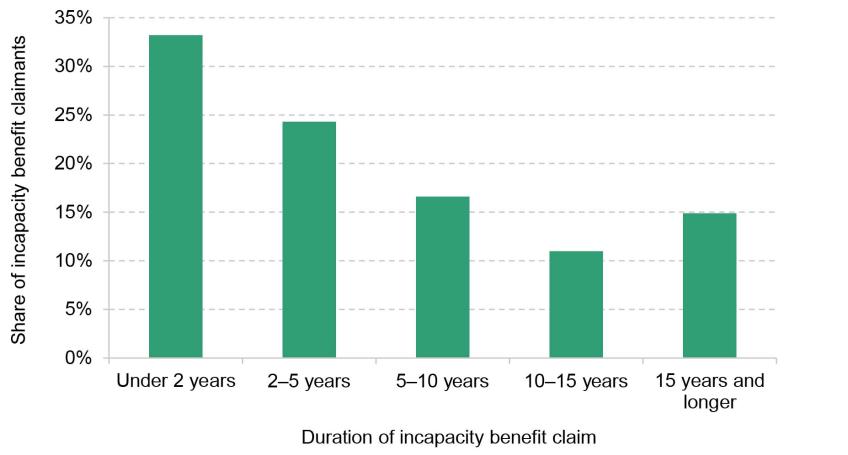
Note: Includes all claimants on UCHE, UC health LCW or employment and support allowance (ESA) in August 2024 by duration of claim, including durations on incapacity benefit and severe disablement allowance.
Source: Department for Work and Pensions Official Statistics
In contrast to incapacity benefits, claimants cycle more quickly onto and off other benefits such as new-style jobseeker’s allowance, so protections for existing claimants of these benefits will only have short-term effects.
Conclusion
In general, there are good reasons to implement transitional protections. They can help households adjust to cuts in income induced by major benefit reforms; it can be costly to impose sudden reductions in income on people, and particularly so for those on relatively low incomes. Sometimes claimants may have planned and made large, irreversible, life decisions around the benefit. However, there is a trade-off between offering protections to current claimants and producing undesirable incentives or unfairness.
The government has a range of options for how to protect incumbent claimants if it chose to do so. If the government is particularly concerned about sudden shocks to a household’s income, it could bring in changes slowly, reducing real incomes incrementally over time. Alternatively, it could offer complete time-limited protection to existing claimants to allow them to adapt. It is difficult to justify indefinite protection, which implies a different treatment of people who happened to receive the benefit before an arbitrary cut-off for decades into the future.
The scale and duration of the protections in the recent UC bill are extensive; existing claimants will be provided with permanent protection from cuts for as long as their claim persists. This will embed significant disparity of treatment between groups on the basis of the date that an individual began to claim – a metric unrelated to the government’s standard measures of need.
If claims follow a similar pattern in the future to the pattern they followed in the past, the transitional arrangements for the cut to UCHE could last decades. By making existing claimants’ favoured status expire if they cease claiming UCHE for more than six months, the government also imposes a disincentive to move into paid work for some existing claimants.
The government has chosen a very strong protection for existing claimants. There is a compelling case for time-limiting this support instead, reducing the impact of the protections over time. This support could last years without being permanent. This tweak to the design of the policy could substantially improve it.
Endnotes
Authors

Eduin Latimer
Eduin is a Senior Research Economist in the Income, Work and Welfare sector. His research focuses on benefits policy and the low-paid labour market.

Matthew Oulton
Matthew is a Research Economist in the Income, Work, and Welfare sector. His research focuses on the UK tax and benefit system.
More from IFS
Understand this issue


Policy analysis


Academic research


