
Following an update from DWP on its new youth employment package, we have updated our analysis with the following:
- The new £3,000 ‘Youth Jobs Grant’ is open to all young UC claimants who have been on the benefit for 6 months or more, irrespective of conditionality regime. In principle, this includes around 320,000 out-of-work claimants who are not currently required to search for work, mostly due to health reasons, in addition to around 170,000 who are actively looking for work.
- In practice, those with no work search requirements due to health reasons are currently very unlikely to find work. DWP data from 2022–25 show that 91% of 16- to 24-year-olds who have been in this group for 6 months were still on the benefit 18 months later.
- The estimate of the total number of young people supported by wage subsidies – 150,000 over three years – remains unchanged.
The government has announced a youth employment package, worth £1 billion over three years, to address the rise in young people who are not in education, employment or training (NEET). Around 960,000 people aged 16–24 were estimated to be NEET in the last quarter of 2025, up from 830,000 three years earlier.
The package includes wage subsidies targeted at around 490,000 young people who have been on universal credit (UC) for 6 months or more, of whom 170,000 are actively searching for work:
- In the 2025 Autumn Budget, the government announced a ‘Jobs Guarantee’ for 18- to 21-year-olds, to commence in April 2026. This covers 100% of employer costs for up to 25 hours a week for 6 months at the (age-relevant) minimum wage, for 18- to 21-year-olds who have been on UC for 18 months or more in the ‘Intensive Work Search’ regime (that is, who do not have work-limiting health conditions).
- In yesterday’s announcement, the Jobs Guarantee was extended to UC claimants (who have been unemployed for 18 months or more) who are aged 22–24.
- A new ‘Youth Jobs Grant’ was announced yesterday for 18- to 24-year-olds who have been on UC for 6 months or more, paying employers £3,000 per hire from this group. This is available to claimants in all conditionality regimes, including those not required to search for work for health reasons.
The package also includes changes to the apprenticeships that will be eligible for public funding, alongside new incentives for employers taking on apprentices:
- The government has removed funding for 16 apprenticeships standards, which tend to be taken by older apprentices (aged 25 and over) and at higher levels. At the same time, it is expanding provision by introducing foundation apprenticeships1 in hospitality and retail, and seven new ‘apprenticeship units’ aligned with Industrial Strategy priorities.
- A subsidy of £2,000 will be paid to small and medium-sized enterprises (SMEs) for each new apprentice that they take on aged 16–24.
Wage subsidies
Who is affected by youth wage subsidies?
Yesterday’s announcement represents a large increase in the number of young people eligible for wage subsidies. As of January 2026, there are around 30,000 18- to 21-year-olds who have been looking for work on UC for 18 months or more in the ‘Intensive Work Search’ regime, who would have been eligible for the Jobs Guarantee. The expansion of the target age group to 22- to 24-year-olds opens up eligibility to an additional 42,000 UC claimants.2 In addition, there are around 420,000 18- to 24-year-olds who are not eligible for the Jobs Guarantee, but are eligible for the new £3,000 Youth Jobs Grant: around 100,000 young people who have been looking for work on UC for 6–18 months, and around 320,000 who have been on UC for 6 months or more but are not required to search for work, mostly due to health reasons.
In practice, these policies are likely to only directly benefit a small percentage of the almost 1 million 16- to 24-year-olds who are NEET. The number of placements will be constrained by employer take-up, and – at least in the case of the Jobs Guarantee – by the administrative capacity of the Department for Work and Pensions (DWP) and the local ‘delivery organisations’ tasked with matching jobseekers to employers. The government expects the Jobs Guarantee to support an average of 30,000 people a year over the next three years, a fraction of the 72,000 UC claimants who are eligible for the policy today. The Youth Jobs Grant is expected to support an average of 20,000 people a year over three years, taking the yearly average number supported by wage subsidies to 50,000. For context, even if all 50,000 jobs were ‘additional’ jobs that would not have existed in the absence of these policies (discussed more below), this would take the NEET rate from 12.8% to 12.1%, still well above the 11.7% seen three years ago and the 11.2% in 2019.3 (If we add the estimated number of new apprenticeships of 17,000 a year, the NEET rate would be 11.9%.)
How do wage subsidies affect hiring costs?
The wage subsidies substantially lower the short-term cost of hiring new 18- to 24-year-olds receiving universal credit, as shown in Figure 1. For example, the Jobs Guarantee reduces by 86% the cost of employing for 6 months a new 21-year-old working full-time on the minimum wage (who has been unemployed on UC for 18 or more months). The Youth Jobs Grant announced yesterday means that the cost of hiring a 21-year-old who has been unemployed on UC for 6–18 months is 30% lower than it would have been in the absence of the policy.
Employer costs are reduced by comparable magnitudes for those aged 18–20 and 22–24. The wage subsidies do not affect the long-term cost of employing young people – the Jobs Guarantee is only available for 6 months, and the £3,000 Youth Jobs Grant is negligible spread over a long period.
Figure 1. Reduction in employer cost of hiring new full-time worker on minimum wage for 6 months, compared with the cost in the absence of wage subsidies, 2026–27
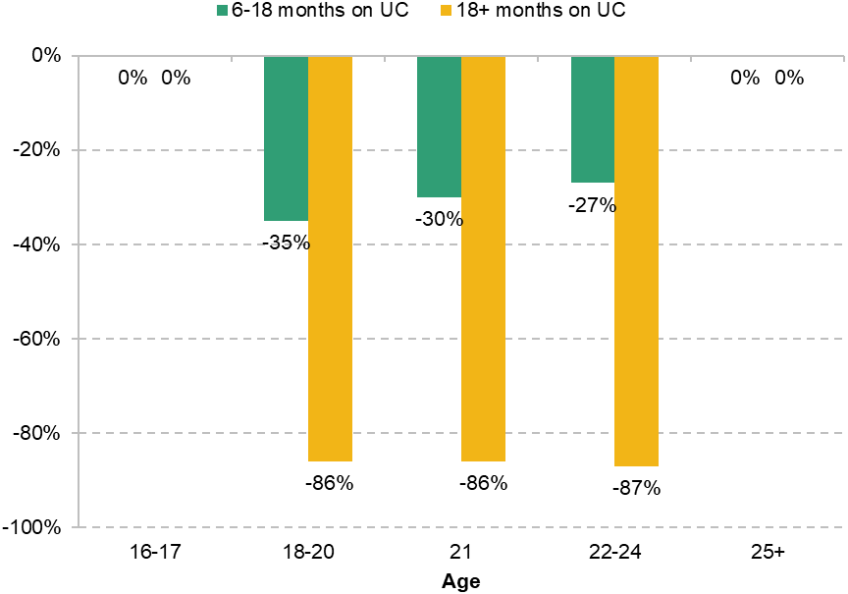
Note: Wage subsidies include the Jobs Guarantee (100% employer costs and £250 onboarding costs) and the Youth Jobs Grant. Full-time is defined as 30 hours.
Source: Authors’ calculations.
What is the rationale for these policies?
There is substantial evidence from the UK and other countries that unemployment spells early on in people’s careers have persistent negative effects on their future labour market trajectories.4 Large-scale youth unemployment can therefore have long-run negative consequences for economic growth and public finances (lowering tax receipts and increasing benefit spending), which creates a rationale for effective policies to address it.
For youth wage subsidies to work well, they need to lead to higher youth employment in the long term. They must therefore result in hires that would not have taken place in the absence of the policies (‘additionality’), and improve participants’ labour market outcomes beyond the duration of the subsidy, whether by retaining them with the same employer or by making them more employable to others.
Studies sending out fictional CVs find that employer callbacks decline sharply in the first 6–8 months of unemployment and flatten out after that.5 By targeting young people who have been unemployed for 6–18 months, the Youth Jobs Grant channels support to those who are likely to experience difficulty finding a job, but before their skills and confidence are eroded by long spells of unemployment. The details of the policy design, which are not yet known, will affect the balance between the scale and additionality of the policy. The Jobs Guarantee relies on intermediate ‘delivery organisations’ to ascertain that new hires are additional, a difficult task which comes at a cost of considerable administrative burden and reduced capacity. On the other hand, DWP statistics from 2022–25 show that only 19% of 16- to 24-year-olds on UC who have been unemployed for 6 months are still on the benefit 18 months later,6 which implies that the majority are likely to find work even in the absence of wage subsidies. Offering £3,000 to all employers without checking for additionality would result in substantial dead weight.
Who is not targeted by these policies?
The Jobs Guarantee is targeted at around 72,000 young UC claimants who are required to search for work. The new £3,000 Youth Jobs Grant is open to all young UC claimants who have been on the benefit for 6 months or more, irrespective of conditionality regime. In principle, this includes around 320,000 out-of-work claimants who are not currently required to search for work, mostly due to health reasons, as well as around 170,000 who are actively looking for work (in the ‘Intensive Work Search regime). However, those with no work search requirements due to health reasons are currently very unlikely to find work: DWP data from 2022–25 show that 91% of 16- to 24-year-olds who have been in this group for 6 months are still on the benefit 18 months later.7
The group of young benefit claimants who are not expected to search for work for health reasons has grown rapidly in recent years, by a third between mid 2022 and mid 2025.8 Measures to stem this rise would help make meaningful progress on youth employment. Furthermore, official NEET estimates imply that there are around 280,000 young people who are NEET but not on out-of-work benefits.
Apprenticeship reform
The recent announcements continue a shift in the apprenticeship system, with the government more actively prioritising funding towards younger people and those not already in employment. Previously, the system has generally been employer-led, with employers deciding which apprenticeships to invest in and accessing subsidies to support that training. Yesterday’s reforms – alongside previous changes to restrict access to higher-level apprenticeship funding – remove support for higher-level apprenticeships more commonly taken by those aged 25 and older, and also introduce stronger incentives for apprenticeships for younger people.
As part of the shift, the reforms remove funding for 16 apprenticeship standards,8 largely related to management and supervisory training, which together accounted for around 10% of the roughly 350,000 apprenticeship starts in 2024–25. These apprenticeships were overwhelmingly taken by older workers who were already employed, with around 90% of these starts taken by people aged over 25. This builds on reforms earlier this year that removed public funding for Level 7 (equivalent to masters level) apprenticeships for learners aged 22 and over, which accounted for a further 10% of apprenticeship starts. The combination of these reforms will remove public support for around one in five apprenticeships started in 2024–25.
At the same time, the government has announced expansions to the types of training eligible for public funding. First, it will expand foundation apprenticeships into hospitality and retail. These lower-level apprenticeships, first introduced in 2025, are available to 16- to 21-year-olds. Second, the reforms introduce ‘apprenticeship units’, which are modular training courses in priority areas and are likely to be even shorter than foundation apprenticeships.
The reforms announced yesterday move away from the tightly defined regulations underpinning apprenticeships introduced by previous governments, which included a minimum duration of one year. At the same time, the government is taking a stronger stance on the sectors it will prioritise for support – modular ‘upskilling’ support for priority sectors, but also expanded entry routes for young people in retail and hospitality, which are not part of the Industrial Strategy (and which, for many young people, are not their long-term career path). It is not at all clear whether previous evidence9 that traditional apprenticeships can deliver positive labour market returns will extend to these new, shorter forms of training.
Endnotes
Authors

Imran Tahir
Imran joined the IFS in 2019 and works in the Education and Skills sector.

Xiaowei Xu
Xiaowei joined the IFS in 2018 and works in the Income, Work and Welfare sector.
More from IFS
Understand this issue


Policy analysis


Academic research


