
Downloads

Download the report as a PDF
PDF | 1.01 MB
1. Introduction
For more than two decades, Ethiopia has experienced remarkable economic growth, with an average annual real GDP growth rate of 9.5% between 2003–04 and 2024–25 (National Bank of Ethiopia, 2024; International Monetary Fund, 2026b).1 During this period, the average GDP growth rate for sub-Saharan Africa was about 4.3% per year, making Ethiopia one of the fastest-growing economies on the continent (International Monetary Fund, 2025a). This sustained growth has translated into significant gains in GDP per capita income, which increased from around $796 in 2002–03 to $3,095 in 2024–25 (constant 2021 international $) according to the World Bank (World Bank, 2026). The poverty rate, based on the international poverty line of $3 a day (2021 international $), also declined, falling from 66% in 1999 to 33% in 2015.
However, in recent years, because of domestic shocks – particularly political instability and conflict in some parts of the country – and global shocks – notably the COVID-19 pandemic – some of the gains in poverty reduction were not sustained. According to the World Bank (2025), poverty by the same measure increased to 39% in 2021 and is projected to have increased further to 43% by 2025 (World Bank, 2025). Real GDP has continued to grow, but growth moderated over the Ethiopian fiscal years 2019–20 to 2021–22, averaging 6.3% per year, before recovering to an average of 7.6% in 2022–23 and 2023–24 (Federal Democratic Republic of Ethiopia, Ministry of Planning and Development, 2025). Growth rose further to 9.2% in 2024–25 (International Monetary Fund, 2026a).
Over the course of 2003–04 to 2024–25, public infrastructure investment was the key structural driver of economic growth. However, as much of this investment was financed through borrowing, the country’s public debt increased in nominal terms and as a percentage of GDP. According to the 2025 Debt Sustainability Analysis (DSA) by the International Monetary Fund (IMF) and the World Bank, Ethiopia’s public debt is classified as unsustainable under current policies (International Monetary Fund and World Bank, 2025).
Domestic revenue mobilisation is relatively weak compared with peer countries in the region and beyond. Revenue performance worsened considerably between 2014–15 and 2023–24: Ethiopia’s tax-to-GDP ratio declined from 12.7% in 2014–15 to around 6.2% in 2023–24. No other country in the world recorded a larger relative decline in its tax-to-GDP ratio over this period (Nair et al., 2025).
To strengthen domestic resource mobilisation and reverse the decline in the tax-to-GDP ratio, the government implemented a series of tax policy and administrative measures and adopted a four-year national medium-term revenue strategy (NMTRS) in October 2024. The NMTRS outlines tax policy and administration reforms to be implemented until 2027–28. It aims to reverse the declining tax-to-GDP ratio, broaden the tax base, improve compliance and enhance the overall efficiency of the tax system.
Over the past two years, major tax reforms, such as value-added tax (VAT) and income tax changes, have been implemented in accordance with the NMTRS. These reforms, alongside complementary tax administration measures, appear to have contributed to a trend reversal of the tax-to-GDP ratio. After reaching a low of 6.2% in 2023–24, tax-to-GDP increased to 7.8% in 2024–25, with IMF projections indicating a further rise to around 9.5% by 2025–26 (International Monetary Fund, 2026b). Nevertheless, recent estimates still show a substantial resource gap to achieving the sustainable development goals (African Development Bank, 2025).
This report provides a detailed overview of Ethiopia’s tax system and the changing level and composition of Ethiopia’s tax revenue collection, and how these compare with those of other countries in the region. The report also reviews the key tax policy reforms implemented over the last five years and their potential impact on revenue and tax administration.
The report is structured as follows. In Section 2, we discuss how taxing power is allocated between the federal government and regional states and we examine the latest trends in revenue collection. In Section 3, we provide a detailed description of the structure of Ethiopia’s tax system. In Section 4, we discuss recent tax policy reforms. In Section 5, we discuss how Ethiopia’s tax revenues compare with other countries in the region. We conclude by considering the implications for tax policy strategy and the potential next steps for tax reform.
2. Overview of tax revenue in Ethiopia
2.1 The federal system
Ethiopia has a federal tax system, with taxing powers and revenues divided between the federal government and the regional states, including the two chartered cities, Addis Ababa and Dire Dawa. The power to levy and collect different taxes is allocated ‘exclusively to the federal government; exclusively to the regional states; concurrent to both the federal government and the regional states; [or is] undesignated’ (Federal Democratic Republic of Ethiopia, 1995). The details of the division of taxation powers according to the 1995 Constitution are presented in Table 2.1.
For taxes not covered in the Constitution, the Constitution explicitly states that the two Houses (the House of Federation and the House of Peoples’ Representatives) shall determine, in a joint session, how taxation powers are assigned to the federal and regional governments, through a two-thirds majority vote.
Table 2.1. Taxation power of the federal and regional governments and city administrations 2, 3, 4

Source: 1995 Federal Democratic Republic of Ethiopia Constitution, Dire Dawa Administration Charter Proclamation (No. 416/2004) and the Addis Ababa City Government Revised Charter Proclamation (No. 361/2003).
VAT is one such case. Because it was only introduced in 2002, the 1995 Constitution does not address it directly. Accordingly, the two Houses held a joint session in April 2002, shortly before the implementation of VAT, to decide how taxing power over it should be assigned. That session granted the federal government the right to ‘legislate’ on VAT but did not specify who should be responsible for collecting it (Yesegat and Krever, 2018). In practice, this has been interpreted as giving the federal government a harmonising role rather than exclusive control over administration: for the past two decades, VAT has been collected by both the regions and the federal government. The regional and city administrations collected VAT from sole proprietors (‘individual businesses’) and the federal government from larger entities (‘bodies’) as a concurrent tax. The latest VAT Proclamation (No. 1341/2024; Federal Democratic Republic of Ethiopia, 2024a) seeks to resolve this ambiguity by assigning administration of VAT to the federal government, including collection from individual businesses; however, as of 2025–26, regional revenue authorities continue collecting VAT from individual businesses. Similarly, before the introduction of the modernised property tax in 2023, a joint session of the two Houses assigned taxing power over it exclusively to the regional states and the two city administrations (Metaferia, 2023).5
The federal government is responsible for collecting all concurrent taxes in full and sharing the revenue with the respective regional governments, according to rules set by the House of Federation. The current revenue-sharing arrangement has been in place since 2019 and is set out in Table 2.2.
Table 2.2. Revenue sharing between the federal and regional government of concurrent taxes since 2019 6

Source: Federal Democratic Republic of Ethiopia, Ministry of Finance (2021).
2.2 Recent tax revenue performance
Despite strong economic growth and a substantial increase in GDP per capita between 2003–04 and 2024–25, Ethiopia’s tax-to-GDP ratio has remained well below that of other countries in the region and well below the 15% threshold that the IMF has identified as a benchmark (Baer et al., 2025). Growth is typically associated with a rising tax-to-GDP ratio, as higher income levels broaden the tax base (Besley and Persson, 2014). However, Ethiopia’s tax-to-GDP ratio fluctuated markedly over this period and actually fell sharply from 12.7% in 2014–15 to 6.2% in 2023–24. This is an unusual pattern by international standards: no other country experienced such a large relative decline in its tax-to-GDP ratio between 2014–15 and 2023–24 (Nair et al., 2025). More recently, though, the tax-to-GDP ratio has begun to recover: it rose to 7.8% in 2024–25 and is projected to reach around 9.5% in 2025–26 (International Monetary Fund, 2026b).
To understand what drove the decline, it is useful to look at the trend across individual tax categories up to 2023–24. As the chart below shows, all major tax categories exhibited a similar downward trend over this period, even as GDP per capita continued to rise. Among them, indirect taxes – defined here as domestic indirect taxes plus VAT and excise on imports – experienced the most significant decline, dropping from 6% of GDP in 2014–15 to 2.5% in 2023–24, a 3.5 percentage point decrease. Trade taxes – a separate category comprising customs duties, surtax and the social welfare levy – also fell, moving from 2.1% of GDP in 2014–15 to 0.7% in 2023–24 – a smaller drop in percentage point terms (1.4 points) but, relative to its 2014–15 level, the steepest decline of the three categories, at roughly 67%. Meanwhile, direct taxes decreased from 4.6% of GDP in 2014–15 to 2.9% in 2023–24, marking a 1.7 percentage point fall (see Figure 2.1). The factors behind this decline are discussed in Section 5.
Figure 2.1. Tax-to-GDP ratio by tax type, 2003–04 to 2023–24

Note: The latest available general government tax revenue data disaggregated by tax type are from the IMF’s World Revenue Longitudinal Database. At the time of analysis, the database provides data only up to 2024, which corresponds to Ethiopia’s 2023–24 fiscal year. Therefore, this chart reports figures only up to 2023–24.
Source: International Monetary Fund (2025b).
2.3 Tax revenue composition
Up until recently, Ethiopia’s tax revenue was heavily dominated by indirect taxes, which raised nearly 6% of GDP and constituted 47% of total tax revenue in 2014–15. As the overall tax-to-GDP ratio fell, indirect taxes declined at a faster rate than other categories, narrowing the gap between tax types. By 2023–24, domestic direct taxes (including property taxes) accounted for around 2.9% of GDP, narrowly ahead of indirect taxes, at 2.5%. Trade taxes raised a further 0.7% of GDP (see Figure 2.1). Direct taxes are therefore the largest single category of tax revenue, but they do not dominate the system: indirect and trade taxes together still raised more (3.2% of GDP) than direct taxes in 2023–24.7
3. The Ethiopian tax system
In this section, we discuss the salient features of the various tax types in Ethiopia, categorising these into direct and indirect taxes.
3.1 Direct taxes
Income tax
Ethiopia operates a schedular income tax system, whereby different types of income are treated differently for income tax purposes and subject to separate schedules. However, taxpayers are taxable on their total income of a given type for the year, even when it is derived from multiple sources.
Income Tax Proclamation No. 979/2016 (as amended) covers the taxation of income in accordance with the following schedules:
- Schedule A, employment income;
- Schedule B, rental income;
- Schedule C, business income;
- Schedule D, other incomes;
- Schedule E, exempt incomes.
The schedular income tax system eases the administrative burden on tax authorities at different levels of government and reduces compliance costs for taxpayers. However, it also means that taxpayers with multiple sources of income benefit from multiple exemptions, reducing the progressivity of the income tax system.
Schedule A: employment income
Employment income tax is levied on a monthly basis on any employee who earns employment income, including salaries, wages, allowances, bonuses, commissions, gratuities and other remunerations received in respect of past, current or future employment. It also includes the value of fringe benefits and amounts received on termination.8 Employees cannot claim deductions for any expenditure incurred in deriving employment income. The monthly basis for employment income tax differs from the typical approach used in high-income countries, which tend to instead levy income tax based on annual employee earnings. This means that employees whose incomes vary over the tax period may face a higher average tax rate than they would under an annual schedule.
Employment income tax is collected through a Pay-As-You-Earn (PAYE) system, whereby employers withhold tax directly from their employees’ salaries and remit it to the respective tax authority.9 Employees are not required to file a tax return with the tax authorities unless they have more than one employer in a calendar month or have self-assessment obligations. Employees must self-withhold tax on their employment income if they are employed by entities that are exempt from normal withholding obligations, such as international organisations or embassies and diplomatic missions, but they themselves are liable for tax.
The employment income tax rate is a progressive marginal rate with a top marginal tax rate of 35% (see Table 3.1). In 2025, the income tax law was amended by increasing the tax-free threshold from ETB 600 to ETB 2,000 per month and adjusting the upper income tax brackets. The reform thus granted income tax relief to lower earners by increasing the income amount that is entirely exempt from tax (see Table 3.1).
Table 3.1. Employment income tax rates and brackets: comparison of 2016 and 2025
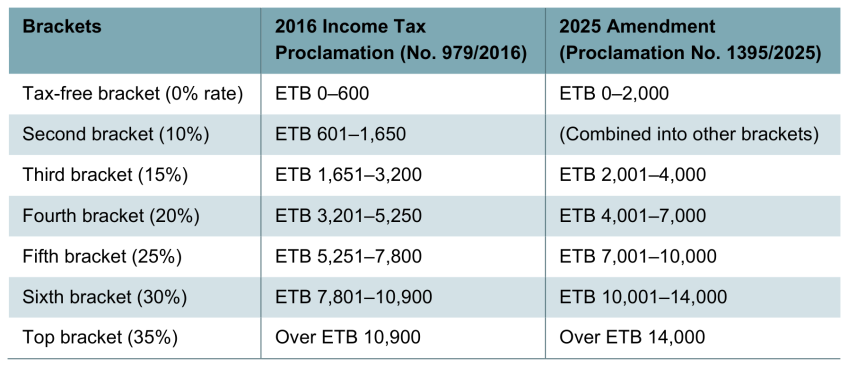
Note: As of July 2025, the new income tax brackets and rates have been implemented across the country following the enactment of Proclamation No. 1395/2025 by the House of Peoples’ Representatives.
Source: Federal Democratic Republic of Ethiopia (2016a) (as amended).
Schedule B: rental income
Rental income tax is imposed for each tax year on individuals or companies renting out a building or buildings. The taxable rental income is the gross amount of income derived from the rental of a building for the year, reduced by the total amount of allowed deductions.
The rental income tax payable by individuals (unincorporated entities) for a tax year is calculated by applying the annual equivalent of employment income tax (as given above) if they fall under Category A of the business income classification (see Table 3.2).10 For ‘bodies’ as defined in the Federal Tax Administration Proclamation (which includes incorporated businesses), the rental income tax rate is 30%.
The following deductions are allowed for expenditures necessarily incurred in deriving rental income and paid during the year, including:
- the cost of the lease of land where the building is situated;
- repairs and maintenance;
- depreciation of the building, furniture and equipment;
- interest and insurance premiums;
- fees and charges (but not tax) levied by a State or City Administration.
This deduction rule applies to taxpayers who maintain books of account as per the financial accounting reporting standards.
The latest income tax amendment (Proclamation No. 1395/2025) narrows the scope of the rental income tax to buildings, residences and warehouses. It excludes rental income from industrial establishments (such as Special Economic Zones), income derived from greenhouse leases under the Capital Lease Proclamation, and income derived from renting out space in a warehouse. All these latter incomes are treated as business income under Schedule C.
Schedule C: business income
The taxation of income derived from business activities is governed by Schedule C: business income. This schedule provides the legal framework for determining taxable business income and allowable deductions. Business income tax is imposed annually on any person/entity who conducts a business and realises taxable income during the tax year.
For tax purposes, ‘business’ encompasses any industrial, commercial, professional or vocational activity carried out for profit, whether conducted on a continuous or short-term basis. It also covers any activity recognised as a trade under the Commercial Code (Proclamation No. 1243/2021). This definition excludes services performed in the capacity of an employee, which fall under Schedule A, and the rental of buildings, which falls under Schedule B.11 Taxable business income is defined as the taxpayer’s total income from business activities for the year, reduced by allowable deductions, and determined on the basis of the profit and loss or income statement.
Business taxpayers are classified into two categories according to their annual turnover and legal form. Table 3.2 sets out the categorisation and the reporting requirements attached to each. The classification applies both to taxpayers earning business income and to those earning rental income.
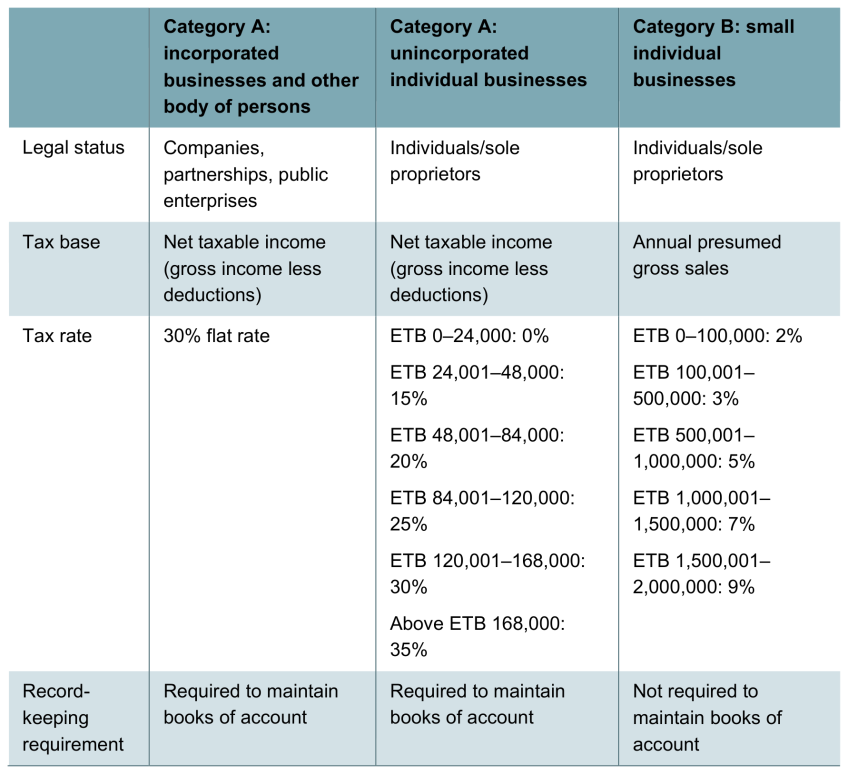
The applicable business income tax rate depends on both the taxpayer’s category and their legal status. Bodies – defined as a company, partnership, public enterprise or public financial agency, or other body of persons whether formed in Ethiopia or elsewhere in the Federal Tax Administration Proclamation No. 983/2016, which all fall under Category A – are subject to a 30% tax on their taxable income,12 while individual businesses (sole proprietors) under Category A are subject to a tax rate equivalent to the annualised employment income tax schedule (see the detail in Table 3.3).
Table 3.2. Business categorisation for tax purposes

Source: Federal Democratic Republic of Ethiopia (2025b); Federal Democratic Republic of Ethiopia (2016a).
Table 3.3. Summary of business income tax
Source: Federal Democratic Republic of Ethiopia (2016a) (as amended).
Category B taxpayers are subject to a simplified tax regime based on presumed (assessed) annual turnover (see Box 3.1). The applicable rate for Category B is a progressive marginal rate between 2% and 9% of presumed turnover (detailed in Table 3.3). Taxpayers under this category are not required to maintain books of account, but they can voluntarily do so; in that case, they are taxed under the standard income tax rules applicable to Category A taxpayers, rather than under the presumptive regime.
Box 3.1. Taxation of Category B taxpayers
Under Ethiopia’s 2025 Income Tax (Amendment) Proclamation No. 1395/2025, Category B taxpayers –individual businesses with annual turnover below ETB 2 million – are taxed on their assessed gross annual turnover under a presumptive tax schedule, with marginal rates of up to 9%, as shown in Figure 3.1. This replaces the previous system, which assessed presumptive tax liabilities across 99 subsector categories and 19 turnover bands, and is intended to make the regime easier for both taxpayers and tax administrators to apply consistently.
Because their tax liability is determined on the basis of assessed turnover rather than declared net income, Category B taxpayers are not required to maintain accounting records. Instead, tax authorities (often committees established by regional revenue authorities at the woreda/district or city administration) estimate a taxpayer’s daily sales – typically based on observable indicators such as business type, location and scale of activity – and convert this into an annual turnover figure. Once the final assessed turnover has been determined, the tax liability is calculated according to the tax schedule set out in Table 3.3, which is visualised in Figure 3.1.
Figure 3.1. Marginal and effective tax rates by turnover for businesses under the presumptive tax regime

Source: Authors’ computation.
When calculating taxable income for Category A businesses, certain expenses from the tax year may be deducted. These include necessary expenditures for deriving and maintaining business income, the cost of trading stock disposed of as per financial reporting standards, depreciation on assets and business intangibles using either the straight-line or diminishing value method (provided the same method is used consistently), losses from disposing of business assets (excluding trading stock), and interest expenses where the proceeds are used to derive business income, subject to specific regulatory limits. Additionally, charitable donations made to recognised Ethiopian charities or societies, or in response to government appeals, are also allowable deductions, but the total deduction for such donations must not exceed 10% of the taxpayer’s taxable income for the year. The applicable depreciation rates are set out in Table 3.4.
Table 3.4. Depreciation rates applicable to a depreciable asset

Note: Intangible assets can only be depreciated using the straight-line method.
Source: Council of Ministers Regulation No. 410/2017.
The income tax law allows businesses incurring a loss in a tax year to carry the loss forward to the following tax year, where it is allowed as a deduction in calculating the taxpayer’s taxable income for that subsequent year. If the loss is not wholly deducted in the subsequent year, the taxpayer continues to carry the remaining amount forward to the following tax year, and so on, until the loss is fully deducted. However, a taxpayer cannot carry a loss forward for more than five tax years after the end of the year in which the loss was incurred.
Schedule D: other incomes
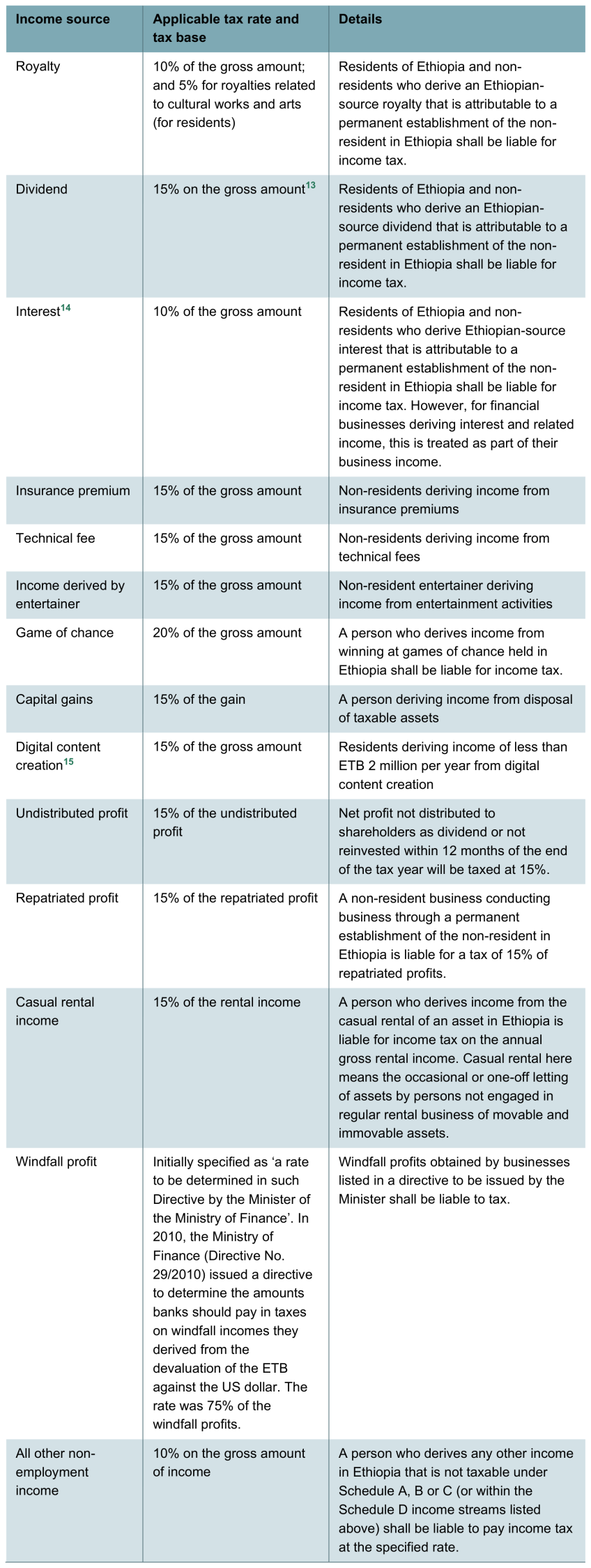
Other taxable sources of income include royalties, dividends, interest income, winnings from games of chance and gains on the disposal of investment assets. Hence, any resident who derives income from these sources (as well as any non-resident who derives income from these sources that is attributable to a permanent establishment) is liable for income tax. Table 3.5 summarises the applicable rates for each income source under Schedule D.
Table 3.5. Details of taxation of ‘other income’ listed as schedule D 13, 14, 15
Source: Federal Democratic Republic of Ethiopia (2016a) (as amended) and Council of Ministers Regulation No. 410/2017.
Schedule E: exempt income
Schedule E of the Income Tax Proclamation provides a comprehensive list of income sources exempt from taxation. These exemptions cover various employment-related benefits such as medical treatment payments, transportation allowances, hardship and per diem payments, food provisions, government allowances for overseas public service, pension contributions, compensation for injury or death, scholarships, child support payments and certain pensions. Additional exemptions apply to specific individuals, including short-term unskilled employees. Governmental, international, and non-profit income, as well as awards, rehabilitation funds, dividends between companies with controlling shares, income specifically exempted by law, and premiums from deposit insurance or new shares, are also included as exempt under Schedule E.
Withholding of income taxes
Another key feature of the Ethiopian business income tax system is that it mandates businesses (excluding micro enterprises), government agencies, non-governmental organisations, non-profit organisations and other taxpayers to withhold income tax at a rate of 3% on the gross amount of payments they make for the following supplies:
- supply of goods in Ethiopia worth more than ETB 20,000 in one transaction or supply contract;
- supply of services worth more than ETB 10,000 in one supply contract.
If the supplier does not provide their tax identification number (TIN) and business licence, the paying business must withhold 30% of the total payment. In addition to this, businesses importing goods and services are subject to a 3% withholding tax on the CIF value of their imported goods and services. These withholding taxes are not final taxes as they can be credited against income taxes due from the company or individual from whom the tax was withheld.
Minimum alternative tax
The latest income tax reform (Proclamation No. 1395/2025) introduced a minimum alternative tax (MAT) on the turnover of Category A taxpayers, which include sole traders (‘individual businesses’), partnerships and incorporated businesses. The MAT acts as a backstop, ensuring that businesses still contribute a minimum share of their turnover in tax even in years when their reported profits, and therefore their standard income tax bill, are low.
The base that the MAT is charged on varies by type of business: annual gross receipts for most businesses, net banking income for banks, gross premium income for insurance companies, and the commission earned for price-regulated entities. The standard MAT rate is 2.5% of this base.
The MAT applies whenever a Category A taxpayer’s standard income tax liability – calculated from its assessed or reported profits across all business income sources – would otherwise come out below the applicable MAT rate. In that case, the taxpayer pays the MAT amount instead. Where the MAT paid exceeds what the taxpayer would have owed under the standard income tax rules, the excess can be carried forward and credited against the taxpayer’s income tax liability in subsequent years, up to five years.
Other direct taxes
Digital services tax
As part of the latest income tax amendment (Proclamation No. 1395/2025), a digital services tax has been introduced into the Ethiopian tax system. Under this provision, both resident and non-resident entities or individuals who derive income from digital services provided in Ethiopia are required to pay income tax. The rate of income tax payable and the mode of payment are to be determined by Council of Ministers Regulations, with a statutory cap of 5% of the gross payment received for the digital services (the base is not specified explicitly, but this appears to be the intention). Because the implementing Regulations have not yet been issued, this tax has not been implemented at the time of writing.
Property tax
Ethiopia’s property tax system dates back to Proclamation No. 80/1976, which introduced what was known as the ‘roof and wall tax’ – a tax on buildings based on their annual rental value. Despite this long history, the tax’s contribution to overall revenue has remained strikingly small, and its administration has been fragmented and inconsistent across the country’s regional states and city administrations.
In an effort to harmonise property tax administration nationwide, the federal government enacted the Property Tax Proclamation No. 1365/2025. The Proclamation establishes a unified national property tax framework intended to enable regional states and city administrations to generate their own revenue, while ensuring transparency and administrative efficiency. It sets out the tax base: the ‘taxable value’ of a property, defined as 25% of its market value. On this base, the Proclamation prescribes floor and ceiling tax rates that regional governments, city administrations and municipalities may set (the details are presented in Table 3.6). The tax is collected annually.
Table 3.6. Summary of the property tax (tax rates and bases) 16

Source: Federal Democratic Republic of Ethiopia (2025a).
Regional direct taxes
As set out in the Federal Democratic Republic of Ethiopia Constitution, regional states and the two chartered cities have their own taxing powers over a range of local revenue sources, separate from the federal income tax schedules discussed above. These include taxes on agricultural income, land use and livestock, as well as a variety of other local levies specific to individual regions and city administrations. Regional states can:
- levy agricultural income tax on individual farmers residing in their territory, based on land size and varying by region;
- levy and collect rural land use fees and, in pastoralist areas, a livestock tax based on herd size;
- collect urban land use fees from urban land leases. Under Proclamation No. 721/2011, citizens may acquire urban land either through open tender/auction or by direct allotment; once acquired, leaseholders must pay annual lease fees that vary according to the land’s location and intended use (residential, commercial or mixed use).
Beyond these core levies, individual regional states and city administrations also impose a range of other local taxes, fees and charges – such as licence fees, market dues and service charges – reflecting the degree of fiscal autonomy the Constitution grants to subnational governments to raise revenue within their own jurisdictions.
3.2 Indirect taxes
Indirect taxes are levied on the production, sale or consumption of goods and services, rather than directly on income, profits or assets. As discussed in Section 2, they remain an important source of government revenue especially for the federal government. This subsection sets out the design of Ethiopia’s three main domestic indirect taxes: value-added tax (VAT); excise tax, levied on a specific set of goods including tobacco, alcohol and vehicles; and stamp duty, charged on specified legal and financial instruments (pure trade taxes are covered as a third category below). For each, we discuss the tax base, rate structure and administration, along with recent reforms aimed at broadening the base, strengthening compliance, and aligning Ethiopian practice with international standards.
Value-added tax
Value-added tax was initially introduced into the tax regime in 2002 and became operational in 2003, replacing the previous sales tax system. The current statutory basis for VAT is provided by Proclamation No. 1341/2024 and Regulation No. 570/2025, which formally repeal Proclamation No. 285/2002 (as subsequently amended) and Regulation No. 79/2002. Value-added tax is levied on three distinct categories of supplies:
- taxable supplies provided by VAT-registered individuals or businesses;
- taxable imports made by any person;
- reverse-charged supplies made by a person outside Ethiopia without a fixed place of business in Ethiopia to a VAT-registered person in Ethiopia.17
The standard VAT rate of 15% applies to all taxable supplies mentioned above. There are currently no reduced VAT rates. In line with the destination-based VAT system, exports are zero-rated.
Certain supplies are exempt from VAT under the current legislation. These include:
- essential basic food items;
- key agricultural inputs;
- health and educational services, religious services and certain social or humanitarian supplies, especially those involving significant employment of disabled persons;
- payments for licences and permits, purchases by diplomatic missions or organisations with diplomatic status, and defence and security-related goods and equipment; and
- supply of gold to the National Bank of Ethiopia.
Further details on exempt goods and services are set out in Table A.1 in the Appendix.
As is common globally, Ethiopia has a turnover-based registration threshold for VAT. Since 2024, the compulsory registration threshold for VAT in Ethiopia has been set at an annual turnover of ETB 2 million. Businesses must register for VAT if there are reasonable grounds to believe that the total value of taxable supplies to be made within any 12-month period will exceed the ETB 2 million threshold, or if the total value has exceeded the threshold in a prior period. Businesses with annual taxable supplies below the compulsory registration threshold of ETB 2 million can voluntarily register for VAT, provided their expected or actual annual taxable turnover is above ETB 1 million.
Businesses below the compulsory VAT registration threshold are exempt from VAT. Until 2025, these businesses instead paid turnover tax (TOT) at a rate of 2% on the sale of goods and 10% on the provision of services; unlike VAT, TOT paid on inputs was not creditable. The government abolished TOT in 2025, folding its revenue-raising role into the presumptive income tax regime instead. Businesses below the VAT threshold are now subject only to presumptive income tax (see Section 3.1 for further detail).
VAT-registered businesses are eligible for full input VAT credit. However, businesses making both taxable (VATable) and exempt supplies can only credit input VAT on shared inputs to the extent it relates to their taxable activity. Where taxable supplies account for 95% or more of total supplies, the full amount of input VAT on jointly used inputs is creditable; where they fall below 5%, no credit is allowed at all. Between these thresholds, credit is apportioned in direct proportion to the taxable share, using the formula Credit = A × (B/C), where A is the input VAT on inputs used jointly for taxable and exempt supplies, B is the value of taxable supplies in the period and C is the value of total supplies. This apportionment formula applies only when an input is used jointly for both taxable and exempt supplies, and the proportion of that use falls within the 5–95% threshold. Where an input can be clearly traced to one category or the other, the input VAT follows that category directly: it is fully creditable if traceable to taxable supplies, and fully non-creditable if traceable to exempt supplies.
VAT administration
The most recent VAT legislation, VAT Proclamation No. 1341/2024, places responsibility for VAT administration, including the collection of VAT from individual businesses, under the federal government. This represents a departure from previous arrangements, in which regional and city administrations collected VAT from individual businesses, while the federal government collected VAT solely from corporate entities. The Ministry of Revenue manages VAT for local transactions, and the Ethiopian Customs Commission handles VAT collection on imports. In areas where the Ministry of Revenue does not have branch offices, it can delegate the administration to the respective regional tax offices.18
VAT withholding system
Designated government institutions and state-owned enterprises (SOEs) are required to withhold VAT due on their purchases. Previously, these withholding agents had to withhold 100% of the VAT payable and remit it directly to the tax authorities. However, this meant that businesses supplying predominantly to such government institutions or SOEs were consistently left in a refund position. To address this, the government amended the VAT withholding rules, reducing the withholding rate from 100% to 50%: withholding agents now withhold only half of the VAT payable, while suppliers collect and remit the remaining 50% themselves. The 50% withheld is treated as VAT already paid to the tax authority on the supplier’s behalf, and the supplier can claim a credit for it in the accounting period in which the taxable supply took place.
VAT filing frequency
The standard filing frequency for most VAT-registered businesses is monthly, although the VAT regulation (No. 570/2025) includes specific provisions allowing foreign suppliers and entities dealing with reverse-charged supplies to report quarterly. Such entities must apply to their respective tax authority for permission to file their returns on a quarterly basis.
VAT refund
The VAT system includes a refund mechanism for registered businesses that accumulate excess input VAT credits. The default treatment is to carry these credits forward, crediting them against output VAT in the following accounting period, and continuing to do so until the excess is fully used. Where a registered person has excess credits carried forward from more than one accounting period, the earliest excess is credited first. However, if an excess amount from a given accounting period has still not been fully credited after being carried forward for six accounting periods, the taxpayer may apply for a refund of that amount. The tax authority must then process and pay the refund within 45 days of receiving the application. If it fails to pay by this deadline, it must pay the registered person interest, at the highest commercial lending rate that prevailed in Ethiopia during the quarter before the late payment began (as set out in VAT Proclamation No. 1341/2024).
Outside this standard six-period process, a registered person can request a refund immediately in two circumstances: where more than 50% of the value of their taxable supplies in an accounting period is zero-rated, or where a registered person with annual taxable supplies exceeding ETB 100 million makes a creditable acquisition of capital goods.
To facilitate timely payment of refunds, the tax authorities retain 10% of VAT collections specifically to fund them.
Excise tax
Excise tax is one of the oldest taxes in the country, dating back to the Imperial Regime (see World Bank, 1967). It is imposed on selected goods such as chat, sugar, perfume, textiles, vehicles, fuel and alcoholic products such as wine and beer. Over the years, it has been reformed to broaden its base and adjust rates in line with inflation. Currently, it is imposed on a wide range of goods deemed to be socially or environmentally hazardous, as well as on goods with inelastic demand. The aims are to reduce the consumption of such socially and environmentally hazardous goods and to raise government revenue. Recent reforms have expanded excisable goods and services to include mobile phone services (internet, voice and SMS).
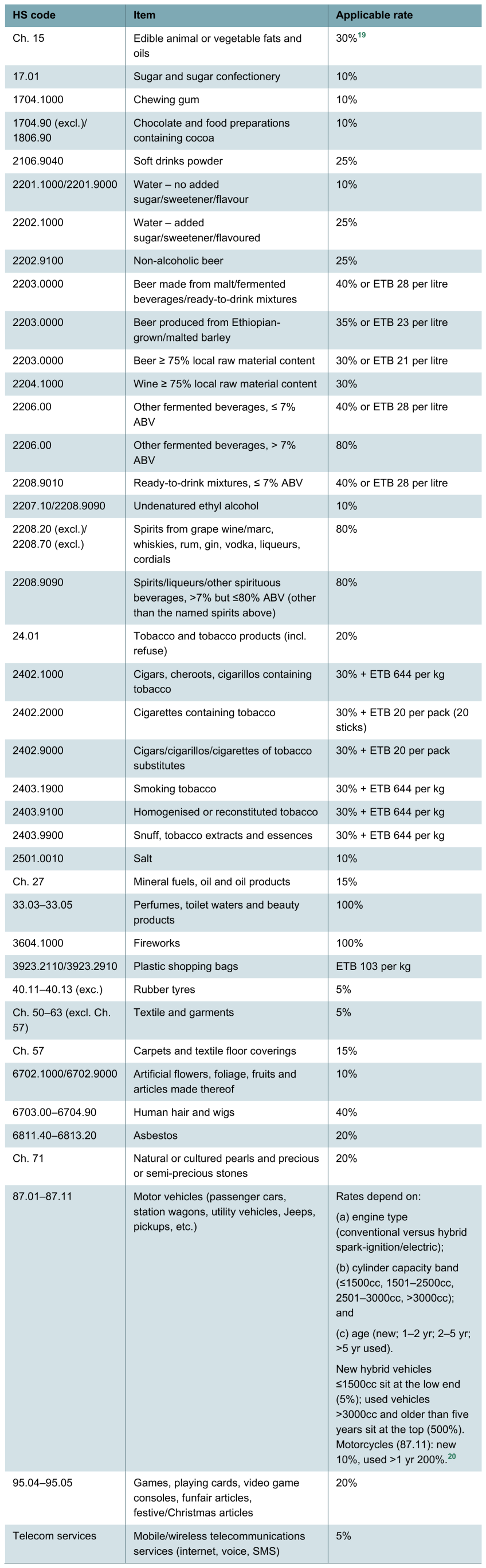
Ethiopia operates a hybrid excise tax system where both specific and ad valorem taxes are applied for certain products. For some products, such as chat and plastic bags, a specific tax applies, while vehicles and other goods (including vegetable fats and oils, sugar, salt and soft drink powder) and telecommunication services are taxed on an ad valorem basis. Beer, cigars and cigarettes containing tobacco are subject to a hybrid regime combining ad valorem and specific rates. For some products, both rates apply together – an ad valorem rate plus a specific amount; for others, only the higher of the two rates applies. Detailed tax rates by products are presented in Table 3.7, which classifies goods by Harmonised System (HS) code – the international product nomenclature also used for customs duty (see Section 3.3) – at chapter (two-digit), heading (four-digit) or tariff-line level; telecommunications services, which fall outside the HS, are listed separately.
Table 3.7. Applicable excise tax rates 19, 20
Source: Federal Democratic Republic of Ethiopia (2020, 2023) and Federal Democratic Republic of Ethiopia, Ministry of Finance (2024b).
The excise tax base for locally produced goods is the ex-factory price. For imported goods, it is the sum of the CIF value and customs duty payable.
Stamp duty
Stamp duty, as set out in Proclamation No. 110/1998, is levied on various legal and financial instruments. The current structure is a hybrid, applying an ad valorem rate to documents with clear valuations and a specific rate to other documents. These specific rates were set in 1998 and have remained unchanged despite high inflation in the intervening years. The stamp duty rates are presented in Table 3.8.
Table 3.8. Applicable stamp duty rates for legal, commercial and financial instruments

Source: Federal Democratic Republic of Ethiopia (1998).
No stamp duty is payable in the following cases:
- the issuance of share certificates on the register of a title of property;
- the import of goods by traders holding an import licence, where the goods are first registered in the trader’s name;
- transactions by public bodies on which the Federal Government of Ethiopia Financial Administration Proclamation No. 57/1996 applies;
- documents granted exemptions from the payment of stamp duty in accordance with international agreements and conventions approved by the government;
- documents of embassies, consulates and missions of foreign states, where the Minister grants an exemption on the basis of reciprocity;
- any transaction granted discretionary exemption for good cause by the Ministry of Finance.
Regional indirect taxes
In addition to the indirect taxes that are applied nationally, several regional states and city administrations in Ethiopia have begun introducing their own indirect taxes on specific goods and services, levied and collected independently by the respective regional or city revenue authorities.
Recently, the Addis Ababa City Administration has introduced a 5% tax on hotel and lodging accommodation services, effective from July 2026. The tax applies to accommodation charges (before VAT) at hotels, motels, pensions, guest houses and lodges registered with the City Administration (Addis Ababa City Council Regulation No. 204/2026). A broadly similar tax has been introduced in the Amhara region. It applies to hotel accommodation at a rate of 1.5% (Yitbarek, 2025).
These regional indirect taxes have not been harmonised – each regional state or city administration designs, legislates and administers its own scheme independently, resulting in variation in tax bases, rates and terminology across jurisdictions.21
3.3 Trade taxes
Customs duty
Customs duties are levied on goods imported into Ethiopia’s customs territory. These duties are overseen and collected by the Customs Commission under the Ministry of Revenue and must be paid before imported goods can be released to importers.
The tax base for customs duties is the CIF value of imports. Tax rates vary across goods, which are classified using the internationally recognised Harmonised System. Standard customs duty rates vary between 0% and 35%, with goods often used as raw materials or in capital investment projects typically subject to zero or low rates of duty, and goods generally considered final goods typically subject to high rates of duty. Additionally, as the government uses customs duty as a policy tool to protect domestic manufacturers, certain key sectors and products are subject to higher customs duty rates. These include finished goods such as textiles, garments and household appliances, which compete directly with local production.
As a member of the Common Market for Eastern and Southern Africa (COMESA), Ethiopia applies preferential customs duty rates to goods originating from other COMESA member states. These rates reflect a 10% reduction on the standard rates set out in the tariff book – that is, a reduction of 10% of the standard rate itself. For example, the standard rates of 0%, 5%, 15%, 25% and 35% become 0%, 4.5%, 13.5%, 22.5% and 31.5%, respectively, for goods originating from COMESA member countries.
Similarly, having ratified the African Continental Free Trade Area (AfCFTA), Ethiopia has begun applying preferential tariffs to goods originating from other member states. In June 2025, the Council of Ministers approved Regulation No. 574/2025, which implements Ethiopia’s AfCFTA tariff concessions. The Regulation sets out Ethiopia’s AfCFTA tariff schedule, classifying tariff lines into three categories with different timelines for removing customs duties on qualifying imports from other AfCFTA member states:
- Category A (90% of tariff lines) – customs duties are eliminated in equal annual increments over the ten years from 2021 to 2030;
- Category B (7% of tariff lines) – duty removal begins in 2026 and is phased over eight years;
- Category C (3% of tariff lines) – goods considered strategic or sensitive, which remain subject to standard customs duty rates with no scheduled removal.
Although Category A reductions were due to start in 2021, the Council of Ministers did not approve the implementing Regulation until June 2025, and the phased elimination only formally began in September 2025. To keep the schedule on track despite this delay, Ethiopia applied the reductions for the missed years (2021–25) all at once at the point of implementation, then resumed annual reductions on the original timeline. For example, a tariff line with a 5% standard duty in 2019 would normally fall by 0.5 percentage points a year; instead, it saw a one-off cut of 2.5 percentage points in 2025 (covering the five missed years), with the usual 0.5-point annual reductions continuing from that adjusted rate through to 2030. The same catch-up approach applies proportionally across all other Category A tariff lines.22
In addition to these trade-agreement preferences, eligible investors may also benefit from preferential customs duty rates granted as part of the government’s investment incentives, as described in Section 3.4.
Preferential customs treatment for exporters
The government provides preferential customs treatment to businesses engaged in export, to facilitate the import of raw materials and capital goods used in producing export goods. This support is delivered through several export incentive schemes – including the duty draw-back scheme, voucher scheme, bonded export factory scheme, bonded export manufacturing warehouse scheme, bonded input supplies warehouse scheme and industrial zone scheme – each with its own administrative mechanism and eligibility conditions (Federal Democratic Republic of Ethiopia, 2024b). Further detail on each scheme is set out in Table A.2 in the Appendix.
While the schemes differ in how and when duty relief is applied (for example, some refund duty already paid once goods are exported, while others waive duty upfront on imports held under customs control), they share a common purpose: reducing the duty cost of imported inputs and streamlining their supply for producers, suppliers and exporters involved in export-oriented manufacturing.
Surtax
Surtax was first introduced into the Ethiopian tax system in 1999 by Council of Ministers Regulation No. 59/1999 but was abolished in 2001 by Regulation No. 69/2001. It was then reintroduced in 2007 (Council of Ministers Regulation No. 133/2007) and levied on goods imported into Ethiopia at a flat rate of 10% on the CIF value of the goods plus all customs duty and excise tax payable. Currently, surtax is only applied to imported goods attracting a customs duty rate of 25% or 35%, with a few exceptions.23 As with customs duties, it is collected and administered by the Ethiopian Customs Commission.
Social welfare levy
As part of its efforts to rehabilitate conflict-affected areas and expand social services such as education and healthcare, the Council of Ministers introduced a social welfare levy on imported goods through Regulation No. 519/2022 in 2022. The levy applies to all imports, except the following (Federal Democratic Republic of Ethiopia, Ministry of Finance, 2024a):
- goods that are exempt from taxes and duties under an international agreement to which Ethiopia is a party;
- goods subject to surtax;
- goods donated to social welfare institutions;
- coins, bank notes, unwrought silver and gold imported by the National Bank of Ethiopia;
- defence and public security equipment, parts and accessories thereof imported by the National Defence Force, federal and regional police institutions, Ethiopian National Intelligence and Security Services, and the Information Network Security Administration, provided they are imported in accordance with the law.
The following items are not exempt from the social welfare levy even when donated to social welfare institutions:
- automobiles with fewer than eight passenger seats and their spare parts;
- pickup vehicles with one or two cabins and their spare parts;
- office equipment and materials.
The applicable rate is 3% of the CIF value of the imported goods.
3.4 Investment tax and customs duty incentives
Various tax and customs duty incentives are currently being granted to eligible investors under Regulation No. 586/2026, issued by the Council of Ministers. These include reduced income tax rates for investments in designated sectors, reductions in customs duties for the importation of capital goods and construction materials, and an investment (capital expenditure) allowance intended to encourage new business development and reinvestment. With the exception of small and medium enterprises, investors must commit at least USD 10 million (or its ETB equivalent) to qualify for the reduced income tax rate incentives described below; small and medium enterprises are instead governed by separate criteria to be issued by the Ministry in a directive. The scope and scale of incentives depend on the sector and the type of investment undertaken, with particular emphasis on strategic areas such as manufacturing, infrastructure, mining and technology.
Reduced income tax rate
Investors establishing new businesses in eligible sectors are entitled to a reduced income tax rate for a specific period, which varies depending on the sector. Investments in selected sectors/subsectors benefit from a reduced income tax rate of 15% for a period ranging from two to six years, depending on the sector.24 Pharmaceutical and medical device manufacturing, basic input manufacturing, basic metal manufacturing, renewable energy generation and aircraft/drone manufacturing are eligible for the longest period of six years; wood product manufacturing receives the shortest period of two years.
Special Economic Zone (SEZ) developers and sub-developers are eligible for a reduced income tax rate of 5% for ten years from the date their business licence is issued. Enterprises operating within an SEZ (as distinct from its developers) instead receive the 15% reduced rate. Businesses engaged in the manufacture of fertiliser in an SEZ are eligible for a reduced rate of 5% for ten years, notwithstanding the enterprise rate that would otherwise apply.
‘Designated startups’ are also eligible for a package of tax incentives aimed at supporting early-stage growth:25 a reduced income tax rate of 5% for ten years and a five-year exemption on dividends distributed to shareholders. The incentive also extends to ‘startup ecosystem builders’ – incubators, accelerators and angel investors – through an exemption on capital gains from the sale of ownership interests in startups.
Companies engaged in the carbon trading market or emissions trading system are eligible for a 15% rate for ten years from commencement of operations, and any investor who uses at least 50% renewable energy in its own production or operations (having previously relied on non-renewable energy), or who sources at least 50% of its production inputs from local recycled materials, is eligible for a 15% rate for five consecutive years.
Companies (excluding financial institutions) that publicly list their shares on a licensed Ethiopian securities exchange and offer them for trading are granted a reduced income tax rate of 25% for three years following their initial public offering; this does not extend to companies whose shares trade only over the counter.
Where an investor qualifies for more than one reduced income tax rate incentive under the Regulation, only the incentive providing the greater advantage may be claimed – the incentives cannot be combined or stacked.
Investment (capital) allowance
Regulation No. 586/2026 introduces a capital expenditure allowance as part of the incentive scheme, available only to investors with at least USD 2 million in capital investment. Eligible investors may immediately deduct a defined percentage of the cost of qualifying capital goods and buildings for business income tax purposes. For most qualifying assets, investors may deduct 50% of the expenditure in the first year, with the remaining balance deducted over the next two years at an equal rate of 25% per year.26 A separate, slower schedule applies to schools, hospitals, commercial buildings and dry ports, for which only 10% may be deducted in the first year, followed by 10% of the remaining balance annually thereafter.
Customs duty incentives
In addition to income tax incentives, eligible investors are allowed to import capital goods and construction materials at preferential customs duty rates. Such benefits are primarily available during the investment phase (i.e. before the business becomes operational) and require an investment licence from the relevant investment authority; once operations commence, further imports under this scheme are only possible with an expansion licence. SEZ developers, administrators and enterprises benefit from an unrestricted version of this incentive, with no limitation on the quantity or timing of qualifying imports. Investors operating outside an SEZ can only import from an approved list of capital goods and construction materials.
Mining, petroleum and geothermal operations are subject to their own, generally more extensive customs duty and tax incentive regime: holders of exploration, mining or petroleum/geothermal licences (and their contractors) may import equipment, machinery, consumables and – for petroleum and geothermal works specifically – aircraft, vessels, fuels and prefabricated structures free of customs duty and tax, in accordance with their approved work programme.
Other incentives
SEZ developers and sub-developers benefit from additional incentives beyond the standard tax and customs duty measures: they are exempt from MAT for the first ten years, meaning that if their standard tax liability falls below the MAT rate during this period, they will not be required to pay MAT on their turnover. They are also exempt from dividend income tax for the first five years.
In addition to lower income tax rates, ‘startup ecosystem builders’ are entitled to relief from MAT in respect of losses incurred on their investments in startups. However, the Investment Incentive Regulation does not clearly specify the mechanism by which this relief operates. For example, the loss might be credited directly against the MAT liability or deducted from the turnover base to which MAT applies. It is also not clear what constitutes a qualifying ‘loss’; for example, ‘loss’ might refer to the startup’s own annual accounting loss or to a capital loss crystallised when the investment is sold or completely written off. It is also worth noting that this MAT relief is only relevant where the ‘startup ecosystem builder’ is itself a MAT-liable taxpayer. Individual angel investors who invest personal savings without operating through a separate registered business entity would not benefit from this incentive, as they have no turnover-generating business activity that would otherwise be subject to MAT. Similarly, mere holding companies with no turnover of their own would not have any MAT liability that could be reduced (although the regulation does not clearly distinguish between consolidated and non-consolidated turnover).
4. Recent policy reforms
This section highlights recent developments in Ethiopia’s tax system, focusing on key tax policy reforms. This includes measures to expand the tax base and improve revenue administration. Several of these are under the auspices of the national medium-term revenue strategy (NMTRS), which sets out the main tax policy and administration reforms to be implemented from 2024–25 to 2027–28. Measured against the 2023–24 baseline, the NMTRS aims to raise the tax-to-GDP ratio by 6.9 percentage points over this period, reaching a target of 13.2% of GDP by 2027–28 (Federal Democratic Republic of Ethiopia, Ministry of Finance and Ministry of Revenue, 2024). Note that the IMF’s June 2025 Article IV consultation report cites a smaller projected increase – a 4 percentage point rise in the tax-to-GDP ratio, to 9.9% of GDP by 2027–28 (International Monetary Fund, 2025c, p. 20).
Table 4.1. Summary of recent tax policy reforms in Ethiopia 27

5. How does Ethiopia’s tax system compare? Cross-country analysis
Ethiopia’s tax-to-GDP ratio remains significantly lower than that of its regional peers. According to the latest available cross-country data, Ethiopia’s tax-to-GDP ratio was 6.2% in 2024 (corresponds to the Ethiopian fiscal year 2023–24), which was lower than the African median of 12.8% in 2024. In 2024, Kenya and Uganda each collected approximately 13% of their GDP through tax revenue, while Rwanda achieved a tax-to-GDP ratio of 13.8% of GDP (see Figure 5.1).
Figure 5.1. Tax-to-GDP ratio (%) for Ethiopia, sub-Saharan African median and selected African countries

Note: The years shown in the chart correspond to Ethiopia’s fiscal years; for example, Gregorian calendar year 2024 corresponds to Ethiopian fiscal year 2023–24. The 2026 figure corresponds to the 2025–26 fiscal year and indicates the latest IMF projection.
Source: International Monetary Fund (2025b), except for Ethiopia in 2024–25 and 2025–26, which is from International Monetary Fund (2026b).
Ethiopia’s tax-to-GDP ratio is comparable only to those of fragile states such as Niger, Chad and South Sudan, and to those of resource-rich countries such as Equatorial Guinea, Angola and Nigeria (see Figure 5.2).
Figure 5.2. Tax-to-GDP ratio (%) for African countries in 2024

Note: For Ethiopia, the corresponding fiscal year is indicated in the Ethiopian label.
Source: International Monetary Fund (2025b), except for Ethiopia in 2024–25, which is from International Monetary Fund (2026b).
Figure 5.3 illustrates the breakdown of tax revenue by major tax categories for selected countries in East Africa and Ethiopia. While the tax policy instruments are broadly similar across these countries (income tax, sales and production taxes, and trade taxes), Ethiopia performs relatively poorly in terms of raising revenue from income tax and sales and production taxes (such as VAT and excise tax). Rwanda and Kenya, in particular, raised more revenue from income and sales taxes.
Figure 5.3. Tax-to-GDP ratio by tax type in 2024: Ethiopia and other eastern African countries

Note: 2024 corresponds to the 2023–24 fiscal year for Ethiopia
Source: International Monetary Fund (2025b).
A recent TaxDev study (Nair et al., 2025) shows that Ethiopia’s weak revenue collection, relative to other countries in the region, can be partly linked to the structure of its economy – characterised by low GDP per capita, a heavy reliance on agriculture, a small manufacturing base, and low urbanisation relative to regional peer countries. These factors can explain around 2 percentage points of the gap with other countries in sub-Saharan Africa.
Another key factor for Ethiopia’s low tax-to-GDP ratio relative to sub-Saharan African countries is uncollected VAT and excise on fuel (Nair et al., 2025). Although fuel was legally required to carry excise tax at a rate of 30% until 2023 and 15% thereafter, and VAT at a rate of 15%, these taxes were not fully applied to fuel for an extended period. The government began applying the full statutory VAT and excise rates on fuel from mid to late 2025, but this was interrupted again in March–April 2026, when the authorities temporarily reapplied VAT and excise on fuel at below-statutory rates in response to a sharp rise in international fuel prices caused by war in the Middle East.28
A third factor is that Ethiopia’s headline VAT rate of 15% is lower than the median rate of 17.5% observed in sub-Saharan African countries (see Figure 5.4, which shows the VAT rates for selected African countries and Ethiopia). This lower rate may partly account for Ethiopia’s weaker VAT revenue collection relative to its peers, as a reduced VAT rate limits the potential tax yield from goods and services. However, Nair et al. (2025) found that this could account for at most 0.4 percentage points of the gap with the median tax-to-GDP ratio in sub-Saharan Africa. Any remaining differences can be attributed to unexplained differences in tax administration and compliance between Ethiopia and peer countries.
The large fall in the tax-to-GDP ratio between 2015–16 and 2022–23 was largely attributable to changes in the structure of the Ethiopian economy. Around 1 percentage point was explained by a large decline in the value of imports relative to GDP. Between 2015–16 and 2021–22, a fall in the quantity of imports was the dominant factor behind the decline, whereas between 2021–22 and 2022–23 the largest driver became a fall in the measured price of imports, linked to the growing overvaluation of the ETB at the official exchange rate (Nair et al., 2025). The devaluation of the ETB in August 2024 appears to have reversed these price effects, leading to higher tax revenue.
Figure 5.4. Standard value added tax rates for Ethiopia and African countries

Source: International Monetary Fund, Fiscal Affairs Department (no date).
6. Conclusion
This report has provided an overview of Ethiopia’s tax system, examined recent trends in the level and composition of tax revenue, reviewed the key tax policy reforms implemented over the past five years, and placed Ethiopia’s tax collection in an international context.
Ethiopia operates a federal tax system in which taxing powers and revenues are divided between the federal government and the regional states and city administrations, with some taxes assigned exclusively to one level of government and others held concurrently.
Ethiopia’s tax-to-GDP ratio fell sharply and persistently, from 12.7% in 2014–15 to a low of 6.2% in 2023–24, which is the largest relative decline in the tax-to-GDP ratio recorded in any country over this period (Nair et al., 2025). This decline was evident across all major categories of tax, even as the economy continued to grow. More recently, performance has started to turn around: the tax-to-GDP ratio recovered to 7.8% in 2024–25 and is projected by the IMF to reach 9.5% by 2025–26, following the government’s adoption of the national medium-term revenue strategy (NMTRS) in October 2024.
In terms of composition, domestic direct taxes are now the largest category, accounting for around 2.9% of GDP in 2023–24, ahead of domestic indirect taxes (2.5% of GDP) and trade taxes (0.7% of GDP). This marks a shift from a decade earlier, when indirect taxes – particularly VAT – were the dominant source of revenue; their relative decline reflects both the falling import intensity of the economy and weaker domestic VAT collection.
The government has enacted reforms across the tax types over the last couple of years. These include: a comprehensive VAT reform in 2024 (raising the registration threshold, narrowing the list of exemptions, and centralising administration under the federal government); a further amendment to excise tax in 2023, extending the tax to internet and mobile services and adjusting vehicle and fuel rates; a simplification of the business income tax categorisation from three taxpayer categories to two; the introduction of a minimum alternative tax and a digital services tax (the latter still awaiting implementing regulations); the first federally legislated property tax; a new social welfare levy on imports; and the phased implementation of preferential tariffs under the African Continental Free Trade Area.
Despite the recent improvement, Ethiopia’s tax-to-GDP ratio remains very low by international and regional standards – comparable only to fragile states and a handful of resource-rich economies, and well below regional peer countries such as Kenya, Uganda and Rwanda. This gap is only partly explained by the structure of the economy, including its large agricultural sector and low urbanisation rate; it also reflects specific administrative gaps and, to a lesser extent, policy choices, such as a VAT rate below the regional median and incomplete implementation of statutory fuel taxes.
Looking ahead, the NMTRS sets out an ambitious agenda for the remainder of the strategy period to 2027–28, targeting a further increase in the tax-to-GDP ratio through continued base-broadening and stronger tax administration. Sustaining the recent recovery, and closing the remaining gap with regional peers, will likely require continued political commitment to implementation, careful monitoring of the revenue impact of each reform, and readiness to adjust course where reforms fall short. Ethiopia’s recent experience shows that when policymakers are willing to make tough decisions, a turnaround in domestic revenue mobilisation is achievable.
Appendix
Table A.1. Value-added tax exempted goods and services

Source: Federal Democratic Republic of Ethiopia (2024a).
Table A.2. Export incentive schemes in Ethiopia

Source: Proclamation No. 768/2012.
References
African Development Bank, 2025. Country focus report 2025: Ethiopia – making Ethiopia’s capital work better for its development. African Development Bank report, https://www.afdb.org/en/documents/country-focus-report-2025-ethiopia-making-ethiopias-capital-work-better-its-development.
Baer, M. K. et al., 2025. Building tax capacity for growth and development: evidence-based analysis for mobilizing domestic revenue. International Monetary Fund report, https://www.imf.org/-/media/files/publications/dp/2025/english/btcgdea.pdf.
Besley, T. and Persson, T., 2014. Why do developing countries tax so little? Journal of Economic Perspectives, 28 (4), 99–120, https://doi.org/10.1257/jep.28.4.99.
Federal Democratic Republic of Ethiopia, Ministry of Planning and Development, 2025. 2024/25 national accounts statistics [data file]. Unpublished data.
International Monetary Fund and World Bank, 2025. The Federal Democratic Republic of Ethiopia: Joint World Bank–IMF Debt Sustainability Analysis. International Monetary Fund and World Bank report, https://documents1.worldbank.org/curated/en/099091725182560879/pdf/BOSIB-9b099c36-ec91-4c49-a173-24653c9e3697.pdf.
International Monetary Fund, 2025a. World Economic Outlook Database, https://data.imf.org/en/datasets/IMF.RES:WEO.
International Monetary Fund, 2025b. World Revenue Longitudinal Database (WoRLD), https://www.imf.org/en/topics/fiscal-policies/world-revenue-longitudinal-database.
International Monetary Fund, 2025c. The Federal Democratic Republic of Ethiopia: 2025 Article IV Consultation, third review under the extended credit facility arrangement, and financing assurances review, International Monetary Fund, Country Report No. 25/188, https://www.imf.org/-/media/files/publications/cr/2025/english/1ethea2025002-source-pdf.pdf.
International Monetary Fund, Fiscal Affairs Department, no date. VAT: sub-standard rates dataset [data file]. International Monetary Fund, xlsx, https://www.imf.org/external/np/fad/tpaf/pages/vat.htm (last accessed 10 December 2025).
International Monetary Fund, 2026a. World Economic Outlook Database: real GDP growth, https://www.imf.org/external/datamapper/NGDP_RPCH@WEO/OEMDC/ADVEC/WEOWORLD (last accessed 27 August 2026).
International Monetary Fund, 2026b. The Federal Democratic Republic of Ethiopia: fifth review under the extended credit facility arrangement, request for rephasing of access, modification of indicative targets and financing assurances review. International Monetary Fund, Country Report 26/174, https://www.imf.org/-/media/files/publications/cr/2026/english/1ethea2026002.pdf
Metaferia, D., 2023. Joint legislative grant regional states edict property taxes. Addis Fortune, https://addisfortune.news/joint-legislative-grant-regional-states-edict-property-taxes.
Nair, V., Phillips, D., Seid, E. and Waltmann, B., 2025. Ethiopia’s tax-to-GDP ratio: benchmark estimation and performance analysis. TaxDev and Ministry of Finance (Ethiopia) report, https://ifs.org.uk/publications/ethiopias-tax-gdp-ratio-benchmark-estimation-and-performance-analysis.
National Bank of Ethiopia, 2024. Ethiopia: macroeconomic and social indicators. In National Bank of Ethiopia Annual Report 2023/2024, National Bank of Ethiopia, https://nbe.gov.et/wp-content/uploads/2025/06/Annual-Report-2023-2024.pdf.
World Bank, 1967. The economy of Ethiopia: tax policy for development, Vol. IV. World Bank, Report AF-60a, https://documents1.worldbank.org/curated/en/566561468249238881/pdf/multi0page.pdf.
World Bank, 2025. Ethiopia poverty and equity brief. World Bank report, https://documents1.worldbank.org/curated/en/099559004212518954/pdf/IDU-74184097-0606-4f26-a1b5-135f87d3c88c.pdf.
World Bank, 2026. World development indicators. World Bank, https://databank.worldbank.org/source/world-development-indicators (last accessed 24 August 2026).
Yesegat, W. A. and Krever, R., 2018. Subnational value added tax in Ethiopia and implications for states’ fiscal capacity. International Centre for Tax and Development, Working Paper 75, https://ictd.ac/publication/subnational-value-added-tax-in-ethiopia-and-implications-for-states-fiscal-capacity-research-in-brief/.
Yitbarek, G., 2025. In Amhara Regional State, new taxes promise growth, but stoke concern among businesses. Addis Fortune, https://addisfortune.news/in-amhara-regional-state-new-taxes-promise-growth-but-stoke-concern-among-businesses.
Legal documents
Addis Ababa City Council, 2026. Regulation No. 204/2026, A regulation to provide for the imposition of a municipal tax on accommodation services rendered by hotels and similar service-providing establishments. Addis Ababa City Administration.
Federal Democratic Republic of Ethiopia, 1995. Proclamation No. 1/1995: Proclamation of the Constitution of the Federal Democratic Republic of Ethiopia. Federal Negarit Gazette.
Federal Democratic Republic of Ethiopia, 1998. Stamp duty Proclamation No. 110/1998. Federal Negarit Gazette.
Federal Democratic Republic of Ethiopia, 2012. Export trade duty incentive schemes Proclamation No. 768/2012. Federal Negarit Gazette.
Federal Democratic Republic of Ethiopia, 2016a. Federal Income Tax Proclamation No. 979/2016. Federal Negarit Gazette.
Federal Democratic Republic of Ethiopia, 2016b. Federal Tax Administration Proclamation No. 983/2016. Federal Negarit Gazette.
Federal Democratic Republic of Ethiopia, 2020. Excise Tax Proclamation No. 1186/2020. Ministry of Justice.
Federal Democratic Republic of Ethiopia, 2021. Commercial Code of the Federal Democratic Republic of Ethiopia, Proclamation No. 1243/2021. Federal Negarit Gazette.
Federal Democratic Republic of Ethiopia, 2023. Excise Tax (Amendment) Proclamation No. 1287/2023. Federal Negarit Gazette.
Federal Democratic Republic of Ethiopia, 2024a. Value Added Tax Proclamation No. 1341/2024. Federal Negarit Gazette.
Federal Democratic Republic of Ethiopia, 2024b. Export Trade Duty Incentive Schemes (Amendment) Proclamation No. 1342/2024. Federal Negarit Gazette.
Federal Democratic Republic of Ethiopia, 2025a. Property Tax Proclamation No. 1365/2025. Federal Negarit Gazette.
Federal Democratic Republic of Ethiopia, 2025b. Income Tax (Amendment) Proclamation No. 1395/2025. Federal Negarit Gazette.
Federal Democratic Republic of Ethiopia, Council of Ministers, 2007. Council of Ministers Regulation No. 133/2007, Import sur-tax. Federal Negarit Gazette.
Federal Democratic Republic of Ethiopia, Council of Ministers, 2017. Council of Ministers Regulation No. 410/2017, Income tax regulations. Federal Negarit Gazette.
Federal Democratic Republic of Ethiopia, Council of Ministers, 2022. Council of Ministers Regulation No. 519/2022, Social welfare levy on imported goods. Federal Negarit Gazette.
Federal Democratic Republic of Ethiopia, Council of Ministers, 2025. Council of Ministers Regulation No. 570/2025, Value added tax regulation. Federal Negarit Gazette.
Federal Democratic Republic of Ethiopia, Council of Ministers, 2026. Council of Ministers Regulation No. 586/2026, Tax and customs duty incentive regulation. Federal Negarit Gazette.
Federal Democratic Republic of Ethiopia, Ministry of Finance, 2021. Macro-fiscal performance in Ethiopia and recent fiscal policy developments (No. 04/2021). Ministry of Finance publication, https://www.mofed.gov.et/media/filer_public/44/33/44336247-02d5-499b-91f1-3427f8db22ed/final_macro-fiscal_performance.pdf.
Federal Democratic Republic of Ethiopia, Ministry of Finance, 2024a. Directive No. 1023/2024, A directive to exempt goods from social welfare levy imposed on import of goods. Ministry of Finance.
Federal Democratic Republic of Ethiopia, Ministry of Finance, 2024b. Directive No. 1007/2024: Adjustments to the Specific Rates of Excise Tax. Ministry of Finance.
Federal Democratic Republic of Ethiopia, Ministry of Finance and Ministry of Revenue, 2024. National Medium-Term Revenue Strategy (NMTRS): FY 2024/25 to FY 2027/28, https://www.mofed.gov.et/media/filer_public/9f/13/9f13f33f-afdc-41cc-88ae-b8914e96b7ab/nmtrs_final__2024_english_version.pdf.
Endnotes
Authors

Edris Seid
Edris joined IFS in Dec 2019 as Ethiopia Country Adviser for the Centre for Tax Analysis in Developing Countries (TAXDEV).

Ben Waltmann
Ben's main research areas are tax and social protection in developing countries, higher education, and dynamic discrete choice models.
More from IFS
Understand this issue


Policy analysis


Academic research


