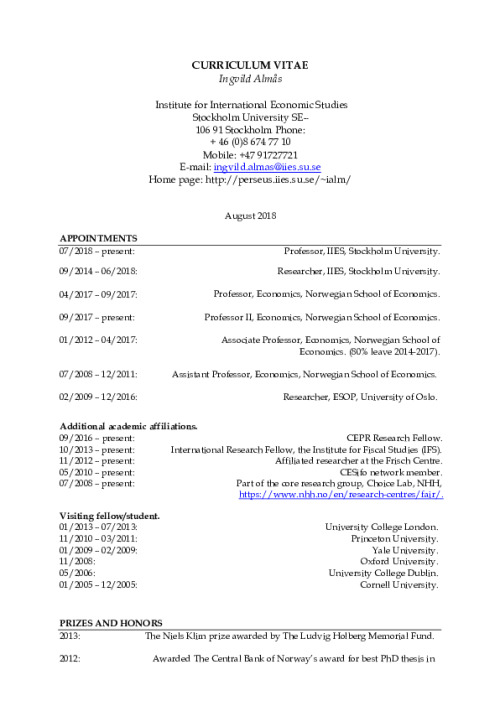
Ingvild Almås is a Professor of Economics, Institute for International Economic Studies (IIES), Stockholm University (SU).
Her main research focuses on gaining a better understanding of economic inequalities. Her research on Economic Inequality has been published in economic journals such as American Economic Review, Journal of Political Economy, and Econometrica, as well as in multidisciplinary journals such as Science, PNAS, and Management Science. In 2020 she was awarded a highly competitive ERC Consolidator Grant for her work on inequality within households and household decision making. Her main research efforts are now devoted to the large-scale research program Kizazi Kijacho, aiming to improve our understanding of household decision making and the dynamic complexities in the child development process, and to evaluate and support the design of scalable models for child development, poverty elevation, and gender equality.
Almås serves on the Committee of Monetary Policy and Financial Stability at the Norwegian Central Bank. She is also a PI at FAIR center of Excellence at Norwegian School of Economics, an International Research Fellow at Institute for Fiscal Studies in London, a CEPR fellow, a member of the European Standing Committee of the Econometric Society, and a member of the European Economic Association Council. She has for several years served as an Editor and co-Editor of different journals, e.g., the Scandinavian Journal of Economics.
Education
PhD Economics, Norwegian School of Economics, 2008
Master Economics, University of Oslo, 2004
Grunnfag (one-year) Development Studies, Oslo University College, 1999
This article uses a novel identification strategy to measure power in the household. Our strategy is to elicit women's willingness to pay to receive a cash transfer instead of their spouse receiving it.
The Hamilton method for estimating CPI bias is simple, intuitive, and has been widely adopted. We show that the method conflates CPI bias with variation in cost-of-living across income levels.
This paper studies how targeted cash transfers to women a ffect their empowerment. We use a novel identifi cation strategy to measure women's willingness to pay to receive cash transfers instead of their partner receiving it. We apply this among women living in poor households in urban Macedonia.