
Today, the Department for Work and Pensions (DWP) released the latest statistics on personal independence payment (PIP), covering up to January 2026. PIP is the main disability benefit in the UK, designed to support individuals with disabilities that increase their living costs. Over the past five years, the number of working-age people receiving disability benefits has risen substantially (from 2.1 million in 2019–20 to 3.4 million in the latest data). This rise has come about primarily due to a substantial increase in the number of people beginning a new PIP award each month. In this comment, we study trends in new PIP awards in the latest data, as well as government efforts to increase reassessments for existing claimants, and the implications for public spending.
New PIP awards have fallen
Figure 1 shows the monthly number of new awards for PIP since January 2016, which, prior to the pandemic, was relatively steady at around 19,000 per month. Beginning in mid 2021, there was a sharp increase, and between September 2023 and September 2024 the figure fluctuated at around 42,000 per month – more than double the pre-pandemic rate. There was a fall back in the first ten months of 2025, but the data released today – covering up to January 2026 – show a more sustained decline. The number of new claimants in the three months to January was 27,000 per month, a 37% decline from the average seen during the post-pandemic peak (September 2023 to September 2024), but still 38% higher than pre-pandemic levels.
The past year’s drop in the number of new awards is the result of fewer people applying (64,000 per month at the end of 2025, down from 74,000 seen around the peak), a lower approval rate among applicants (down from 54% around the peak to 46% in the latest data), and a slight rise in the backlog of new applications waiting to be processed.1 In its November 2025 forecast, the Office for Budget Responsibility (OBR) stated that it forecast disability benefit applications to fall back to 60,000 per month, about halfway between the pre-pandemic norm and the levels seen around the peak.2 Today’s figures show applications have fallen to near that level, and awards have fallen by a similar amount. Of course, it is too early to say whether this trend will continue and numbers will settle at the lower level the OBR expects.
Figure 1. Monthly new awards of personal independence payment
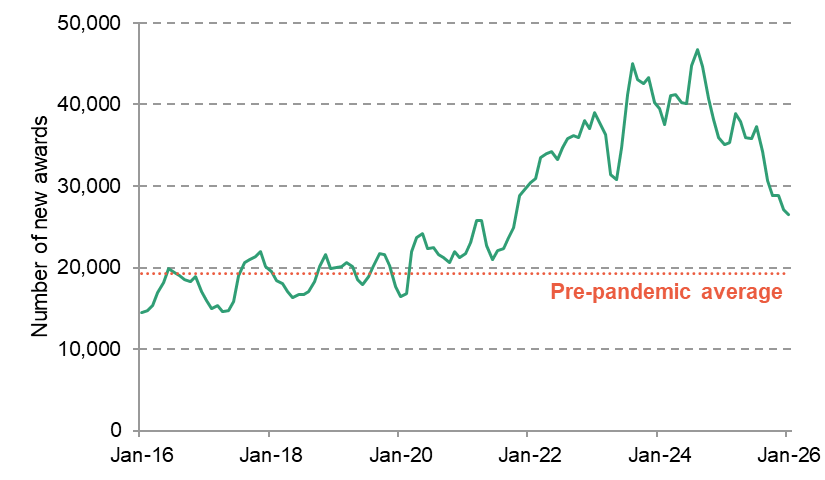
Note: This graph shows a three-month moving average. Statistics are for England and Wales, and include PIP recipients above state pension age, but do not include reassessments from disability living allowance. Statistics include awards arising from initial awards, mandatory reconsiderations and appeals. The pre-pandemic average is for March 2019 to February 2020.
Source: Authors’ calculations using DWP Stat-Xplore.
Government has increased reassessments for existing PIP claimants
The number of recipients of PIP at any one time is determined not only by the number of new awards but also by how long those awards last. The average duration of PIP awards has increased over time; 67% of those who started receiving PIP in 2017 were still claiming five years later, up from 59% who started receiving in 2014.
PIP recipients have scheduled reassessments where DWP re-evaluates their disability and decides whether they are still entitled to PIP.3 In recent years, DWP has prioritised assessing the increased number of new applications, at the expense of scheduled reassessments. This has led to a growing backlog of PIP recipients who are scheduled to have a reassessment but have not yet had it. DWP has committed to carrying out more reassessments, in an effort to reduce the existing backlog, which was nearly 400,000 in May 2024.
Figure 2 shows the fraction of PIP recipients who are subject to a scheduled reassessment each month. Across 2023 and 2024, an average of 1.2% of the caseload underwent a reassessment each month. In the six months to January 2026, that figure was 1.7%. Higher numbers of reassessments will increase the number of people who are judged no longer eligible for PIP, slowing the increase in the overall PIP caseload. However, each additional reassessment has a limited impact on the number of PIP recipients – 89% of reassessments in 2025 resulted in a continuation of the award.
Figure 2. Scheduled PIP reassessments as a share of total caseload
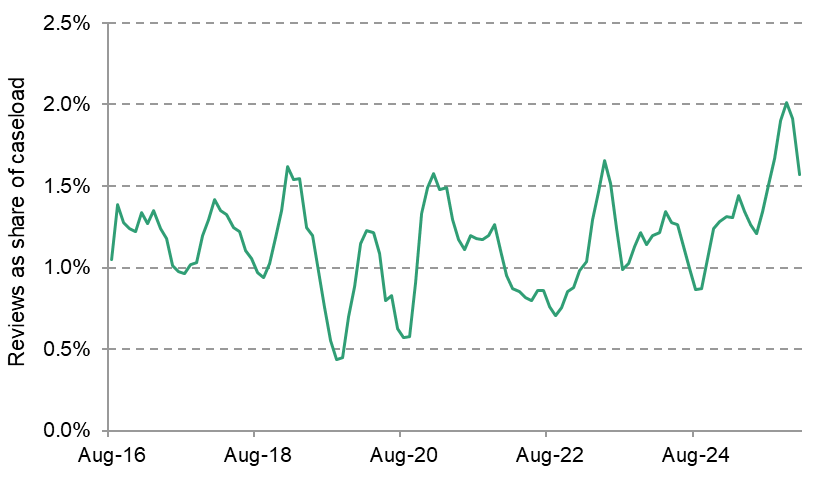
Note: This graph shows a three-month moving average of monthly scheduled reassessments divided by total PIP caseload. Statistics are for England and Wales, include PIP recipients above state pension age, but do not include reassessments due to a change in circumstances.
Source: Authors’ calculations using DWP Stat-Xplore.
The impacts of the rise in PIP claimants are likely to be long-lasting
The government has previouslyexpressed concern about the number of disability benefit recipients and spending on disability benefits, and today’s data – suggesting that new PIP awards have fallen from their post-pandemic peak – show progress towards at least slowing the rise in those figures. Only time will tell whether they will continue to fall.
No matter what happens to new awards in the future, the impact of the post-pandemic rise in disability benefit recipients has important implications. Evidence from existing recipients suggests that recent claimants are likely to be receiving PIP for a long time. For the public finances, this means higher spending for many years, even if the recent drop in new awards continues. Indeed, on the OBR’s November forecast – which assumes a meaningful decline in new PIP applications – working-age disability benefit spending rises to £32 billion by 2029–30 – up from £14 billion in 2019–20 and £25 billion today (all in 2025–26 prices). Across all working-age health-related benefits, including incapacity benefits which are targeted at those whose disability limits their work capability, real spending (2025–26 prices) is expected to rise to £64 billion in 2029–30, up from £36 billion in 2019–20 and £56 billion today.
Endnotes
Authors

Eduin Latimer
Eduin is a Senior Research Economist in the Income, Work and Welfare sector. His research focuses on benefits policy and the low-paid labour market.

Sam Ray-Chaudhuri
Sam joined the IFS in 2022 and works as a research economist in the Income, Work and Welfare sector.
More from IFS
Understand this issue


Policy analysis


Academic research


