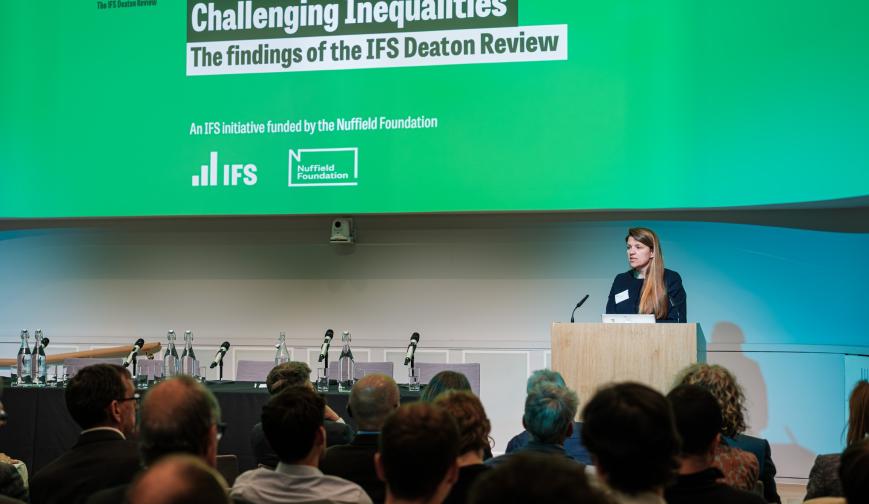
Inequalities and public policy: implications of the IFS Deaton Reviewworkshop 28 April 2026 at 09:00 The IFS-Deaton Review’s final workshop, where we explored the review's findings and their policy implications in the UK context.
New 'Challenging Inequalities' book launchesannouncementWe are pleased to announce the publication of 'Challenging Inequalities', our rigorous, evidence-based account of inequality.21 April 2026
Challenging Inequalities: implications of the IFS Deaton Reviewevent 1 June 2026 at 15:00 This in-person event, in partnership with and hosted by the Royal Society of Edinburgh, will discuss the findings of the IFS-Deaton Review
Geographical inequalitiesevent 1 May 2024 at 01:05 This event examined spatial inequalities in the UK: what the inequalities are, why they exist, how and why they are changing...
Gender Inequalitiesevent 1 May 2024 Men do more paid work, and when they do it, then tend to be paid more than women. Women do more unpaid work and childcare in the home...
Educational Inequalitiesevent 17 April 2024 Education is one of the most important predictors of people’s life chances, shaping outcomes like work and pay, health, and wealth...
Studies of inequalities in Europe and North America launchednewsToday we publish a series of reports on the evolution of inequalities in 17 countries in Europe and North America.29 November 2023
Inequalities: which ones matter, and what to do about them?event 27 February 2023 Paul Johnson, Director of The Institute for Fiscal Studies, gave a talk at the Oxford Martin School where he drew on the extensive work...
Inequality and the benefits systemevent 2 February 2023 at 11:00 At this online event on February 2nd from 11:00 to 12:15, we present and discuss findings from a major new work on benefits.
IFS residential conference 2023event 20 December 2022 Every two years, IFS holds a residential conference, aiming to facilitate high-level knowledge exchange between practitioners, policymakers and...
Event – Political inequalitiesevent 2 December 2022 Politics is central to inequalities. The balance of power and influence over the political process may be of concern in and of itself, and it can also
Racial and ethnic inequalitiesevent 14 November 2022 At this online event we discussed findings from a report on racial and ethnic inequalities.
Event – Income and wealth inequalities in the UKevent 9 November 2022 at 14:00 Differences in income and wealth are among the most salient and consequential inequalities in our society.
Event – Creating a New Political Economy Framework: Where Do We Go From Here?newsIn the wake of a widespread sense that neo-classical economic models have failed us, we have an opportunity to improve...23 August 2022
Is economic inequality a problem?event 20 August 2022 There’s an unequal distribution of income and opportunity between different groups in almost every country in the world. In most countries millions...
Educational inequalitiesevent 16 August 2022 Education is one of the most important predictors of people’s life chances, shaping outcomes like work and pay, health, and wealth...
Early childhood inequalitiesevent 23 June 2022 at 10:00 The environment that children are raised in, and their development of cognitive, and social and emotional skills affect the subsequent trajectory of..
How does our early education shape our future?event 26 May 2022 at 18:00 What do you picture when you think of education? Schools, teachers, homework, probably tests and exams…
Conference – Inequalities in the 21st Centuryevent 24 May 2022 nequalities are at the forefront of today’s public and policy debates. The IFS Deaton Review of Inequalities, chaired by Nobel laureate...
Is economic inequality a problem? – Garden Talkevent 24 May 2022 IFS Director and review panellist Paul Johnson gave a talk and took part in a Q & A for The Garden, an online platform featuring experts and...
Event – Tax and top incomesevent 7 April 2022 at 13:30 The top 1% of UK adults receive around 15% of pre-tax income. The source of top incomes, who gets them and how they are taxed is important for underst
Inequality in the labour marketevent 15 March 2022 at 09:30 The availability of work with good wages and conditions makes a big difference to our material wellbeing and the kinds of lives we lead.
Event – Firms, market power, innovation and inequalityevent 3 March 2022 at 09:30 Firms are at the centre of our economy: they make the things we buy, set prices, invent new things and provide jobs. They also differ widely in...
Tackling Inequality, BBC Radio 4’s AnalysisnewsNobel laureate and chair of the review, Sir Angus Deaton, joins IFS Director and review panel member, Paul Johnson , on BBC Radio 4’s Analysis.5 February 2022
Event – Men and women at work: the more things change the more they stay the same?event 6 December 2021 at 15:30 Men and women have historically held very different roles inside and outside the household, and with respect to paid and unpaid work. These have...
Event – What’s the impact of trade on inequality?event 17 November 2021 at 15:30 The growth of international trade, and of trade between lower-income countries and high-income countries in particular, has had profound effects on...
Event – What’s wrong with inequality?event 23 September 2021 When should inequalities in society be of ethical concern, and a target of public policy, and why?
Inequality post Covid-19event 28 May 2021 Featuring contributors to Inequality: The IFS Deaton Review, the ‘Inequality post-COVID-19’ workshop will examine different dimensions of inequality a
Angus Deaton on BBC’s Rethink FairnessnewsAngus Deaton, Nobel Laureate and Chair of Inequality: the IFS Deaton Review, appeared on Rethink Fairness: Health, part of the BBC’s ‘Rethink’ proje8 January 2021
Paul Johnson on BBC Radio 4’s Rethink FairnessnewsIFS Director and IFS Deaton Review contributor Paul Johnson appeared on Rethink Fairness: Wealth, part of the BBC’s ‘Rethink’ project.4 January 2021
Going solo: self-employment in today’s labour marketevent 19 November 2020 Self-employment in the UK has risen dramatically. In 1975, 8% of workers were self-employed; this had increased to 12% by 2000, and 14% by...
Workshop on the Political Economy of Inequalityevent 13 November 2020 This was an event jointly organised by the IFS Deaton Review and the LSE. The event took place on November 13th, 2020.
Sir Angus Deaton – Inequality and the future of capitalismevent 11 November 2020 “Capitalism generates inequality, it is in its genes. We cannot have the benefits without risking the cost. Thus, we must...
Attitudes towards inequality and redistributionevent 9 November 2020 This was an event jointly organised by the IFS Deaton Review, IIES (Stockholm University) and FAIR (NHH). The event took place on October 14th, 2020.
ESRC Centre for the Microeconomic Analysis of Public Policy wins ONS Research Excellence AwardnewsProfessor Sir Richard Blundell and the team at the ESRC Centre for the Microeconomic Analysis of Public Policy (CPP) have won the ONS Research Excelle30 October 2020
Can COVID reduce global inequality?event 27 October 2020 Professor Sir Richard Blundell and the team at the ESRC Centre for the Microeconomic Analysis of Public Policy (CPP) have won the ONS Research...
Gorman Lectures 2020: Inequality and Automationevent 12 October 2020 On 12 and 13th October, Daron Acemoglu (MIT) delivered the 2020 Gorman Lectures on the subject of Inequality and Automation.
Responding to the challenges for work and welfare policy post-Covidevent 5 October 2020 On 29th September The British Academy and the Institute for Fiscal Studies hosted a roundtable on Responding to the challenges for work and welfare po
Welfare and the low wage labour marketevent 1 October 2020 A research workshop on welfare and the low wage labour market was held as part of the IFS Deaton Review on 28th and 29th September, co-organised by...
IFS Deaton Review session held at 2020 World Congress of Econometric Societyevent 28 July 2020 Panel members and other contributors to the IFS Deaton Review led a session on inequalities at the 2020 World Congress of the Econometric Society on 1
COVID-19: the impact on the UK’s ethnic minority populationsevent 6 July 2020 The LSE has started running a public event series – COVID 19: The Policy Response. Video of the event featuring Lucinda Platt, panel member for...
Inequalities and the COVID-19 crisisevent 3 July 2020 The Royal Economic Society has launched a series of webinars focusing on the economic issues and policy solutions to the COVID-19 crisis.
Angus Deaton gives congressional testimony on COVID-19 and inequalitynewsAngus Deaton, chair of the IFS Deaton Review, has given congressional evidence on how the coronavirus pandemic is exposing and exaggerating...30 June 2020
IFS Deaton Review panellists lead inequalities session at European Economic Associationevent 10 September 2019 Several IFS Deaton Review panellists led a special session on inequalities at the European Economic Association’s annual conference on 26th August...
Launch event panel discussionevent 15 May 2019 Here, at the launch event for the review, the panel discusses the review and takes questions from the audience.
Social mobility continues to fall – and moving up is harder if you grow up in the North or Midlands.press releaseInheritances will be twice as big on average for those born in the 1980s as for those born in the 1960s.7 September 2023
30-year-olds without any qualifications are more likely to be disabled than university graduates in their 60spress releaseNew research, out today by the Institute for Fiscal Studies, finds that differences in rates of disability between education groups...22 August 2023
Decades of benefit reforms have pushed more people into work – but very often into part-time, low-paid work with little prospect of progressionpress releaseUK benefit reforms in recent decades have followed a consistent pattern of resulting in higher employment than the system they replaced...1 February 2023
UK ethnic minorities seeing sharp progress in education, but wages and wealth lag behindpress releaseHowever, big differences remain between ethnic minority groups, new IFS Deaton Review of Inequalities chapter shows14 November 2022
Wealth is the growing economic divide in the UK todaypress releaseRising asset prices alongside a long-term stagnation in earnings have shifted the economic dividing lines.9 November 2022
Lack of progress on closing educational inequalities disadvantaging millions throughout lifepress releaseNew research on inequalities, carried out for the IFS Deaton Review of Inequalities and funded by the Nuffield Foundation...16 August 2022
Inequalities in early child development remained stubbornly high through the 2010spress releaseInequalities in the early cognitive, social and emotional development of children in the UK, which are so important in shaping later life...23 June 2022
Higher taxes have reduced after-tax top income inequality, but some top incomes are still taxed at preferential ratespress releaseThere is much interest in how much income the top 1% receive and how much tax they pay and frequent debates about whether these outcomes are fair.7 April 2022
Labour market inequalities show a need to boost wage growth of middle earners and low earners in non-traditional employmentpress releaseChronic lack of real wage growth has blighted the UK since the financial crisis of the late 2000s.15 March 2022
Barely any change to gender earnings gap in last 25 years once you account for increases in women’s educationpress releaseThe average working-age woman in the UK earned 40% less than her male counterpart in 2019.4 March 2022
A rise in ‘superstar firms’, with many of the rest stagnating, has put upward pressure on wage inequalitypress releaseWe have seen a long period of stagnation in productivity and wages within most firms while a minority of high-performers...3 March 2022
Press release: Most people care about inequalities – but there is little agreement about what, if anything, government should do about thempress releaseDisagreements about social and economic inequalities – how big they are, how much they matter, what causes them, and what to do about them...23 September 2021
Press release: Are the inequalities seen today a sign of a broken system? Launch of the IFS Deaton Review of inequalitiespress releaseToday IFS formally launches the most comprehensive scientific analysis of inequalities yet attempted.14 May 2019